As I noted earlier, the Supreme Court just handed down a historical First Amendment decision in the case of Federal Communications Commission v. Fox Television Stations. Here are my initial general thoughts on the case that were just sent out in a PFF press release. Again, more commentary to follow later today as I continue to digest the decision.
While the Court decided this case on purely procedural grounds, its failure to address the constitutional issues at stake will leave the First Amendment freedoms of both media creators and consumers in this country uncertain until another case winds its way up to the court, which could take years. Practically speaking, as Justice Thomas noted, what’s the point of continuing to apply a censorship regime to one of the oldest mediums—broadcast TV and radio—when kids are flocking to unregulated mediums in large numbers? At this point, we’re doing little more than protecting adults from themselves and destroying over-the-air broadcasting in the process.
Until the Court clearly addresses the First Amendment protection of broadcasting in light of the Digital Revolution, we’ll just have to speculate as to how to reconcile the broadcast law of bygone era with the Court’s recent Internet jurisprudence—which has strongly supported the First Amendment. Although new media technologies and platforms are not covered currently by FCC content controls, the specter of regulation now haunts all media as platforms continue to converge and broadcast content gets repurposed on other platforms.
Finally, what makes the Court’s ruling even less sensible is that all parents have an extensive array of tools and strategies at their disposal to control media in their homes and in their lives of the children. That is especially the case for broadcast television programming, which is easier to control than ever before. The Court has held that user empowerment and private blocking solutions should shield the Internet from content regulation. Why shouldn’t the same principle apply to broadcasting?
 This week, the Ninth Circuit Court of Appeals struck down a California video game statute as unconstitutional, holding that it violated both the First and Fourteenth Amendments to the federal Constitution. The California law, which passed in October 2005 (A.B.1179), would have blocked the sale of “violent” video games to those under 18 and required labels on all games. Offending retailers could have been fined for failure to comply with the law. It was immediately challenged by the Video Software Dealers Association and the Entertainment Software Association and, in August of 2007, a district court decision in the case of Video Software Dealers Association v. Schwarzenegger [decision here] enforced a permanent injunction against the law. The Ninth Circuit heard the state’s challenge to the injunction last year and handed down it’s decision this week [decision here] holding the statute unconstitutional. The key passage:
We hold that the Act, as a presumptively invalid content based restriction on speech, is subject to strict scrutiny and not the “variable obscenity” standard from Ginsberg v. New York
, 390 U.S. 629 (1968). Applying strict scrutiny, we hold that the Act violates rights protected by the First Amendment because the State has not demonstrated a compelling interest, has not tailored the restriction to its alleged compelling interest, and there exist less-restrictive means that would further the State’s expressed interests. Additionally, we hold that the Act’s labeling requirement is unconstitutionally compelled speech under the First Amendment because it does not require the disclosure of purely factual information; but compels the carrying of the State’s controversial opinion. Accordingly, we affirm the district court’s grant of summary judgment to Plaintiffs and its denial of the State’s cross-motion. Because we affirm the district court on these grounds, we do not reach two of Plaintiffs’ challenges to the Act: first, that the language of the Act is unconstitutionally vague, and, second, that the Act violates Plaintiffs’ rights under the Equal Protection Clause of the Fourteenth Amendment.
Continue reading →
My new article on “FCC v. Fox and the Future of the First Amendment” has just been published in the February 2009 edition of Engage, the journal of the Federalist Society. Here’s how it begins:
On November 4th, 2008, the Supreme Court heard oral arguments in the potentially historic free speech case of Federal Communications Commission v. Fox Television Stations, Inc. This case, which originated in the Second Circuit Court of Appeals, deals with the FCC’s new policy for “fleeting expletives” on broadcast television. The FCC lost and appealed to the Supreme Court. By contrast, the so-called “Janet Jackson case” — CBS v. FCC — was heard in the Third Circuit Court of Appeals. The FCC also lost that case and has also petitioned the Supreme Court to review the lower court’s ruling.
These two cases reflect an old and odd tension in American media policy and First Amendment jurisprudence. Words and images presented over one medium-in this case broadcast television-are regulated differently than when transmitted through any other media platform (such as newspapers, cable TV, DVDs, or the Internet). Various rationales have been put forward in support of this asymmetrical regulatory standard. Those rationales have always been weak, however. Worse yet, they have opened the door to an array of other regulatory shenanigans, such as the so-called Fairness Doctrine, and many other media marketplace restrictions.
Whatever sense this arrangement made in the past, technological and marketplace developments are now calling into question the wisdom and efficacy of the traditional broadcast industry regulatory paradigm. This article will explore both the old and new rationales for differential First Amendment treatment of broadcast television and radio operators and conclude that those rationales: (1) have never been justified, and (2) cannot, and should not, survive in our new era of media abundance and technological convergence.
I go on in the piece to make the case against the those rationales and the call for the Supreme Court to use the
Fox and CBS cases to end this historical First Amendment anomaly of differential treatment of broadcast platforms relative to all other media providers.
This article can be downloaded as a PDF here, or viewed down below the fold in the Scribd reader.
Continue reading →
 It appears that the long legal saga of the Child Online Protection Act of 1998 (COPA) has finally come to a close. This morning, according to AP, the U.S. Supreme Court rejected the government’s latest request to revive the law, which was stuck down as an unconstitutional violation of the First Amendment by lower courts and never went into effect.
COPA was an effort by Congress to modify the Communications Decency Act of 1996 (CDA) in response to the Supreme Court’s decision in Reno v. ACLU finding that the CDA was unconstitutionally over-broad. COPA sought to narrow the scope of regulation and protect minors from sexual material on the Internet by making it a crime for someone to “knowingly” place materials online that were “harmful to minors.” The law provided an affirmative defense from prosecution, however, to those parties who made a “good faith” effort to “restrict[ ] access by minors to material that is harmful to minors” using credit cards or age verification schemes. Although narrower than the CDA, COPA was immediately challenged and also blocked by lower courts because it was still too sweeping in effect. Moreover, the courts found there were other “less restrictive means” that parents could use to deal with objectionable content — such as Internet filters.
Following the initial challenge, COPA then became the subject of an epic, decade-long legal battle that finally concluded today when the U.S. Supreme Court refused to revisit the law. COPA had already been reviewed by the Supreme Court twice before — in 2002 and 2004. Thus, a third visit to the Supreme Court by COPA would have been something of a historical development in the world of First Amendment jurisprudence. But with the Supreme Court’s rejection of the government’s appeal today, lower court rulings stand and COPA will remain unconstitutional and unenforceable.
The key recent legal battle occurred in the Third Circuit Court of Appeals, which upheld a lower court ruling striking down COPA. The Third Circuit’s full decision is here. And I penned a 3-part series on the lower court ruling by Judge Lowell Reed Jr., senior judge of the U.S. District Court for the Eastern District of Pennsylvania, here, here, and here. Also make sure to check out this summary of COPA’s legal journey that Alex Harris penned last November.
While COPA is now dead and buried, it would be foolish to think this is the end of efforts to legislate on this front. Although it remains unclear what the legislative response will look like during a time of Democratic rule, I am certain that legislation will be floated in short order (i.e., “Son of COPA”) to try to get around the constitutional issues and regulate objectionable online content. If legislators were smart, they’d avoid legally risky solutions like more centralized filtering mandates or age verification requirements. They’d be on safer ground to consider going the subsidy route and finding a way to get parental control tools in the hands of more families and institutions. I’m not saying that I favor such subsidies, merely that such an approach would almostly certainly pass legal muster and probably wouldn’t even be challenged in court. They might also consider more public education / PSA-driven approached to online safety. Those approaches may end up finding more support in a Democratic Congress and administration anyway.
[More coverage at NYT, Reuters, CNet and Ars.]
Over at Ars, Matt Lasar has a piece about the need for better FCC indecency complaint statistics. He has been monitoring the wild fluctuations in indecency complaint tallies in recent years and wonders:
whether the agency’s indecency/obscenity statistics reflect spontaneous viewer response to the level of erotic/linguistic friskiness on TV or solely on the power of coordinated campaigns launched by groups like the Parents Television Council.
Indeed, PTC is the primary culprit. As I noted in my big 2005 PFF report “Examining the FCC’s Complaint-Driven Broadcast Indecency Enforcement Process”, “The PTC’s increasingly effective use of computer-generated campaigns against specific TV programs is a leading factor in explaining the large jump in indecency complaints in recent years.” The PTC has even taken credit for it themselves, as I noted in the paper.
How did the FCC’s indecency process get so screwy, and how did the PTC come to influence it so greatly? As I noted in that paper (as well as a Supreme Court filing with my friends at CDT), in recent years the FCC has quietly and without major notice made two methodological changes to its tallying of broadcast indecency complaints, both changes urged upon the FCC by a single advocacy group — the PTC — targeting broadcast indecency:
Continue reading →
Today was a big day — and not just because there was an election going on! As I mentioned yesterday, the other big news was that the U.S. Supreme Court was hearing oral arguments in the potentially historic free speech case of Federal Communications Commission v. Fox Television Stations, Inc. Again, all the background you need can be found in my post yesterday, so here I will just be summarizing my general thoughts about how the oral arguments played out this morning.
Unfortunately, because no electronic devices or even notepads are allowed in the courtroom, much of what I am relaying here is from memory or from the notes that I surreptitiously scribbled on a tiny piece of scrap paper when the guards weren’t looking. (And yes, I have been reprimanded before for taking notes in the Court!) The transcript has just been released, however, so you can read it through and judge for yourself. Anyway, here are some general thoughts:
Continue reading →
WASHINGTON, November 4 – When I heard yesterday that the Supreme Court had declined C-SPAN’s request for immediate release of the audio tapes from today’s oral argument in Federal Communications Commission v. Fox Television Stations, I thought I would have to wait for months.
I will have to wait months for the audio-tape, of course, but the other part of the story is the Supreme Court now releases the transcript of oral arguments on the same day. It has already done so on the SCOTUS site. And (surprise-of-surprises), the transcript identifies the individual justices who are asking questions!
This is probably old hat to those who follow the high court on a day-in-and-day-out basis. It’s been a few years (I think
Brand X was the last case) since I’ve heard one live. But this is a true revolution in transparency, and very helpful for those who want to follow what goes on at the Supreme Court.
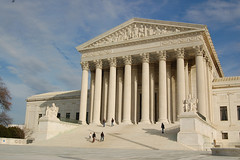 Tomorrow morning, the U.S. Supreme Court will hear oral arguments in the potentially historic free speech case of Federal Communications Commission v. Fox Television Stations, Inc. I plan on attending and will try to post some thoughts about how the arguments played out here later tomorrow afternoon or evening. [I won’t be able to live blog of Twitter it because no electronic devices are allowed in the courtroom, which I’ve always thought is outrageous.] In the meantime, here again is the background of the case.
The
FCC v. Fox case is the indecency case involving the FCC’s new policy for “fleeting expletives.” I wrote about the Second Circuit Court of Appeals decision here and the full 2nd Circuit decision is here. [By contrast, the so-called “Janet Jackson case” — CBS v. FCC — took place in the Third Circuit Court of Appeals and that court recently handed down a decision that also went against the FCC. I wrote about the Third Circuit’s decision here.]
In a 2-1 decision, the Second Circuit ruled that “the FCC’s new policy sanctioning “fleeting expletives” is arbitrary and capricious under the Administrative Procedure Act for failing to articulate a reasoned basis for its change in policy.” The decision demonstrates how, over just the past few years, the FCC has arbitrarily thrown out 30+ years worth of precedent and greatly expand the scope of its regulatory authority over speech on broadcast TV and radio. As a result, the FCC’s order was vacated and remanded to the agency. The agency appealed the decision, however, and the Supreme Court accepted it for review.
Continue reading →
Like many others, I have long been troubled by the fact that the Supreme Court does not allow TV cameras or live audio coverage of the cases it hears. I know all the arguments against live video or audio coverage and I find them all quite unconvincing when weighed against the public’s right to hear the oral arguments and decisions that will have such a direct bearing on their lives and liberty. We should be allowed to see, or at least hear, these arguments and decisions as they happen.
Anyway, as I was reading through an article today in
Broadcasting & Cable about how “C-SPAN Seeks Oral Argument Tapes in Fox Swearing Case,” I couldn’t help but think about how particularly ironic it was that our nation’s highest court would be considering one of the most important free speech cases in decades — FCC v. Fox — and it yet wouldn’t be allowing any of us to listen in live when it takes place on November 4th! If we are lucky, the Court might grant C-SPAN expedited access to the tapes of the arguments, but it may be that we have to wait many weeks to hear what was said.
Seems silly to me. Worse yet, it means I will have to camp out in front of the Supreme Court the night before and freeze my butt off in the hope of getting a seat in the courtroom to hear the live argument! Which brings up the final bit of irony I always like to point out about restricting cameras and microphones from courtrooms: Why are they letting
anyone in the courtroom at all if they so fear instantaneous public access to the arguments?
Lately I’ve been writing about potentially historic upcoming First Amendment case of FCC v. Fox Television Stations. The Supreme Court will hear the case on Tuesday, November 4th. All the briefs in the case are in and can be found on the ABA website here. But I’ve pasted the links for all of them below as well. In coming days and weeks I might be highlighting some of the comments from the briefs. [The docket number for the case is 07-582]. The amicus brief I filed with my friends at CDT can be found here, and I wrote about it last week here on the TLF.
The
FCC v. Fox case is the indecency case involving the FCC’s new policy for “fleeting expletives.” I wrote about the Second Circuit Court of Appeals decision here. The full decision is here. The FCC v. Fox case could become the most important First Amendment-related Supreme Court case since FCC v. Pacifica Foundation, which just turned 30 years old last month. Anyway, here are all the briefs in the case, starting with the merit briefs by the lead parties:
Continue reading →

 The Technology Liberation Front is the tech policy blog dedicated to keeping politicians' hands off the 'net and everything else related to technology.