I have always found it strange that the ACLU speaks with two voices when it comes to user empowerment as a response to government regulation of the Internet. That is, when responding to government efforts to regulate the Internet for online safety or speech purposes, the ACLU stresses personal responsibility and user empowerment as the first-order response. But as soon as the conversation switches to online advertising and data collection, the ACLU suggests that people are basically sheep who can’t possibly look out for themselves and, therefore, increased Internet regulation is essential. They’re not the only ones adopting this paradoxical position. In previous essays I’ve highlighted how both EFF and CDT do the same thing. But let me focus here on ACLU.
Writing today on the ACLU “Free Future” blog, ACLU senior policy analyst Jay Stanley cites a new paper that he says proves “the absurdity of the position that individuals who desire privacy must attempt to win a technological arms race with the multi-billion dollar internet-advertising industry.” The new study Stanley cites says that “advertisers are making it impossible to avoid online tracking” and that it isn’t paternalistic for government to intervene and regulate if the goal is to enhance user privacy choices. Stanley wholeheartedly agrees. In this and other posts, he and other ACLU analysts have endorsed greater government action to address this perceived threat on the grounds that, in essence, user empowerment cannot work when it comes to online privacy.
Again, this represents a very different position from the one that ACLU has staked out and brilliantly defended over the past 15 years when it comes to user empowerment as the proper and practical response to government regulation of objectionable online speech and pornography. For those not familiar, beginning in the mid-1990s, lawmakers started pursuing a number of new forms of Internet regulation — direct censorship and mandatory age verification were the primary methods of control — aimed at curbing objectionable online speech. In case after case, the ACLU rose up to rightly defend our online liberties against such government encroachment. (I was proud to have worked closely with many former ACLU officials in these battles.) Most notably, the ACLU pushed back against the Communications Decency Act of 1996 (CDA) and the Child Online Protection Act of 1998 (COPA) and they won landmark decisions for us in the process. Continue reading →
There was an important article about online age verification in The New York Times yesterday entitled, “Verifying Ages Online Is a Daunting Task, Even for Experts.” It’s definitely worth a read since it reiterates the simple truth that online age verification is enormously complicated and hugely contentious (especially legally). It’s also worth reading since this issue might be getting hot again as Facebook considers allowing kids under 13 on its site.
Just five years ago, age verification was a red-hot tech policy issue. The rise of MySpace and social networking in general had sent many state AGs, other lawmakers, and some child safety groups into full-blown moral panic mode. Some wanted to ban social networks in schools and libraries (recall that a 2006 House measure proposing just that actually received 410 votes, although the measure died in the Senate), but mandatory online age verification for social networking sites was also receiving a lot of support. This generated much academic and press inquiry into the sensibility and practicality of mandatory age verification as an online safety strategy. Personally, I was spending almost all my time covering the issue between late 2006 and mid-2007. The title of one of my papers on the topic reflected the frustration many shared about the issue: “Social Networking and Age Verification: Many Hard Questions; No Easy Solutions.”
Simply put, too many people were looking for an easy, silver-bullet solution to complicated problems regarding how kids get online and how to keep them safe once they get there. For a time, age verification became that silver bullet for those who felt that “we must do something” politically to address online safety concerns. Alas, mandatory age verification was no silver bullet. As I summarized in this 2009 white paper, “Five Online Safety Task Forces Agree: Education, Empowerment & Self-Regulation Are the Answer,” all previous research and task force reports looking into this issue have concluded that a diverse toolbox and a “layered approach” must be brought to bear on these problems. There are no simple fixes. Specifically, here’s what each of the major online child safety task forces that have been convened since 2000 had to say about the wisdom of mandatory age verification: Continue reading →
Andrew Orlowski of The Register (U.K.) recently posted a very interesting essay making the case for treating online copyright and privacy as essentially the same problem in need of the same solution: increased property rights. In his essay (“‘Don’t break the internet’: How an idiot’s slogan stole your privacy“), he argues that, “The absence of permissions on our personal data and the absence of permissions on digital copyright objects are two sides of the same coin. Economically and legally they’re an absence of property rights – and an insistence on preserving the internet as a childlike, utopian world, where nobody owns anything, or ever turns a request down. But as we’ve seen, you can build things like libraries with permissions too – and create new markets.” He argues that “no matter what law you pass, it won’t work unless there’s ownership attached to data, and you, as the individual, are the ultimate owner. From the basis of ownership, we can then agree what kind of rights are associated with the data – eg, the right to exclude people from it, the right to sell it or exchange it – and then build a permission-based world on top of that.”
And so, he concludes, we should set aside concerns about Internet regulation and information control and get down to the business of engineering solutions that would help us property-tize both intangible creations and intangible facts about ourselves to better shield our intellectual creations and our privacy in the information age. He builds on the thoughts of Mark Bide, a tech consultant:
For Bide, privacy and content markets are just a technical challenges that need to be addressed intelligently.”You can take two views,” he told me. “One is that every piece of information flowing around a network is a good thing, and we should know everything about everybody, and have no constraints on access to it all.” People who believe this, he added, tend to be inflexible – there is no half-way house. “The alternative view is that we can take the technology to make privacy and intellectual property work on the network. The function of copyright is to allow creators and people who invest in creation to define how it can be used. That’s the purpose of it. “So which way do we want to do it?” he asks. “Do we want to throw up our hands and do nothing? The workings of a civilised society need both privacy and creator’s rights.” But this a new way of thinking about things: it will be met with cognitive dissonance. Copyright activists who fight property rights on the internet and have never seen a copyright law they like, generally do like their privacy. They want to preserve it, and will support laws that do. But to succeed, they’ll need to argue for stronger property rights. They have yet to realise that their opponents in the copyright wars have been arguing for those too, for years. Both sides of the copyright “fight” actually need the same thing. This is odd, I said to Bide. How can he account for this irony? “Ah,” says Bide. “Privacy and copyright are two things nobody cares about unless it’s their own privacy, and their own copyright.”
These are important insights that get at a fundamental truth that all too many people ignore today: At root,
most information control efforts are related and solutions for one problem can often be used to address others. But there’s another insight that Orlowski ignores: Whether we are discussing copyright, privacy, online speech and child safety, or cybersecurity, all these efforts to control the free flow of digitized bits over decentralized global networks will be increasingly complex, costly, and riddled with myriad unintended consequences. Importantly, that is true whether you seek to control information flows through top-down administrative regulation or by assigning and enforcing property rights in intellectual creations or private information.
Let me elaborate a bit (and I apologize for the rambling mess of rant that follows).
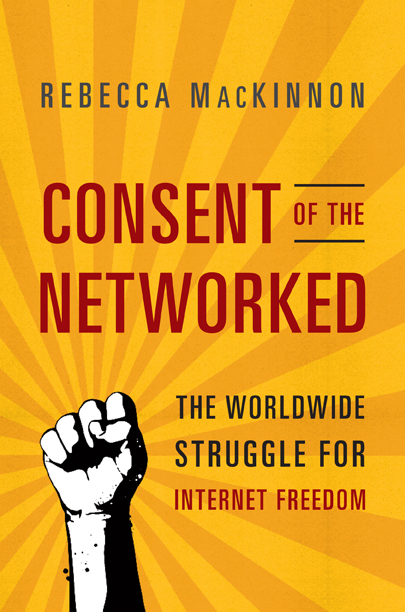 Rebecca MacKinnon’s new book, Consent of the Networked: The Worldwide Struggle for Internet Freedom, is well-researched exploration of the forces driving Internet developments and policy across the globe today. She serves up an outstanding history of recent global protest movements and social revolutions and explores the role that Internet technologies and digital networks played in those efforts. She also surveys some of the recent policy fights here and abroad over issues such as online privacy, Net neutrality regulation, free speech matters, and the copyright wars. The Consent of the Networked is certainly worth reading and will go down as one of the most important Internet policy books of 2012.
A Call to Action
Of course, it’s not just a history lesson. MacKinnon has also issued a call-to-arms here. As a well-known web activist, MacKinnon has emerged as a leading force in the broad-based, if loosely-defined, “Net freedom” movement. The term “Net freedom,” she notes, means very different things to different people. It’s “like a Rorschach inkblot test: different people look at the same ink splotch and see very different things.” (p. 188) Nonetheless, on the global stage, the Internet freedom movement is fundamentally tied up with efforts to hold both governments and corporate actors more accountable for their actions toward the Netizens, digital networks, and online speech and expression. Continue reading →
Filings are due to the Federal Trade Commission (FTC) today as part of its review of the Children’s Online Privacy Protection Act (COPPA) and the COPPA rule that the FTC devised and enforces. I didn’t have time to pen as much as I wanted, but I did submit a short filing to the agency in the matter based on some of my previous work both with Berin Szoka and on my own. Here’s the executive summary for my filing:
It goes without saying that the Children’s Online Privacy Protection Act (COPPA) is complicated law and rule. When considering the rule and proposals to amend it, it is easy to get lost in the weeds and ignore the bigger picture. That would be a mistake. There are broader, more important questions that need to be asked as part of the Federal Trade Commission’s effort to expand this regulatory regime. These questions involve not only the costs of increased regulation for online business interests, but the impact of expanded regulation on market structure, competition, and innovation. More importantly, these questions cut to the core of whether the public (including children) will be served with more and better digital innovations in the future. There is no free lunch. Regulation—even well-intentioned regulation like COPPA—is not a costless exercise. There are profound trade-offs for online content and culture that must always be considered.
Whatever one thinks about the effectiveness or sensibility of the COPPA regulatory model for the Web 1.0 world, it is clear that the regime is being strained by the unforeseen realities of the Web 2.0 world of hyper-ubiquitous connectivity and user-generated content creation and sharing. The digital genie cannot be put back in the bottle. While COPPA may continue to have a marginal role to play in this rapidly evolving world, that role will likely be increasingly limited by the inherent realities of the information age.
Entire filing can be found on the Mercatus website, on SSRN, or via Scribd [Also embedded below in a Scribd reader.] Continue reading →
 John Perry Barlow famously said that in cyberspace, the First Amendment is just a local ordinance. That’s still true, of course, and worth remembering. But at least today there is good news in the shire. The local ordinance still applies with full force, if only locally.
As I write in CNET this evening (see “Video Games Given Full First Amendment Protection“), the U.S. Supreme Court issued a strong and clear opinion today nullifying California’s 2005 law prohibiting the sale or rental to minors of what the state deemed “violent video games.” Continue reading →
My latest Forbes column is entitled “With Freedom of Speech, The Technological Genie Is Out of the Bottle,” and it’s a look back at the amazing events that unfolded over the past week in the U.K. regarding privacy, free speech, and Twitter. I’m speaking, of course, about the “super-injunction” mess. I relate this episode to the ongoing research Jerry Brito and I are doing examining the increasing challenges of information control.
I begin by noting that:
When it comes to freedom of speech in the age of Twitter, for better or worse, the genie is out of the bottle. Controlling information flows on the Internet has always been challenging, but new communications technologies and media platforms make it increasingly difficult for governments to crack down on speech and data dissemination now that the masses are empowered. The most recent exhibit in the information control follies comes from the United Kingdom, where in the span of just one week the country’s enhanced libel law procedure was rendered a farce.
I go on to explain how Britain’s super-injunction regulatory regime unraveled so quickly and why it’s unlikely to be effectively enforceable in the future. Read the entire essay over at
Forbes and then also check out Jerry’s Time TechLand editorial from last week, “Twitter’s Super-Duper U.K. Censorship Trouble.” I also just saw this piece by British defamation expect John Maher: “Law Playing Catch-up with New Media.” It’s worth a read.
Today the Mercatus Center has released a short new paper I have authored on “Unappreciated Benefits of Advertising and Commercial Speech.” I begin the piece by noting that:
Federal policy makers, state legislators, and state attorneys general have recently shown interest in regulating commercial advertising and marketing. Several new regulatory initiatives are being proposed, or are already underway, that could severely curtail or restrict advertising or marketing on a variety of platforms. The consequences of these stepped-up regulatory efforts will be profound and will hurt consumer welfare both directly and indirectly.
I go on to note that “advertising can be an easy target for politicians or regulatory activist groups who make a variety of (typically unsubstantiated) claims about its negative impact on society,” but then continue on to explain how “the role of commercial speech in a free-market economy is often misunderstood or taken for granted.” I outline how, despite regulators’ concerns, consumers actually derive three important types of benefits from advertising and marketing: (1) Informational / Educational Benefits; (2) Market Choice / Pro-Competitive Benefits; and (3) Media Promotion / Cross-Subsidization. After discussing each benefit, I conclude that:
For these reasons, a stepped-up regulatory crusade against advertising and marketing will hurt consumer welfare since it will raise prices, restrict choice, and diminish marketplace competition and innovation—both in ad-supported content and service markets, and throughout the economy at large. Simply stated, there is no free lunch.
Read the entire 1,800-word essay here. I have also embedded the document down below in a Scribd reader.
Continue reading →
This week, we’ve seen reports in both The New York Times (“Stage Set for Showdown on Online Privacy“) and The Wall Street Journal (“Watchdog Planned for Online Privacy“) that the Obama Administration is inching closer toward adopting a new Internet regulatory regime in the name of protecting privacy online. In this essay, I want to talk about information control regimes, not from a normative perspective, but from a practical one. In doing so, I will compare the relative complexities associated with controlling various types of information flows to protect against four theoretical information harms: objectionable content, defamation, copyright, and privacy.
From a normative perspective, there are many arguments for and against various forms of information control. Here, for example, are the reasons typically given for why society might want to impose regulations on the Internet (or other communications channels) to address each of the four issues identified above:
- Content control / Censorship: We must control information flows to protect children from objectionable content or all citizens against some other form of supposedly harmful speech (hate speech, terrorist recruitment, etc).
- Defamation control: We must control information flows to protect people’s reputations.
- Copyright control: We must control information flows to protect the property rights of creators against unauthorized use / distribution.
- Privacy control: We must control information flows to protect against information flows that include information about individuals.
Again, there are plenty of good normative arguments in the opposite direction, many of which are based on free speech considerations since, by definition, information control regimes limit the flow of forms of speech. For privacy, I discussed such speech-related considerations in my essay on “Two Paradoxes of Privacy Regulation.” But what about the administrative or enforcement burdens associated with each form of information control? I increasingly find that question as interesting as the normative considerations.
Continue reading →
In a post here last month on “Two Paradoxes of Privacy Regulation,” I discussed some of the interesting — and to me, troubling — similarities between rising calls for online privacy regulation and ongoing attempts to enact various types of controls on online speech or expression. In that essay, I argued that while most privacy advocates are First Amendment supporters as it pertains to content regulation, they abandon their free speech values and corresponding constitutional tests when it comes to privacy regulation. When the topic of debate shifts from concerns about potentially objectionable content to the free movement of personal information, personal responsibility and self-regulation become the last option, not the first. Privacy advocates typically ignore, downplay, or denigrate user-empowerment tools, even though many of those same advocates endorse “self-help” efforts as the superior method of dealing with objectionable speech or media content. In essence, therefore, they are claiming self-help is the right answer in one context, but not the other. Ironically, therefore, privacy advocates and moral conservatives actually share much in common in that they are using the same playbook to advance their goals: They are rejecting personal responsibility and user-empowerment tools and techniques in favor or government control for their respective issues.
Keeping that insight in mind, I want to take this comparison a step further and suggest that what really unites these two movements is a general conservatism about how our online lives and online business should be governed. For the moral conservatives, that instinct is well-understood. They want hold the line against what they believe is a decaying moral order by restricting access to potentially objectionable speech or content — dirty words, violent video games, online porn, or whatever else. The conservatism of the modern privacy movement is less obvious at first blush. I suspect that many privacy conservatives would not consider themselves “conservative” at all, and they might even be highly offended at being grouped in with moral conservatives who seek to wield government power to control online speech and expression. Nonetheless, the two groups share a common trait —
an innate hostility to the impact of technological / social change within the realm of “rights” or values they care about. In their respective arenas, they both rejected the evolutionary dynamism of the free marketplace and they long for a return to a simpler and supposedly better time. Continue reading →

 The Technology Liberation Front is the tech policy blog dedicated to keeping politicians' hands off the 'net and everything else related to technology.