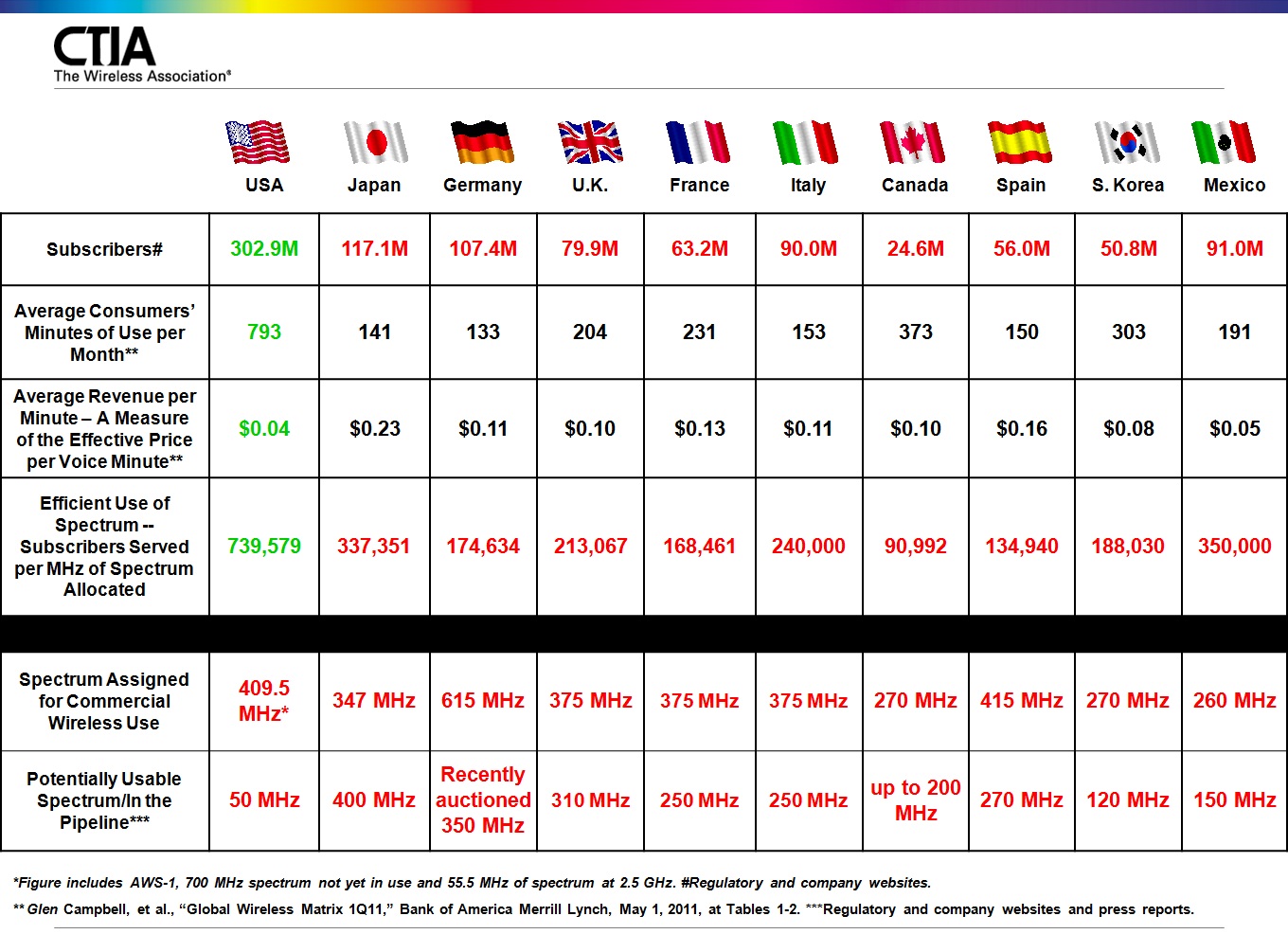
Here’s a terrifically useful chart from CTIA that offers some international wireless use and spectrum availability comparisons. [Click on chart to expand.] The average minutes of use and average revenue per minute differences are fairly staggering. But the really important takeaway from this chart is the last line, which depicts how little spectrum is dripping out of the faucet right now. Having just 50 MHz of “potentially usable spectrum in the pipeline” is troubling and needs to be addressed by policymakers immediately. America’s wireless demands continue to explode, but supply isn’t keeping up.
 On CNET this morning, I argue that delay in approving FCC authority for voluntary incentive auctions is largely the fault of last year’s embarrassing net neutrality rulemaking.
While most of the public advocates and many of the industry participants have moved on to other proxy battles (which for most was all net neutrality ever was), Congress has remained steadfast in expressing its great displeasure with the Commission and how it conducted itself for most of 2010.
In the teeth of strong and often bi-partisan opposition, the Commission granted itself new jurisdiction over broadband Internet on Christmas Eve last year. Understandably, many in Congress are outraged by Chairman Julius Genachowski’s chutzpah.
So now the equation is simple: while the Open Internet rules remain on the books, Congress is unlikely to give the Chairman any new powers.
House Oversight Committee Chairman Darrell Issa has made the connection explicit, telling reporters in April that incentive auction authority will not come while net neutrality hangs in the air. There’s plenty of indirect evidence as well.
Continue reading →
 Last week the Senate Commerce Committee passed–with deep bi-partisan support–the Public Safety Spectrum and Wireless Innovation Act.
The bill, co-sponsored by Committee Chairman Jay Rockefeller and Ranking Member Kay Bailey Hutchison, is a comprehensive effort to resolve several long-standing stalemates and impending crises having to do with one of the most critical 21st century resources: radio spectrum.
My analysis of the bill appears today on CNET. See “Spectrum reform, public safety network move forward in Senate.”
The proposed legislation is impressive in scope; it offers new and in some cases novel solutions to more than half-a-dozen spectrum-related problems, including: Continue reading →
 For Forbes.com this morning, I take a close look at last month’s controversial FCC order requiring facilities-based wireless carriers to negotiate data roaming agreements with other carriers.
There are business, technical, and legal reasons why the order stands on unsteady ground, which the article looks at in detail.
The order, by encouraging artificial competition in nationwide mobile broadband, could also undermine arguments against AT&T’s merger with T-Mobile USA.
How so? If every regional, local, or rural carrier can offer their customers access to the nationwide coverage of Verizon, AT&T, or Sprint, on terms overseen for “commercial reasonableness” by the FCC, what’s the risk of consumer harm from combining AT&T and T-Mobile’s infrastructure? Indeed, doing so would create stronger nationwide 3G and 4G networks for other carriers to use. In that sense, it’s actually pro-competitive, and a pragmatic solution to spectrum exhaustion. Continue reading →
Following AT&T’s announcement last month of its planned acquisition of T-Mobile USA, pundits and other oddsmakers have settled in for a long tour of duty. Speculation, much of it uninformed, is already clogging the media about the chances the $39 billion deal—larger even than last year’s merger of Comcast and NBC Universal—will be approved.
Both the size of the deal and previous consolidation in the communications industry lead some analysts and advocates to doubt the transaction will or ought to survive the regulatory process.
Though the complex review process could take a year or perhaps even longer, I’m confident that the deal will go through—as it should. To see why, one need only look to previous merger reviews by the Department of Justice and the Federal Communications Commission, both of which must approve the AT&T deal. Continue reading →
On Forbes
this morning, I analyze the legislative and judicial challenges to last year’s FCC Open Internet rules, the so-called net neutrality order.
Despite the urgency of Friday’s budget machinations, the House took time out to pass House Joint Resolution 37, which “disapproves” the FCC’s December rulemaking. If passed by the Senate and not vetoed by President Obama, HJR 37 would effectively nullify the net neutrality rules, and ensure the FCC cannot pass alternate versions of them absent new authority to do so from Congress.
Most commentators believe that the House action was merely symbolic. Passage in the Senate requires only a simple majority, but the neutrality fight has turned violently partisan since the mid-term elections and getting a few Democratic Senators on-board may be hard. More to the point, the White House last week pre-emptively threatened to veto the resolution.
Continue reading →
Here are some quick thoughts on the proposed AT&T – T-Mobile merger, mostly borrowed from my previous writing on the wireless marketplace. First, however, I highly recommend this excellent analysis of the issue by Larry Downes, which cuts through the hysteria we’re already hearing and offers a sober look at the issues at stake here. Anyway, here are a few of my random thoughts on the deal:
-
The deal will likely be approved: First, to cut to the chase.. After much wrangling, the deal will probably be approved primarily because of two factors, both of which help political officials as much as AT&T: (1) The deal delivers upon the National Broadband Plan promise of getting the country blanketed with wireless broadband; and (2) it “brings home” T-Mobile by giving an American company control of a German-held interest. As Larry Dignan of ZNet says, it is tantamount to “playing the patriotism card.”
-
One reason it might not be approved: Some Administration critics, especially from the more liberal part of the Democratic base, could make this a litmus test for Obama administration’s antitrust enforcement efforts. In the wake of the Comcast merger approval — albeit after several pounds of flesh were handed over “voluntarily” to get the deal approved — some of the Administration’s base will be looking for blood. I remember how the Powell FCC was under real heat to “get tough” on mergers back in 2001-02 and during that time blocked the proposed DirecTV-EchoStar deal, possibly as a result of the pressure. The same thing could happen to AT&T – T-Mobile here.
-
It’s all about spectrum: From AT&T’s perspective, this deal is all about getting more high-quality spectrum, which is in increasingly short supply. Indeed, as Jerry Brito noted earlier, this merger should serve as another wake-up call regarding the need to get spectrum reform going again to ensure that existing players can reallocate their spectrum to those who demand it most. (Hint: Incentivize the TV broadcasters to sell... NOW!) But, in the short-term, this deal helps AT&T built out a more robust nationwide wireless network. Over the long-haul, that should help T-Mobile deliver better service to its customers. Continue reading →
What I hoped would be a short blog post to accompany the video from Geoff Manne and my appearances this week on PBS’s “Ideas in Action with Jim Glassman” turned out to be a very long article which I’ve published over at Forbes.com.
I apologize to Geoff for taking an innocent comment he made on the broadcast completely out of context, and to everyone else who chooses to read 2,000 words I’ve written in response.
So all I’ll say here is that Geoff Manne and I taped the program in January, as part of the launch of TechFreedom and of “The Next Digital Decade.” Enjoy!
 I’ve written posts today for both CNET and Forbes on legislation introduced yesterday by Senators Olympia Snowe and John Kerry that would require the FCC and NTIA to complete inventories of existing spectrum allocations. These inventories were mandated by President Obama last June (after Congress failed to pass legislation), but got lost at the FCC in the net neutrality armageddon.
Everyone believes that without relatively quick action to make more spectrum available, the mobile Internet could seize up. Given the White House’s showcasing of wireless as a leading source of new jobs, investment, and improved living conditions for all Americans, both Congress and President Obama, along with the FCC and just about everyone else, knows this is a crisis that must be avoided.
Indeed, the National Broadband Plan estimates conservatively that mobile users will need 300-500 mhz of new spectrum over the next 5-10 years. Continue reading →
 (Follow the links for Part I, Part II, Part III and Part IV.)
In this final post on the FCC’s Dev. 23, 2010 Open Internet Report and Order, I’ll look briefly at the problematic legal foundation on which the FCC has built its new regulations on broadband Internet access. That discussion need only be brief largely because the extended legal analysis has already been admirably detailed by FCC Commissioner Robert McDowell. His dissent (see pages 145-177 of the Report and Order) calmly and systematically dismantles the case made by the majority (See ¶¶ 115-150).
This is no theoretical discussion of statutory interpretation. Even before the rules have been published on the Federal Register, two broadband providers—Verizon and then MetroPCS—have already filed lawsuits in the D.C. Circuit Court of Appeals challenging the FCC’s authority to regulate. (See Jim DeLong’s definitive deciphering of Verizon’s efforts to secure exclusive jurisdiction in the D.C. Circuit) The arguments sketched out in Commissioner McDowell’s dissent are likely to mirror the complainants’ briefs in these and likely other Petitions for Review of the Order.
Continue reading →


 The Technology Liberation Front is the tech policy blog dedicated to keeping politicians' hands off the 'net and everything else related to technology.