Facebook has been at the center of a controversy involving its moderation policies and The Pirate Bay, a popular Bittorrent tracker that was found guilty of copyright infringement by a Swedish court last month. Since early April, Facebook has enforced a “site-wide” ban on links to The Pirate Bay – including those in private messages.
This practice may run afoul of federal wiretapping statutes that bar service providers from “intercepting” private messages, according to an article that appeared on Wired Threat Level last week. Wired quotes Kevin Bankston, a senior attorney for the Electronic Frontier Foundation, who explains that Facebook’s filtering raises “serious questions about whether Facebook is in compliance with federal wiretapping law.”
It’s important to draw a distinction between the traditional notion of “wiretapping” and Facebook’s “interception” of user messages, which doesn’t involve any human intervention. Regardless of how the courts may interpret ancient laws like the 1986 Electronic Communications Privacy Act, an automated computer system flagging and deleting certain strings from user messages simply isn’t comparable to a third party secretly listening in on a private phone conversation.
Besides, Facebook makes clear to its users from the get-go that their messages and postings are subject to a set of rules (which Facebook lays out in plain English). If Facebook believes a message or posting is against the rules, it can block or remove it. This is not an unreasonable rule; many online discussion forums have enforced similar policies since the Web’s early days. Such filtering is possible only if sites can “examine” messages to identify misconduct.
Continue reading →
I was reading this Sun Magazine interview with the always-interesting Nick Carr and I liked what he had to say here about the public’s inconsistent views on privacy:
If you ask people whether they’re concerned about the ability of the government or corporations to gather information about them online, they’ll say yes. But if you look at how they behave online, they don’t display much fear of exposing themselves. What that says about people — and it’s true for most of us — is that we will readily forgo our privacy in exchange for convenient and useful services, particularly if they’re free. That’s a trade-off you make all the time on the Internet. Even if people were more conscious of how this information might be exploited, I doubt most would change their behavior.
This reminds me of the classic “hamburgers for DNA” quip from security expert Bruce Schneier who once famously noted that:
If McDonalds in the United States would give away a free hamburger for an DNA sample they would be handing out free lunches around the clock. So people care about their privacy, but they don’t care to pay for it. In the United States we have frequent shopper cards, which will track down people’s purchases for a 5 cents discount on a can of tuna fish. I don’t think you can convince the public to care about it.
Continue reading →
Online child safety — especially the fear of predators lurking on social networking sites (SNS) — continues to spur calls by state and federal lawmakers for regulation. At first, some federal lawmakers advocated outright bans on SNS in schools and libraries via the Deleting Online Predators Act (DOPA). Meanwhile, state and local lawmakers — specifically state Attorneys General (AGs) — have been even more vociferous in their calls for regulation in the form of mandatory age verification for social networking sites, which would cover a broad swath of online sites and activities according to their definitions of SNS. But the question that ultimately gets lost in this debate is: Just how much risk do social networking sites really pose for teens? Which risks are real and which are overblown? And what’s the best way to deal with the risks that we find to be legitimate?
 Nancy Willard devotes her life to answering those questions. Willard is one of America’s leading experts on online safety and risk prevention. She runs the Center for Safe and Responsible Internet Use and she is the author of two outstanding books, Cyberbullying and Cyberthreats and Cyber-Safe Kids, Cyber-Savvy Teens. In my opinion, Willard’s general approach to online child safety is the most enlightened, level-headed, and likely to be effective. That’s because Willard focuses on putting fears in perspective, identifying the actual risks that kids face online, and devising sensible strategies to deal with risks and problems as they are discovered. Her approach is holistic and built upon sound data, targeted risk-identification strategies, and time-tested education and mentoring methods. For my money, it’s the most sensible approach to online safety issues. In fact, when other parents ask me for “just one thing” to read on the topic, I usually recommend Willard’s work — especially her amazing book Cyber-Safe Kids, Cyber-Savvy Teens. And her background in early childhood education, special education for “at risk” children with emotional and behavior difficulties, as well as experience in computer law, means she is uniquely suited to be analyzing these issues. In sum, this is woman we should all be closely listening to on these issues.
Recently, Willard has been responding to criticisms that state AGs have leveled against the Internet Safety Technical Task Force (ISTTF) and its final report. [Disclaimer: I was a member of the ISTTF.] I’ve already outlined the ISTTF’s work at length here, but the three key takeaways from the report were that:
- the risk of predation on social network sites has been over-stated; the data suggest that cyber-bullying is the bigger problem on SNS;
- there is no silver-bullet technical solution to online child safety concerns, and mandatory age verification, in particular, would not make kids safer online but could even create bigger problems in the long-run;
- education and empowerment are the real keys to keeping kids safer online.
Continue reading →
 I haven’t been blogging much lately because, along with my PFF colleagues Berin Szoka and Adam Marcus, I’m working on a lengthy paper about the importance of Section 230 to Internet freedom. Section 230 is the sometimes-forgotten portion of the Communications Decency Act of 1996 that shielded Internet Service Providers (ISP) from liability for information posted or published on their systems by users or other third parties. It was enshrined into law with the passage of the historic Telecommunications Act of 1996. Importantly, even though the provisions of the CDA seeking to regulate “indecent” speech on the Internet were struck down as unconstitutional, Sec. 230 was left untouched.
Section 230 of the CDA may be the most important and lasting legacy of the Telecom Act and it is indisputable that it has been remarkably important to the development of the Internet and online free speech and expression in particular. In many ways, Section 230 is the cornerstone of “Internet freedom” in its truest and best sense of the term.
In recent years, however, Sec. 230 has come under fire from some academics, judges, and other lawmakers. Critics raise a variety of complaints — all of which we will be cataloging and addressing in our forthcoming PFF paper. But what unifies most of the criticisms of Sec. 230 is the belief that Internet “middlemen” (which increasingly includes almost any online intermediary, from ISPs, to social networking sites, to search engines, to blogs) should do more to police their networks for potentially “objectionable” or “offensive” content. That could include many things, of course: cyberbullying, online defamation, harassment, privacy concerns, pornography, etc. If the online intermediaries failed to engage in that increased policing role, they would open themselves up to lawsuits and increased liability for the actions of their users.
The common response to such criticisms — and it remains a very good one — is that the alternative approach of strict secondary liability on ISPs and other online intermediaries would have a profound “chilling effect” on online free speech and expression. Indeed, we should not lose sight of what Section 230 has
already done to create vibrant, diverse online communities. Brian Holland, a visiting professor at Penn State University’s Dickinson School of Law, has written a brilliant paper that does a wonderful job of doing just that. It’s entitled “In Defense of Online Intermediary Immunity: Facilitating Communities of Modified Exceptionalism” and it can be found on SSRN here. I cannot recommend it highly enough. It is a masterpiece.
Continue reading →
I’ve spent a lot of time in recent years trying to debunk various myths about online child safety or at least put those risks into perspective. Too often, press reports and public policy initiatives are being driven by myths, irrational fears, or unjustified “moral panics.” Luckily, the New York Times reports that there’s another study out this week that helps us see things in a more level-headed light. This new MacArthur Foundation report is entitled Living and Learning with New Media: Summary of Findings from the Digital Youth Project. This white paper is a summary of three years of research on kids’ informal learning with digital media. The survey incorporates the insights from 800 youth and young adults and over 5000 hours of online observations. The information will eventually be contained in a book from MIT Press (“Hanging Out, Messing Around, Geeking Out: Living and Learning with New Media.”)
From the summary of the study on the MacArthur website:
“It might surprise parents to learn that it is not a waste of time for their teens to hang out online,” said Mizuko Ito, University of California, Irvine researcher and the report’s lead author. “There are myths about kids spending time online – that it is dangerous or making them lazy. But we found that spending time online is essential for young people to pick up the social and technical skills they need to be competent citizens in the digital age.”
Importantly, regarding the concerns many parents and policymakers have about online predation, Ms. Ito told the
New York Times that, “Those concerns about predators and stranger danger have been overblown.” “There’s been some confusion about what kids are actually doing online. Mostly, they’re socializing with their friends, people they’ve met at school or camp or sports.”
In the report, according to the summary, the researchers “identified two distinctive categories of teen engagement with digital media: friendship-driven and interest-driven. While friendship-driven participation centered on “hanging out” with existing friends, interest-driven participation involved accessing online information and communities that may not be present in the local peer group.” The specific findings of the study are as follows:
Continue reading →
See my take on the election and the prospects for capitalism in today’s Wall Street Journal:
If Barack Obama ran for president by calling for a heavier hand of government, he also won by running one of the most entrepreneurial campaigns in history.
Will he now grasp the lesson his campaign offers as he crafts policies aimed at reigniting the national economy? Amid a recession, two wars, and a global financial crisis, will he come to see that unleashing the entrepreneur is the best way to raise the revenue he needs for his lofty priorities?
Just FYI, the latest update of my booklet on “Parental Controls and Online Child Protection: A Survey of Tools & Methods” is now live. The new version, Version 3.1, provides minor updates to all sections of the book and a new appendix of relevant research in the field. I issue major updates early each year and 1 or 2 tweaks during the course of the year to reflect the evolution of the parental control and online child safety market and debate. 
For those not familiar with the report, it explores the market for parental control tools, rating schemes, education efforts, and initiatives aimed at promoting online child safety. I believe that the parental controls and content management tools cataloged in the report represent a better, less restrictive alternative to government regulation. As I conclude after evaluating that state of the market: “There has never been a time in our nation’s history when parents have had more tools and methods at their disposal to help them decide what constitutes acceptable media content in their homes and in the lives of their children.”
The report is available free-of-charge on the PFF website, and the previous editions of the report are housed there too in case you want to see how it has evolved over the past two years. For those interested in taking a quick look at the report, I have embedded it down below the fold as a Scribd file. Finally, as is always the case, I encourage readers to send me updates and suggestions for how to improve the report and I will incorporate them into future versions.
Continue reading →
John Markoff had an interesting article in the New York Times this weekend entitled “Internet Traffic Begins to Bypass the U.S..” In the piece, Markoff notes that “The era of the American Internet is ending” since “data is increasingly flowing around the United States,” instead of all flowing though our country, as it once did. Markoff focuses on how that “may have intelligence — and conceivably military — consequences.”
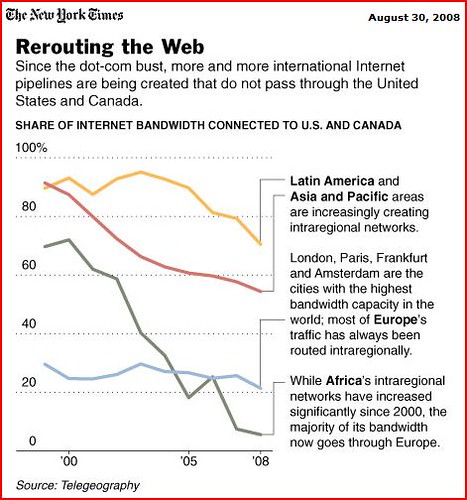 Indeed, it may. But what I also found interesting about this fact is the implications it will have for the future of content regulation. As Harvard’s Yochai Benkler told the
Times, “This is one of many dimensions on which we’ll have to adjust to a reduction in American ability to dictate terms of core interests of ours.” Content controls are one way that lawmakers enforce what they perceive to be a country’s “core interests.” As less and less Internet traffic flows through the U.S., it could become increasingly difficult for American lawmakers to impose their particular vision or morality on the Internet.
Indeed, it may. But what I also found interesting about this fact is the implications it will have for the future of content regulation. As Harvard’s Yochai Benkler told the
Times, “This is one of many dimensions on which we’ll have to adjust to a reduction in American ability to dictate terms of core interests of ours.” Content controls are one way that lawmakers enforce what they perceive to be a country’s “core interests.” As less and less Internet traffic flows through the U.S., it could become increasingly difficult for American lawmakers to impose their particular vision or morality on the Internet.
And that’s both good and bad news.
Continue reading →
A few days ago, I posted an essay about the recent history of “moral panics,” or “technopanics,” as Alice Marwick refers to them in her brilliant new article about the recent panic over MySpace and social networking sites in general.
I got thinking about technopanics again today after reading the
Washington Post’s front-page article, “When the Phone Goes With You, Everyone Else Can Tag Along.” In the piece, Post staff writer Ellen Nakashima discusses the rise of mobile geo-location technologies and services, which are becoming more prevalent as cell phones grow more sophisticated. These services are often referred to as “LBS,” which stands for “location-based services.”
Many of phones and service plans offered today include LBS technologies, which are very useful for parents like me who might want to monitor the movement of their children. Those same geo-location technologies can be used for other LBS purposes. Geo-location technologies are now being married to social networking utilities to create an entirely new service and industry: “social mapping.” Social mapping allows subscribers to find their friends on a digital map and then instantly network with them. Companies such as Loopt and Helio have already rolled out commercial social mapping services. Loopt has also partnered with major carriers to roll out its service nationwide, including the new iPhone 3G. It is likely that many other rivals will join these firms in coming months and years.
These new LBS services present exciting opportunities for users to network with friends and family, and it also open up a new world of commercial / advertising opportunities. Think of how stores could offer instantaneous coupons as you walk by their stores, for example. And very soon, you can imagine a world were many of our traditional social networking sites and services are linked into LBS tools in a seamless fashion. But as today’s
Washington Post article notes, mobile geo-location and social mapping is also raising some privacy concerns:
Continue reading →
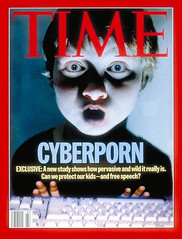
Sean Garrett of the 463 Blog posted an excellent essay this week about the great moral panic of 1995, when Time magazine ran its famous cover “Cyberporn” story that included this unforgettable image. Unfortunately for Time, the article also included a great deal of erroneous information about online pornography that was pulled from a bogus study that found 83.5 percent of all online images were pornographic! The study was immediately debunked by scholars, but not before Congress rushed to judgment and passed the Communications Decency Act, which sought to ban all “indecent” online content. It was later struck down as unconstitutional, of course.
Anyway, Sean’s essay also brought to my attention this amazing new article by Alice Marwick, a PhD Candidate in the Department of Media, Culture, and Communication at New York University: “To Catch a Predator? The MySpace Moral Panic“. The topic of “moral panics” is something I have done quite a bit of work on, but Marwick’s paper is absolute must-reading on the topic, especially as it pertains to the recent moral panic of MySpace and social networking sites.
Continue reading →

 The Technology Liberation Front is the tech policy blog dedicated to keeping politicians' hands off the 'net and everything else related to technology.