Christopher Wolf, director of the law firm Hogan Lovells’ Privacy and Information Management group, addresses his new book with co-author Abraham Foxman, Viral Hate: Containing Its Spread on the Internet. To what extent do hateful or mean-spirited Internet users hide behind anonymity? How do we balance the protection of the First Amendment online while addressing the spread of hate speech? Wolf discusses how to define hate speech on the Internet; whether online hate speech leads to real-world violence; how news sites like the Huffington Post and New York Times have dealt with anonymity; lessons we should impart on the next generation of Internet users to discourage hate speech; and cases where anonymity has proved particularly beneficial or valuable.
Download
Related Links
It was my pleasure last night to take part in an hour-long conversation on “Privacy, Security, and the Digital Age,” which was co-sponsored by Mediaite and the Koch Institute. The discussion focused on a wide range of issues related to government surveillance powers, Big Data, and the future of privacy. It opened with dueling remarks from former U.S. Ambassador to the U.N. John Bolton and Ben Wizner of the ACLU. You can view their respective remarks here.
I then sat on a panel that included Atlantic Media CTO Tom Cochrane and Michael R. Nelson, who is affiliated with with Bloomberg Government and Georgetown University. The entire session was expertly moderated by Andrew Kirell of Mediaite. He did an amazing job facilitating the discussion. Anyway, the videos for my panel are below, split into two parts. My comments focused heavily on the importance of separating the government uses of data from private sector uses and explaining the need to create a high and tight firewall between State and Industry when it comes to information sharing. I also argued that we will never get a handle on government-related privacy concerns until we get control of the scope of government power. I used the example of the drug war and our government’s constantly-expanding militaristic activities both abroad and here at home. So long as government is expanding without any rational, constitutional constraint, we are going to have serious surveillance and privacy problems. (See this essay, “It’s About Power, not Privacy,” by my colleague Eli Dourado for more on that theme.)
Last month, it was my great pleasure to serve as a “provocateur” at the IAPP’s (Int’l Assoc. of Privacy Professionals) annual “Navigate” conference. The event brought together a diverse audience and set of speakers from across the globe to discuss how to deal with the various privacy concerns associated with current and emerging technologies.
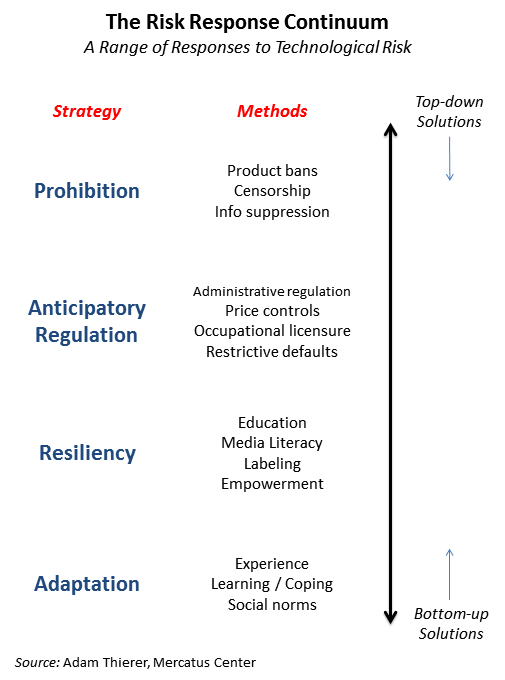
My remarks focused on a theme I have developed here for years: There are no simple, silver-bullet solutions to complex problems such as online safety, security, and privacy. Instead, only a “layered” approach incorporating many different solutions–education, media literacy, digital citizenship, evolving society norms, self-regulation, and targeted enforcement of existing legal standards–can really help us solve these problems. Even then, new challenges will present themselves as technology continues to evolve and evade traditional controls, solutions, or norms. It’s a never-ending game, and that’s why education
must be our first-order solution. It better prepares us for an uncertain future. (I explained this approach in far more detail in this law review article.)
Anyway, if you’re interested in an 11-minute video of me saying all that, here ya go. Also, down below I have listed several of the recent essays, papers, and law review articles I have done on this issue.
Continue reading →
 Ronald J. Deibert is the director of The Citizen Lab at the University of Toronto’s Munk School of Global Affairs and the author of an important new book, Black Code: Inside the Battle for Cyberspace, an in-depth look at the growing insecurity of the Internet. Specifically, Deibert’s book is a meticulous examination of the “malicious threats that are growing from the inside out” and which “threaten to destroy the fragile ecosystem we have come to take for granted.” (p. 14) It is also a remarkably timely book in light of the recent revelations about NSA surveillance and how it is being facilitated with the assistance of various tech and telecom giants.
The clear and colloquial tone that Deibert employs in the text helps make arcane Internet security issues interesting and accessible. Indeed, some chapters of the book almost feel like they were pulled from the pages of techno-thriller, complete with villainous characters, unexpected plot twists, and shocking conclusions. “Cyber crime has become one of the world’s largest growth businesses,” Deibert notes (p. 144) and his chapters focus on many prominent recent examples, including cyber-crime syndicates like Koobface, government cyber-spying schemes like GhostNet, state-sanctioned sabotage like Stuxnet, and the vexing issue of zero-day exploit sales.
Deibert is uniquely qualified to narrate this tale not just because he is a gifted story-teller but also because he has had a front row seat in the unfolding play that we might refer to as “How Cyberspace Grew Less Secure.” Continue reading →
In mid-April, the Federal Trade Commission (FTC) requested comments regarding “the consumer privacy and security issues posed by the growing connectivity of consumer devices, such as cars, appliances, and medical devices” or the so-called “Internet of Things.” This is in anticipation of a November 21 public workshop that the FTC will be hosting on the same issue.
These issues are finally starting to catch the attention of the public and policymakers alike with the rise of wearable computing, remote home automation and monitoring technologies, smart grids, autonomous vehicles and intelligent traffic systems, and so on. The Internet of Things represents the next great wave of Internet innovation, but it also represents the next great battleground in the field of Internet policy.
I filed comments with the FTC today in this proceeding and made a few simple points about why they should proceed cautiously here. A summary of my filing follows. Continue reading →
Last week on his personal blog, Peter Fleischer, Global Privacy Counsel for Google, posted an interesting essay entitled “We Need a Better, Simpler Narrative of US Privacy Laws.” Fleischer says that Europe has done a better job marketing its privacy regime to the world than the United States and argues that “The US has to figure out how to explain its privacy laws on the global stage” since “Europe is convincing many countries around the world to implement privacy laws that follow the European model.” He notes that “in the last year alone, a dozen countries in Latin America and Asia have adopted euro-style privacy laws [while] not a single country, anywhere, has followed the US model.” Fleischer argues that this has ramifications for long-term trade policy and global Internet regulation more generally.
I found this essay very interesting because I deal with some of these issues in my latest law review article, “The Pursuit of Privacy in a World Where Information Control is Failing” (Harvard Journal of Law & Public Policy, vol. 36, no. 2, Spring 2013). In the article, I suggest that the U.S. does have a unique privacy regime and it is one that is very similar in character to the regime that governs online child safety issues. Whether we are talking about online safety or digital privacy, the defining characteristics of the U.S. regime are that it is bottom-up, evolutionary, education-based, empowerment-focused, and resiliency-centered. It focuses on responding to safety and privacy harms after exhausting other alternatives, including market responses and the evolution of societal norms.
The EU regime, by contrast, is more top-down in character and takes a more static, inflexible view of privacy rights. It tries to impose a one-size-fits-all model on a diverse citizenry and it attempts to do so through heavy-handed data directives and ongoing “agency threats.” It is a regime that makes more sweeping pronouncements about rights and harms and generally recommends a “precautionary principle” approach to technological change in which digital innovation is more “permissioned.”
Put simply, the U.S. regime is
reactive in character while the E.U. regime is more preemptive. The U.S. system focuses on responding to safety and privacy problems using a more diverse toolbox of solutions, some of which are governmental in character while others are based on evolving social and market norms and responses. To be clear, law does enter the picture here in the U.S., but it does so in a very different way than it does in the E.U. Continue reading →
[Note: I later adapted this essay into a short book, which you can download for free here.]
Let’s talk about “permissionless innovation.” We all believe in it, right? Or do we? What does it really mean? How far are we willing to take it? What are its consequences? What is its opposite? How should we balance them?
What got me thinking about these questions was a recent essay over at
The Umlaut by my Mercatus Center colleague Eli Dourado entitled, “‘Permissionless Innovation’ Offline as Well as On.” He opened by describing the notion of permissionless innovation as follows:
In Internet policy circles, one is frequently lectured about the wonders of “permissionless innovation,” that the Internet is a global platform on which college dropouts can try new, unorthodox methods without the need to secure authorization from anyone, and that this freedom to experiment has resulted in the flourishing of innovative online services that we have observed over the last decade.
Eli goes on to ask, “why it is that permissionless innovation should be restricted to the Internet. Can’t we have this kind of dynamism in the real world as well?”
That’s a great question, but let’s ponder an even more fundamental one: Does anyone really believe in the ideal of “permissionless innovation”? Is there anyone out there who makes a consistent case for permissionless innovation
across the technological landscape, or is it the case that a fair degree of selective morality is at work here? That is, people love the idea of “permissionless innovation” until they find reasons to hate it — namely, when it somehow conflicts with certain values they hold dear. Continue reading →
 My latest Forbes column is entitled “Why Doesn’t Society Just Fall Apart?” and it’s a short review of Bruce Schneier’s latest book, Liars & Outliers: Enabling the Trust that Society Needs to Thrive. It’s an interesting exploration of the societal pressures that combine to ensure that (most!) societies don’t go off the rails and end in anarchic violence. In particular, he identifies and discusses four “societal pressures” combine to help create and preserve trust within society. Those pressures include: (1) Moral pressures; (2) Reputational pressures; (3) Institutional pressures; and (4) Security systems. By “dialing in” these societal pressures in varying degrees, trust is generated over time within groups.
Of course, these societal pressures also fail on occasion, Schneier notes. He explores a host of scenarios — in organizations, corporations, and governments — when trust breaks down because defectors seek to evade the norms and rules the society lives by. These defectors are the “liars and outliers” in Schneier’s narrative and his book is an attempt to explain the complex array of incentives and trade-offs that are at work and which lead some humans to “game” systems or evade the norms and rules others follow. Continue reading →
It’s time again to look back at the major cyberlaw and information tech policy books of the year. I’ve decided to drop the top 10 list approach I’ve used in past years (see 2008, 2009, 2010) and just use a more thematic listing of major titles released in 2011. This thematic approach gets me out of hot water since I have found that people take numeric lists very seriously, especially when they are the author of one of the books and their title isn’t #1 on the list! Nonetheless, at the end, I will name what I regard as the most important Net policy book of the year.
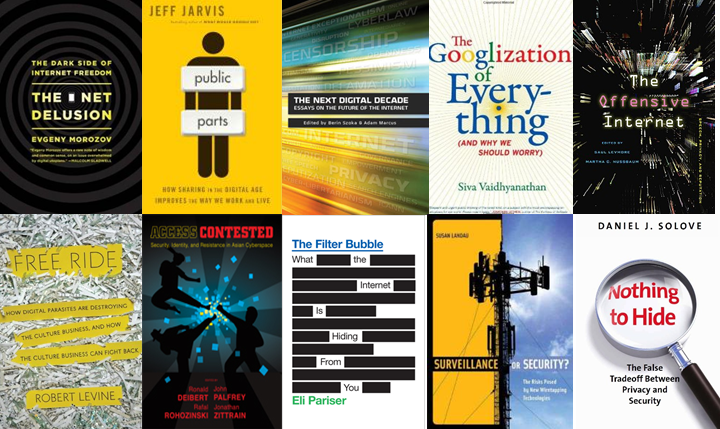
I hope I’ve included all the major titles released during the year, but I ask readers to please let me know what I have missed that belongs on this list. I want this to be a useful resource to future scholars and students in the field. [Reminder: Here’s my compilation of major Internet policy books from the past decade.] Where relevant, I’ve added links to my reviews as well as discussions with the authors that Jerry Brito conducted as part of his “Surprisingly Free” podcast series. Finally, as always, I apologize to international readers for the somewhat U.S.-centric focus of this list.
Continue reading →

 The Technology Liberation Front is the tech policy blog dedicated to keeping politicians' hands off the 'net and everything else related to technology.