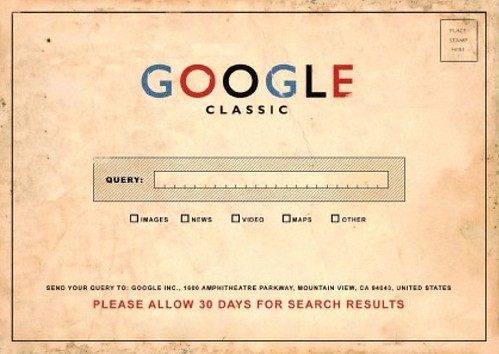
Found here.
Keeping politicians' hands off the Net & everything else related to technology
 I finally got around to reading Planet Google: One Company’s Audacious Plan to Organize Everything We Know, by Randall Stross. It’s very well done. Stross is a frequently contributor to the New York Times and the author of several other interesting books on the technology industry. He knows how to weave a story together, and it helps that Google’s story is a pretty amazing one.
Each chapter discusses a different part of Google’s growing family of services — GMail, Google Maps, Google Earth, Book Search, and YouTube. Of course, it all started with search and Stross does a good job explaining how the ingenious Google search algorithm has grown from dorm room project to the greatest aggregator of human knowledge that the world has ever known. This, in turn, has powered Google’s hugely successful online advertising system. The real secret of their success with online advertising, Stross argues, is that “Google’s impersonal, mathematical approach search also provides you with the ability to serve advertisements that are tailored to a search, rather than to the person submitting the search request, whose identity would have to be known.”
Despite the benefits of such generally anonymous searching, as Google has grown and added new services and capabilities, concerns about the sheer volume of data that the company collects have led to heightened privacy concerns. Indeed, privacy is a core theme that Stross uses in the book to tie many of the chapters and issues together. Google is constantly struggling to strike the right balance between providing more access to the world’s information while also being careful not to raise privacy concerns. But it’s unclear exactly how much more information collection that users (or public officials) will tolerate before advocating stricter limits on Google’s reach. As Stross points out:
Guided by its founding mission, to organize all the world’s information, Google has created storage capacity that allows it to gain control of what its users are you doing in a comprehensive way that no other company has done, and to preserve those records indefinitely, without the need to clear out old records to make way for new ones. Moreover, Google differentiates its service by refining its own proprietary software formula to mine and massage the data, technology that it zealously protects from the sight of rivals. This sets up a conflict between Google’s wish to operate a “black box” (completely opaque to the outside) and its users’ wish for transparency.
My problem with what Nick Carr is saying about Wikipedia here — as well as in his book The Big Switch — is that he always seems to assume that Wikipedia constitutes the totality of most searches for information online. I suppose it does for some people, but I have a hard time accepting the argument that everyone’s search for enlightenment ends there, even if Wikipedia does rank high in many search results today.
For me, Wikipedia is just a launch pad; a great starting point in the search for truth. I take much of what I read on Wikipedia with a large grain of salt, however, because I know not every entry is as trustworthy as others, and entries could change at any moment. But that’s true of much of what one finds online! If one adopts a sort of caveat emptor attitude toward Wikipedia, and then uses it to seek out truth from alternative sources found in each entry, or from other searches, then were is the harm? Only if one could show that the search for truth ends with Wikipedia would I be as concerned as Carr and other Internet pessimists and Wikipedia critics (like Lee Siegel and Andrew Keen). But I just don’t believe that is the case.
Moreover, it is impossible for me to believe that we have fewer authoritative sources of information at our disposal today than we did in the past. Continue reading →
 I used to have a (semi-crazy) uncle who typically began conversations with lame jokes or bad riddles. This sounds like one he might have used had he lived long enough: What do Thomas Jefferson, a moose, and cyberspace have in common?
The answer to that question can be found in a new book, In Search of Jefferson’s Moose: Notes on the State of Cyberspace, by David G. Post, a Professor of Law at Temple University. Post, who teaches IP and cyberspace law at Temple, is widely regarded as one of the intellectual fathers of the “Internet exceptionalist” school of thinking about cyberlaw. Basically, Post sees this place we call “cyberspace” as something truly new, unique, and potentially worthy of some special consideration, or even somewhat different ground rules than we apply in meatspace. More on that in a bit.
[ Full disclosure: Post’s work was quite influential on my own thinking during the late 1990s, so much so that when I joined the Cato Institute in 2000, one of the first things I did was invite David to become an adjunct scholar with Cato. He graciously accepted and remains a Cato adjunct scholar today. Incidentally, Cato is hosting a book forum for him on February 4th that I encourage you to attend or watch online. Anyway, it’s always difficult to be perfectly objective when you know and admire someone, but I will try to do so here.]
Post’s book is essentially an extended love letter — to both cyberspace and Jefferson. Problem is, as Post even admits at the end, it’s tough to know which subject this book is suppose to teach us more about. The book loses focus at times — especially in the first 100 pages — as Post meanders between historical tidbits of Jefferson’s life and thinking and what it all means for cyberspace. But the early focus is on TJ. Thus, those who pick up the book expecting to be immediately immersed in cyber-policy discussions may be a bit disappointed at first. As a fellow Jefferson fanatic, however, I found all this history terrifically entertaining, whether it was the story of Jefferson’s Plow and his other agricultural inventions and insights, TJ’s unique interest in science (including cryptography), or that big moose of his.
OK, so what’s the deal with the moose? When TJ was serving as a minister to France in in the late 1780s, at considerable expense to himself, he had the complete skeleton, skin and horns of a massive American moose shipped to the lobby of his Paris hotel. Basically, Jefferson wanted to make a bold statement to his French hosts about this New World he came from and wake them up to the fact that some very exciting things were happening over there that they should be paying attention to. That’s one hell of way to make a statement!
Jerry Yang’s departure as Yahoo! CEO opens the door to a renewed bid by Microsoft to buy Yahoo!’s search business (or Yahoo! itself). Such a merger could produce a significantly stronger challenger to Google in the search market. With this possibility in mind, the WSJ just ran a fascinating history of the “paid search”  business—the placement of “contextually targeted” ads next to search engine results based on the search terms that produced those results.
In a nutshell, Microsoft failed to see (back in 1998-2003) the enormous potential of paid search—just as small start-ups (such as Google) were starting to develop the technology and business model that today account for a $12+ billion/year industry, which is twice the size of the display ad market and which supports a great deal of the online content and services we have all come to take for granted online. Microsoft first put its toe in the water of paid search with a small-scale partnership with Goto.com in 1999-2000. But this partnership failed because of internal resistance from the managers of Microsoft’s display-ad program. In 2000, Google launched Adwords and thus began its transformation from start-up into economic colossus. By 2002, Microsoft realized that it needed to catchup fast, and approached Goto.com (by then renamed Overture) about a takeover. But Microsoft ultimately chose in 2003 not to buy the startup because Bill Gates and Steve Ballmer “balked at Overture’s valuation of $1 billion to $2 billion, arguing that Microsoft could create the same service for less.”
Microsoft, meanwhile, spent the next 18 months deploying hundreds of programmers to build a search engine and a search-ad service, which it code-named Moonshot. The company launched its search engine in late 2004 and its search-ad system in May 2006.
But Microsoft’s ad system came too late:
Advertisers applauded Moonshot for its technical innovation. But Microsoft had trouble coaxing people to migrate to its search engine from Google; advertisers were unwilling to spend large sums on MSN’s search ads. By building a new system instead of buying Overture, Mr. Mehdi says, “we really delayed our time to market.”
What’s most fascinating about the piece is that it seems to suggest that Microsoft missed its opportunities to get into paid search not because it was “dumb,” “uninnovative” or a “bad” company, but for the same sorts of reasons that big, highly successful and even particularly innovative companies fail. The reasons companies generally succeed in mastering “adaptive” innovation of the technologies behind their established business models are the very reasons why such great companies struggle to encourage or channel the “disruptive” innovation that renders their core technologies and business models obsolete. Continue reading →
 I’ve just finished reading Blown to Bits: Your Life, Liberty, and Happiness After the Digital Explosion, by Hal Abelson, Ken Ledeen, and Harry Lewis, and it’s another title worth adding to your tech policy reading list. The authors survey a broad swath of tech policy territory — privacy, search, encryption, free speech, copyright, spectrum policy — and provide the reader with a wonderful history and technology primer on each topic.
I like the approach and tone they use throughout the book. It is certainly something more than “Internet Policy for Dummies.” It’s more like “Internet Policy for the Educated Layman”: a nice mix of background, policy, and advice. I think Ray Lodato’s Slashdot review gets it generally right in noting that, “Each chapter will alternatively interest you and leave you appalled (and perhaps a little frightened). You will be given the insight to protect yourself a little better, and it provides background for intelligent discussions about the legalities that impact our use of technology.”
Abelson, Ledeen, and Lewis aren’t really seeking to be polemical in this book by advancing a single thesis or worldview. To the extent the book’s chapters are guided by any central theme, it comes in the form of the “two basic morals about technology” they outline in Chapter 1:
The first is that information technology is inherently neither good nor bad — it can be used for good or ill, to free us or to shackle us. Second, new technology brings social change, and change comes with both risks and opportunities. All of us, and all of our public agencies and private institutions, have a say in whether technology will be used for good or ill and whether we will fall prey to its risks or prosper from the opportunities it creates. (p. 14)
Mostly, what they aim to show is that digital technology is reshaping society and, whether we like or it not, we better get used to it — and quick! “The digital explosion is changing the world as much as printing once did — and some of the changes are catching us unaware, blowing to bits our assumptions about the way the world works… The explosion, and the social disruption that it will create, have barely begun.” (p 3)
In that sense, most chapters discuss how technology and technological change can be both a blessing and a curse, but the authors are generally more optimistic than pessimistic about the impact of the Net and digital technology on our society. What follows is a quick summary of some of the major issues covered in Blown to Bits.
By Berin Szoka & Adam Thierer
As we noted in our intro to this ongoing series, Google’s tenth anniversary has passed with Googlephobia reaching new heights of hysteria.
But is Google really too big and dangerous, or are people just too lazy to find other alternatives to each of the wonderful services that Google offers? If one is truly paranoid about the firm’s supposed dominance, it doesn’t take much effort to live a Google-free life. To prove it, we set out to find alternatives to each of the services that Google provides. After awhile, we got a little tired of compiling alternatives in each category and just provided links for the additional choices at your disposal. It’s tough to see what the fuss is about with the cornucopia of choices at our disposal. If you don’t like Google, then just don’t use it or any of its services. The choice is yours.
In each case, we’ve listed Google first, even though Google may not be the market leader ( e.g., Google’s relatively unknown social network Orkut).
Search Engines
By Berin Szoka & Adam Thierer as part of an ongoing series

With Google celebrating its 10th anniversary this week, many panicky pundits are using the occasion to claim that Google has become the Great “Satan” of the Internet. Nick Carr wonders what the future holds for “The OmniGoogle.” The normally level-headed Mike Malone worries that Google is “turning into Big Brother.” And Washington Post’s Rob Dubbin says that he can’t escape Google’s “tentacles,” even for just 24 hours. Meanwhile, speculation abounds that the Justice Department is preparing a major antitrust lawsuit against Google concerning its advertising partnership with Yahoo! or perhaps even a broader suit concerning Google’s “dominance” of online advertising generally.
Carr quotes Google co-founder Sergey Brin’s now-famous 2003 interview:
I think people tend to exaggerate Google’s significance in both directions. Some say Google is God. Others say Google is Satan. But if they think Google is too powerful, remember that with search engines, unlike other companies, all it takes is a single click to go to another search engine. People come to Google because they choose to. We don’t trick them.
In the last five years, Google has become far more than just a search engine. As Google’s suite of suite of complementary products continues to grow, so too does the specter of Google as an all-knowing and therefore all-powerful economic colossus. Yet Google isn’t even close to being the sort of nefarious monopolist out to destroy user privacy at every turn, as some seem to imply—if not exclaim. Indeed, in our view, the Net is overall a far better place because of the existence of Google and the many free services it provides consumers.
Our point is not that Google should be immune from criticism. Indeed, healthy criticism of corporate actions plays a vital role in the free market by disciplining corporate policies and behavior—often thus providing an effective alternative to government regulation. This is particularly important in the area of consumer privacy protection, as demonstrated by Google’s quick response to public concern about its Chrome EULA. Continue reading →
Over at Ars, Ben Kuchera has a review of Ask.com’s redesign of its web portal for kids, AskKids.com. It’s a great new addition to the growing list of safe seach tools and web portals geared toward younger surfers.

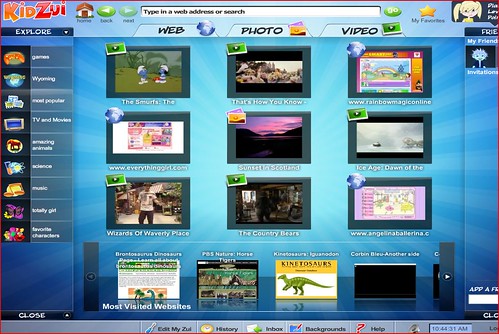
I’m also a big fan of KidZui, the new browser for kids that provides access to over 800,000 kid-friendly websites, videos, and pictures that have been pre-screened by over 200 trained teachers and parents. The company employs a rigorous 5-step “content selection process” to determine if it is acceptable for kids between 3-12 years of age. My kids, both under the age of 7, just love it, but I can’t see many kids older than 10 enjoying it because it is mostly geared toward the youngest web surfers.
Last year, as part of my 10-part series coinciding with “Internet Safety Month,” I wrote about the market for safe search tools and web portals for kids. I generally divide these sites and services into two groups:
(1) “Safe Search” Tools and Portals for Kids (2) Child- and Teen-Oriented Websites
Below I will describe each group and list the many sites and services currently available. I encourage readers to offer additional suggestions for sites that belong on the list. (I keep a running list of these sites and services in my book, “Parental Controls and Online Child Protection: A Survey of Tools & Methods.”)
Declan has got it exactly right here in commenting about the antitrust circus taking place between Google and Microsoft right now as the rhetorical war between them heats up and the feds—both in Congress and at the DOJ—get more and more involved in monitoring this market:
The underlying problem is that antitrust law is so malleable that it can be bent into virtually any shape that its practitioners desire. Given nearly any set of hard-nose business practices, some economist can be hired to claim that “predatory” prices are illegally low (hurting competitors) or illegally high (hurting consumers). No wonder Lester Thurow, the former dean of MIT’s business school, concluded that “the time has come to recognize that the antitrust approach has been a failure. The costs it imposes far exceed any benefits it brings.” And no wonder that some state attorneys general are now sniffing around to see if there’s a way for them to join the antitrust hunt.
And things are only going to get worse–far, far worse–in coming months.
 The Technology Liberation Front is the tech policy blog dedicated to keeping politicians' hands off the 'net and everything else related to technology.

