Posts tagged as:

2009 was not as big of a year for Internet and information technology (“info-tech”) policy books as 2008 was, but there were still some notable titles released that offered interesting perspectives about the future of the Net and the impact the Digital Revolution is having on our lives, culture, and economy.  So, like last year, I figured I would throw together my list of the 10 most important info-tech policy books of the year.
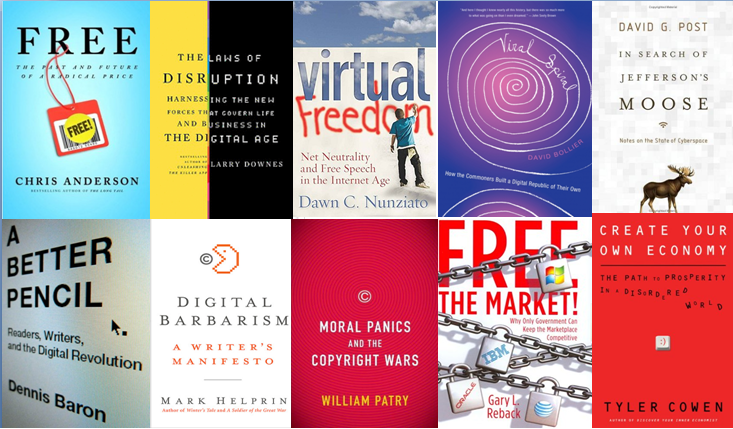
book covers collage 2009First, let me repeat a few of the same caveats and disclaimers that I set forth last year.  What qualifies as an “important” info-tech policy book? Simply put, it’s a title that many people are currently discussing and that we will likely be referencing for many years to come.  However, I want to be clear that merely because a book appears on my list it does not necessarily mean I agree with everything said in it. In fact, as was the case in previous years, I found much with which to disagree in my picks for the most important books of 2009 and I find that the cyber-libertarianism I subscribe to has very few fans out there.

Another caveat: Narrowly-focused titles lose a few points on my list. For example, if a book deals mostly with privacy issues, copyright law, or antitrust policy, it does not exactly qualify as the same sort of “tech policy book” as other titles found on this list since it is a narrow exploration of just one set of issues with a bearing on technology policy.

With those caveats in mind, here are my choices for the Most Important Info-Tech Policy Books of 2009. Continue reading →


Robert Corn-RevereAs I noted here a few days ago, the Federal Communications Commission held a workshop on Tuesday about “Speech, Democratic Engagement, and the Open Internet.”  It was a shockingly one-sided affair with the deck being stacked almost entirely in favor of advocates of Net neutrality regulation. Worse yet, those advocates shamelessly made up spooky stories about a future of “private censorship” that could only be remedied by using the First Amendment as a club to beat private players into submission. The token opposition at this Chicken Little circus was Robert Corn-Revere, a Partner at the law firm of Davis Wright Tremaine LLP in Washington, D.C.   Bob set the record straight–both in terms of baseless accusations that were flying that day as well as the revisionist histories of the First Amendment that were being put forward. I’m happy to report that Bob allowed PFF to reprint his remarks as a new white paper entitled, “The First Amendment, the Internet & Net Neutrality: Be Careful What You Wish For.”

In his essay, Corn-Revere discusses the relationship between the First Amendment and regulatory policy, particularly the treatment of new communications technologies, and he warns that government regulation of broadband networks could “provide the vehicle for advancing new First Amendment theories for media regulation” and online speech and expression more generally.  “It should not be forgotten,” he argues, “that the federal government’s initial impulse was to censor the Internet and to subject it to a far lower level of First Amendment protection. It pursued this agenda for more than a decade but was blocked by a series of First Amendment rulings.”  The Communications Decency Act and the Child Online Protection Act are just two notable examples. Luckily, the courts determined that “the open Internet would be at great risk if the government is allowed to exercise such power,” he notes, and they struck down such laws.

Continue reading →

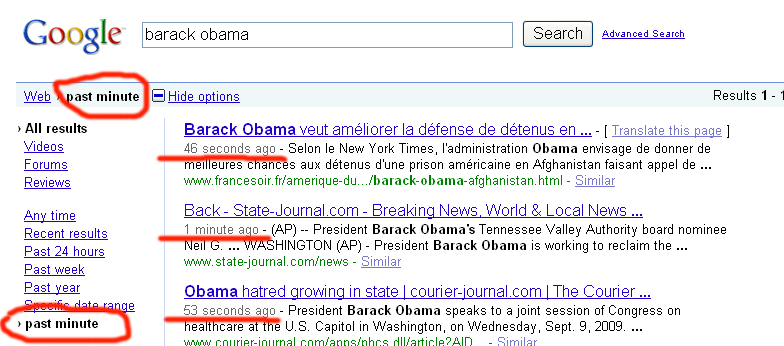
As I’ve been saying, search is “Getting Better All the Time,” with constant innovation like Bing’s new integrated social functionality. I’m eagerly awaiting Microsoft’s new Bing 2.0. Here’s another small but very cool innovation from Google:

google_past_minute

I’ve noted that Google and Microsoft both face what Clayton Christensen famously called the “Innovator’s Dilemma” in trying to handle disruptive innovation in search technology. But noting Microsoft’s innovations in bringing social functionality to search with its “Ping” tools in Bing, I pointed out a few days ago that, “Microsoft, with less to lose and without a huge installed user base to worry about annoying by violating Google’s ‘Prime Directive’ of elegant simplicity, may have an easier time introducing ‘disruptive’ innovations to search than Google.”

The trick will be for Microsoft to find ways of promoting radical innovation from inside, despite the forces of inertia inherent in any large company. One way to do that, as I noted, would be by imitating Google’s “20 percent” program. But a more radical way would be for Microsoft to make Bing a “skunkworks” much like Lockheed Martin’s original “skunkworks,” Xerox’s Palo Alto Research Center (PARC), AT&T’s Bell Labs, GM’s Saturn Motors—or Microsoft’s own XBox. That’s precisely what SEO guru Rand Fishkin (CEO of SEOmoz) suggests Microsoft needs to do to “get serious” in an interview with Affilorama:

I think Google[‘s search market share] could be reduced from like 85% to like 75%, and you could see Microsoft, basically Bing taking over 25%. I don’t think they’ll get more than that. I don’t think they have the ability to do it. Until or unless they are willing do with Bing what they did with Xbox. So Microsoft had, you know, the game market was well established – Sony competing head to head with Nintendo and other players like Neo Geo coming in and this kind of thing and how is Microsoft going to win this? They didn’t know the first thing about it, you know, they weren’t in this field. So what they did with XBox is they made it a startup. They didn’t even put it on Microsoft campus, they made it a different team of people who were only reporting to Xbox people, they basically built a separate company. The fact that it was owned by Microsoft just means that they get the benefits of the cash and the relationships. That’s extremely powerful. The fact that they’re unwilling to do this with search tells me they’re not serious about it. Right? So you might hear like Steve Balmer and other executives from Microsoft say like “search is very important to us, we’re really serious about it”. I think it’s like “serious to them” and I’m using air quotes here, like serious to them in the same way that Google says “competing with Microsoft Office is serious to us”. It’s just sort of like, “Oh yeah?! You’re going to fight us there, well we’re going to fight you on this front!” Like, serious my ass. I just don’t see it. If they do serious and spin it out, I’ll be interested – I’ll be very interested if it becomes it’s own startup if it becomes like its own XBox, that kind of thing, that could be exciting – that could be interesting.

Microsoft is making a major push to integrate social networking tools like Facebook and Twitter into its Bing search engine: users will soon be able to “Ping” search results they like to their friends directly from Bing. Back in January, in “Google, the Innovator’s Dilemma and the Future of Search & Web Ads,” I talked about the implications of this history of search from the WSJ):

Microsoft missed its opportunities to get into paid search not because it was “dumb,” “uninnovative” or a “bad” company, but for the same sorts of reasons that big, highly successful and even particularly innovative companies fail.  The reasons companies generally succeed in mastering “adaptive” innovation of the technologies behind their established business models are the very reasons why such great companies struggle to encourage or channel the “disruptive” innovation that renders their core technologies and business models obsolete.  This dynamic was described brilliantly in Harvard Business School professor Clayton Christensen’s classic 1997 book The Innovator’s Dilemma:  When New Technologies Cause Great Firms to Fail… Let’s hope that Microsoft—as well as Yahoo!—have carefully studied the vast literature produced by business schools in the wake of Christensen’s book about how big companies can avoid the Innovator’s Dilemma by promoting—and capitalizing on—radical innovation from within.  Indeed, this seems to be precisely what has guided Google’s own strategy as it has grown from “disruptive innovator” to become the very sort of behemoth that cannot easily escape the Dilemma, even if corporate managers are fully aware of the problem on a theoretical level.  If Google can do it, Microsoft should be able to, too.  But let’s also not discount the possibility that, no matter how hard Google’s management might try to retain the innovative culture of a start-up, the giant  can’t do that well enough to prevent its own apparent market dominance from being disrupted by new upstart innovators in search and advertising technologies.

My prediction seems to be coming true: Microsoft, with less to lose and without a huge installed user base to worry about annoying by violating Google’s “Prime Directive” of elegant simplicity, may have an easier time introducing “disruptive” innovations to search than Google. Of course, it’s unlikely that any one feature will prove the “killer app” that suddenly causes Bing’s market share to explode—and Google’s to plummet—but a steady stream of such nifty features could convince many users to switch to Bing.

At 29, I’m old enough to remember when Microsoft seemed as cool as Google does today. Hell, I remember being thrilled as a sophomore in high school by Bill Gates’ 1995 book The Road Ahead and the accompanying CD-ROM (which included, as I recall, a tour of Gates’s ultra-futuristic home).  If Microsoft can “get its mojo back,” the company could truly become a web services provider to rival Google.  We’d all benefit from having more choices in search engines, advertising platforms and related tools. And, driving each other to “build a better mousetrap,” the two companies could lead us down the “Road Ahead” from Search 2.0 to Search 3.0 and beyond. So here’s to hoping that Redmond can solve the “Innovator’s Dilemma” with tools like Google’s “20 percent” time that free engineers to innovate!

We’ve written a lot lately about Microsoft’s efforts to reinvent itself, first rebranding its Live search engine as the Bing, and then partnering with Yahoo! to make Bing the search engine on Yahoo!’s still-impressive empire of content and services. But if Microsoft is going to beat Google in Search 3.0 and master shifts in the driving paradigms of the Internet from search and browsers to ubiquitous integration of social networking and other paradigms as yet unforeseen, Microsoft will need more than just brilliant engineering: They’ll need clever marketing.

So it seems that the software titan is turning to user-generated advertising, such as this gem:

http://www.youtube.com/v/h9DBynJUCS4&color1=0xb1b1b1&color2=0xcfcfcf&hl=en&feature=player_embedded&fs=1

WARNING: Battlestar Galactica spoiler: Google may well be in danger of losing its monopoly on cool to Microsoft if Bing can get at least four of the Final Five Cylons to volunteer as back-up singers in a promo video contest.

Google clearly considers Microsoft a threat, having recently launched an ad campaign of its own for its Apps services, which compete directly with Microsoft Office.

I’m listening to the audiobook of Telecosm, George Gilder’s prophetic book about how abundant broadband would revolutionize the planet—which I recommend to everyone. I came across this passage, which reminded me just how good we really have it:

Reported to catalog only 16 percent of web pages, the best Internet search engines are foundering under the load, taking as long as six months to add new content.

If that was Search 1.0, Search 2.0 is great! Today’s search engines will index this post in a matter of minutes and while there are still parts of the “Deep Web” that aren’t crawled, a number of Search 3.0 upstarts are working on solving that problem, too!

Nick Wingfield has a great piece in today’s WSJ: Yahoo Tie-Up Is Latest Sign Tide Turning for Microsoft’s Ballmer (subscription required but can be found through a Google News search) about how Microsoft’s fortunes may be looking up across the board—especially with yesterday’s Yahoo!/Microsoft search/advertising partnership. The most interesting passage is this one:

For [Microsoft CEO Steve] Ballmer, the agreement provides some redemption in an area he has stressed is critical to Microsoft’s future. In an interview, he says the Yahoo deal received “more of my personal attention over the last 18 months than anything else we’re involved with,” including focusing on its most important new product in years, Windows 7. “It’s a big deal,” he says.

Of course, complex partnerships always require lots of time from senior management, but in this case, Ballmer’s quip speaks directly to the costs of antitrust scrutiny in terms of one of the most valuable resources available to any company: the time and attention of senior management. The “attentional cost” can of this deal for Microsoft could be broken into four parts beyond the normal costs of structuring any deal to make the most business sense:

  1. How to structure the a Microsoft/Yahoo! deal so that it would be approved by regulators (defensive);
  2. How to block a Google/Yahoo! deal (offensive);
  3. Nursing the deal through the regulatory approval process over the coming months; and
  4. The possibility that all of these costs could be wasted, to varying degrees, if antitrust regulators decide to block or restrict the deal.

These are all “deadweight losses” on the economy pure and simple—and ultimately costs to consumers.

Continue reading →

We’ve just published an op-ed over at Forbes.com about today’s big Yahoo!-Microsoft deal.


Searching For Success: Web 1.0 Titans Struggle to Reinvent Themselves by Berin Szoka & Adam Thierer

Yahoo! and Microsoft on Wednesday announced a partnership in which Microsoft’s Bing search engine technology will power search for both companies, but Yahoo! will manage advertising sales and content creation.

This should be cause for celebration as a good thing for consumers. By providing a strong competitor with a combined 28% market share, the deal should also be a source of relief at Google, which has come under increasing attack for its supposed market dominance. But if recent concerns about online search, advertising, competition and privacy are any guide, many will fail to appreciate why the deal is pro-consumer, or what it says about the rapid evolution of the Internet.

It’s easy to forget that just a decade ago most of us still hadn’t done our first Google search, Microsoft was still focused on the desktop and Yahoo! was still serving up the online equivalent of the Yellow Pages. AltaVista, AOL, CompuServe and Geocities still ruled the roost.

Today, as we enjoy the fruits of a true cyber-renaissance, cyberspace circa 1999 increasingly looks like the Digital Dark Ages: The old online walled gardens have crumbled, desktop applications have migrated to the cloud and search has redefined our experience of the Web.

Oh, and did we mention just about all of it is “free“? Sounds like exactly the sort of vigorous innovation, expanding consumer choice, falling prices and cut-throat competition that policymakers should want, right?

Alas, regulators seem stuck in the past. European officials in particular seem hell-bent on continuing the antitrust crusade of the ’90s against Microsoft, myopically focused on fading paradigms (desktop operating systems and Web browsers). But instead of narrowly defining high-tech markets based on yesterday’s technologies or market structures, policymakers should embrace the one constant of the Internet economy: dynamic, disruptive and irrepressible change.

Continue reading →

Cory Doctorow has called for a Wikipedia-style effort to build an open source, non-profit search engine. From his column in The Guardian:

What’s more, the way that search engines determine the ranking and relevance of any given website has become more critical than the editorial berth at the New York Times combined with the chief spots at the major TV networks. Good search engine placement is make-or-break advertising. It’s ideological mindshare. It’s relevance… It’s a terrible idea to vest this much power with one company, even one as fun, user-centered and technologically excellent as Google. It’s too much power for a handful of companies to wield. The question of what we can and can’t see when we go hunting for answers demands a transparent, participatory solution. There’s no dictator benevolent enough to entrust with the power to determine our political, commercial, social and ideological agenda. This is one for The People. Put that way, it’s obvious: if search engines set the public agenda, they should be public.

He goes on to claim that “Google’s algorithms are editorial decisions.”   For Doctorow, this is an outrage: “so much editorial power is better vested in big, transparent, public entities than a few giant private concerns.”

I wish Doctorow well in his effort to crowdsource a Google-killer, but I’m more than a little skeptical that anyone would actually want to use his search engine of The People.  My guess is that, like most things produced in the name of “The People” (Soviet toilet paper comes to mind), it will probably won’t be much fun to use, and will likely chafe noticeably. (For the record, I love and regularly use Wikipedia; I just don’t think that model is unlikely to produce a particularly useful search engine.  As Doctorow himself has noted of Google, “they make incredibly awesome search tools.”)

But I’m glad to see that Doctorow has conceded an important point of constitutional law: The First Amendment protects the editorial discretion of search engines, like all private companies, to decide what to content to communicate.  For a newspaper, that means deciding which articles or editorials to run.  For a library or bookstore, it means which books to carry.  For search engines, it means how to write their search algorithims. Continue reading →