Posts tagged as:

Filings are due to the Federal Trade Commission (FTC) today as part of its review of the Children’s Online Privacy Protection Act (COPPA) and the COPPA rule that the FTC devised and enforces. I didn’t have time to pen as much as I wanted, but I did submit a short filing to the agency in the matter based on some of my previous work both with Berin Szoka and on my own.  Here’s the executive summary for my filing:

It goes without saying that the Children’s Online Privacy Protection Act (COPPA) is complicated law and rule. When considering the rule and proposals to amend it, it is easy to get lost in the weeds and ignore the bigger picture. That would be a mistake. There are broader, more important questions that need to be asked as part of the Federal Trade Commission’s effort to expand this regulatory regime. These questions involve not only the costs of increased regulation for online business interests, but the impact of expanded regulation on market structure, competition, and innovation. More importantly, these questions cut to the core of whether the public (including children) will be served with more and better digital innovations in the future. There is no free lunch. Regulation—even well-intentioned regulation like COPPA—is not a costless exercise. There are profound trade-offs for online content and culture that must always be considered.

Whatever one thinks about the effectiveness or sensibility of the COPPA regulatory model for the Web 1.0 world, it is clear that the regime is being strained by the unforeseen realities of the Web 2.0 world of hyper-ubiquitous connectivity and user-generated content creation and sharing. The digital genie cannot be put back in the bottle.  While COPPA may continue to have a marginal role to play in this rapidly evolving world, that role will likely be increasingly limited by the inherent realities of the information age.

Entire filing can be found on the Mercatus website, on SSRN, or via Scribd [Also embedded below in a Scribd reader.] Continue reading →

The National Transportation Safety Board recommended yesterday that states ban all non-emergency use of portable electronic devices while driving, except for devices that assist the driver in driving (such as GPS). The recommendation followed the NTSB’s investigation of a tragic accident in Missouri triggered by a driver who was texting.

Personally I don’t see how someone can pay attention to the road while texting. (I’m having a hard enough time paying attention to a conference presentation while I’m typing this!) But the National Transportation Safety Board’s recommendation is a classic example of regulatory overreach based on anecdote.  The NTSB wants to use one tired driver’s indefensible and extreme texting (which led to horrific results) as an excuse to ban all use of portable electronic devices while driving – including hands-free phone conversations.  Before states act on this recommendation, they should carefully examine systematic evidence – not just anecdotes — to determine whether different uses of handheld devices pose different risks. They should also consider whether bans on some uses would expose drivers to risks greater than the risk the ban would prevent.

Jeff Winkler of The Daily Caller was kind enough to call me for comment after seeing some tweets of mine about a new proposal floated by U.S. Transportation Secretary Ray LaHood to potentially mandate cell phone jamming technology be embedded in every car to minimize the risk of distracted driving.  While I am sympathetic to the concerns he and others have raised about the serious dangers associated with distracted driving, LaHood has been continuously upping the ante in terms of proposed regulatory responses to the problem.

Back in October, La Hood suggested that a ban on all cell phone communications in cars might be needed. He argued that even hands-free phone conversations are a “cognitive distraction” and should be prohibited and has also suggested that such a ban should extend to in-vehicle information and entertainment systems such as Ford Motor Co.’s Sync and General Motors Co.’s OnStar system. This means almost every conceivable in-vehicle technology could be regulated under LaHood’s “cognitive distraction” paradigm, including your car stereo and GPS system.  This week LaHood went further and suggested that it may be necessary to also mandate some sort of scrambling technology be embedded in all vehicles to completely block any potential wireless communications or connectivity.

My comments on that proposal appear in Winkler’s piece today, although Winkler notes that LaHood appears now to be backing off the idea.  However, just in case this idea (or the idea of banning all communications devices from cars more generally) pops up again, here’s what I find wrong with LaHood’s approach: Continue reading →

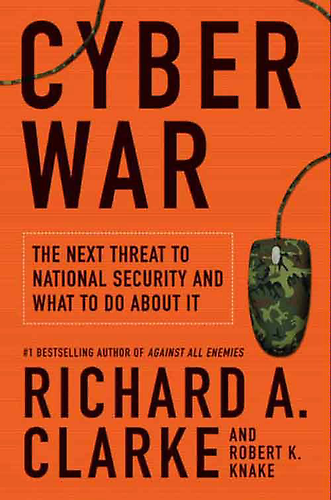
While on vacation last week, I finished up a few new cyber-policy books and one of them was  Cyber War: The Next Threat to National Security and What to Do About It by Richard A. Clarke and Robert K. Knake.  The two men certainly possess the right qualifications for a review of the subject.  Clarke was National Coordinator for Security, Infrastructure Protection, and Counterterrorism during the Clinton years and also served in the Reagan and two Bush administrations. Knake is an international affairs fellow at the Council on Foreign Relations where he specializes in cybersecurity.

Clarke and Knake’s book is important if for no other reason than, as they note, “there are few books on cyber war.” (p. 261) Thus, their treatment of the issue will likely remain the most relevant text in the field for some time to come.

They define cyber war as “actions by a nation-state to penetrate another nation’s computers or networks for the purposes of causing damage or disruption” (p. 6) and they argue that such actions are on the rise.  And they also claim that the U.S. has the most to lose if and when a major cyber war breaks out, since we are now so utterly dependent upon digital technologies and networks.

At their best, Clarke and Knake walk the reader through the mechanics of cyber war, who some of the key players and countries are who could engage in it, and identify what the costs of such of war would entail.  Other times, however, the book suffers from a somewhat hysterical tone, as the authors are out here not just to describe cyber war, but to also issue a clarion call for regulatory action to combat it.  Ryan Singel of Wired, for example, has taken issue with the book’s “doomsday scenario that stretches credulity” and claims that “Like most cyberwar pundits, Clarke puts a shine on his fear mongering by regurgitating long-ago debunked hacker horror stories.”  Bruce Schneier and Jim Harper have raised similar concerns elsewhere.

Continue reading →

Common Sense Media (CSM) is a media “watchdog” group that provides a terrifically useful service to the public through independent reviews of popular media content (movies, music, TV, games, and more). As a parent, I find their service indispensable and, as a policy analyst, I have praised their rating system and their media literacy / digital citizenship programs again and again, including numerous endorsements in my special report on Parental Controls & Online Child Protection and other testimony and filings before Congress and federal regulatory agencies.

Thus, being such a big fan of CSM, I was quite dismayed to see the comments they just submitted to the Federal Trade Commission (FTC) as part of the agency’s review of the Children’s Online Privacy Protection Act (COPPA). They advocate not just expanded educational efforts, which are great, but also expanding COPPA’s age scope to cover all kids under 18 as well as opt-in mandates for the collection and use of any “personal information” or “behavioral marketing.”  For all the background on the law and the FTC’s resulting COPPA rule, see this beefy paper Berin Szoka and I authored last year and this testimony and follow-up submission Berin did for the Senate Commerce Committee. And then read the joint submission made by PFF, CDT, and EFF in the same FTC proceeding that CSM just filed in.

Sadly, it’s clear to me that Common Sense Media didn’t take anything we warned about in those papers or filings seriously—or perhaps that they just didn’t bother to read them very carefully, if at all. Their filing is a classic example of good intentions gone wrong. I understand that they want to take additional steps to protect children online, but they completely ignore the practical realities of COPPA expansion and its associated trade-offs:

Continue reading →

The Online Safety and Technology Working Group (OSTWG) has just released its final report to Congress entitled, “Youth Safety on a Living Internet.”  As I mentioned here last year, this government task force was established by the “Protecting Children in the 21st Century Act,” (part of the ‘‘Broadband Data Improvement Act’,’ Pub. L. No. 110-385) and its mission was to review and evaluate:

  • The status of industry efforts to promote online safety through educational efforts, parental control technology, blocking and filtering software, age-appropriate labels for content or other technologies or initiatives designed to promote a safe online environment for children;
  • The status of industry efforts to promote online safety among providers of electronic communications services and remote computing services by reporting apparent child pornography, including any obstacles to such reporting;
  • The practices of electronic communications service providers and remote computing service providers related to record retention in connection with crimes against children; and,
  • The development of technologies to help parents shield their children from inappropriate material on the Internet.

The task force included over 30 experts from academia, industry, advocacy groups, and think tanks. It was my great honor to be a member of OSTWG and to serve as the chair of 1 of the 4 subcommittees. The four subcommittees addressed: data retention, child pornography reporting, educational efforts, and parental controls technologies. I chaired that last subcommittee on parental controls.

Our conclusions will not be surprising to those who have read previous online safety task force reports, which I have summarized in 2009 white paper, “Five Online Safety Task Forces Agree: Education, Empowerment & Self-Regulation Are the Answer.”  Generally speaking, we concluded that there is no silver-bullet technical solution to online child safety concerns. Instead – and again in agreement with previous research and task force reports – we have concluded that a diverse toolbox and a “layered approach” must be brought to bear on these problems and concerns. Here’s how we put it in the report:

Continue reading →

In my recent testimony before the House Commerce Committee on a proposal to require event data recorders in all new cars sold in the United States, I pointed out that the mandate would go far beyond what is needed to ensure safety. Indeed, the cost of EDRs raises the prices of new cars, marginally reducing the pool of used cars and keeping lower income drivers in older used cars which are less safe.

The demand for EDRs in all cars, collecting and transmitting data about all crashes, suggests that something more than statistically relevant safety data is what advocates of this mandate want. I put a finer point on these issues today in answers to questions propounded to me after the hearing.

The proposed EDR mandate includes controls on the use of EDR information, a nominal protection for privacy, but the EDR mandate “sets the stage for migration away from consumer privacy toward serving the goals of government and industry related not only to safety but also to general law enforcement, taxation, and surveillance.”

The bill is H.R. 5381, the Motor Vehicle Safety Act of 2010. Other bills with EDR mandates include H.R. 5169, H.R. 5345, and S. 3271.

By Berin Szoka & Adam Thierer

This morning, The Progress & Freedom Foundation (PFF) and the Electronic Frontier Foundation (EFF) filed joint comments with the Federal Communications Commission (FCC) in the inquiry “Empowering Parents and Protecting Children in an Evolving Media Landscape.” (MB Docket No. 09-194)  As Adam summarized here before, the stated purpose of this FCC Notice of Inquiry is to:

seek information on the extent to which children are using electronic media today, the benefits and risks these technologies bring for children, and the ways in which parents, teachers, and children can help reap the benefits while minimizing the risks [and] to gather data and recommendations from experts, industry, and parents that will enable us to identify actions that all stakeholders can take to enable parents and children to navigate this promising electronic media landscape safely and successfully.

In our joint comments with Lee Tien and Seth David Schoen of EFF, we warned that the FCC should tread carefully when considering taking action on areas described in their inquiry. The agency simply has no authority to act on many of the topics discussed throughout the NOI, and it should not attempt to preempt successful private sector solutions. Congress never authorized the Commission to regulate Internet media, nor asked the agency to consider doing so.  In fact, Congress plainly declared that the Internet should be kept “unfettered by Federal or State regulation.” Continue reading →

Rep. Bart Stupak, (D-MI) recently introduced the ‘‘Online Age Verification and Child Safety Act’’ (H.R. 4059), which would require mandatory online age verification for “any pornographic website accessible by any computer located within the United States to display any pornographic material, including free content that may be available prior to the purchase of a subscription or product.”  The measure does not specify how such verification is to be administered, saying only that “any website or online service” must “establish and maintain a system of internal policies, procedures and controls to ensure that no such material is displayed to any user attempting to access their site without first verifying that the user is 18 years or older.”

In essence, the Stupak bill is the “Son of COPA,” or the Child Online Protection Act of 1998, a law that has been constitutionally tested and come up short during an epic, decade-long legal battle in which it was made clear that mandatory age verification is unwise, unworkable, and unconstitutional under the First Amendment.

COPA sought to make it a crime for someone to “knowingly” place materials online that were “harmful to minors.” The law provided an affirmative defense from prosecution, however, to those parties who made a “good faith” effort to “restrict[ ] access by minors to material that is harmful to minors” using credit cards or age verification schemes. COPA was immediately challenge, however, and a 10-year court battle ensued.  The law was blocked by lower courts because it was too sweeping in effect and because courts held that there were other “less restrictive means” that parents could use to deal with objectionable content — such as Internet filters.

COPA’s decade-long legal battle finally concluded in January 2009 when the U.S. Supreme Court refused to revisit the law.  COPA had already been reviewed by the Supreme Court twice before — in 2002 and 2004.  Thus, a third visit to the Supreme Court by COPA would have been something of a historical development in the world of First Amendment jurisprudence. But with the Supreme Court’s rejection of the government’s appeal in January, lower court rulings stood and COPA remained unconstitutional and unenforceable. The key recent legal battle occurred in the Third Circuit Court of Appeals, which upheld a lower court ruling striking down COPA. The Third Circuit’s full decision is here. And I penned a 3-part series on the lower court ruling by Judge Lowell Reed Jr., senior judge of the U.S. District Court for the Eastern District of Pennsylvania, here, here, and here. Also make sure to check out this summary of COPA’s legal journey that Alex Harris penned last November.

Many, many times here before I have documented my serious ongoing reservations about mandatory age verification.  [In particular, see this lengthy white paper and this event transcript for all the details.]  Moreover, as I pointed out in a recent PFF white paper (“Five Online Safety Task Forces Agree: Education, Empowerment & Self-Regulation Are the Answer“), every major online safety task force that has studied the possibility of mandatory age verification for the Internet has come to the same conclusion: It won’t work, it’s unconstitutional, and it raises serious privacy concerns. Down below the fold I have pulled some of the relevant language from the five online safety task forces that have met since 2000 and considered this issue.  Continue reading →

Net Cetera OnGuardOnline.gov is a project of a dozen federal agencies and several private child safety organizations who have collaborated to create a website which “provides practical tips from the federal government and the technology industry to help you be on guard against Internet fraud, secure your computer, and protect your personal information.”  The Federal Trade Commission (FTC) is particularly instrumental in maintaining and promoting the site but it works closely with those other agencies and organizations to craft messages and programs.

OnGuardOnline has just released a terrific new online safety resource called  Net Cetera: Chatting with Kids about Being Online. This 54-page document is an outstanding resource for parents.  The report’s advice and recommendations are spot on across the board and I particularly want to highlight the important section right at the front of the document entitled, “Talk to Your Kids.”  It begins: “The best way to protect your kids online? Talk to them. Research suggests that when children want important information, most rely on their parents.” Quite right.  And the NetCetra report goes on to offer the following excellent advice:

  • Start early. After all, even toddlers see their parents use all kinds of devices. As soon as your child is using a computer, a cell phone or any mobile device, it’s time to talk to them about online behavior, safety, and security. As a parent, you have the opportunity to talk to your kid about what’s important before anyone else does.
  • Create an honest, open environment. Kids look to their parents to help guide them. Be supportive and positive.  Listening and taking their feelings into account helps keep conversation afloat. You may not have all the answers, and being honest about that can go a long way.

Continue reading →