Defining “privacy” is a legal and philosophical nightmare. Few concepts engender more definitional controversies and catfights. As someone who is passionate about his own personal privacy — but also highly skeptical of top-down governmental attempts to regulate and/or protect it — I continue to be captivated by the intellectual wrangling that has taken place over the definition of privacy. Here are some thoughts from a wide variety of scholars that make it clear just how frustrating this endeavor can be:
- “Perhaps the most striking thing about the right to privacy is that nobody seems to have any very clear idea what it is.” – Judith Jarvis Thomson, “The Right to Privacy,” in Philosophical Dimensions of Privacy: An Anthology, 272, 272 (Ferdinand David Schoeman ed., 1984).
- privacy is “exasperatingly vague and evanescent.” – Arthur Miller, The Assault on Privacy: Computers, Data Banks, and Dossiers, 25 (1971).
- “[T]he concept of privacy is infected with pernicious ambiguities.” – Hyman Gross, The Concept of Privacy, 42 N.Y.U. L. REV. 34, 35 (1967).
- “Attempts to define the concept of ‘privacy’ have generally not met with any success.” – Colin Bennett, Regulating Privacy: Data Protection and Public Policy In Europe and the United States, 25 (1992).
- “When it comes to privacy, there are many inductive rules, but very few universally accepted axioms.” – David Brin, The Transparent Society: Will Technology Force Us To Choose Between Privacy and Freedom? 77 (1998).
- “Privacy is a value so complex, so entangled in competing and contradictory dimensions, so engorged with various and distinct meanings, that I sometimes despair whether it can be usefully addressed at all.” – Robert C. Post, Three Concepts of Privacy, 89 GEO. L.J. 2087, 2087 (2001).
- “[privacy] can mean almost anything to anybody.” – Fred H. Cate & Robert Litan, Constitutional Issues in Information Privacy, 9 Mich. Telecomm. & Tech. L. Rev. 35, 37 (2002).
- privacy has long been a “conceptual jungle” and a “concept in disarray.” “[T]he attempt to locate the ‘essential’ or ‘core’ characteristics of privacy has led to failure.” – Daniel J. Solove, Understanding Privacy 196, 8 (2008).
- “Privacy has really ceased to be helpful as a term to guide policy in the United States.” – Woodrow Hartzog, quoted in Cord Jefferson, Spies Like Us: We’re All Big Brother Now, Gizmodo, Sept. 27, 2012.
- “for most consumers and policymakers, privacy is not a rational topic. It’s a visceral subject, one on which logical arguments are largely wasted.” – Larry Downes, A Rational Response to the Privacy “Crisis,” Cato Institute, Policy Analysis No. 716 (Jan. 7, 2013), at 6.
In my new
Harvard Journal of Law & Public Policy article, “The Pursuit of Privacy in a World Where Information Control is Failing” I build on these insights to argue that: Continue reading →
 I’m excited to announce the release of my latest law review article, “The Pursuit of Privacy in a World Where Information Control is Failing,” which appears in the next edition (vol. 36) of the Harvard Journal of Law & Public Policy. This is the first of two complimentary law review articles that I will be releasing this year dealing with privacy policy. The second, which will be published later this summer by the George Mason University Law Review, is entitled, “A Framework for Benefit-Cost Analysis in Digital Privacy Debates.” (FYI: Both articles focus on privacy claims made against private actors — namely, efforts to limit private data collection — and not on privacy rights against governments.)
The new
Harvard Journal article is divided into three major sections. Part I focuses on some of normative challenges we face when discussing privacy and argues that there may never be a widely accepted, coherent legal standard for privacy rights or harms here in the United States. It also explores the tensions between expanded privacy regulation and online free speech. Part II turns to the many enforcement challenges that are often ignored when privacy policies are being proposed or formulated and argues that legislative and regulatory efforts aimed at protecting privacy must now be seen as an increasingly intractable information control problem. Most of the problems policymakers and average individuals face when it comes to controlling the flow of private information online are similar to the challenges they face when trying to control the free flow of digitalized bits in other information policy contexts, such as online safety, cybersecurity, and digital copyright.
If the effectiveness of law and regulation is limited by the normative considerations discussed in Part I and the practical enforcement complications discussed in Part II, what alternatives remain to assist privacy-sensitive individuals? I address that question in Part III of the paper and argue that the approach America has adopted to deal with concerns about objectionable online speech and child safety offers a path forward on the privacy front as well. Continue reading →
We live in an entitlement era, when rights are seemingly invented out of whole-cloth. It should come as no surprise, therefore, that a bit of “rights inflation” is creeping into debates about Internet policy. Today, for example, a coalition of groups and individuals (many of which typically advocate greater government activism), have floated a “Declaration of Internet Freedom.” My concern with their brief manifesto is that is seems to based on a confused interpretation of the word “freedom,” which many of the groups behind the effort take to mean freedom for the government to reorder the affairs of cyberspace to achieve values they hold dear.
The manifesto begins with the assertion that “We stand for a free and open Internet,” and then says “We support transparent and participatory processes for making Internet policy and the establishment of five basic principles:”
- Expression: Don’t censor the Internet.
- Access: Promote universal access to fast and affordable networks.
- Openness: Keep the Internet an open network where everyone is free to connect, communicate, write, read, watch, speak, listen, learn, create and innovate.
- Innovation: Protect the freedom to innovate and create without permission. Don’t block new technologies, and don’t punish innovators for their users actions.
- Privacy: Protect privacy and defend everyone’s ability to control how their data and devices are used.
This effort follows close on the heels of a proposal from Rep. Darrell Issa (R-CA) and Sen. Ron Wyden (D-OR) to craft a “Digital Bill of Rights” that, not to be outdone, includes ten principles. They are: Continue reading →
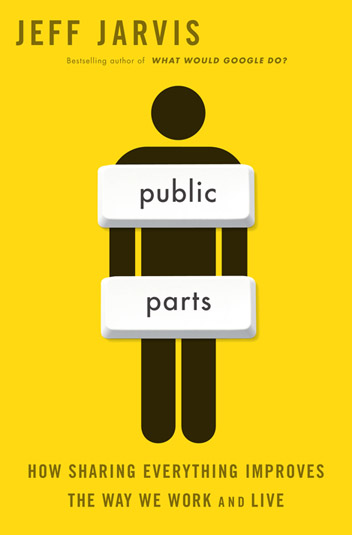 In his latest weekly Wall Street Journal column, Gordon Crovitz has penned a review of the new Jeff Jarvis book, Public Parts: How Sharing in the Digital Age Improves the Way We Work and Live
. Gordon’s review closely tracks my own thoughts on the book, which I laid out last week in my Forbes essay, “Is Privacy Overrated?” Gordon’s essay is entitled “Are We Too Hung Up on Privacy” and he finds, like I do, that Jarvis makes compelling case for understanding the benefits of publicness as the flip-side of privacy. Instead of repeating all the arguments we make in our reviews here, I’ll just ask people go check out both of our essays if they are interested.
In his latest weekly Wall Street Journal column, Gordon Crovitz has penned a review of the new Jeff Jarvis book, Public Parts: How Sharing in the Digital Age Improves the Way We Work and Live
. Gordon’s review closely tracks my own thoughts on the book, which I laid out last week in my Forbes essay, “Is Privacy Overrated?” Gordon’s essay is entitled “Are We Too Hung Up on Privacy” and he finds, like I do, that Jarvis makes compelling case for understanding the benefits of publicness as the flip-side of privacy. Instead of repeating all the arguments we make in our reviews here, I’ll just ask people go check out both of our essays if they are interested.
I did, however, want to elaborate on one thing I didn’t have time to discuss in my review of the Jarvis book. While I like the approach he used in the book, I thought Jarvis could have spent a bit more time exploring some the thorny legal issues in play when advocates of privacy regulation look to enshrine into law quite expansive views of privacy “rights.”
One of the things that both Crovitz and I appreciated about the Jarvis book was the way he tries to get us to think about privacy in the context of ethics instead of law. “Privacy is an ethic governing the choices made by the recipient of someone else’s information,” Jarvis argues, while “publicness is an ethic governing the choices made by the creator of one’s own information,” he says. In my review, I explained why this was so important: Continue reading →
PFF has just released the transcript of an excellent panel discussion I moderated last week entitled, “Let’s Make a Deal: Broadcasters, Mobile Broadband, and a Market in Spectrum.” As I’ve mentioned here before, one of the hottest issues in DC right now is the question of broadcast TV spectrum reallocation. Blair Levin, who serves as the Executive Director of the Omnibus Broadband Initiative at the Federal Communications Commission, recently raised the possibility of reallocating a portion of broadcast television spectrum for alternative purposes, namely, mobile broadband. Such a “cash-for-spectrum” swap would give mobile broadband providers to spectrum they need to roll out next generation wireless broadband networks while making sure broadcaster receive compensation for any spectrum they hand over. The FCC just recently released a public notice on “Data Sought on Users of Spectrum,” (NBP Public Notice # 26) that looks into the matter. “This inquiry,” the agency says,” takes into account the value that the United States puts on free, over-the-air television, while also exploring market-based mechanisms for television broadcasters to contribute to the broadband effort any spectrum in excess of that which they need to meet their public interest obligations and remain financially viable.” Meanwhile, the House Energy and Commerce Communications Subcommittee is set to hold a hearing on the issue next Tuesday.
PFF’s panel discussion on this issue featured an all-star cast of characters, including opening remarks by Blair Levin, and a terrific discussion ensued. [You can hear the full audio from the event here.] Down below I have highlighted some of the major points each speaker made during the discussion and also embedded the complete transcript in a Scribd reader. Also, just a reminder that my PFF colleague Barbara Esbin and I authored a short paper on this issue recently: “An Offer They Can’t Refuse: Spectrum Reallocation That Can Benefit Consumers, Broadcasters & the Mobile Broadband Sector.”
Continue reading →
Along with my colleague Barbara Esbin, the Director of PFF’s Center for Communications and Competition Policy, I have just released a new paper on discussing the possibility of reallocating a portion of broadcast television spectrum for alternative purposes, namely, mobile broadband. As I discussed here before, Blair Levin, the Executive Director of the FCC’s Omnibus Broadband Initiative, has been suggesting that it might be possible to craft a grand bargain whereby broadcasters get cash for some (or all) of their current spectrum allocations if they return spectrum to the FCC for reallocation and re-auction, likely to mobile broadband services.
In our paper, “An Offer They Can’t Refuse: Spectrum Reallocation That Can Benefit Consumers, Broadcasters & the Mobile Broadband Sector,” [PDF] Barbara and I argue that:
the benefits of such a deal could be enormous for wireless broadband providers, developers of digital technologies, and consumers. Expanding the pool of spectrum available for next-generation wireless broadband offerings will ensure that innovative new networks, devices, and services are made available to the public on a timely basis. Ultimately, that will mean more high-speed choices for consumers, especially those in rural areas harder to reach with high-speed wireline networks. Finally, more generally, anything that moves us in the direction of a freer market in spectrum is a good thing.
But fairness to broadcasters lies at the heart of this spectrum reallocation plan. If a deal can’t be structured that broadcasters would find acceptable, they should not be forced to come to the table. When we speak of an offer they can’t refuse, we mean one so attractive that no rational businessperson or investor would pass it up. It is essential broadcasters be willing partners in the deal, and be full participants in the process of shaping its contours.
Read the entire thing here, or below the fold as a Scribd document. Continue reading →
 I’ll be heading to Oxford University this week to participate in an Oxford Internet Institute (OII) forum on the subject of “Child Protection, Free Speech and the Internet: Mapping the Territory and Limitations of Common Ground.” It’s being led by several experts from the OII as well as my good friends John Morris and Leslie Harris of the Center for Democracy & Technology (CDT). The aims of this forum are:
- To facilitate a dialogue between NGOs campaigning to protect respectively, child protection and children’s rights online, and freedom of speech and other civil liberties online.
- To promote a better understanding of each others’ positions, to share perspectives and information with a view to identifying areas of common ground and areas of disagreement.
- To identify any shared policy goals, and possible tools to support the achievement of those goals.
- To publicize the findings of the forum in international policy debates about Internet governance and regulation.
Conference participants were asked to submit a 2-3 pg summary of their views on a couple of questions that will be discussed at this event. I have listed those questions, and my answers, down below the fold. It’s my best attempt to date to succinctly outline my views about how to balance content concerns and free speech issues going forward. Continue reading →
 by Adam Thierer & Berin Szoka — (Ver. 1.0 — Summer 2009)
We are attempting to articulate the core principles of cyber-libertarianism to provide the public and policymakers with a better understanding of this alternative vision for ordering the affairs of cyberspace. We invite comments and suggestions regarding how we should refine and build-out this outline. We hope this outline serves as the foundation of a book we eventually want to pen defending what we regard as “Real Internet Freedom.” [Note: Here’s a printer-friendly version, which we also have embedded down below as a Scribd document.]
I. What is Cyber-Libertarianism?
Cyber-libertarianism refers to the belief that individuals—acting in whatever capacity they choose (as citizens, consumers, companies, or collectives)—should be at liberty to pursue their own tastes and interests online.
Generally speaking, the cyber-libertarian’s motto is “Live & Let Live” and “Hands Off the Internet!” The cyber-libertarian aims to minimize the scope of state coercion in solving social and economic problems and looks instead to voluntary solutions and mutual consent-based arrangements.
Cyber-libertarians believe true “Internet freedom” is freedom
from state action; not freedom for the State to reorder our affairs to supposedly make certain people or groups better off or to improve some amorphous “public interest”—an all-to convenient facade behind which unaccountable elites can impose their will on the rest of us.
Continue reading →
As Berin mentioned last week, we have a new paper out on proposals to expand the Children’s Online Privacy Protection Act (COPPA) of 1998. We generically refer to those COPPA-expansion efforts as “COPPA 2.0.” Hence, the title of our paper: “COPPA 2.0: The New Battle over Privacy, Age Verification, Online Safety & Free Speech.” To recap what Berin already noted, in the name of improving online child safety, some legislators and state attorneys general (AGs) are advocating the expansion of COPPA’s “verifiable parental consent” model of age verification before certain sites or services may collect, or enable the sharing of, personal information for children.
Unlike “COPPA 1.0,” however, which only applied to children under the age of 13, “COPPA 2.0” would apply to all minors up to age 17. Moreover, the range of sites covered by the new law would generally be expanded to include just about any site or service with social networking functionality.
Since Berin has already summarized our general concerns with efforts to expand COPPA’s “verifiable parental consent” online age verification system to cover more online users and sites, I thought I would focus here on what I believe will be the most controversial (and important) part of our paper — our discussion about how COPPA 2.0 affects the speech rights of both adults
and adolescents.
Continue reading →
With today’s historic Supreme Court decision in FCC v. Fox, I have been commenting on the logic and implications of the decision. Part 3 dealt with the majority’s decision in the case, which was driven solely by procedural / admin law considerations. This installment will discuss the very interesting concurring opinion penned by Justice Thomas, which is the only one that takes a serious look at the constitutional foundations of the FCC’s current regulatory regime. While I was sad to see Justice Thomas join the majority’s decision upholding the FCC’s radical expansion of speech regulation in recent years, he joined that majority only on straightforward procedural grounds. On the underlying constitutional issues at stake here, it is clear from his concurring statement that he is ready for the Court to hear a challenge to the previous court precedents and traditional regulatory doctrines that have long supported FCC speech and media controls.
“I write separately,” Justice Thomas says “to note the questionable viability of the two precedents that support the FCC’s assertion of constitutional authority to regulate the programming at issue in this case.” Specifically, he addresses the two key cases upon which almost all FCC speech regulation rests: Red Lion Broadcasting Co. v. FCC, 395 U. S. 367 (1969) and FCC v. Pacifica Foundation, 438 U. S. 726 (1978). Thomas continues: “Red Lion and Pacifica were unconvincing when they were issued, and the passage of time has only increased doubt regarding their continued validity.”
BOOM! With those words, Justice Thomas has dropped the hammer and taken what will hopefully be the first swing at toppling the house of cards that is modern FCC speech regulation. Justice Thomas goes on to itemize the many problems with what I have referred to as “America’s Jurisprudential Twilight Zone” when it comes to how we apply the First Amendment to media platforms in this country. He states:
Continue reading →

 The Technology Liberation Front is the tech policy blog dedicated to keeping politicians' hands off the 'net and everything else related to technology.