The future of emerging technology policy will be influenced increasingly by the interplay of three interrelated trends: “innovation arbitrage,” “technological civil disobedience,” and “spontaneous private deregulation.” Those terms can be briefly defined as follows:
“Innovation arbitrage” refers to the idea that innovators can, and will with increasingly regularity, move to those jurisdictions that provide a legal and regulatory environment more hospitable to entrepreneurial activity. Just as capital now fluidly moves around the globe seeking out more friendly regulatory treatment, the same is increasingly true for innovations. And this will also play out domestically as innovators seek to play state and local governments off each other in search of some sort of competitive advantage.
“Technological civil disobedience” represents the refusal of innovators (individuals, groups, or even corporations) or consumers to obey technology-specific laws or regulations because they find them offensive, confusing, time-consuming, expensive, or perhaps just annoying and irrelevant. New technological devices and platforms are making it easier than ever for the public to openly defy (or perhaps just ignore) rules that limit their freedom to create or use modern technologies.
“Spontaneous private deregulation” can be thought of as de facto rather than the de jure elimination of traditional laws and regulations owing to a combination of rapid technological change as well the potential threat of innovation arbitrage and technological civil disobedience. In other words, many laws and regulations aren’t being formally removed from the books, but they are being made largely irrelevant by some combination of those factors. “Benign or otherwise, spontaneous deregulation is happening increasingly rapidly and in ever more industries,” noted Benjamin Edelman and Damien Geradin in a Harvard Business Reviewarticle on the phenomenon.[1]
In this essay, I want to briefly highlight how, over the course of just the past month, a single company has offered us a powerful example of how both global innovation arbitrage and technological civil disobedience—
or at least the threat thereof—might become a more prevalent feature of discussions about the governance of emerging technologies. And, in the process, that could lead to at least the partial spontaneous deregulation of certain sectors or technologies. Finally, I will discuss how this might affect technological governance more generally and accelerate the movement toward so-called “soft law” governance mechanisms as an alternative to traditional regulatory approaches. Continue reading →
Today, the U.S. Department of Transportation released its eagerly-awaited “Federal Automated Vehicles Policy.” There’s a lot to like about the guidance document, beginning with the agency’s genuine embrace of the potential for highly automated vehicles (HAVs) to revolutionize this sector and save thousands of lives annually in the process.
It is important we get HAV policy right, the DOT notes, because, “35,092 people died on U.S. roadways in 2015 alone” and “94 percent of crashes can be tied to a human choice or error.” (p. 5) HAVs could help us reverse that trend and save thousands of lives and billions in economic costs annually. The agency also documents many other benefits associated with HAVs, such as increasing personal mobility, reducing traffic and pollution, and cutting infrastructure costs.
I will not attempt here to comment on every specific recommendation or guideline suggested in the new DOT guidance document. I could nit-pick about some of the specific recommended guidelines, but I think many of the guidelines are quite reasonable, whether they are related to safety, security, privacy, or state regulatory issues. Other issues need to be addressed and CEI’s Marc Scribner does a nice job documenting some of them is his response to the new guidelines.
Instead of discussing those specific issues today, I want to ask a more fundamental and far-reaching question which I have been writing about in recent papers and essays:
Is this guidance or regulation? And what does the use of informal guidance mechanisms like these signal for the future of technological governance more generally? Continue reading →
This week, my Mercatus Center colleague Andrea Castillo and I filed comments with the White House Office of Science and Technology Policy (OSTP) in a proceeding entitled, “Preparing for the Future of Artificial Intelligence.” For more background on this proceeding and the accompanying workshops that OSTP has hosted on this issue, see this White House site.
In our comments, Andrea and I make the case for prudence, patience, and a continuing embrace of “permissionless innovation” as the appropriate policy framework for artificial intelligence (AI) technologies at this nascent stage of their development. Down below, I have pasted our full comments, which were limited to just 2,000 words as required by the OSTP. But we plan on releasing a much longer report on these issues in coming months. You can find the full version of filing that includes footnotes here.
Sen. Warren makes many interesting points about the dangers of regulatory capture, but the heart of her argument about how to deal with the problem can basically be summarized as ‘Let’s Build a Better Breed of Bureaucrat and Give Them More Money.’ In her own words, she says we should “limit opportunities for ‘cultural’ capture'” of government officials and also “give agencies the money that they need to do their jobs.”
It may sound good in theory, but I’m always a bit perplexed by that argument because the implicit claims here are that:
(a) the regulatory officials of the past were somehow less noble-minded and more open to corruption than some hypothetical better breed of bureaucrat that is out there waiting to be found and put into office; and
(b) that the regulatory agencies of the past were somehow starved for resources and lacked “the money that they need to do their jobs.”
Neither of these assumptions is true and yet those arguments seem to animate most of the reform proposals set forth by progressive politicians and scholars for how to deal with the problem of capture. Continue reading →
On May 3rd, I’m excited to be participating in a discussion with Yale University bioethicist Wendell Wallach at the Microsoft Innovation & Policy Center in Washington, DC. (RSVP here.) Wallach and I will be discussing issues we write about in our new books, both of which focus on possible governance models for emerging technologies and the question of how much preemptive control society should exercise over new innovations.
Of all the books of technological criticism or skepticism that I’ve read in recent years—and I have read stacks of them!—
A Dangerous Master is by far the most thoughtful and interesting. I have grown accustomed to major works of technological criticism being caustic, angry affairs. Most of them are just dripping with dystopian dread and a sense of utter exasperation and outright disgust at the pace of modern technological change.
Although he is certainly concerned about a wide variety of modern technologies—drones, robotics, nanotech, and more—Wallach isn’t a purveyor of the politics of panic. There are some moments in the book when he resorts to some hyperbolic rhetoric, such as when he frets about an impending “techstorm” and the potential, as the book’s title suggests, for technology to become a “dangerous master” of humanity. For the most part, however, his approach is deeper and more dispassionate than what is found in the leading tracts of other modern techno-critics.
U.S. Commodity Futures Trading Commission (CFTC) Commissioner J. Christopher Giancarlo delivered an amazing address this week before the Depository Trust & Clearing Corporation 2016 Blockchain Symposium. The title of his speech was “Regulators and the Blockchain: First, Do No Harm,” and it will go down as the definitive early statement about how policymakers can apply a principled, innovation-enhancing policy paradigm to distributed ledger technology (DLT) or “blockchain” applications.
“The potential applications of this technology are being widely imagined and explored in ways that will benefit market participants, consumers and governments alike,” Giancarlo noted in his address. But in order for that to happen, he said, we have to get policy right. “It is time again to remind regulators to ‘do no harm,'” he argued, and he continued on to note that
The United States’ global leadership in technological innovation of the Internet was built hand-in-hand with its enlightened “do no harm” regulatory framework. Yet, when the Internet developed in the mid-1990s, none of us could have imagined its capabilities that we take for granted today. Fortunately, policymakers had the foresight to create a regulatory environment that served as a catalyst rather than a choke point for innovation. Thanks to their forethought and restraint, Internet-based applications have revolutionized nearly every aspect of human life, created millions of jobs and increased productivity and consumer choice. Regulators must show that same forethought and restraint now [for the blockchain].
What Giancarlo is referring to is the approach that the U.S. government adopted toward the Internet and digital networks in the mid-1990s. You can think of this vision as “permissionless innovation.” As I explain in my recent book of the same title, permissionless innovation refers to the notion that we should generally be free to experiment and learn new and better ways of doing things through ongoing trial-and-error. Continue reading →
I wanted to draw your attention to this important address on online platform regulation by Alex Chisholm, the head of UK’s Competition and Markets Authority. That’s the non-ministerial department in the UK responsible for competition policy issues. Chisholm delivered the address on October 27th at the Bundesnetzagentur conference in Bonn. It’s a terrific speech that other policymakers would be wise to read and mimic to ensure that antitrust and competition policy decisions don’t derail the many benefits of the Information Revolution.
“Today, as regulators, we have the responsibility but also the great historical privilege of playing an influential role in the deployment throughout the economy of the latest of these defining technological eras,” Chisholm began. “As regulators, we must try to minimise the inevitable mismatch between how we’ve done things before and the opportunities and risks of the new,” he argued.
He continued on to specify three recommendations for those crafting policy on this front: Continue reading →
One of my favorite themes, and not just in the field of tech policy, is the “Unintended Consequences of Well-Intentioned Regulations.” I believe that all laws and regulations have dynamic effects and that to fully appreciate the true impact of any particular public policy, you must always closely investigate the potential opportunity costs and unintended consequences associated with those policies. Because all too often laws and regulations are hastily put on the books with the very best of intentions in mind, only to later be shown to produce the opposite of what was intended.
Today’s case in point comes from a Wall Street Journal article by Rachel Bachman and it involves how the growing wave of cycling helmet laws are having a net negative impact on public health because they discourage ridership in the aggregate. Thus, those potential riders are then either (a) just less active overall or (b) driving their cars to get where they need to go. And both of those results are, ultimately, riskier than cycling without a helmet. For that reason, Bachman reports, cycling advocates “are pushing back against mandatory bike-helmet laws in the U.S. and elsewhere. They say mandatory helmet laws, particularly for adults, make cycling less convenient and seem less safe, thus hindering the larger public-health gains of more people riding bikes.” Supporting evidence comes from this 2012 paper in the journal Risk Analysis by Piet de Jong, a professor in the department of applied finance and actuarial studies at Sydney’s Macquarie University. His paper included an empirical model that showed how mandatory bike-helmet laws “have a net negative health impact.”
This strikes me as one of the very best examples of how to do dynamic benefit-cost analysis and show the full range of societal impacts associated with well-intentioned regulations. And it reminds me of the playground example I use in several of my papers: Laws and liability threats discouraged tall playground climbing structures in the ’80s and ’90s. Continue reading →
I wanted to draw your attention to yet another spectacular speech by Maureen K. Ohlhausen, a Commissioner with the Federal Trade Commission (FTC). I have written here before about Commissioner Ohlhausen’s outstanding speeches, but this latest one might be her best yet.
On Tuesday, Ohlhausen was speaking at U.S. Chamber of Commerce Foundation day-long event on “The Internet of Everything: Data, Networks and Opportunities.” The conference featured various keynote speakers and panels discussing, “the many ways that data and Internet connectiviting is changing the face of business and society.” (It was my honor to also be invited to deliver an address to the crowd that day.)
As with many of her other recent addresses, Commissioner Ohlhausen stressed why it is so important that policymakers “approach new technologies and new business models with regulatory humility.” Building on the work of the great Austrian economist F.A. Hayek, who won a Nobel prize in part for his work explaining the limits of our knowledge to plan societies and economies, Ohlhausen argues that: Continue reading →
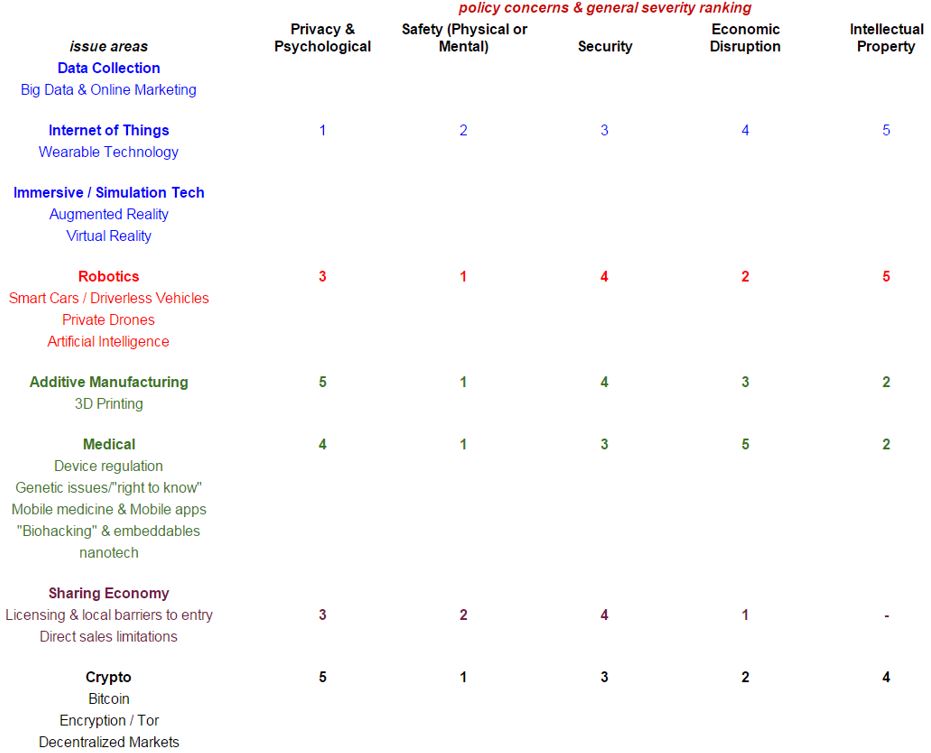
On the whiteboard that hangs in my office, I have a giant matrix of technology policy issues and the various policy “threat vectors” that might end up driving regulation of particular technologies or sectors. Along with my colleagues at the Mercatus Center’s Technology Policy Program, we constantly revise this list of policy priorities and simultaneously make an (obviously quite subjective) attempt to put some weights on the potential policy severity associated with each threat of intervention. The matrix looks like this: [Sorry about the small fonts. You can click on the image to make it easier to see.]
I use 5 general policy concerns when considering the likelihood of regulatory intervention in any given area. Those policy concerns are:
privacy (reputation issues, fear of “profiling” & “discrimination,” amorphous psychological / cognitive harms);
safety (health & physical safety or, alternatively, child safety and speech / cultural concerns);
security (hacking, cybersecurity, law enforcement issues);
The Technology Liberation Front is the tech policy blog dedicated to keeping politicians' hands off the 'net and everything else related to technology. Learn more about TLF →





 The Technology Liberation Front is the tech policy blog dedicated to keeping politicians' hands off the 'net and everything else related to technology.