Posts tagged as:

[This essay originally appeared on the AIER blog on May 23, 2019 under the title, “Spring Cleaning for the Regulatory State.”]


Spring is in full blossom, and many of us are in the midst of our annual house-cleaning ritual. A regular deep clean makes good sense because it makes our living spaces more orderly and gets rid of the gunk and grime that has amassed over the past year.

Unfortunately, governments almost never engage in their own spring-cleaning exercise. Statutes and regulations continue to accumulate, layer by layer, until they suffocate not only economic opportunity, but also the effective administration of government itself. Luckily, some states have realized this and have taken steps to help address this problem.

Mountains of Regulations

First, here are some hard facts about regulatory accumulation:

  • Red tape grows: Since the first edition of his annual publication Ten Thousand Commandments in 1993, Wayne Crews has documented how federal agencies have issued 101,380 rules. Other reports find agency staffing levels jumped from 57,109 to 277,163 employees from 1960 to 2017, while agency budgets swelled in real terms from $3 billion in 1960 to $58 billion in 2017 (2009$).
  • Nothing ever gets cleaned up: A Deloitte survey of U.S. Code reveals that 68 percent of federal regulations have never been updated and that 17 percent have only been updated once. If a company never updated its business model, it would fail eventually. But governments get away with doing the same thing without any fear of failure. “If it were a country, U.S. regulation would be the world’s eighth-largest economy, ranking behind India and ahead of Italy,” Crews notes.
  • The burden of regulatory accumulation is getting worse: “The estimate for regulatory compliance and economic effects of federal intervention is $1.9 trillion annually,” Crews finds, which is equal to 10 percent of the U.S. gross domestic product for 2017. When federal spending is added to regulatory costs are added to federal spending, Crews finds, the burden equals $4.173 trillion, or 30 percent of the entire economy. Mercatus Center research has found that “economic growth in the United States has, on average, been slowed by 0.8 percent per year since 1980 owing to the cumulative effects of regulation.” This means that “the US economy would have been about 25 percent larger than it actually was as of 2012” if regulation had been held to roughly the same aggregate level it stood at in 1980.

In sum, the evidence shows that the red tape is growing without constraint, hindering entrepreneurship and innovation, deterring new investment, raising costs to consumers, limiting worker opportunities/wages, and undermining economic growth.

Regulations accumulate in this fashion because the administrative state is on autopilot. Legislatures pass broad statutes delegating ambiguous authority to agencies. Bureaucrats are then free to roll the regulatory snowball down the hill until it has become so big that its momentum cannot be stopped.

The Death of Common Sense

Policy makers enact new rules with the best of intentions, of course, but we should not assume that the untrammeled growth of the regulatory state produces positive results. There is no free lunch, after all. Every regulation is a restriction on opportunities for experimentation with new and potentially better ways of doing things. Sometimes such restrictions make sense because regulations can pass a reasonable cost-benefit test. It would be foolish to assume that all regulations on the books do.

Spring cleaning for the regulatory state, therefore, should be viewed as an exercise in “good governance.” The goal is not to get rid of all regulations. The goal is to make sure that rules are reasonable and cost-effective so that the public can actually understand the law and get the highest value out of their government institutions.

Philip K. Howard, founder and chair of the nonprofit coalition Common Good and the author of The Death of Common Sense, has written extensively about how regulatory accumulation has become a chronic problem. “Too much law,” he argues, “can have similar effects as too little law.” “People slow down, they become defensive, they don’t initiate projects because they are surrounded by legal risks and bureaucratic hurdles,” Howard notes. “They tiptoe through the day looking over their shoulders rather than driving forward on the power of their instincts. Instead of trial and error, they focus on avoiding error.”

In such an environment, risk-taking and entrepreneurialism are more challenging and economic dynamism suffers. But regulatory accumulation also hurts the quality of government institutions and policies, which become fundamentally incomprehensible or illogical. “Society can’t function when stuck in a heap of accumulated mandates of past generations,” Howard concludes. This is why an occasional regulatory house cleaning is essential to unleash economic opportunity and improve the functioning of our democratic institutions.

Regulatory House Cleaning Begins

Reforms to address this problem are finally happening. In a series of new essays, my colleague James Broughel has documented how several states — including IdahoOhioVirginia, and New Jersey — are undertaking serious efforts to get regulatory accumulation under control. They are utilizing a variety of mechanisms, including “regulatory reduction pilot programs” and “red tape review commissions.” Recently, Idaho actually initiated a sunset of its entire regulatory code and will now try to figure out how to clean up its 8,200 pages of regulations containing 736 chapters of state rules.

Meanwhile, other states are undertaking serious reform in one of the worst forms of regulatory accumulation: occupational licenses. The Federal Trade Commission notes that roughly 30 percent of American jobs require a license today, up from less than 5 percent in the 1950s. Research by economist Morris Kleiner and others finds that “restrictions from occupational licensing can result in up to 2.85 million fewer jobs nationwide, with an annual cost to consumers of $203 billion.” And many of the rules do not even serve their intended purpose. A major 2015 Obama administration report on the costs of occupational licensing concluded that “most research does not find that licensing improves quality or public health and safety.”

ArizonaWest Virginia, and Nebraska are among the leaders in reforming occupational-licensing regimes using a variety of approaches. In some cases, the reforms sunset licensing rules for specific professions altogether. Other proposals grant workers reciprocity to use a license they obtained in another state. Finally, some states have proposed letting most professions operate without any license at all but then requiringall, but then require them to make it clear to consumers that they are unlicensed.

The Need for a Fresh Look

Sunsets are not silver-bullet solutions, and the recent experience with sunsetting and “de-licensing” requirements at the state level has been mixed because many legislatures ignore or circumvent requirements. Nonetheless, sunsets can still help prompt much-needed discussions about which rules make sense and which ones no longer do.

Sunsets can be forward-looking, too. I have proposed that when policy makers craft new laws, especially for fast-paced tech sectors, they should incorporate a clause that what we might think of as “the Sunsetting Imperative.” It would demand that any existing or newly imposed technology regulation should include a provision sunsetting the law or regulation within two years. Reforms like these are also sometimes referred to as “temporary legislation” or “fresh look” requirements. Policy makers can always reenact rules that are still relevant and needed.

By forcing a periodic spring cleaning, sunsets and fresh-look requirements can help stem the tide of regulatory accumulation and ensure that only those policies that serve a pressing need remain on the books. There is no good reason for governments not to clean up their messes on occasion, just like the rest of us have to.

Image result for joseph schumpeterIn my first essay for the American Institute for Economic Research, I discuss what lessons the great prophet of innovation Joseph Schumpeter might have for us in the midst of today’s “techlash” and rising tide of techopanics.  I argue that, “[i]f Schumpeter were alive today, he’d have two important lessons to teach us about the techlash and why we should be wary of misguided interventions into the Digital Economy.” Specifically:
We can summarize Schumpeter’s first lesson in two words: Change happens. But disruptive change only happens in the right policy environment. Which gets to the second great lesson that Schumpeter can still teach us today, and which can also be summarized in two words: Incentives matter. Entrepreneurs will continuously drive dynamic, disruptive change, but only if public policy allows it.

This week I will be traveling to Montreal to participate in the 2018 G7 Multistakeholder Conference on Artificial Intelligence. This conference follows the G7’s recent Ministerial Meeting on “Preparing for the Jobs of the Future” and will also build upon the  G7 Innovation Ministers’ Statement on Artificial Intelligence . The goal of Thursday’s conference is to, “focus on how to enable environments that foster societal trust and the responsible adoption of AI, and build upon a common vision of human-centric AI.” About 150 participants selected by G7 partners are expected to participate, and I was invited to attend as a U.S. expert, which is a great honor. 

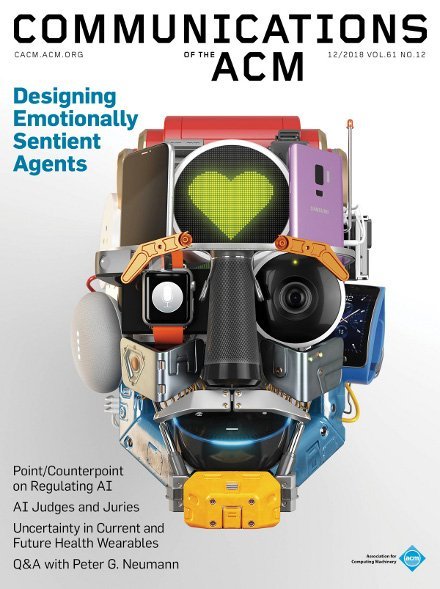
I look forward to hearing and learning from other experts and policymakers who are attending this week’s conference. I’ve been spending a lot of time thinking about the future of AI policy in recent books, working papers, essays, and debates. My most recent essay concerning a vision for the future of AI policy was co-authored with Andrea O’Sullivan and it appeared as part of a point/counterpoint debate in the latest edition of the Communications of the ACM. The ACM is the Association for Computing Machinery, the world’s largest computing society, which “brings together computing educators, researchers, and professionals to inspire dialogue, share resources, and address the field’s challenges.” The latest edition of the magazine features about a dozen different essays on “Designing Emotionally Sentient Agents” and the future of AI and machine-learning more generally.

In our portion of the debate in the new issue, Andrea and I argue that “Regulators Should Allow the Greatest Space for AI Innovation.” “While AI-enabled technologies can pose some risks that should be taken seriously,” we note, “it is important that public policy not freeze the development of life-enriching innovations in this space based on speculative fears of an uncertain future.” We contrast two different policy worldviews — the precautionary principle versus permissionless innovation — and argue that:

artificial intelligence technologies should largely be governed by a policy regime of permissionless innovation so that humanity can best extract all of the opportunities and benefits they promise. A precautionary approach could, alternatively, rob us of these life-saving benefits and leave us all much worse off.

That’s not to say that AI won’t pose some serious policy challenges for us going forward that deserve serious attention. Rather, we are warning against the dangers of allowing worst-case thinking to be the default position in these discussions. Continue reading →

Last week, I had the honor of being a panelist at the  Information Technology and Innovation Foundation’s event on the future of privacy regulation. The debate question was simple enough: Should the US copy the EU’s new privacy law?

When we started planning the event, California’s Consumer Privacy Act (CCPA) wasn’t a done deal. But now that it has passed and presents a deadline of 2020 for implementation, the terms of the privacy conversation have changed. Next year, 2019, Congress will have the opportunity to pass a law that could supersede the CCPA and some are looking to the EU’s General Data Protection Regulation (GDPR) for guidance. Here are some reasons for not taking that path. Continue reading →

In recent months, my colleagues and I at the Mercatus Center at George Mason University have published a flurry of essays about the importance of innovation, entrepreneurialism, and “moonshots,” as well as the future of technological governance more generally. A flood of additional material is coming, but I figured I’d pause for a moment to track our progress so far. Much of this work is leading up to my next on the freedom to innovate, which I am finishing up currently.

Continue reading →

Yesterday was National Lemonade Day. Over at the Mercatus Bridge blog, Jennifer Skees and I used the opportunity to highlight the increasing regulatory crackdown on kids operating ventures without first seeking the proper permits from local authorities. We ask, “wouldn’t it be better to teach them the value of hard work and entrepreneurial effort instead of threatening them with penalties for not getting costly permits to do basic jobs?” Here’s our answer:


Today is National Lemonade Day. For many Americans a lemonade stand was their first experience in entrepreneurship. But unfortunately, this time honored tradition that teaches the value of hard work, entrepreneurship, and innovation may be under threat from overzealous grown-ups.

Should we really force kids to get licenses to start lemonade stands, sell bottles of water outside a ballpark, or mow lawns for a little extra money? And wouldn’t it be better to teach them the value of hard work and entrepreneurial effort instead of threatening them with penalties for not getting costly permits to do basic jobs?

Recent news stories have highlighted examples of kids being confronted with local regulations that essential tell them not to be entrepreneurial until they’ve gotten someone’s blessing–or else face fines or other penalties for those efforts.

Out in San Francisco, for example, a neighbor threatened to call the police on an eight-year-old girl selling water to raise money for a trip to Disneyland after her mother had lost her job. The neighbor berated the little girl for “illegally selling water without a permit.” Luckily, national outrage seems to have fallen in favor of this rogue entrepreneur instead of “Permit Patty.” But this is far from an isolated case.

Another story went viral earlier this year involving kids and lemonade stands. Country Time lemonade pledged to pay the fines received or the permit cost for children’s lemonade stands. Who thought we’d reach the day when we need a Lemonade Legal Defense Fund? But just prior to the launch, Stapleton, Colorado police were called to shut down the lemonade stand of  four and six year-old brothersfor failing to have a business license. Kids who probably can’t read or fill out the necessary forms are expected to obtain a formal license for a tradition that dates back about 120 years. Continue reading →

[first published at The Bridge on August 9, 2018]

What happens when technological innovation outpaces the ability of laws and regulations to keep up?

This phenomenon is known as “the pacing problem,” and it has profound ramifications for the governance of emerging technologies. Indeed, the pacing problem is becoming the great equalizer in debates over technological governance because it forces governments to rethink their approach to the regulation of many sectors and technologies.

The Innovation Cornucopia

Had Rip Van Winkle woken up his famous nap today, he’d be shocked by all the changes around him. At-home genetics tests, personal drones, driverless cars, lab-grown meats, and 3D-printed prosthetic limbs are just some of the amazing innovations that would boggle his mind. New devices and services are flying at us so rapidly that we sometimes forget that most did not even exist a short time ago. Continue reading →

In preparation for a Federalist Society teleforum call that I participated in today about the compliance costs of the EU’s General Data Protection Regulation (GDPR), I gathered together some helpful recent articles on the topic and put together some talking points. I thought I would post them here and try to update this list in coming months as I find new material. (My thanks to Andrea O’Sullivan for a major assist on coming up with all this.)

Key Points :

  • GDPR is no free lunch; compliance is very costly
      • All regulation entails trade-offs, no matter how well-intentioned rules are
      • $7.8 billion estimated compliance cost for U.S. firms already
      • Punitive fees can range from €20 million to 4 percent of global firm revenue
      • Vagueness of language leads to considerable regulatory uncertainty — no one knows what “compliance” looks like
      • Even EU member states do not know what compliance looks like: 17 of 24 regulatory bodies polled by Reuters said they were unprepared for GDPR
  • GDPR will hurt competition & innovation; favors big players over small
      • Google, Facebook & others beefing up compliance departments. (“ EU official, Vera Jourova: “They have the money, an army of lawyers, an army of technicians and so on.”)
      • Smaller firms exiting or dumping data that could be used to provide better, more tailored services
      • PwC survey found that 88% of companies surveyed spent more than $1 million on GDPR preparations, and 40% more than $10 million.
      • Before GDPR, half of all EU ad spend went to Google. The first day after it took effect, an astounding 95 percent went to Google.
      • In essence, with the GDPR, the EU is surrendering on the idea of competition being possible going forward
      • The law will actually benefit the same big companies that the EU has been going after on antitrust grounds. Meanwhile, the smaller innovators and innovations will suffer.

Continue reading →

The National Academies of Sciences, Engineering, and Medicine has released an amazing new report focused on, “Assessing the Risks of Integrating Unmanned Aircraft Systems (UAS) into the National Airspace System.” In what the Wall Street Journal rightly refers to as an “unusually strongly worded report,” the group of experts assembled by the National Academies call for a sea change in regulatory attitudes and policies toward regulation of Unmanned Aircraft Systems (or “drones”) and the nation’s airspace more generally.

The report uses the term “conservative” or “overly conservative” more than a dozen times to describe the Federal Aviation Administration’s (FAA) problematic current approach toward drones. They point out that the agency has “a culture with a near-zero tolerance for risk,” and that the agency needs to adjust that culture to take into account “the various ways in which this new technology may reduce risk and save lives.” (Ch. S, p.2) The report continues on to say that:

The committee concluded that “fear of making a mistake” drives a risk culture at the FAA that is too often overly conservative, particularly with regard to UAS technologies, which do not pose a direct threat to human life in the same way as technologies used in manned aircraft. An overly conservative attitude can take many forms. For example, FAA risk avoidance behavior is often rewarded, even when it is excessively risk averse, and rewarded behavior is repeated behavior. Balanced risk decisions can be discounted, and FAA staff may conclude that allowing new risk could endanger their careers even when that risk is so minimal that it does not exceed established safety standards.  The committee concluded that a better measure for the FAA to apply is to ask the question, “Can we make UAS as safe as other background risks that people experience daily?” As the committee notes, we do not ground airplanes because birds fly in the airspace, although we know birds can and do bring down aircraft. [. . . ] In many cases, the focus has been on “What might go wrong?” instead of a holistic risk picture: “What is the net risk/benefit?” Closely related to this is what the committee considers to be paralysis wherein ever more data are often requested to address every element of uncertainty in a new technology. Flight experience cannot be gained to generate these data due to overconservatism that limits approvals of these flights. Ultimately, the status quo is seen as safe. There is too little recognition that new technologies brought into the airspace by UAS could improve the safety of manned aircraft operations, or may mitigate, if not eliminate, some nonaviation risks. (p. S-2)

Importantly, the report makes it clear that the problem here is not just that “an overly conservative risk culture that overestimates the severity and the likelihood of UAS risk can be a significant barrier to introduction and development of these technologies,” but, more profoundly, the report highlights how,  “Avoiding risk entirely by setting the safety target too high creates imbalanced risk decisions and can degrade overall safety and quality of life.” (p. 3-6,7) In other words, we should want a more open and common sense-oriented approach to drones, not only to encourage more life-enriching innovation, but also because it could actually make us safer as a result.

No Reward without Some Risk

What the National Academies report is really saying here is that  there can be no reward without some risk.  This is something I have spent a great deal of time writing about in my last book, a recent book chapter, and various other essays and journal articles over the past 25 years.  As I noted in my last book, “living in constant fear of worst-case scenarios—and premising public policy on them—means that best-case scenarios will never come about.”  If we want a wealthier, healthier, and safer society, we must embrace change and risk-taking to get us there.

This is exactly what that National Academies report is getting at when they note that the FAA”s “overly conservative culture prevents safety beneficial operations from entering the airspace. The focus is on what might go wrong. More dialogue on potential benefits is needed to develop a holistic risk picture that addresses the question, What is the net risk/benefit?” (p. 3-10)

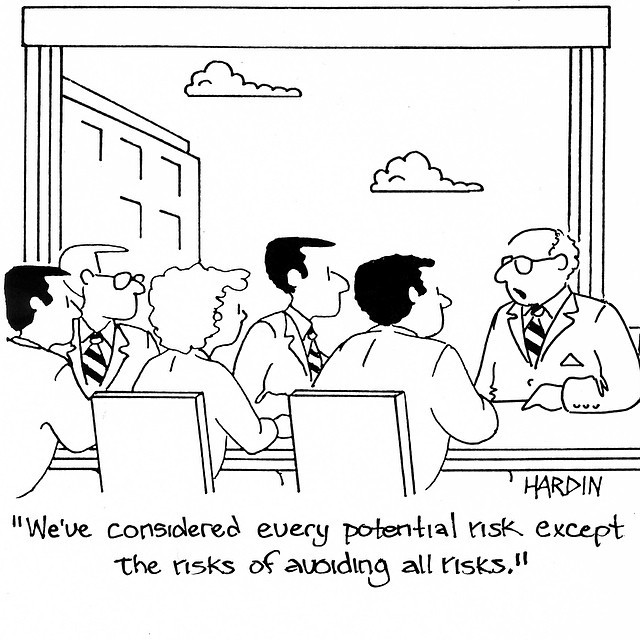
In other words, all safety regulation involves trade-offs, and if (to paraphrase a classic Hardin cartoon you’ll see to your right) we consider every potential risk except the risk of avoiding all risks, the result will be not only a decline in short-term innovation, but also a corresponding decline in safety and overall living standards over time.

Countless risk scholars have studied this process and come to the same conclusion. “We could virtually end all risk of failure by simply declaring a moratorium on innovation, change, and progress,” notes engineering historian Henry Petroski. But the costs to society of doing so would be catastrophic, of course. “The history of the human race would be dreary indeed if none of our forebears had ever been willing to accept risk in return for potential achievement,” observed H.L. Lewis, an expert on technological risk trade-offs.

The most important book ever written on this topic was Aaron Wildavsky’s 1988 masterpiece, Searching for Safety. Wildavsky warned of the dangers of “trial without error” reasoning and contrasted it with the trial-and-error method of evaluating risk and seeking wise solutions to it. Wildavsky argued that real wisdom is born of experience and that we can learn how to be wealthier and healthier as individuals and a society only by first being willing to embrace uncertainty and even occasional failure. As he put it:

The direct implication of trial without error is obvious: If you can do nothing without knowing first how it will turn out, you cannot do anything at all. An indirect implication of trial without error is that if trying new things is made more costly, there will be fewer departures from past practice; this very lack of change may itself be dangerous in forgoing chances to reduce existing hazards. . . . Existing hazards will continue to cause harm if we fail to reduce them by taking advantage of the opportunity to benefit from repeated trials.

When this logic takes the form of public policy prescriptions, it is referred to as the “precautionary principle,” which generally holds that, because new ideas or technologies could pose some theoretical danger or risk in the future, public policies should control or limit the development of such innovations until their creators can prove that they won’t cause any harms.

Again, if we adopt that attitude, human safety actually suffers because it holds back beneficial experiments aimed at improving the human condition. As the great economic historian Joel Mokyr argues, “technological progress requires above all tolerance toward the unfamiliar and the eccentric.” But the regulatory status quo all too often rejects “the unfamiliar and the eccentric” out of an abundance of caution. While usually well-intentioned, that sort of status quo thinking holds back new and better was of doing old things better, or doing all new things. The end result is that real health and safety advances are ignored or forgone.

How Status Quo Thinking at the FAA Results in Less Safety

This is equally true for air safety and FAA regulation of drones. “Ultimately, the status quo is seen as safe,” the National Acadamies report notes. “There is too little recognition that new technologies brought into the airspace by UAS could improve the safety of manned aircraft operations, or may mitigate, if not eliminate, some nonaviation risks.” The example of the life-saving potential of drones have already been well-documented.

Drones have already been used to monitor fires, help with search-and-rescue missions for missing people or animals, assist life guards by dropping life vests to drowning people, deliver medicines to remote areas, and help with disaster monitoring and recovery efforts. But that really just scratches the surface in terms of their potential.

Some people scoff at the idea of drones being used to deliver small packages to our offices or homes. But consider how many of those packages are delivered by human-operated vehicles that are far more likely to be involved in dangerous traffic accidents on our over-crowded roadways. If drones were used to make some of those deliveries, we might be able to save a lot of lives. Or how about an elderly person stuck at home during storm, only to realize they are out of some essential good or medicine that is a long drive away. Are we better off having them (or someone else) get behind the wheel to drive and get it, or might a drone be able to deliver it more safely?

The authors of the National Academies report understand this, as they made clear when they concluded that, “operation of UAS has many advantages and may improve the quality of life for people around the world. Avoiding risk entirely by setting the safety target too high creates imbalanced risk decisions and can degrade overall safety and quality of life.” (Ch. 3, p. 5-6)

Reform Ideas: Use the “Innovator’s Presumption” & “Sunsetting Imperative”

Given that reality, the National Academies report makes several sensible reform recommendations aimed at countering the FAA’s hyper-conservatism and bias for the broken regulatory status quo. I won’t go through them all, but I think they are an excellent set of reforms that deserve to be taken seriously.

I do, however, want to highly recommend everyone take a close look at this one outstanding recommendation in Chapter 3, which is aimed at keep things moving and making sure that status quo thinking doesn’t freeze beneficial new forms of airspace innovation. Specifically, the National Academies report recommends that:

The FAA should meet requests for certifications or operations approvals with an initial response of “How can we approve this?” Where the FAA employs internal boards of executives throughout the agency to provide input on decisions, final responsibility and authority and accountability for the decision should rest with the executive overseeing such boards. A time limit should be placed on responses from each member of the board, and any “No” vote should be accompanied with a clearly articulated rationale and suggestion for how that “No” vote could be made a “Yes.” (Ch. 3, p. 8)

I absolutely love this reform idea because it essentially combines elements of two general innovation policy reform ideas that I discussed in my recent essay, “Converting Permissionless Innovation into Public Policy: 3 Reforms.” In that piece, I proposed the idea of instituting an “Innovator’s Presumption” that would read: “Any person or party (including a regulatory authority) who opposes a new technology or service shall have the burden to demonstrate that such proposal is inconsistent with the public interest.” I also proposed a so-called “Sunsetting Imperative” that would read: “Any existing or newly imposed technology regulation should include a provision sunsetting the law or regulation within two years.”

The National Academies report recommendation above basically embodies the spirit of both the Innovator’s Presumption and the Sunsetting Imperative. It puts the burden of proof on opponents of change and then creates a sort of shot clock to keep things moving.

These are the kind of reforms we need to make sure status quo thinking at regulatory agencies doesn’t hold back life-enriching and life-saving innovations. It’s time for a change in the ways business is done at the FAA to make sure that regulations are timely, effective, and in line with common sense. Sadly, as the new National Academies report makes clear, today’s illogical policies governing airspace innovation are having counter-productive results that hurt society.

Image result for Zuckerberg Schmidt laughing

Two weeks ago, as Facebook CEO Mark Zuckerberg was getting grilled by Congress during a two-day media circus set of hearings, I wrote a counterintuitive essay about how it could end up being Facebook’s greatest moment. How could that be? As I argued in the piece, with an avalanche of new rules looming, “Facebook is potentially poised to score its greatest victory ever as it begins the transition to regulated monopoly status, solidifying its market power, and limiting threats from new rivals.”

With the exception of probably only Google, no firm other than Facebook likely has enough lawyers, lobbyists, and money to deal with layers of red tape and corresponding regulatory compliance headaches that lie ahead. That’s true both here and especially abroad in Europe, which continues to pile on new privacy and “data protection” regulations. While such rules come wrapped in the very best of intentions, there’s just no getting around the fact that  regulation has costs. In this case, the unintended consequence of well-intentioned data privacy rules is that the emerging regulatory regime will likely discourage (or potentially even destroy) the chances of getting the new types of innovation and competition that we so desperately need right now.

Others now appear to be coming around to this view. On April 23, both the  New York Times and The Wall Street Journal ran feature articles with remarkably similar titles and themes. The New York Times article by Daisuke Wakabayashi and Adam Satariano was titled, “How Looming Privacy Regulations May Strengthen Facebook and Google,” and The Wall Street Journal’s piece, “Google and Facebook Likely to Benefit From Europe’s Privacy Crackdown,” was penned by Sam Schechner and Nick Kostov. “In Europe and the United States, the conventional wisdom is that regulation is needed to force Silicon Valley’s digital giants to respect people’s online privacy. But new rules may instead serve to strengthen Facebook’s and Google’s hegemony and extend their lead on the internet,” note Wakabayashi and Satariano in the  NYT essay. They continue on to note how “past attempts at privacy regulation have done little to mitigate the power of tech firms.” This includes regulations like Europe’s “right to be forgotten” requirement, which has essentially put Google in a privileged position as the “chief arbiter of what information is kept online in Europe.” Continue reading →