Why do mobile carriers sell phones with a subscription? My roommate and I were debating this the other night. Most other popular electronics devices aren’t sold this way. Cable and satellite companies don’t sell televisions with their video service. ISPs don’t sell laptops and desktops with their Internet service. Bundling phones with mobile service subscriptions is pretty unique. (The only mass-market analogs I can think of are satellite radio and GPS service.)
Why might this be? Continue reading →
Earlier today on Twitter, I listed what I thought were the Top 5 “Biggest Internet Policy Issues of 2012.” In case you don’t follow me on Twitter — and shame on you if you don’t! — here were my choices:
- Copyright wars reinvigorated post-SOPA; tide starting to turn in favor of copyright reform. [TLF posts on copyright.]
- Privacy still red-hot w ECPA reform, online advertising regs & kids’ privacy issues all pending. [TLF posts on privacy.]
- WCIT makes Internet governance / NetFreedom a major issue worldwide. [TLF posts on Net governance.]
- Antitrust threat looms larger w pending Google case + Apple books investigation. [TLF posts on antitrust.]
- Cybersecurity regulatory push continues in both legislative (CISPA) & executive branch. [TLF posts on cybersecurity.]
Lists like these are entirely subjective, of course, but I am basing my list on the general amount of chatter I tended to see and hear about each topic over the course of the year.
What do you think the top tech policy issues of the year were?
I caught this tidbit today in a Washington Post article about Julius Genachowski’s tenure as Federal Communications Commission chairman:
He wound up presiding over a crucial period in which the powerful companies of Silicon Valley turned into Washington power players. Lobbying the FCC has become a major economic franchise. Each day, hundreds of dark-suited lawyers crowd the antiseptic, midcentury-modern agency building.
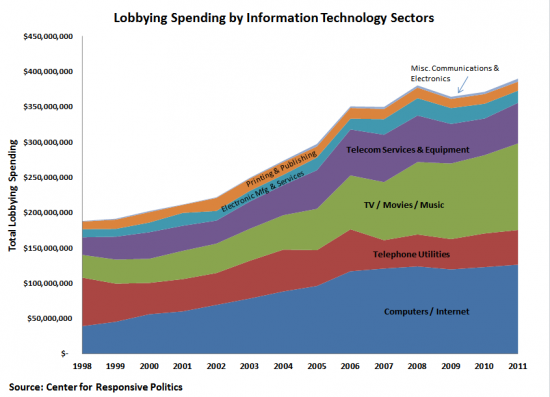
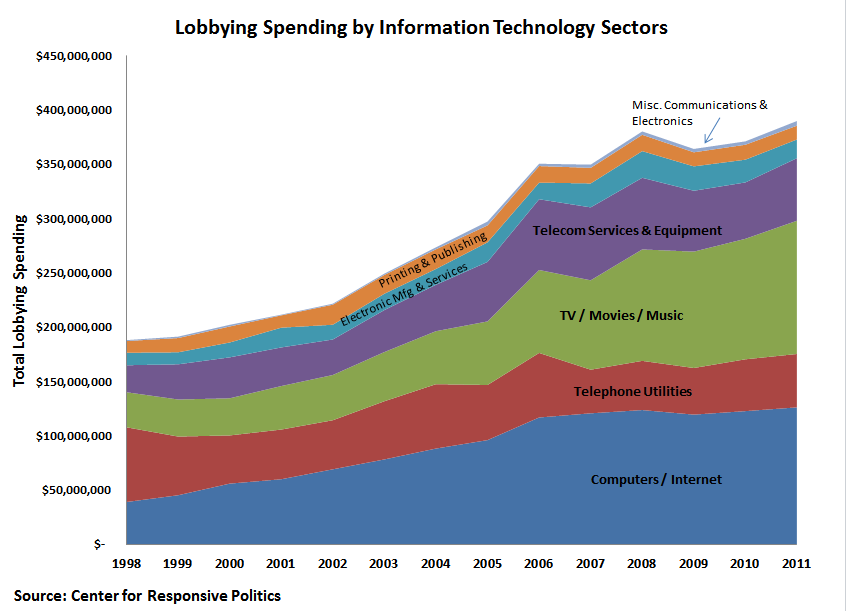
Can anyone think this is a good thing? To be clear, I don’t think Genachowski is solely responsible for Silicon Valley innovators getting more aggressive in Washington or for tech lobbying becoming “a major economic franchise” at the FCC. There’s plenty of blame to go around in that regard. Regardless, every legislative and regulatory action that opens the door to greater regulation of the information economy also opens the door a bit wider to unproductive rent-seeking and cronyist activities. Moreover, every minute and every dollar spent focusing on making legislators and regulators happy is another minute and dollar that could have better been spent making consumers happy in the marketplace. It’s a pure deadweight loss to society.
And there has been a remarkable expansion in such tech lobbying activity over the past decade, as the following charts illustrate. The first shows the dramatic growth of lobbying by computer and Internet companies relative to other sectors and the second shows lobbying spending by specific computer and Internet companies. [Click to enlarge.]
Continue reading →
With each passing year, Washington’s appetite for Internet regulation grows. While “Hands Off the Net!” was a popular rallying cry just a decade ago—and was even a shared sentiment among many policymakers—today’s zeitgeist seems to instead be “Hands All Over the Net.” Countless interests and regulatory advocates have pet Internet policy issues they want Washington to address, including copyright, privacy, cybersecurity, online taxation, broadband regulation, among many others.
Rep. Darrell Issa (R-CA) wants to do something to slow down this legislative locomotive. He has proposed the “Internet American Moratorium Act (IAMA), which would impose a two-year moratorium on “any new laws, rules or regulations governing the Internet.” The prohibition would apply to both Congress and the Executive Branch but makes an exception to any rules dealing with national security.
Will Rep. Issa’s proposal make any difference if implemented? Any congressionally imposed legislative moratorium is a symbolic gesture and not a binding constraint since Congress is always free to pass another law later to get around an earlier prohibition. So, in that sense, a moratorium might not change much. Nonetheless, such symbolic gestures are often important and Issa is to be commended for at least trying to raise awareness about the dangers of creeping regulation of online life and the digital economy.
If policymakers really want to take a more substantive step to slow the flow of red tape, they should consider a different approach. Instead of (or, perhaps, in addition to) a two-year legislative moratorium, they should impose a variant of “Moore’s Law” for information technology laws and regulations. “Moore’s Law,” as most of you know, is the principle named after Intel co-founder Gordon E. Moore who first observed that, generally speaking, the processing power of computers doubles roughly every 18 months while prices remain fairly constant.
As I argued in a Forbes column earlier this year, we should apply this same principle to high-tech policy. Continue reading →
Here’s a presentation I’ve been using lately for various audiences about “Cronyism: History, Costs, Case Studies and Solutions.” In the talk, I offer a definition of cronyism, explain its origins, discuss how various academics have traditionally thought about it, outline a variety of case studies, and then propose a range of solutions. Readers of this blog might be interested because I briefly mention the rise of cronyism in the high-tech sector. Brent Skorup and I have a huge paper in the works on that topic, which should be out early next year.
Yesterday AT&T announced that it would invest an additional $14 billion in the next three years to expand its 4G LTE network to cover 300 million people and expand its wired all-IP broadband infrastructure to 75 percent of its customer locations throughout its 22-state wired service area. For many consumers, this investment will provide their first opportunity for access to high-speed broadband at home. For many others, it will provide their first opportunity to make a choice among competing providers of high-speed broadband services. This impressive commitment to transition outdated communications infrastructure to an all-IP future will benefit millions of consumers and accelerate our Internet transformation nationwide. Continue reading →
The precautionary principle generally states that new technologies should be restricted or heavily regulated until they are proven absolutely safe. In other words, out of an abundance of caution, the precautionary principle holds that it is “better to be safe than sorry,” regardless of the costs or consequences. The problem with that, as Kevin Kelly reminded us in his 2010 book, What Technology Wants, is that because “every good produces harm somewhere… by the strict logic of an absolute Precautionary Principle no technologies would be permitted.” The precautionary principle is, in essence, the arch-enemy of progress and innovation. Progress becomes impossible when experimentation and trade-offs are considered unacceptable.
I was reminded of that fact while reading this recent piece by Marc Scribner in the
Washington Post, “Driverless Cars Are on the Way. Here’s How Not to Regulate Them.” Scribner highlights the efforts of the D.C. Council to regulate autonomous vehicles. A new bill introduced by Council member Mary Cheh (D-Ward 3) proposes several preemptive regulations before driverless autos would be allowed on the streets of Washington. Scribner summarizes the provisions of the bill and their impact: Continue reading →
“All this top-40s music sounds the same.” I think we’ve all heard this sentiment. The nature of regional radio broadcasting almost requires a regression to the mean in musical tastes. A radio station cannot be all things to all people. I suspect most people will be surprised to learn that some of the most innovative radio broadcasts are taking place at hundreds of stations across the country—and only few people can listen to them. These stations, known as low power FM (LPFM), carry niche programming like independent folk rock music, fishing shows, political news, reggae, blues, and religious programming. (And one station in Sitka, Alaska consists entirely of a live feed of whale sounds.) Continue reading →
Yesterday it was my privilege to speak at a Free State Foundation (FSF) event on “Ideas for Communications Law and Policy Reform in 2013.” It was moderated by my friend and former colleague Randy May, who is president of FSF, and the event featured opening remarks from the always-excellent FCC Commissioner Robert McDowell.
During the panel discussing that followed, I offered my thoughts about the problem America continues to face in cleaning up communications and media law and proposed a few ideas to get reform done right once and for all. I don’t have time to formally write-up my remarks, but I thought I would just post the speech notes that I used yesterday and include links to the relevant supporting materials. (I’ve been using a canned version of this same speech at countless events over the past 15 years. Hopefully lawmakers will take up some of these reforms some time soon so I’m not using this same set of remarks in 2027!)
Continue reading →

 The Technology Liberation Front is the tech policy blog dedicated to keeping politicians' hands off the 'net and everything else related to technology.