The video game industry’s string of unbroken First Amendment court victories continued this week with a win in the case of Video Software Dealers Association v. Schwarzenegger. [Decision here.] In this case, the VSDA and the Entertainment Software Association brought a suit seeking a permanent injunction against a California law passed in October 2005 (A.B.1179), which would have blocked the sale of violent video games to those under 18. Offending retailers could have been fined for failure to comply with the law.
The court’s decision overturning the law was written by Judge Ronald Whyte and it echoed what every previous decision on this front has held, namely:
Continue reading →
Many lawmakers and regulators are currently proposing the expansion of broadcast industry regulation. For example, fines have been greatly increased for “indecent” programming on broadcast television and radio, and efforts are underway to extend indecency regulations to cover cable and satellite television. Meanwhile, some policymakers are advocating government regulation of “excessively violent” programming on both broadcast and pay TV. In my latest law review article, “Why Regulate Broadcasting: Toward a Consistent First Amendment Standard for the Information Age,” I hope to show why these efforts are seriously misguided, likely unworkable, and almost certainly completely unconstitutional.
This 52-page article appears in the latest volume of the Catholic University Law School’s
CommLaw Conspectus. The article can be found online here.
In this essay, I make the case that the radically unfair system of modern broadcast industry regulation must be completely abolished. “If America is to have a consistent First Amendment in the Information Age,” I argue, “efforts to extend the broadcast regulatory regime must be halted and that regime must be relegated to the ash heap of history.” I go on to make the case against all the traditional broadcast industry regulatory rationales and conclude that: “the traditional rationales for asymmetrical regulation of broadcasting — scarcity, pervasiveness, and the public interest — either no longer make sense or are increasingly impractical to enforce in an age of technological convergence and media abundance. Instead of resisting the inexorable movement toward media parity and a consistent First Amendment standard for the Information Age, policymakers should embrace these changes and focus on responding to the problem of objectionable content through education and empowerment-based strategies that enable families to craft their own household media standards.”
http://documents.scribd.com/ScribdViewer.swf?document_id=2887127&access_key=key-17dpa2kpdbyetd67b4f5&page=&version=1&auto_size=true
Well, I know I’m starting to sound like a broken record on this point, but it never ceases to amaze me how some policymakers get away with speaking so poorly of parents during policy debates about media content. First, you will recall that, in late April, the Federal Communications Commission released a report calling for the regulation of violent video content on the grounds that parental control tools and efforts were ineffective. (For details, see my essay: “FCC Violence Report Concludes that Parenting Doesn’t Work.”) Then, just last week, at a House Commerce hearing on “The Images Kids See on the Screen,” Rep. Ed Markey and several other members of the committee argued that parents just couldn’t cope with modern media and that government needed to step in on their behalf. But nothing could top the performance of Sen. John Rockefeller at today’s Senate Commerce Committee hearing on “The Impact of Media Violence on Children.”
Sen. Rockefeller opened the hearing with a verbal tirade “repeatedly bashing TV and its executives as though they were Dan Aykroyd’s Irwin Mainway SNL character out to sell bags-o-glass to unsuspecting kids,” as John Eggerton of Broadcasting & Cable noted. Sen. Rockefeller, who is planning to soon introduce legislation to regulate “excessively violent” television programming, said that the industry is being “cowardly” and “debasing our culture” in a “never-ending race to the bottom.”
Rockefeller went on to say that the industry was “blaming parents” for not dealing with the problem of objectionable content with private controls and methods instead of censoring content themselves before it ever got on air. “Parents do not want more tools,” he argued, “they want the content off the air.” Of course, that point is debatable as I’ll discuss more below.
Continue reading →
I am testifying today at 10:00 in the House Energy & Commerce Committee (Telecom & Internet subcommittee) at a hearing on “The Images Kids See on the Screen.” The purpose of the hearing is to examine the negative things that children may be exposed to on various screens (TV violence, product placement, fatty foods, smoking, etc.) and what should be done about it. My prepared remarks are attached below.
Testimony of Adam D. Thierer
Senior Fellow and Director of the Center for Digital Media Freedom
The Progress & Freedom Foundation
June 22, 2007
Mr. Chairman and members of the Committee, thank you for inviting me here today and giving me the opportunity to testify. My name is Adam Thierer and I am a senior fellow with the Progress & Freedom Foundation (PFF) where I serve as director of PFF’s Center for Digital Media Freedom.
This hearing is particularly timely for me because this week PFF released a new special report that I spent the last two years compiling entitled, “Parental Controls and Online Child Protection: A Survey of Tools and Methods.” The booklet provides a broad survey of everything on the market today that can help parents better manage media content, whether it be broadcast television, cable or satellite TV, music devices, mobile phones, video game consoles, the Internet, or social networking websites. (Incidentally, this booklet can be downloaded free-of-charge at www.pff.org/parentalcontrols, and I plan on making frequent updates to the report and re-posting the document online as new information comes to my attention).
As I note in my book, we live in an “always-on,” interactive, multimedia world. Parents need to be prepared to deal with media on multiple platforms, screens, and devices. While this can be a formidable challenge, luckily, there has never been a time when parents have had more tools and methods at their disposal to help them determine and enforce what is acceptable in their homes and in the lives of their children. And that conclusion is equally applicable to all major media platforms, or all the screens our children might view.
Continue reading →
 Today, PFF has released my latest book: Parental Controls and Online Child Protection: A Survey of Tools and Methods. The entire publication is online and can be downloaded at http://www.pff.org/parentalcontrols (Note: I will be making constant updates to the book in coming months and will post them to that site).
As the title implies, the report provides a broad survey of everything on the market today that can help parents better manage media content, whether it be broadcast television, cable or satellite TV, music devices, mobile phones, video game consoles, the Internet, or social networking websites. I put this report together to show policymakers, the press and the public that many constructive options exist that can help parents control media in their homes and in the lives of their children.
While it can be a formidable challenge to be a parent in an “always-on,” interactive, multimedia world, luckily, there has never been a time in our nation’s history when parents have had more tools and methods at their disposal to help them determine and enforce what is acceptable in their homes and in the lives of their children. And that conclusion is equally applicable to all major media platforms. In the past, the OFF button was the only technical control at a parent’s disposal. Today, by contrast, parents (like me!) have myriad tools and methods to restrict or tailor media content to their own household tastes and values. Those restrictive tools include: the V-Chip and TV ratings; cable and satellite set-top box screening tools; DVD blocking controls; cell phone blocking tools; video game console controls; Internet filtering and monitoring tools, instant messaging monitoring tools; operating system controls; web browser controls; search engine “safe search” tools; media time management devices, and so on. You will find an exhaustive discussion of all these tools and many others in my book.
Continue reading →
Some lawmakers at the federal, state and local level have advocated video game industry regulation in the name of protecting children from potentially objectionable content, usually of a violent nature. In my opinion, the better approach–and one that doesn’t involve government censorship or regulation of games–is to empower parents to better make these decisions for their own families. And the key to that effort is an effective rating / labeling system for game content that parents understand and use.
Luckily, there are good signs that the video game industry’s voluntary ratings system–the ESRB (the Entertainment Software Rating Board)–is doing exactly that. The game industry established the ESRB in 1994 and it has rated thousands of games since then. (The ESRB estimates it rates over 1,000 games per year). Virtually every title produced by major game developers for retail sale today carries an ESRB rating and content descriptors. Generally speaking, the only games that do not carry ESRB ratings today are those developed by web amateurs that are freely traded or downloaded via the Internet.
The ESRB applies seven different rating symbols and over 30 different content “descriptors” that it uses to give consumers highly detailed information about games. Thus, by simply glancing at the back of each game container, parents can quickly gauge the appropriateness of the title for their children.
So, how effective is this system, as measured by parental awareness and usage of the ESRB ratings and labels? Since 1999, the ESRB has asked Peter D. Hart Research Associates to study that question and conduct polls asking parents if they are aware of the ESRB ratings and if they use them. As this chart illustrates, the results are impressive with both awareness and use growing rapidly since 1999:
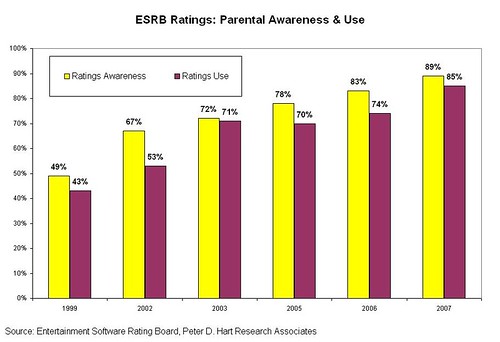
Better yet, all gaming platforms and most PCs can read these ratings and labels and allow parents to block games rated above a certain level they find unacceptable. But the real strength of the ESRB’s ratings system lies in the content descriptors, which give parents plenty of warning about what they will see or hear in each title. That way, parents can talk to their kids about those games or just not buy them for their kids until they think they are ready.
The game industry deserves credit not only for creating such an excellent content rating / labeling system, but also putting significant resources into public education / awareness efforts to ensure parents know how to take advantage of it. So then, why are lawmakers continuing to waste millions of taxpayer dollars litigating unneeded regulatory efforts?
Over at National Review Online today, Peter Suderman has a good discussion of the current state of video game politics. As usual, a lot of politicians are playing games; political games, that is. Suderman notes that:
…attacking the video-game industry has long been a favored sport amongst politicians eager to shore up their credibility with the concerned parent crowd. At the state level, at least ten laws banning the sale of certain video games to minors have been brought to life. In California, Governor Arnold Schwarzenegger, a guy who made his name hacking and slashing his enemies to a bloody pulp on the big screen, apparently didn’t want high schoolers doing digital imitations: He tried to ban the sale of violent games to minors back in 2005. Oregon is currently considering a similar law, and New York Governor Eliot Spitzer recently stated that he intends to pursue one as well. But these laws go down like a final level boss once they hit the courts. To date, not one of the dubious proposals has stood up to a court challenge.
Some lawmakers can’t even be bothered to worry about anything so insignificant as considering whether a law is constitutional. Regarding one video-game ban, Minnesota state legislator Sandy Poppas shrugged off any such responsibility, saying, “Legislators don’t worry too much about what’s constitutional. We just try to do what’s right, and we let the courts figure that out.” The recurrent bashing of the game industry tends to resemble a major league team taking on a troop of t-ballers: Politicians get to knock a couple of balls out of the park in front of parents, but the whole thing is just a show.
Indeed it is. I made a similar argument in a piece for NRO last year as well as my big PFF study, “Fact and Fiction in the Debate over Video Game Regulation.”
The FCC has just issued its long-awaited report on Violent Television Programming and Its Impact on Children. Unsurprisingly, it recommends that the government should assume a great role in regulating the video content that comes into our homes. The agency concludes that: “We believe that further action to enable viewer-initiated blocking of violent television content would serve the government’s interests in protecting the well-being of children and facilitating parental supervision and would be reasonably likely to be upheld as constitutional.” (p. 15)
Ambiguity Defined
Ironically, however, the FCC’s report goes on to undercut its own argument for regulation again and again because of the stunning level of ambiguity surrounding everything they propose. For example, in the second paragraph of the report, the FCC notes that “A broad range of television programming aired today contains [violent] content, including, for example, cartoons, dramatic series, professional sports such as boxing, news coverage, and nature programs.” Is the agency saying such things could be regulated? They never tell us.
Or consider the endless number of questions raised by this paragraph on pages 20-21:
We believe that developing an appropriate definition of excessively violent programming would be possible, but such language needs to be narrowly tailored and in conformance with judicial precedent. Any definition would need to be clear enough to provide fair warning of the conduct required. A definition sufficient to give notice of upcoming violent programming content to parents and potential viewers could make use of, or be a refinement of, existing voluntary rating system definitions or could make use of definitions used in the research community when studying the consequences of violent programming. For more restrictive time channeling rules, a definition based on the scientific literature discussed above, which recognizes the factors most important to determining the likely impact of violence on the child audience, could be developed. For example, such a definition might cover depictions of physical force against an animate being that, in context, are patently offensive. In determining whether such depictions are patently offensive, the Government could consider among other factors the presence of weapons, whether the violence is extensive or graphic, and whether the violence is realistic. (p. 20-21)
Let’s try to unpack some of this because defining “excessive violence” is really the core of this debate.
Continue reading →
The Parents Television Council (PTC), a media activist group that routinely petitions Congress and the FCC for greater content regulation, recently released a new poll which they say proves that the V-Chip and parental control technologies have been a failure.
Their poll finds that only 11% of those surveyed said they used the V-chip or their cable box parental controls to block unwanted content from their television during the past week. And that result is virtually unchanged from a poll they took last September asking the same question. Therefore, the PTC concludes that recent efforts by broadcasters and cable companies to spend hundreds of millions of dollars educating families about these parental control tools have been a failure. And, unsurprisingly, the PTC feels that this again shows the need for government regulators need to step in and do more national nannying for us.
As I’ll make clear in a moment, the V-Chip and current television ratings are certainly not perfect. And I have no doubt that household usage of these tools is quite low for reasons I’ll get into. But let me first address what appears to be a rather glaring methodological deficiency of this PTC poll which makes it difficult to take seriously.
Continue reading →
<img alt="Film%20not%20Rated.jpg" src="http://www.techliberation.com/Film%20not%20Rated.jpg” width=”240″ height=”240″ / align=”right” class=”noborder”/>This review is terribly late, but I finally got around to watching the DVD of Kirby Dick’s documentary “This Film Is Not Yet Rated,” which goes after the MPAA’s movie rating system. Dick tries to paint the MPAA’s private, voluntary ratings board as a “star chamber” that sits in judgment of visual arts and routinely “censors” content it finds at odds with the desires of the studios, government, the military, churches, and so on. But to me, the whole film is much ado about nothing and, worse yet, it fails to adequately address the very real risk of a government censorship popping up in the absence of a private ratings system.
By way of quick background, the MPAA’s familiar ratings system was created by former MPAA president Jack Valenti back in 1968. It was partially a response to the growing pressure for film censorship. Back then – – and this is one of many things Dick’s documentary largely ignores – – there were local censor boards who sat in judgment of films and decided if they could be shown in their communities. And there were ongoing efforts by many lawmakers at all levels to impose regulation on movies or at least strong-arm movie makers into changing content in certain ways.
And so the MPAA ratings system was born. A crucial feature of the MPAA system was that those doing the ratings would be anonymous. The reason this was done was to protect them from being pressured by both those who made the films (who obviously want less restrictive ratings) and those in government or the public who critique the films (many of whom would want stricter ratings).
But keeping raters and the rating process secretive has always had one obvious downside: The system lacks transparency. Why is it that two films with very similar content get two different ratings? Sometimes it’s obvious, other times it’s not. And this is what has Kirby Dick, and the many directors or film critics he interviews in the documentary, up in arms.
Continue reading →

 The Technology Liberation Front is the tech policy blog dedicated to keeping politicians' hands off the 'net and everything else related to technology.
