Posts tagged as:

Timothy Ravich, a board certified aviation lawyer in private practice and an adjunct professor of law at the Florida International University School of Law and the University of Miami School of Law, discusses the future of unmanned aerial system (UAS), also known as drones.

Ravich defines what UAVs are, what they do, and what their potential non-military uses are. He explains that UAV operations have outpaced the law in that they are not sufficiently supported by a dedicated and enforceable regime of rules, regulations, and standards respecting their integration into the national airspace.

Ravich goes on to explain that Congress has mandated the FAA to integrate UAS into the national airspace by 2015, and explains the challenges the agency faces. Among the novel issues domestic drone use raises are questions about trespass, liability, and privacy.

Download

Related Links

Today over at the International Association of Privacy Professionals (IAPP) Daily Dashboard blog, I have a guest post entitled, “Let’s Not Place All Our Eggs in the Do Not Track Basket.” The essay builds on my Senate Commerce Committee testimony last week by arguing that:

If there’s one lesson I’ve learned in twenty-one years of covering information technology policy, it’s that there are no simple silver-bullet solutions to complex issues like online safety, hate speech, spam, cybersecurity, data breaches or digital privacy. Problems such as these demand a layered, multifaceted approach that incorporates many solutions, the first among these being education and awareness-based efforts.

I continue on to explain why that means we should be cautious about placing too much faith in privacy techno-fixes like Do Not Track, which won’t likely be any more successful than past silver bullet efforts. (Note: Justin Brookman of CDT will be offering a counterpoint to my essay next week on the IAPP blog. I look forward to seeing what he has to say. He also testified alongside me in the Senate last week.)

By the way, for those of you not familiar with the IAPP, it is “the largest and most comprehensive global information privacy community and resource, helping practitioners develop and advance their careers and organizations manage and protect their data. More than just a professional association, the IAPP provides a home for privacy professionals around the world to gather, share experiences and enrich their knowledge.” In my opinion, the IAPP is doing amazing work and deserves the attention of anyone who cares about the future of privacy and privacy policy. I strongly recommend you check out their excellent site and explore all the important resources they provide and other things they do.

Anyway, if you are interested in the issues discussed in my IAPP guest post, you might also want to check out some of the related essays down below the fold: Continue reading →

Today I’ll be testifying at a Senate Commerce Committee hearing on online privacy and commercial data collection issues. In my remarks, I make three primary points:

  1. First, no matter how well-intentioned, restrictions on data collection could negatively impact the competitiveness of America’s digital economy, as well as consumer choice.
  2. Second, it is unwise to place too much faith in any single, silver-bullet solution to privacy, including “Do Not Track,” because such schemes are easily evaded or defeated and often fail to live up to their billing.
  3. Finally, with those two points in mind, we should look to alternative and less costly approaches to protecting privacy that rely on education, empowerment, and targeted enforcement of existing laws. Serious and lasting long-term privacy protection requires a layered, multifaceted approach incorporating many solutions.

The testimony also contains 4 appendices elaborating on some of these themes.

Down below, I’ve embedded my testimony, a list of 10 recent essays I’ve penned on these topics, and a video in which I explain “How I Think about Privacy” (which was taped last summer at an event up at the University of Maine’s Center for Law and Innovation). Finally, the best summary of my work on these issues can be found in this recent Harvard Journal of Law & Public Policy article, “The Pursuit of Privacy in a World Where Information Control is Failing.” (This is the first of two complimentary law review articles I will be releasing this year dealing with privacy policy. The second, which will be published early this summer by the George Mason University Law Review, is entitled, “A Framework for Benefit-Cost Analysis in Digital Privacy Debates.”) Continue reading →

Marc Hochstein, Executive Editor of American Banker,  a leading media outlet covering the banking and financial services community, discusses bitcoin.

According to Hochstein, bitcoin has made its name as a digital currency, but the truly revolutionary aspect of the technology is its dual function as a payment system competing against companies like PayPal and Western Union. While bitcoin has been in the news for its soaring exchange rate lately, Hochstein says the actual price of bitcoin is really only relevant for speculators in the short-term; in the long-term, however, the anonymous, decentralized nature of bitcoin has far-reaching implications.

Hochstein goes on to talk about  the new market in bitcoin futures and some of bitcoin’s weaknesses—including the volatility of the bitcoin market.

Download

Related Links

With Bitcoin enjoying a spike in price against government currencies, there is lots of talk about it on the Interwebs, including Jerry’s typically thoughtful post from earlier today. If you’re not familiar with it yet, here’s a good Bitcoin primer, which also counsels reading a lot more before you acquire Bitcoin, as Bitcoin may fail. If you like Bitcoin and want to buy some, don’t go all goofy. Do your homework. As if you need to be told, be careful with your money.

Much of the commentary in the popular press declares a Bitcoin bubble for one reason or another. It might be a bubble, but nobody actually knows. A way of guessing is to compare Bitcoin’s qualities as a currency and payment network to the alternatives. Like any service or good, there are many dimensions to value storage and transfer.

I may not capture them all, and they certainly don’t predict the correct price against the dollar or other currencies. That depends on the ultimate viscosity of Bitcoin. But Bitcoin certainly has value of a different kind: it may discipline fiat currencies and the states that control them.

Intrinsic Value: If you’re just starting to think about money, this is where you’ll find Bitcoin an obvious failure. These evanescent strings of code have no intrinsic value whatsoever! Anyone relying on them as a store of value is a volunteer victim. Smart people stick with U.S. dollars and other major currencies, thin sheets of cloth or plastic with special printing on them…

No major currency has intrinsic value. Indeed, there isn’t much of anything that has intrinsic value. The value of a thing depends on other people’s demand for it. This is as true of Bitcoin as it is of dollars, sandwiches, and sand. So the intrinsic value question, which seems to cut in favor of traditional currencies, is actually a wash.

Transferability: Bitcoin is good with transferability–far better than any physical currency and quite a bit better than most payment systems. Not only is it fast, with transactions “settling” fairly quickly, but it is borderless. The genius of PayPal (after it gave up on being a replacement monetary system itself) was quick transfer to most places that rich people want to send money. Bitcoin allows quick transfer anywhere the Internet goes.

Acceptance: Bitcoin bombs badly in the area of acceptance. Try buying a sandwich with Bitcoin today and you’ll go hungry because few people and businesses accept it. This is a real problem, but it’s nothing intrinsic to Bitcoin. When Hank Aaron broke Babe Ruth’s home run record, people didn’t understand that credit cards were like money. (Watch the video at the link two or three times if you need to. It’s not only a great moment in sports.) Acceptance of different form-factors for value and payments can change.

Cost: How many billions of dollars per year do we pay for storage and transfer of money? Bitcoin is free.

Inflation-Resistance: Assuming the algorithms work as advertised, the quantity of Bitcoin will rise to a pre-established level of about 21 million over the next couple of decades and will never increase after that. This compares favorably to fiat currencies, the quantity of which are amended by their managers, sometimes quite dramatically, to undercut their value. If you want to hold money, holding Bitcoin is a better deal than holding dollars. Which brings us to…

Deflation-Resistance: Without central planners around to carefully debase its value, Bitcoin might go deflationary, with people refusing to spend it while it rises against all other stores of value and goods. Arguably, that’s what’s happening in the current Bitcoin price-spike. People are buying it in anticipation of its future increase in value.

Deflation can theoretically cause an economy to seize up, with everyone refusing to buy in anticipation of their money gaining in value over the short term. There is room for discussion about whether hyper-deflation can actually occur, how long a hyper-deflation can persist, and whether the avoidance of deflation is worth the risk of having centrally managed currency. I have a hard time being concerned that excessive savings could occur. However, whatever the case with those related issues, Bitcoin is probably deflation-prone compared to dollars and other managed currencies.

Surveillance-Resistance: Where you put your money is a reflection of your values. Payment systems and governments today are definitely gawking through that window into our souls.

Bitcoin, on the other hand, allows payments to be made with very little chance of their being tracked. I say “little chance” because there is some chance of tracking payments on the network. Sophisticated efforts to mask payments will be met by sophisticated efforts to track them. Relatively speaking, though, payments through traditional payment systems like checks, credit cards, and online transfer are super-easy to track. Cash is pretty darn hard to track. So Bitcoin stacks up well against our formal payment systems, but equally or perhaps poorly to cash.

Seizure-Resistance: The digital, distributed nature of Bitcoin makes it resistant to official seizure. Are you in a country that exercises capital controls? (What a euphemism, “capital controls.” It’s seizure.) Put your money into Bitcoin and you can email it to yourself. Carve your Bitcoin code into the inner lip of your frisbee before heading out on that Black Sea vacation. Chances are they won’t catch it at the border.

Traditional currencies either exist in physical form or they’re held and transferred by institutions that are more obediant to the state than they are loyal to their customers. (If Cyprus has anything to do with the current price-spike of Bitcoin, it’s as a lesson to others. Cypriots apparently did not move into Bitcoin in significant numbers.)

Because Bitcoin transactions are relatively hard to track, many can be conducted–how to put this?– independent of one’s tax obligations. In relation to the weight of the tax burden, Bitcoin may grow underground economies. Indeed, it flourishes where transactions (in drugs, for example) are outright illegal. Bitcoin probably moves the Laffer curve to the left.

Security: The tough one for Bitcoin is security. Most people don’t know how to store computer code reliably and how to prevent others from accessing it. Individuals have lost Bitcoin because of hard-drive crashes. (This will cause small losses in the total quantity of Bitcoin over time.) Bitcoin exchanges have collapsed because hackers broke in. And there’s a genuine risk that viruses might camp on your computer, waiting for you to open your (otherwise encrypted) wallet file. They’ll send your Bitcoin to heaven-knows-where the moment you do.

When a Bitcoin transaction has happened, it is final. Like a cash expenditure or loss, there is no reversability and nobody to complain to if you don’t have access to the person on the other side of the transaction. The downside of a currency that costs nothing to transfer is the lack of a 1-800 number to call.

So Bitcoin lags traditional currencies along the security dimension. But this is not intrinsic to Bitcoin. Security will get better as people learn and technology advances. (How ’bout a mega-firewall that requires approval of all outbound Internet traffic while the wallet is open?)

There may be Bitcoin-based payment services, banks, and lenders that provide reversibility, security, that pay interest, and all the other goodies associated with dollars today. To the extent they can stay clear of the regulatory morass, they may be less expensive, more innovative, and, in the early going, more risky.

So what’s the right price for Bitcoin? Only a fool can say. (No offense, all of you declaring a Bitcoin bubble.) I think it depends on the ultimate “viscosity” of Bitcoin.

Let’s say Bitcoin’s exclusive use becomes a momentary medium of exchange: Every buyer converts currency to Bitcoin for transfer, and every seller immediately converts it to her local currency. There’s not much need to hold Bitcoin, so there’s not that much demand for Bitcoin. Its equilibrium price ends up pretty low.

On the other hand, say everybody in the world keeps a little Bitcoin on hand for quick, costless transactions once there’s a handy, reliable, and secure Bitcoin payment system downloadable to our phones. If lots of people hold Bitcoin just because, that highly viscous environment suggests a high price for Bitcoin relative to other currencies and things.

Whatever the case, people are now buying Bitcoin because they think others are going to buy it in the future. Whether they’re “speculators” trying to buy in ahead of other speculators, or if they’re buying Bitcoin as a hedge against the varied weaknesses of fiat currencies and state-controlled payment systems, it doesn’t matter.

What does matter, I think, is having this outlet. The availability of Bitcoin is a small, but growing and important security against fiat currencies and state-controlled payments. It is a competitor to state money.

Bitcoin’s existence makes central bankers slightly less free to inflate the money they control, states will have slightly less success with seizing money, and surveillance of traditional payment systems will be decreasingly useful for law enforcement, taxation, and control.

I don’t think Bitcoin delivers us to libertarian “Shangri-la” or anarcho-capitalism, but it’s a technology that fetters government some. It’s a protection for people, their hard-earned wealth, and their privacy. That’s the value of Bitcoin, in my mind, no matter its current price.

Defining “privacy” is a legal and philosophical nightmare. Few concepts engender more definitional controversies and catfights. As someone who is passionate about his own personal privacy — but also highly skeptical of top-down governmental attempts to regulate and/or protect it — I continue to be captivated by the intellectual wrangling that has taken place over the definition of privacy. Here are some thoughts from a wide variety of scholars that make it clear just how frustrating this endeavor can be:

  • Perhaps the most striking thing about the right to privacy is that nobody seems to have any very clear idea what it is.” – Judith Jarvis Thomson, “The Right to Privacy,” in Philosophical Dimensions of Privacy: An Anthology, 272, 272 (Ferdinand David Schoeman ed., 1984).
  • privacy is “exasperatingly vague and evanescent.” – Arthur Miller, The Assault on Privacy: Computers, Data Banks, and Dossiers, 25 (1971).
  • [T]he concept of privacy is infected with pernicious ambiguities.” – Hyman Gross,  The Concept of Privacy, 42 N.Y.U. L. REV. 34, 35 (1967).
  • Attempts to define the concept of ‘privacy’ have generally not met with any success.” – Colin Bennett, Regulating Privacy: Data Protection and Public Policy In Europe and the United States,  25 (1992).
  • When it comes to privacy, there are many inductive rules, but very few universally accepted axioms.” – David Brin, The Transparent Society: Will Technology Force Us To Choose Between Privacy and Freedom? 77 (1998).
  • Privacy is a value so complex, so entangled in competing and contradictory dimensions, so engorged with various and distinct meanings, that I sometimes despair whether it can be usefully addressed at all.” – Robert C. Post, Three Concepts of Privacy, 89 GEO. L.J. 2087, 2087 (2001).
  • [privacy] can mean almost anything to anybody.” – Fred H. Cate & Robert Litan, Constitutional Issues in Information Privacy, 9 Mich. Telecomm. & Tech. L. Rev. 35, 37 (2002).
  • privacy has long been a “conceptual jungle” and a “concept in disarray.” “[T]he attempt to locate the ‘essential’ or ‘core’ characteristics of privacy has led to failure.” – Daniel J. Solove, Understanding Privacy 196, 8 (2008).
  • Privacy has really ceased to be helpful as a term to guide policy in the United States.” – Woodrow Hartzog, quoted in Cord Jefferson, Spies Like Us: We’re All Big Brother Now, Gizmodo, Sept. 27, 2012.
  • for most consumers and policymakers, privacy is not a rational topic. It’s a visceral subject, one on which logical arguments are largely wasted.” – Larry Downes,  A Rational Response to the Privacy “Crisis,” Cato Institute, Policy Analysis No. 716 (Jan. 7, 2013), at 6.

In my new Harvard Journal of Law & Public Policy article, “The Pursuit of Privacy in a World Where Information Control is Failing” I build on these insights to argue that: Continue reading →

Free Press is holding its National Conference for Media Reform next week. The conference agenda describes the Internet as “central” to freedom of expression, which is how all mass media technologies have been described since the invention of the printing press ushered in the mass communications era. Despite recognizing that the Internet is a mass media technology, Free Press does not believe the Internet should be accorded the same constitutional protections as other mass media technologies. Like so many others, Free Press has forgotten that the dangers posed by government control of the Internet are similar to those posed by earlier mass media technologies. In a stunning reversal of the concepts embodied in the Bill of Rights, Free Press believes the executive and legislative branches of government are the source of protection for the freedom of expression. In their view, “Internet freedom means net neutrality.Continue reading →

Last week on his personal blog, Peter Fleischer, Global Privacy Counsel for Google, posted an interesting essay entitled “We Need a Better, Simpler Narrative of US Privacy Laws.” Fleischer says that Europe has done a better job marketing its privacy regime to the world than the United States and argues that “The US has to figure out how to explain its privacy laws on the global stage” since “Europe is convincing many countries around the world to implement privacy laws that follow the European model.” He notes that “in the last year alone, a dozen countries in Latin America and Asia have adopted euro-style privacy laws [while] not a single country, anywhere, has followed the US model.” Fleischer argues that this has ramifications for long-term trade policy and global Internet regulation more generally.

I found this essay very interesting because I deal with some of these issues in my latest law review article, “The Pursuit of Privacy in a World Where Information Control is Failing” (Harvard Journal of Law & Public Policy, vol. 36, no. 2, Spring 2013). In the article, I suggest that the U.S. does have a unique privacy regime and it is one that is very similar in character to the regime that governs online child safety issues. Whether we are talking about online safety or digital privacy, the defining characteristics of the U.S. regime are that it is bottom-up, evolutionary, education-based, empowerment-focused, and resiliency-centered. It focuses on responding to safety and privacy harms after exhausting other alternatives, including market responses and the evolution of societal norms.

The EU regime, by contrast, is more top-down in character and takes a more static, inflexible view of privacy rights. It tries to impose a one-size-fits-all model on a diverse citizenry and it attempts to do so through heavy-handed data directives and ongoing “agency threats.” It is a regime that makes more sweeping pronouncements about rights and harms and generally recommends a “precautionary principle” approach to technological change in which digital innovation is more “permissioned.”

Put simply, the U.S. regime is reactive in character while the E.U. regime is more preemptive.  The U.S. system focuses on responding to safety and privacy problems using a more diverse toolbox of solutions, some of which are governmental in character while others are based on evolving social and market norms and responses. To be clear, law does enter the picture here in the U.S., but it does so in a very different way than it does in the E.U.   Continue reading →

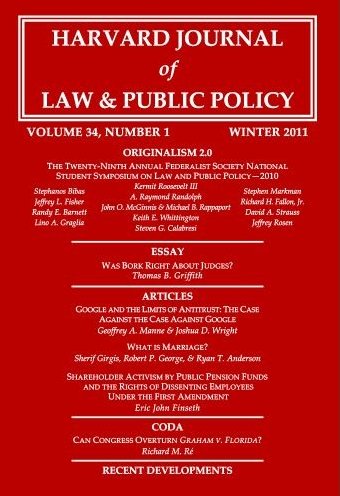
HJLPP coverI’m excited to announce the release of my latest law review article, “The Pursuit of Privacy in a World Where Information Control is Failing,” which appears in the next edition (vol. 36) of the Harvard Journal of Law & Public Policy. This is the first of two complimentary law review articles that I will be releasing this year dealing with privacy policy. The second, which will be published later this summer by the George Mason University Law Review, is entitled, “A Framework for Benefit-Cost Analysis in Digital Privacy Debates.” (FYI: Both articles focus on privacy claims made against private actors — namely, efforts to limit private data collection — and not on privacy rights against governments.)

The new Harvard Journal article is divided into three major sections. Part I focuses on some of normative challenges we face when discussing privacy and argues that there may never be a widely accepted, coherent legal standard for privacy rights or harms here in the United States. It also explores the tensions between expanded privacy regulation and online free speech. Part II turns to the many enforcement challenges that are often ignored when privacy policies are being proposed or formulated and argues that legislative and regulatory efforts aimed at protecting privacy must now be seen as an increasingly intractable information control problem. Most of the problems policymakers and average individuals face when it comes to controlling the flow of private information online are similar to the challenges they face when trying to control the free flow of digitalized bits in other information policy contexts, such as online safety, cybersecurity, and digital copyright.

If the effectiveness of law and regulation is limited by the normative considerations discussed in Part I and the practical enforcement complications discussed in Part II, what alternatives remain to assist privacy-sensitive individuals? I address that question in Part III of the paper and argue that the approach America has adopted to deal with concerns about objectionable online speech and child safety offers a path forward on the privacy front as well. Continue reading →

[Note: I later adapted this essay into a short book, which you can download for free here.]

Let’s talk about “permissionless innovation.” We all believe in it, right? Or do we? What does it really mean? How far are we willing to take it? What are its consequences? What is its opposite? How should we balance them?

What got me thinking about these questions was a recent essay over at The Umlaut by my Mercatus Center colleague Eli Dourado entitled, “‘Permissionless Innovation’ Offline as Well as On.” He opened by describing the notion of permissionless innovation as follows:

In Internet policy circles, one is frequently lectured about the wonders of “permissionless innovation,” that the Internet is a global platform on which college dropouts can try new, unorthodox methods without the need to secure authorization from anyone, and that this freedom to experiment has resulted in the flourishing of innovative online services that we have observed over the last decade.

Eli goes on to ask, “why it is that permissionless innovation should be restricted to the Internet. Can’t we have this kind of dynamism in the real world as well?”

That’s a great question, but let’s ponder an even more fundamental one: Does anyone really believe in the ideal of “permissionless innovation”? Is there anyone out there who makes a consistent case for permissionless innovation across the technological landscape, or is it the case that a fair degree of selective morality is at work here? That is, people love the idea of “permissionless innovation” until they find reasons to hate it — namely, when it somehow conflicts with certain values they hold dear. Continue reading →