The Mercatus Center at George Mason University has just released a new paper on,”Permissionless Innovation and Immersive Technology: Public Policy for Virtual and Augmented Reality,” which I co-authored with Jonathan Camp. This 53-page paper can be downloaded via the Mercatus website, SSRN or Research Gate.
Here is the abstract for the paper:
Immersive technologies such as augmented reality, virtual reality, and mixed reality are finally taking off. As these technologies become more widespread, concerns will likely develop about their disruptive social and economic effects. This paper addresses such policy concerns and contrasts two different visions for governing immersive tech going forward. The paper makes the case for permissionless innovation, or the general freedom to innovate without prior constraint, as the optimal policy default to maximize the benefits associated with immersive technologies.
The alternative vision — the so-called precautionary principle — would be an inappropriate policy default because it would greatly limit the potential for beneficial applications and uses of these new technologies to emerge rapidly. Public policy for immersive technology should not be based on hypothetical worst-case scenarios. Rather, policymakers should wait to see which concerns or harms emerge and then devise ex post solutions as needed.
To better explain why precautionary controls on these emerging technologies would be such a mistake, Camp and I provide an inventory of the many VR, AR, and mixed reality applications that are already on the market–or soon could be–and which could provide society with profound benefits. A few examples include: Continue reading →
The Mercatus Center at George Mason University has just released a new paper on, “Artificial Intelligence and Public Policy,” which I co-authored with Andrea Castillo O’Sullivan and Raymond Russell. This 54-page paper can be downloaded via the Mercatus website, SSRN, or ResearchGate. Here is the abstract:
There is growing interest in the market potential of artificial intelligence (AI) technologies and applications as well as in the potential risks that these technologies might pose. As a result, questions are being raised about the legal and regulatory governance of AI, machine learning, “autonomous” systems, and related robotic and data technologies. Fearing concerns about labor market effects, social inequality, and even physical harm, some have called for precautionary regulations that could have the effect of limiting AI development and deployment. In this paper, we recommend a different policy framework for AI technologies. At this nascent stage of AI technology development, we think a better case can be made for prudence, patience, and a continuing embrace of “permissionless innovation” as it pertains to modern digital technologies. Unless a compelling case can be made that a new invention will bring serious harm to society, innovation should be allowed to continue unabated, and problems, if they develop at all, can be addressed later.
Today, the U.S. Department of Transportation released its eagerly-awaited “Federal Automated Vehicles Policy.” There’s a lot to like about the guidance document, beginning with the agency’s genuine embrace of the potential for highly automated vehicles (HAVs) to revolutionize this sector and save thousands of lives annually in the process.
It is important we get HAV policy right, the DOT notes, because, “35,092 people died on U.S. roadways in 2015 alone” and “94 percent of crashes can be tied to a human choice or error.” (p. 5) HAVs could help us reverse that trend and save thousands of lives and billions in economic costs annually. The agency also documents many other benefits associated with HAVs, such as increasing personal mobility, reducing traffic and pollution, and cutting infrastructure costs.
I will not attempt here to comment on every specific recommendation or guideline suggested in the new DOT guidance document. I could nit-pick about some of the specific recommended guidelines, but I think many of the guidelines are quite reasonable, whether they are related to safety, security, privacy, or state regulatory issues. Other issues need to be addressed and CEI’s Marc Scribner does a nice job documenting some of them is his response to the new guidelines.
Instead of discussing those specific issues today, I want to ask a more fundamental and far-reaching question which I have been writing about in recent papers and essays:
Is this guidance or regulation? And what does the use of informal guidance mechanisms like these signal for the future of technological governance more generally? Continue reading →
Another year in the books for the Technology Liberation Front. Many developments unfolded in 2015 in the technology world and we covered much of it (on TLF and in other outlets). The most popular posts this year revolved around the Internet of Things, privacy, unlicensed spectrum, and municipal and public broadband networks. Thanks for reading, and enjoy the year in review. Continue reading →
Today, the U.S. Department of Transportation and the Federal Aviation Administration (FAA) announced that it will soon require Unmanned Aircraft Systems (UAS) or private drones, used for both personal and commercial purposes, to be registered in a national database. To facilitate this process, the agencies announced the creation of a new federal task force that will develop recommendations for a UAS registration process. Rules are to be published by November 20th (presumably to cover new devices sold before Christmas).
Here are some quick initial reactions on the proposed registration rules: Continue reading →
This Wednesday, TechFreedom joined Niskanen Center and a coalition of free market groups in urging the White House to endorse the use of strong encryption and disavow efforts to intentionally weaken encryption, whether by installing “back doors,” “front doors,” or any security vulnerabilities into encryption products.
We urge your Administration to consider the full ramifications of weakening or limiting encryption. There is no such thing as a backdoor that only the US government can access: any attempt to weaken encryption means making users more vulnerable to malicious hackers, identity thieves, and repressive governments. America must stand for the right to encryption — it is nothing less than the Second Amendment for the Internet.
“
The White House’s silence on encryption is deafening,” said Tom Struble, Policy Counsel at TechFreedom. “The President’s hitherto failure to endorse strong encryption has given ammunition to European regulators seeking to restrict cross-border data flows and require that data on EU citizens be stored in their own countries. Just yesterday, the European Court of Justice struck down a longstanding agreement that made it easier for Europeans to access American Internet services. If the White House continues to dawdle, it will only further embolden ‘digital protectionism’ across the pond.”
The letter’s signatories include: Niskanen Center, TechFreedom, FreedomWorks, R Street Institute, Students For Liberty, Citizen Outreach, Downsize DC, Institute for Policy Innovation, Less Government, Center for Financial Privacy and Human Rights, and American Commitment.
The big news out of Europe today is that the European Court of Justice (ECJ) has invalidated the 15-year old EU-US safe harbor agreement, which facilitated data transfers between the EU and US. American tech companies have relied on the safe harbor to do business in the European Union, which has more onerous data handling regulations than the US. [PDF summary of decision here.] Below I offer some quick thoughts about the decision and some of its potential unintended consequences.
#1) Another blow to new entry / competition in the EU: While some pundits are claiming this is a huge blow to big US tech firms, in reality, the irony of the ruling is that it will bolster the market power of the biggest US tech firms, because they are the only ones that will be able to afford the formidable compliance costs associated with the resulting regulatory regime. In fact, with each EU privacy decision, Google, Facebook, and other big US tech firms just get more dominant. Small firms just can’t comply with the EU’s expanding regulatory thicket. “It will involve lots of contracts between lots of parties and it’s going to be a bit of a nightmare administratively,” said Nicola Fulford, head of data protection at the UK law firm Kemp Little when commenting on the ruling to the BBC. “It’s not that we’re going to be negotiating them individually, as the legal terms are mostly fixed, but it does mean a lot more paperwork and they have legal implications.” And by driving up regulatory compliance costs and causing constant delays in how online business is conducted, the ruling will (again, on top of all the others) greatly limits entry and innovation by new, smaller players in the digital world. In essence, EU data regulations have already wiped out much of the digital competition in Europe and now this ruling finishes off any global new entrants who might have hoped of breaking in and offering competitive alternatives. These are the sorts of stories never told in antitrust circles: costly government rulings often solidify and extend the market dominance of existing companies. Dynamic effects matter. That is certainly going to be the case here. Continue reading →
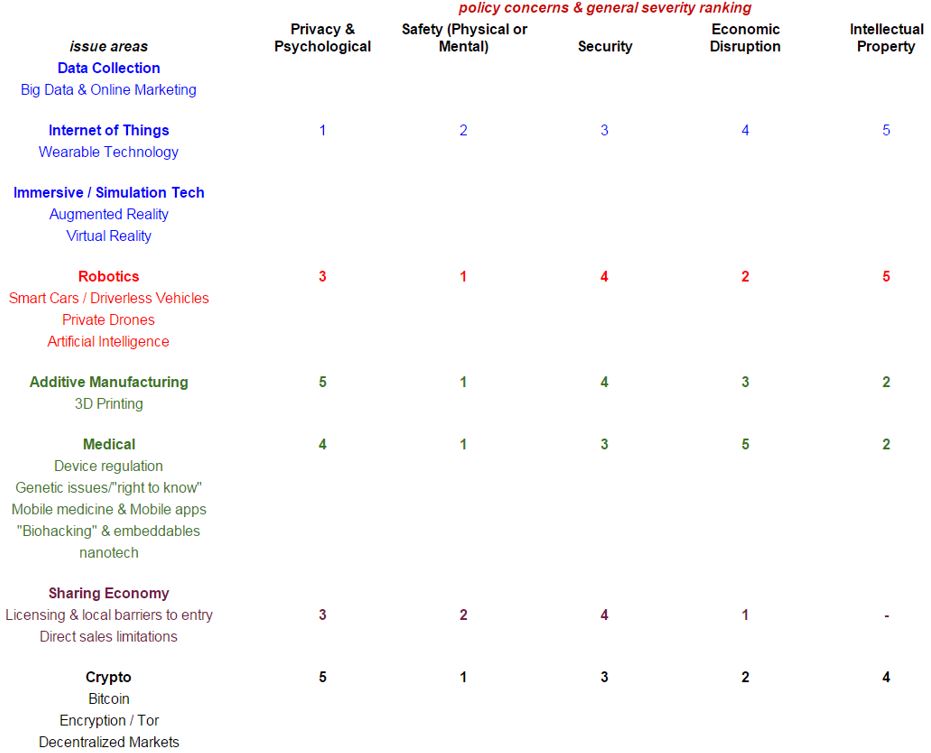
On the whiteboard that hangs in my office, I have a giant matrix of technology policy issues and the various policy “threat vectors” that might end up driving regulation of particular technologies or sectors. Along with my colleagues at the Mercatus Center’s Technology Policy Program, we constantly revise this list of policy priorities and simultaneously make an (obviously quite subjective) attempt to put some weights on the potential policy severity associated with each threat of intervention. The matrix looks like this: [Sorry about the small fonts. You can click on the image to make it easier to see.]
I use 5 general policy concerns when considering the likelihood of regulatory intervention in any given area. Those policy concerns are:
privacy (reputation issues, fear of “profiling” & “discrimination,” amorphous psychological / cognitive harms);
safety (health & physical safety or, alternatively, child safety and speech / cultural concerns);
security (hacking, cybersecurity, law enforcement issues);
On Thursday, it was my great pleasure to participate in a Washington Legal Foundation (WLF) event on “Online Privacy Regulation: The Challenge of Defining Harm.” The entire event video can be found on YouTube here, but down below I pasted the clip of just my remarks. Other speakers at the event included: FTC Commissioner Maureen K. Ohlhausen, Commissioner; John B. Morris, Jr., the Associate Administrator and Director of Internet Policy athe U.S. Department of Commerce’s National Telecommunications and Information Administration; and Katherine Armstrong, Counsel at the law firm of Hogan Lovells. Glenn Lammi of the WLF moderated the session.
My remarks drew upon a few recent law review articles I have published relating digital privacy debates to previous debates over free speech and online child safety issues. (Here are those articles: 1, 2, 3).
Along with colleagues at the Mercatus Center at George Mason University, I am releasing two major new reports today dealing with the regulation of the sharing economy. The first report is a 20-page filing to the Federal Trade Commissionthat we are submitting to the agency for its upcoming June 9th workshop on “The “Sharing” Economy: Issues Facing Platforms, Participants, and Regulators.” We have been invited to participate in that event and I will be speaking on the fourth panel of the workshop. The filing I am submitting today for that workshop was co-authored with my Mercatus colleagues Christopher Koopman and Matt Mitchell.
The Technology Liberation Front is the tech policy blog dedicated to keeping politicians' hands off the 'net and everything else related to technology. Learn more about TLF →

 The Technology Liberation Front is the tech policy blog dedicated to keeping politicians' hands off the 'net and everything else related to technology.
Quick Thoughts on FAA’s Proposed Drone Registration System
by Adam Thierer on October 19, 2015 · 3 comments
Here are some quick initial reactions on the proposed registration rules: Continue reading →