Posts tagged as:

Today, the U.S. Senate Commerce Committee held a hearing on “The State of Online Consumer Privacy.”

The push for online privacy regulation has real momentum, as proposed privacy legislation from numerous lawmakers, a Department of Commerce report proposing a compulsory Do Not Track mechanism to regulate business marketing practices, and the Obama Administration’s proposed “Privacy Bill of Rights” all indicate.

However, Congress should be very wary of such proposals. A politically defined Do Not Track regime risks undermining targeted advertising, impeding business transactions that occur between strangers, and stifling mobile ecosystems that are barely out of the cradle. Rattling consumers needlessly by encouraging them to opt-out of largely beneficial information collection is an especially unwise idea in our uncertain economic climate – especially when major industry participants are developing such mechanisms on their own.

The opportunity to undermine online marketing – wrongly called “surveillance” – appeals to some, but such privacy purists have no right to call the shots for anyone but themselves and those who agree with them. The right to use information acquired through voluntary transactions is no less important than the right to decide whether to disclose information in the first place.

Continue reading →

Yet another hearing on privacy issues has been slated for this coming Wednesday, March 16th. This latest one is in the Senate Commerce Committee and it is entitled “The State of Online Consumer Privacy.” As I’m often asked by various House and Senate committee staffers to help think of good questions for witnesses, I’m listing a few here that I would love to hear answered by any Federal Trade Commission (FTC) or Dept. of Commerce (DoC) officials testifying. You will recall that both agencies released new privacy “frameworks” late last year and seem determined to move America toward a more “European-ized” conception of privacy regulation. [See our recent posts critiquing the reports here.] Here are a few questions that should be put to the FTC and DoC officials, or those who support the direction they are taking us. Please feel free to suggest others:

  • Before implying that we are experiencing market failure, why hasn’t either the FTC or DoC conducted a thorough review of online privacy policies to evaluate how well organizational actions match up with promises made in those policies?
  • To the extent any sort of internal cost-benefit analysis was done internally before the release of these reports, has an effort been made to quantify the potential size of the hidden “privacy tax” that new regulations like “Do Not Track” could impose on the market?
  • Has the impact of new regulations on small competitors or new entrants in the field been considered?  Has any attempt been made to quantify how much less entry / innovation would occur as a result of such regulation?
  • Were any economists from the FTC’s Economics Bureau consulted before the new framework was released? Did the DoC consult any economists?
  • Why do FTC and DoC officials believe that citing unscientific public opinions polls from regulatory advocacy organizations serves as a surrogate for serious cost-benefit analysis or an investigation into how well privacy policies actual work in the marketplace?
  • If they refuse to conduct more comprehensive internal research, have the agencies considered contracting with external economists to build a body of research looking into these issues (as the Federal Communications Commission did in a decade ago in its media ownership proceeding)?
  • Has either agency attempted to determine consumer’s “willingness to pay” for increased privacy regulation?
  • More generally, where is the “harm” and aren’t there plenty of voluntary privacy-enhancing tools out there that privacy-sensitive users can tap to shield their digital footsteps, if they feel so inclined?

You have to wade through a lot to reach the good news at the end of Time reporter Joel Stein’s article about “data mining”—or at least data collection and use—in the online world. There’s some fog right there: what he calls “data mining” is actually ordinary one-to-one correlation of bits of information, not mining historical data to generate patterns that are predictive of present-day behavior. (See my data mining paper with Jeff Jonas to learn more.) There is some data mining in and among the online advertising industry’s use of the data consumers emit online, of course.

Next, get over Stein’s introductory language about the “vast amount of data that’s being collected both online and off by companies in stealth.” That’s some kind of stealth if a reporter can write a thorough and informative article in Time magazine about it. Does the moon rise “in stealth” if you haven’t gone outside at night and looked at the sky? Perhaps so.

Now take a hard swallow as you read about Senator John Kerry’s (D-Mass.) plans for government regulation of the information economy.

Kerry is about to introduce a bill that would require companies to make sure all the stuff they know about you is secured from hackers and to let you inspect everything they have on you, correct any mistakes and opt out of being tracked. He is doing this because, he argues, “There’s no code of conduct. There’s no standard. There’s nothing that safeguards privacy and establishes rules of the road.”

Securing data from hackers and letting people correct mistakes in data about them are kind of equally opposite things. If you’re going to make data about people available to them, you’re going to create opportunities for other people—it won’t even take hacking skills, really—to impersonate them, gather private data, and scramble data sets. Continue reading →

What I hoped would be a short blog post to accompany the video from Geoff Manne and my appearances this week on PBS’s “Ideas in Action with Jim Glassman” turned out to be a very long article which I’ve published over at Forbes.com.

I apologize to Geoff for taking an innocent comment he made on the broadcast completely out of context, and to everyone else who chooses to read 2,000 words I’ve written in response.

So all I’ll say here is that Geoff Manne and I taped the program in January, as part of the launch of TechFreedom and of “The Next Digital Decade.”   Enjoy!


Twitter curmudgeon @derekahunter writes: “With all the medical advances of last 100 years, why hasn’t anyone created a cough drop that doesn’t taste like crap?” Dammit, he’s right! Why hasn’t the market for cold remedies produced a tasty cough drop? Put differently, the market for cold remedies has failed to produce a tasty cough drop. The market has failed. Market . . . failure.

We have now established the appropriateness of a regulatory solution for the taste problem in the field of cold remedies. Have we not? There is a market failure.

No, we haven’t.

“Market failure” is not what happens when a given market has failed so far to reach outcomes that a smart person would prefer. It occurs when the rules, signals, and sanctions in and around a given marketplace would cause preference- and profit-maximizing actors to reach a sub-optimal outcome. You can’t show that there’s a market failure by arguing that the current state of the actual market is non-ideal. You have to show that the rules around that marketplace lead to non-ideal outcomes. The bad taste of cough drops is not evidence of market failure.

The failure of property rights to account for environmental values leads to market failure. A coal-fired electric plant might belch smoke into the air, giving everyone downwind a bad day and a shorter life. If the company and its customers don’t have to pay the costs of that, they’re going to over-produce and over-consume electricity at the expense of the electric plant’s downwind neighbors. The result is sub-optimal allocation of goods, with one set of actors living high on the hog and another unhappily coughing and wheezing.

Take an issue that’s closer to home for tech policy folk: People seem to underweight their privacy when they go online, promiscuously sharing anything and everything on Facebook, Twitter, and everyplace else. Marketers are hoovering up this data and using it to sell things to people. The data is at risk of being exposed to government snoops. People should be more attentive to privacy. They’re not thinking about long-term consequences. Isn’t this a market failure?

It’s not. It’s consumers’ preferences not matching up with the risks and concerns that people like me and my colleagues in the privacy community share. Consumers are preference-maximizing—but we don’t like their preferences! That is not a market failure. Our job is to educate people about the consequences of their online behavior, to change the public’s preferences. That’s a tough slog, but it’s the only way to get privacy in the context of maximizing consumer welfare.

If you still think there’s a market failure in this area—I readily admit that I’m on the far edge of my expertise with complex economic concepts like this—you haven’t finished making your case for regulation. You need to show that the rules, signals, and sanctions in and around the regulatory arena would produce a better outcome than the marketplace would. Be sure that you compare real market outcomes to real regulatory outcomes, not real market outcomes to ideal regulatory outcomes. Most arguments for privacy regulation simply fail to account for the behavior of the regulatory universe.

Adam has collected quotations on the subject of regulatory capture from many experts. I wrote a brief series of “real regulators” posts on the SEC and the Madoff scam a while back (1, 2, 3). And a recent article I’m fond of goes into the problem that many people think only consumers suffer, asking: “Are Regulators Rational?”

There’s no good-tasting cough drop because the set of drops that remedy coughing and the set of drops that taste good are mutually exclusive. Not because of market failure.

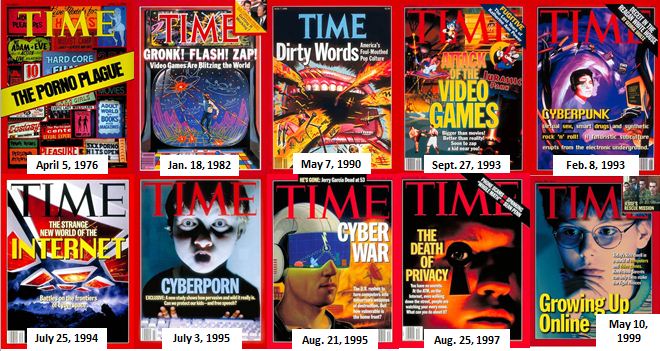
[UPDATE Feb. 2012: This little essay eventually led to an 80-page working paper, “Technopanics, Threat Inflation, and the Danger of an Information Technology Precautionary Principle.”]


In this essay, I will suggest that (1) while “moral panics” and “techno-panics” are nothing new, their cycles seem to be accelerating as new communications and information networks and platforms proliferate; (2) new panics often “crowd-out” or displace old ones; and (3) the current scare over online privacy and “tracking” is just the latest episode in this ongoing cycle.

What Counts as a “Techno-Panic”?

First, let’s step back and define our terms. Christopher Ferguson, a professor at Texas A&M’s Department of Behavioral, Applied Sciences and Criminal Justice, offers the following definition: “A moral panic occurs when a segment of society believes that the behavior or moral choices of others within that society poses a significant risk to the society as a whole.” By extension, a “techno-panic” is simply a moral panic that centers around societal fears about a specific contemporary technology (or technological activity) instead of merely the content flowing over that technology or medium. In her brilliant 2008 essay on “The MySpace Moral Panic,” Alice Marwick noted: Continue reading →

It seems peculiar to me that some of the same individuals and groups who so vociferously opposed a “broadcast flag” technological mandate in past years are now in a mad rush to have federal policymakers mandate a “Do Not Track” regulatory regime for privacy purposes. The broadcast flag debate, you will recall, centered around the wisdom of mandating a technological fix to the copyright arms race before digitized high-definition broadcast signals were effectively “Napster-ized.” At least that was the fear six or seven years ago. TV broadcasters and some content companies wanted the Federal Communications Commission (FCC) to recognize and enforce a string of code that would have been embedded in digital broadcast program signals such that mass redistribution of video programming could have been prevented.

Flash forward to the present debate about mandating a “Do Not Track” scheme to help protect privacy online. As I noted in my filing last week to the Federal Trade Commission, at root, Do Not Track is just another “information control regime.” Much like the broadcast flag proposal, it’s an attempt to use a technological quick-fix to solve a complex problem. When it comes to such information control efforts, however, there aren’t many good examples of simple fixes or silver-bullet solutions that have worked, at least not for very long. The debates over Wikileaks, online porn, Internet hate speech, and Spam all demonstrate how challenging it can be to put information back into the bottle once it is released into the digital wild.

To be clear, I am not opposed to technological solutions like broadcast flag or Do Not Track, but I am opposed to forcing them upon the Internet and digital markets in a top-down, centrally-planned fashion. While I am skeptical that either scheme would work well in practice (whether voluntary or mandated), my concern in these debates is that forcing such solutions by law will have many unintended consequences, not the least of which will be the gradual growth of invasive cyberspace controls in these or other contexts. After all, if we can have “broadcast flags” and “Do Not Track” schemes, why not “flag” mandates for objectionable speech or “Do Not Porn” browser mandates? Continue reading →

Today I filed roughly 30 pages worth of comments with the Federal Trade Commission (FTC) in its proceeding on “Protecting Consumer Privacy in an Era of Rapid Change: a Proposed Framework for Businesses and Policy Makers.” [Other comments filed in the proceeding can be found here.] Down below, I’ve attached the Table of Contents from my filing so you can see the major themes I’ve addressed, and I’ve also attached the entire document in a Scribd reader. In coming days and weeks, I’ll be expanding upon some of these themes in follow-up essays.

In my filing, I argue that while it remains impossible to predict with precision the impact a new privacy regulatory regime will have the Internet economy and digital consumers, regulation will have consequences; of that much we can be certain.  As the FTC  and other policy makers move forward with proposals to expand regulation in this regard, it is vital that the surreal “something-for-nothing” quality of current privacy debate cease. Those who criticize data collection or online advertising and call for expanded regulation should be required to provide a strict cost-benefit analysis of the restrictions they would impose upon America’s vibrant digital marketplace.

In particular, it should be clear that the debate over Do Not Track and online advertising regulation is fundamentally tied up with the future of online content, culture, and services. Thus, regulatory advocates must explain how the content and services supported currently by advertising and marketing will be sustained if current online data collection and ad targeting techniques are restricted. Continue reading →

Video is now available for all of the excellent programming at this year’s State of The Net 2011 conference. (Programming will also be available over time on C-SPAN’s video library.) The Conference, organized by the Advisory Committee to the Congressional Internet Caucus, featured Members of Congress, leading academics, Administration, agency, and Congressional staff and other provocateurs. Topics this year ranged from social networking, Wikileaks, COICA, copyright, privacy, security, broadband policy and, of course, the end-of-the-year vote by the FCC to approve new rules for network management by broadband providers, aka net neutrality. Continue reading →

You have to read all the way to the end to get exactly what the New York Times is getting at in its Sunday editorial, “Netizens Gain Some Privacy.”

Congress should require all advertising and tracking companies to offer consumers the choice of whether they want to be followed online to receive tailored ads, and make that option easily chosen on every browser.

That means Congress—or the federal agency it punts to—would tell authors of Internet browsing software how they are allowed to do their jobs. Companies producing browser software that didn’t conform to federal standards would be violating the law.

In addition, any Web site that tailored ads to their users’ interests, or the networks that now generally provide that service, would be subject to federal regulation and enforcement that would of necessity involve investigation of the data they collect and what they do with it.

Along with existing browser capabilities (Tools > Options > Privacy tab > cookie settings), forthcoming amendments to browsers will give users more control over the information they share with the sites they visit. That exercise of control is the ultimate do-not-track. It’s far preferable to the New York Times‘ idea, which has the Web user issuing a request not to be tracked and wondering whether government regulators can produce obedience.

[I got enough push-back to a recent post arguing the existence of market nimbleness in the browser area that I’m unsure of the thesis I expressed there. The better explanation of what’s going on may be that regulatory pressure is moving browser authors and others to meet the peculiar demands of the pro-regulatory community. The reason they have waited to act until now is because they do not perceive consumers’ interests to be met by protections against tailored advertising. The question of what meets consumers’ interests won’t be answered if regulation supplants markets, of course.]