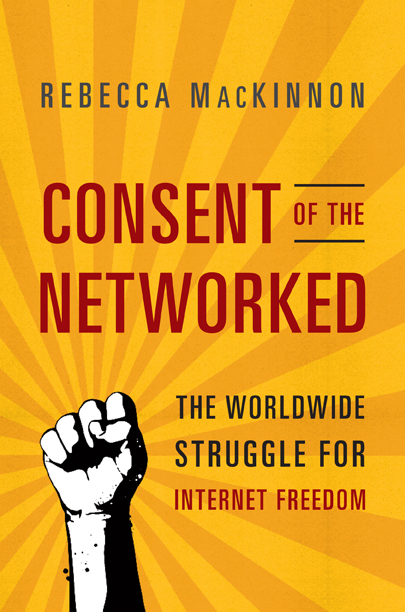
 Rebecca MacKinnon’s new book, Consent of the Networked: The Worldwide Struggle for Internet Freedom, is well-researched exploration of the forces driving Internet developments and policy across the globe today. She serves up an outstanding history of recent global protest movements and social revolutions and explores the role that Internet technologies and digital networks played in those efforts. She also surveys some of the recent policy fights here and abroad over issues such as online privacy, Net neutrality regulation, free speech matters, and the copyright wars. The Consent of the Networked is certainly worth reading and will go down as one of the most important Internet policy books of 2012.
A Call to Action
Of course, it’s not just a history lesson. MacKinnon has also issued a call-to-arms here. As a well-known web activist, MacKinnon has emerged as a leading force in the broad-based, if loosely-defined, “Net freedom” movement. The term “Net freedom,” she notes, means very different things to different people. It’s “like a Rorschach inkblot test: different people look at the same ink splotch and see very different things.” (p. 188) Nonetheless, on the global stage, the Internet freedom movement is fundamentally tied up with efforts to hold both governments and corporate actors more accountable for their actions toward the Netizens, digital networks, and online speech and expression. Continue reading →
According to the BBC, the European Commission is apparently set to adopt formal rules guaranteeing a so-called “right to be forgotten” online. As part of the Commission’s overhaul of the 1995 Data Protection Directive, this new regulation will mandate that, “people will be able to ask for data about them to be deleted and firms will have to comply unless there are ‘legitimate’ grounds to retain it,” the BBC reports.
I’ve written about “right to be forgotten” and “online eraser button” proposals before in my
Forbes essay, “Erasing Our Past On The Internet,” a Mercatus white paper on “Kids, Privacy, Free Speech & the Internet: Finding the Right Balance.” and in this essay here on the TLF on “The Conflict Between a “Right to Be Forgotten” & Speech / Press Freedoms.” While I can appreciate the privacy and reputational concerns that lead to calls for such information controls, the reality is that a mandatory “right to be forgotten” is a recipe for massive Internet censorship. As I noted in those earlier essays, such notions conflict violently with speech rights and press freedoms. Enshrining into law such expansive privacy norms places stricter limits on others’ rights to speak freely, or to collect and analyze information about others. Continue reading →
 After three years of politicking, it now looks like Congress may actually give the FCC authority to conduct incentive auctions for mobile spectrum, and soon. That, at least, is what the FCC seems to think.
At CES last week, FCC Chairman Julius Genachowski largely repeated the speech he has now given three years in a row. But there was a subtle twist this time, one echoed by comments from Wireless Bureau Chief Rick Kaplan at a separate panel.
Instead of simply warning of a spectrum crunch and touting the benefits of the incentive auction idea, the Chairman took aim at a House Republican bill that would authorize the auctions but limit the agency’s “flexibility” in designing and conducting them. “My message on incentive auctions today is simple,” he said, “we need to get it done now, and we need to get it done right.” Continue reading →
Filings are due to the Federal Trade Commission (FTC) today as part of its review of the Children’s Online Privacy Protection Act (COPPA) and the COPPA rule that the FTC devised and enforces. I didn’t have time to pen as much as I wanted, but I did submit a short filing to the agency in the matter based on some of my previous work both with Berin Szoka and on my own. Here’s the executive summary for my filing:
It goes without saying that the Children’s Online Privacy Protection Act (COPPA) is complicated law and rule. When considering the rule and proposals to amend it, it is easy to get lost in the weeds and ignore the bigger picture. That would be a mistake. There are broader, more important questions that need to be asked as part of the Federal Trade Commission’s effort to expand this regulatory regime. These questions involve not only the costs of increased regulation for online business interests, but the impact of expanded regulation on market structure, competition, and innovation. More importantly, these questions cut to the core of whether the public (including children) will be served with more and better digital innovations in the future. There is no free lunch. Regulation—even well-intentioned regulation like COPPA—is not a costless exercise. There are profound trade-offs for online content and culture that must always be considered.
Whatever one thinks about the effectiveness or sensibility of the COPPA regulatory model for the Web 1.0 world, it is clear that the regime is being strained by the unforeseen realities of the Web 2.0 world of hyper-ubiquitous connectivity and user-generated content creation and sharing. The digital genie cannot be put back in the bottle. While COPPA may continue to have a marginal role to play in this rapidly evolving world, that role will likely be increasingly limited by the inherent realities of the information age.
Entire filing can be found on the Mercatus website, on SSRN, or via Scribd [Also embedded below in a Scribd reader.] Continue reading →
 Jim Adler, Chief Privacy Officer and General Manager of Data Systems at Intelius, always has interesting and thoughtful things to say about online privacy debates. I recommend following him on Twitter (@jim_adler). Today, he posted an interesting essay on his blog entitled “Creepy Is As Creepy Does, which begins by noting that “with increasing volume, ‘creepy’ has snuck its way in to the privacy lexicon and become a mainstay in conversations around online sharing and social networking. How is it possible that we use the same word to describe Frankenstein and Facebook?” Good question. Better question: Why is “creepiness” the standard by which we are judging privacy matters? I posted a comment to his blog post elaborating on that point that I thought I would also post here:
I think we’d be better served by moving privacy deliberations — at least the legal ones — away from “creepiness” and toward a serious discussion about what constitutes actual harm in these contexts. While there will be plenty of subjective squabbles over the definition of “harm” as it relates to online privacy / reputation, I believe we can be more concrete about it than continuing these silly debates about “creepiness,” which could not possibly be any more open-ended and subjective.
Continue reading →
 Earlier this year I read Scott Cleland’s new book, Search & Destroy: Why You Can’t Trust Google, Inc., after he was kind enough to send me an advance copy. I didn’t have time to review it at the time and just jotted down a few notes for use later. Because the year is winding down, I figured I should get my thoughts on it out now before I publish my end of year compendium of important tech policy books.
Cleland is President of Precursor LLC and a noted Beltway commentator on information policy issues, especially Net neutrality regulation, which he has vociferously railed against for many years. On a personal note, I’ve known Scott for many years and always enjoyed his analysis and wit, even when I disagree with the thrust of some of it.
And I’m sad to report that I disagree with most of it in
Search & Destroy, a book that is nominally about Google but which is really a profoundly skeptical look at the modern information economy as we know it. Indeed, Cleland’s book might have been more appropriately titled, “Second Thoughts about Cyberspace.” In a sense, it represents an outline for an emerging “cyber-conservative” vision that aims to counter both “cyber-progressive” and “cyber-libertarian” schools of thinking.
After years of having Scott’s patented bullet-point mini-manifestos land in my mailbox, I think it’s only appropriate I write this review in the form of a bulleted list! So, here it goes.. Continue reading →
When Senator William Proxmire (D-WI) proposed and passed the Fair Credit Reporting Act forty years ago, he almost certainly believed that the law would fix the problems he cited in introducing it. It hasn’t. The bulk of the difficulties he saw in credit reporting still exist today, at least to hear consumer advocates tell it.
Advocates of sweeping privacy legislation and other regulation of the information economy would do well to heed the lessons offered by the FCRA. Top-down federal regulation isn’t up to the task of designing the information society. That’s the upshot of my new Cato Policy Analysis, “Reputation under Regulation: The Fair Credit Reporting Act at 40 and Lessons for the Internet Privacy Debate.” In it, I compare Senator Proxmire’s goals for the credit reporting industry when he introduced the FCRA in 1969 against the results of the law today. Most of the problems that existed then persist today. Some problems with credit reporting have abated and some new problems have emerged.
Credit reporting is a complicated information business. Challenges come from identity issues, judgments about biography, and the many nuances of fairness. But credit reporting is simple compared to today’s expanding and shifting information environment.
“Experience with the Fair Credit Reporting Act counsels caution with respect to regulating information businesses,” I write in the paper. “The federal legislators, regulators, and consumer advocates who echo Senator Proxmire’s earnest desire to help do not necessarily know how to solve these problems any better than he did.”
Management of the information economy should be left to the people who are together building it and using it, not to government authorities. This is not because information collection, processing, and use are free of problems, but because regulation is ill-equipped to solve them.
This week I will again be attending the Family Online Safety Institute’s excellent annual summit. The 2-day affair brings together some of the world’s leading experts on online safety and privacy issues. It’s a great chance to learn about major developments in the field. As I was preparing for the session I am moderating on Thursday, I thought back to the first FOSI annual conference, which took place back in 2007. What is remarkable about that period compared to now is that there was a flurry of legislative and regulatory activity related to online child safety then that we simply do not see today.
In fact, just 3 1/2 years ago, John Morris of the Center for Democracy and Technology and I compile a legislative index [summary here] that cataloged the more than 30 legislative proposals that had been introduced in the the 110th session of Congress. There was also a great deal of interest in these issues within the regulatory community. Finally, countless state and local measures related to online safety and speech issues had been floated. Today, by contrast, it is hard for me to find any legislative measures focused on online safety regulation at the federal level, and I don’t see much activity at the agency level either. I haven’t surveyed state and local activity, but it seems like it has also died down.
Generally speaking, I think this is a good development since I am opposed to most proposals to regulate online speech, expression, or conduct. But let’s ignore the particular wisdom of such measures and ask a simple question:
What explains the decline in Internet safety legislation and online content regulation? I believe there are three possible explanations: Continue reading →
I highly recommend this important new study on “Why Parents Help Their Children Lie to Facebook about Age: Unintended Consequences of the Children’s Online Privacy Protection Act” by danah boyd of New York University, Eszter Hargittai from Northwestern University, Jason Schultz from University of California, Berkeley, and John Palfrey from Harvard University. COPPA is a complicated and somewhat open-ended law and regulatory regime. COPPA requires that commercial operators of websites and services obtain “verifiable parental consent” before collecting, disclosing, or using “personal information” (name, contact information) of children under the age of 13 if either their website or service (or “portion thereof”) is “directed at children” or they have actual knowledge that they are collecting personal information from a child.
The new study, which surveyed over 1,000 parents of children between the ages of 10 and 14, reveals that, despite the best of intentions, COPPA is having many unintended costs and consequences:
Although many sites restrict access to children, our data show that many parents knowingly allow their children to lie about their age — in fact, often help them to do so — in order to gain access to age–restricted sites in violation of those sites’ ToS. This is especially true for general–audience social media sites and communication services such as Facebook, Gmail, and Skype, which allow children to connect with peers, classmates, and family members for educational, social, or familial reasons.
The authors conclude that “COPPA inadvertently undermines parents’ ability to make choices and protect their children’s data” and that their results “have significant implications for policy–makers, particularly in light of ongoing discussions surrounding COPPA and other age–based privacy laws.” Indeed, this paper could really shake up the debate over online kids’ privacy regulation. I will have more analysis of the paper in my weekly
Forbes column this weekend.
Additional reading for COPPA background and current controversies: Berin Szoka & Adam Thierer, “COPPA 2.0: The New Battle over Privacy, Age Verification, Online Safety & Free Speech,” (May 21, 2009); and Adam Thierer, “Kids, Privacy, Free Speech & the Internet: Finding the Right Balance,” (August 12, 2011).

 The Technology Liberation Front is the tech policy blog dedicated to keeping politicians' hands off the 'net and everything else related to technology.