A few days ago, the big news in the telecom world was that President Obama again ordered federal agencies to share and sell their spectrum to expand commercial mobile broadband use. This effort is premised on the fact that agencies use their gifted airwaves poorly while demand for mobile broadband is surging. While the presidential memorandum half-heartedly supports clearing out agencies from some bands and selling it off, the focus of the memo is shared access, whereby federal agencies agree to allow non-federal users to use the same spectrum bands with non-interfering technologies.
The good news is that there is no mention of PCAST’s 2012 recommendation to the president to create a 1000 MHz “superhighway” of unlicensed federal spectrum accessed by sensing devices. This radical proposal would replace the conventional clearing-and-auction process with a spectrum commons framework reliant on unproven sensing technologies. Instead of consumers relying on carriers’ spectrum for mobile broadband, this plan would crudely imitate (in theory) wifi on steroids, where devices would search out access over a huge portion of valuable spectrum, avoiding federal users. Its omission in the recent memo likely means the unlicensed superhighway won’t be pursued.
Still, this doubling-down on other forms of dynamic spectrum sharing is unfortunate for several reasons. Continue reading →
Last week on his personal blog, Peter Fleischer, Global Privacy Counsel for Google, posted an interesting essay entitled “We Need a Better, Simpler Narrative of US Privacy Laws.” Fleischer says that Europe has done a better job marketing its privacy regime to the world than the United States and argues that “The US has to figure out how to explain its privacy laws on the global stage” since “Europe is convincing many countries around the world to implement privacy laws that follow the European model.” He notes that “in the last year alone, a dozen countries in Latin America and Asia have adopted euro-style privacy laws [while] not a single country, anywhere, has followed the US model.” Fleischer argues that this has ramifications for long-term trade policy and global Internet regulation more generally.
I found this essay very interesting because I deal with some of these issues in my latest law review article, “The Pursuit of Privacy in a World Where Information Control is Failing” (Harvard Journal of Law & Public Policy, vol. 36, no. 2, Spring 2013). In the article, I suggest that the U.S. does have a unique privacy regime and it is one that is very similar in character to the regime that governs online child safety issues. Whether we are talking about online safety or digital privacy, the defining characteristics of the U.S. regime are that it is bottom-up, evolutionary, education-based, empowerment-focused, and resiliency-centered. It focuses on responding to safety and privacy harms after exhausting other alternatives, including market responses and the evolution of societal norms.
The EU regime, by contrast, is more top-down in character and takes a more static, inflexible view of privacy rights. It tries to impose a one-size-fits-all model on a diverse citizenry and it attempts to do so through heavy-handed data directives and ongoing “agency threats.” It is a regime that makes more sweeping pronouncements about rights and harms and generally recommends a “precautionary principle” approach to technological change in which digital innovation is more “permissioned.”
Put simply, the U.S. regime is
reactive in character while the E.U. regime is more preemptive. The U.S. system focuses on responding to safety and privacy problems using a more diverse toolbox of solutions, some of which are governmental in character while others are based on evolving social and market norms and responses. To be clear, law does enter the picture here in the U.S., but it does so in a very different way than it does in the E.U. Continue reading →
2013 is shaping up to be another big year for Internet and information technology policy books. Here’s a list of what’s coming out or already on the market. As faithful readers know, I put together end-of-year lists of important info-tech policy books, and here are the lists for 2008, 2009, 2010, 2011 and the most recent one for 2012. And here’s my compendium of all the major tech policy books from the 2000s. So I’ll do my best to get through all these books and whatever else follows throughout the year. Consider this my public service to the Internet policy community: I read nerdy Internet policy books so that you don’t have to!
Let me know what else I may have missed and I will add it to the list.
- Ian Brown & Christopher T. Marsden – Regulating Code: Good Governance and Better Regulation in the Information Age
- Robert W. McChesney – Digital Disconnect: How Capitalism Is Turning the Internet Against Democracy
- Jaron Lanier – Who Owns the Future?
- Marvin Ammori – On Internet Freedom
- Abraham H. Foxman and Christopher Wolf – Viral Hate: Containing Its Spread on the Internet
- Giovanni Ziccardi – Resistance, Liberation Technology and Human Rights in the Digital Age
- John O. McGinnis – Accelerating Democracy: Transforming Governance Through Technology
- Scott Shackelford – Managing Cyber Attacks in International Law, Business and Relations: In Search of Cyber Peace
- Viktor Mayer-Schonberger & Kenneth Cukier – Big Data: A Revolution That Will Transform How We Live, Work, and Think
- Evgeny Morozov – To Save Everything, Click Here: The Folly of Technological Solutionism
- Ronald Deibert – Black Code: Inside the Battle for Cyberspace
- Eric Schmidt & Jared Cohen – The New Digital Age: Reshaping the Future of People, Nations and Business
- Dorothea Kleine – Technologies Of Choice? ICTs, Development, and the Capabilities Approach
- Nicco Mele – The End of Big: How the Internet Makes David the New Goliath
- Thomas Rid – Cyber War Will Not Take Place
- Ethan Zuckerman – Rewire: Digital Cosmopolitans in the Age of Connection
- Nate Anderson – The Internet Police: How Crime Went Online, and the Cops Followed
- Paul Rosenzweig – Cyber Warfare: How Conflicts in Cyberspace Are Challenging America and Changing the World
- Alice E. Marwick – Status Update: Celebrity, Publicity, and Branding in the Social Media Age
- Gautam Shroff – The Intelligent Web: Search, Smart Algorithms, and Big Data
- Anupam Chander – The Electronic Silk Road: How the Web Binds the World Together in Commerce
- Laura DeNardis – The Global War for Internet Governance (likely 2014 launch)
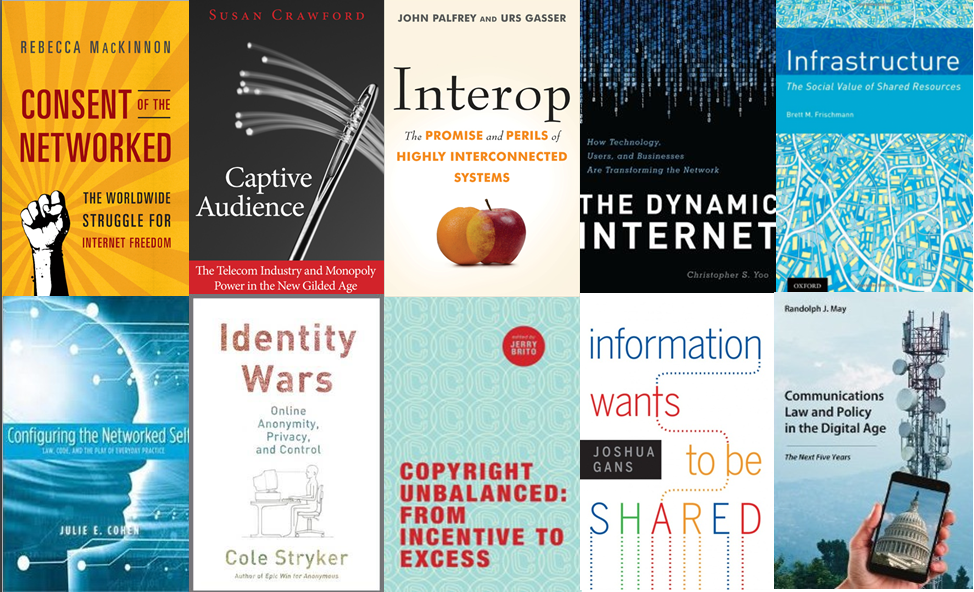
The number of major cyberlaw and information tech policy books being published annually continues to grow at an astonishing pace, so much so that I have lost the ability to read and review all of them. In past years, I put together end-of-year lists of important info-tech policy books (here are the lists for 2008, 2009, 2010, and 2011) and I was fairly confident I had read just about everything of importance that was out there (at least that was available in the U.S.). But last year that became a real struggle for me and this year it became an impossibility. A decade ago, there was merely a trickle of Internet policy books coming out each year. Then the trickle turned into a steady stream. Now it has turned into a flood. Thus, I’ve had to become far more selective about what is on my reading list. (This is also because the volume of journal articles about info-tech policy matters has increased exponentially at the same time.)
So, here’s what I’m going to do. I’m going to discuss what I regard to be the five most important titles of 2012, briefly summarize a half dozen others that I’ve read, and then I’m just going to list the rest of the books out there. I’ve read most of them but I have placed an asterisk next to the ones I haven’t. Please let me know what titles I have missed so that I can add them to the list. (Incidentally, here’s my compendium of all the major tech policy books from the 2000s and here’s the running list of all my book reviews.)
Continue reading →
Earlier today on Twitter, I listed what I thought were the Top 5 “Biggest Internet Policy Issues of 2012.” In case you don’t follow me on Twitter — and shame on you if you don’t! — here were my choices:
- Copyright wars reinvigorated post-SOPA; tide starting to turn in favor of copyright reform. [TLF posts on copyright.]
- Privacy still red-hot w ECPA reform, online advertising regs & kids’ privacy issues all pending. [TLF posts on privacy.]
- WCIT makes Internet governance / NetFreedom a major issue worldwide. [TLF posts on Net governance.]
- Antitrust threat looms larger w pending Google case + Apple books investigation. [TLF posts on antitrust.]
- Cybersecurity regulatory push continues in both legislative (CISPA) & executive branch. [TLF posts on cybersecurity.]
Lists like these are entirely subjective, of course, but I am basing my list on the general amount of chatter I tended to see and hear about each topic over the course of the year.
What do you think the top tech policy issues of the year were?
 [Updated 7/10/14: See new addendum at bottom. Updated 4/28/13: Included links to several things + started list of additional resources at end.]
Each year I am contacted by dozens of people who are looking to break into the field of information technology policy as a think tank analyst, a research fellow at an academic institution, or even as an activist. Some of the people who contact me I already know; most of them I don’t. Some are free-marketeers, but a surprising number of them are independent analysts or even activist-minded Lefties. Some of them are students; others are current professionals looking to change fields (usually because they are stuck in boring job that doesn’t let them channel their intellectual energies in a positive way). Some are lawyers; others are economists, and a growing number are computer science or engineering grads. In sum, it’s a crazy assortment of inquiries I get from people, unified only by their shared desire to move into this exciting field of public policy.
I always do my best to answer their emails, calls, and requests for meetings. Unfortunately, there’s only so much time in the day and I am sometimes not able to get back to all of them. I always feel bad about that, so, this essay is an effort to gather my thoughts and advice and put it all one place so that I will at least have something to send these folks. Perhaps I’ll try to update it over time.
#1) Understand that Specialization Matters
I don’t want to bury the lede here, so let me start with the most important piece of advice I share with everyone who contacts me:
specialization matters. When I got started in the sleepy field of information technology policy back in 1991, it was possible to be a jack-of-all-trades. There were only a few issues that really mattered, and most of them were tied up with traditional communications and media policy. If you knew a little something about telephony, universal service subsidies, spectrum policy, and broadcast regulation, then you could be an analyst in this field. There were only a handful of people in the think tank world back then who even cared about such issues. Continue reading →
In my last post, I discussed an outstanding new paper from Ronald Cass on “Antitrust for High-Tech and Low: Regulation, Innovation, and Risk
.” As I noted, it’s one of the best things I’ve ever read about the relationship between antitrust regulation and the modern information economy. That got me thinking about what other papers on this topic that I might recommend to others. So, for what it’s worth, here are the 12 papers that have most influenced my own thinking on the issue. (If you have other suggestions for what belongs on the list, let me know. No reason to keep it limited to just 12.)
- J. Gregory Sidak & David J. Teece, “Dynamic Competition in Antitrust Law,” 5 Journal of Competition Law & Economics (2009).
- Geoffrey A. Manne & Joshua D. Wright, “Innovation and the Limits of Antitrust,” 6 Journal of Competition Law & Economics, (2010): 153
- Joshua D. Wright, “Antitrust, Multi-Dimensional Competition, and Innovation: Do We Have an Antitrust-Relevant Theory of Competition Now?” (August 2009).
- Daniel F. Spulber, “Unlocking Technology: Antitrust and Innovation,” 4(4) Journal of Competition Law & Economics, (2008): 915.
- Ronald Cass, “Antitrust for High-Tech and Low: Regulation, Innovation, and Risk
,” 9(2) Journal of Law, Economics and Policy, Forthcoming (Spring 2012)
- Richard Posner, “Antitrust in the New Economy,” 68 Antitrust Law Journal, (2001).
- Stan J. Liebowitz & Stephen E. Margolis,”Path Dependence, Lock-in, and History,” 11(1) Journal of Law, Economics and Organization, (April 1995): 205-26.
- Robert Crandall and Charles Jackson, “Antitrust in High-Tech Industries,” Technology Policy Institute (December 2010).
- Bruce Owen, “Antitrust and Vertical Integration in ‘New Economy’ Industries,” Technology Policy Institute (November 2010).
- Douglas H. Ginsburg & Joshua D. Wright, “Dynamic Analysis and the Limits of Antitrust Institutions,” 78 (1) Antitrust Law Journal (2012): 1-21.
- Thomas Hazlett, David Teece, Leonard Waverman, “Walled Garden Rivalry: The Creation of Mobile Network Ecosystems,” George Mason University Law and Economics Research Paper Series, (November 21, 2011), No. 11-50.
- David S. Evans, “The Antitrust Economics of Two Sided Markets.”
 I’m pretty rough on all the Internet and info-tech policy books that I review. There are two reasons for that. First, the vast majority of tech policy books being written today should never have been books in the first place. Most of them would have worked just fine as long-form (magazine-length) essays. Too many authors stretch a promising thesis into a long-winded, highly repetitive narrative just to say they’ve written an entire book about a subject. Second, many info-tech policy books are poorly written or poorly argued. I’m not going to name names, but I am frequently unimpressed by the quality of many books being published today about digital technology and online policy issues.
The books of Harvard University cyberlaw scholars John Palfrey and Urs Gasser offer a welcome break from this mold. Their recent books, Born Digital: Understanding the First Generation of Digital Natives, and Interop: The Promise and Perils of Highly Interconnected Systems, are engaging and extremely well-written books that deserve to be books. There’s no wasted space or mindless filler. It’s all substantive and it’s all interesting. I encourage aspiring tech policy authors to examine their works for a model of how a book should be done.
In a 2008 review, I heaped praise on Born Digital and declared that this “fine early history of this generation serves as a starting point for any conversation about how to mentor the children of the Web.” I still recommend highly to others today. I’m going to be a bit more critical of their new book, Interop, but I assure you that it is a text you absolutely must have on your shelf if you follow digital policy debates. It’s a supremely balanced treatment of a complicated and sometimes quite contentious set of information policy issues.
In the end, however, I am concerned about the open-ended nature of the standard that Palfrey and Gasser develop to determine when government should intervene to manage or mandate interoperability between or among information systems. I’ll push back against their amorphous theory of “optimal interoperability” and offer an alternative framework that suggests patience, humility, and openness to ongoing marketplace experimentation as the primary public policy virtues that lawmakers should instead embrace. Continue reading →
Wow, what a year for cyberlaw and information technology policy books! Both in terms of number of titles and the gravity of the books released, 2010 was one of the biggest years of the past decade (perhaps matched only by 2006 or 2008 in terms of significance). So, here’s my annual list of the Most Important Info-Tech Policy Books of 2010.
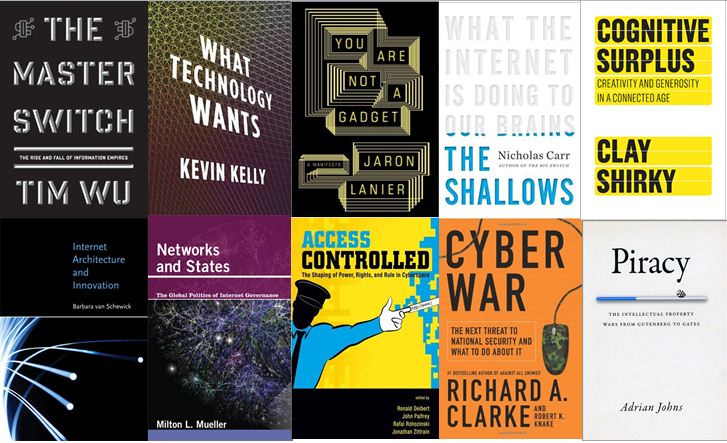 First, however, as is the case each year [see my 2008 & 2009 lists], I need to repeat a few disclaimers. First, what qualifies as an “important” info-tech policy book is highly subjective, but I would define it as a title that many people — especially scholars in the field — are currently discussing and that we will likely be referencing for many years to come. But I “weight” books in the sense that narrowly-focused titles lose a few points. For example, books that deal mostly with privacy issues, copyright law, or antitrust policy do not exactly qualify as the same sort of “info-tech policy book” as other titles that offer a broader exploration of policy issues / concerns. For that reason, “big picture” info-tech policy books tend to rank higher on my lists.
The second caveat: Merely because a book appears on my list
it does not necessarily mean I agree with everything in it. In fact, as was the case in previous years, I found much with which to disagree in my picks for the most important books of 2010 and I find that the cyber-libertarianism I subscribe to has very few fans out there.
With those caveats in mind, here are my choices for the Most Important Info-Tech Policy Books of 2010. Continue reading →
PFF today released the fifth installment in our ongoing series on “The Wrong Way to Reinvent Media.” This series of papers explores various tax and regulatory proposals that would have government play an expanded role in supporting the press, journalism, or other media content. In the latest essay, Berin Szoka, Ken Ferree, and I discuss proposals for direct subsidies for failing media outlets and out-of-work journalists.
We argue taxpayer support for failing outlets and unemployed journalists implicates significant First Amendment concerns. On the whole, subsidies can make “journalists and media operators more dependent upon the State; compromise press independence and diminish public trust in the free press; and result in government discrimination in the politically inescapable dilemma of determining eligibility for subsidies.” Such an agenda would also entail huge cost to taxpayers—initially about $35 billion per year according to advocates—and would represent “a massive wealth transfer from one class of speakers to another…”
We warn that calls for seemingly beneficent bailouts “to save” the media and journalism may actually be driven by those who have something more nefarious in mind: a “post-corporate” world shorn of media capitalists, and “such radicalism must be rejected if we hope to sustain a truly free press and uphold America’s proud tradition of keeping a high and tight wall of separation between Press and State.”
The ideas within these and other essays in the series will be worked into a major PFF filing in the Federal Communications Commission’s (FCC) proceeding on the “Future of Media” on May 7. The paper may be viewed online here and I’ve attached it down below in a Scribd reader.
Continue reading →


 The Technology Liberation Front is the tech policy blog dedicated to keeping politicians' hands off the 'net and everything else related to technology.