James Barrat, author of Our Final Invention: Artificial Intelligence and the End of the Human Era, discusses the future of Artificial Intelligence (AI). Barrat takes a look at how to create friendly AI with human characteristics, which other countries are developing AI, and what we could expect with the arrival of the Singularity. He also touches on the evolution of AI and how companies like Google and IBM and government entities like DARPA and the NSA are developing artificial general intelligence devices right now.
Download
Related Links
I didn’t have nearly as much time this year to review the steadily growing stream of information policy books that were released. The end-of-year lists I put together in the past were fairly comprehensive (see 2008, 2009, 2010, 2011 and 2012), but I got sidetracked this year with 7 law review articles and an eBook project and had almost no time for book reviews, or even general blogging for that matter.
So, I’ve just listed some of the more notable titles from 2013 even though I didn’t find the time to describe them all. The first couple are the titles that I believe will have the most lasting influence on information technology policy debates. Needless to say, just because I believe that some of these titles will have an impact on policy going forward does not mean I endorse the perspectives or recommendations in any of them. And that would certainly be the case with my choice for most important Net policy book of the year, Ian Brown and Chris Marsden’s
Regulating Code. Their book does a wonderful job mapping the unfolding universe of Internet “co-regulation” and “multi-stakeholderism,” but their defense of a more politicized information policy future leaves lovers of liberty like me utterly demoralized.
The same could be said of many other titles on the list. As I noted in concluding several reviews over the past year, liberty is increasingly a loser in Internet policy circles these days. And it’s not just neo-Marxist rants like McChesney’s
Digital Disconnect or Lanier’s restatement of the Unibomber Manifesto, Who Owns the Future? The sad reality is that pretty much everybody these days has a pet peeve they want addressed through pure power politics because, you know, something must be done! The very term “Internet freedom” has already been grotesquely contorted into something akin to an open mandate for governments to meticulously plan virtually every facet of economic and social activity in the Information Age.
Anyway, despite that caveat, many interesting books were released in 2013 on an ever-expanding array of specific information policy topics. Here’s the list of everything that landed on my desk over the past year. Continue reading →
Here are a few Internet policy essays I collected over the past year which I thought were particularly well done and worth highlighting once more. They are listed in chronological order:
- L. Gordon Crovitz – “Silicon Valley’s ‘Suicide Impulse,'” Wall Street Journal, January 28. (“It’s a measure of how far Silicon Valley has strayed from its entrepreneurial roots that a top regulator is calling on technology companies to do less lobbying and more competing,” Crovitz argued. “Rather than lobby government to go after one another, Silicon Valley lobbyists should unite to go after overreaching government. Instead of the “suicide impulse” of lobbying for more regulation, Silicon Valley should seek deregulation and a long-overdue freedom to return to its entrepreneurial roots.”)
- John Gruber – “Open and Shut,” Daring Fireball, March 1. (An absolutely brutal evisceration of Tim Wu’s recent work.)
- R. U. Sirius – “Cypherpunk Rising: WikiLeaks, Encryption, and the Coming Surveillance Dystopia,” The Verge, March 7.
- Julian Sanchez – “A Reply to Epstein & Pilon on NSA’s Metadata Program,” Cato at Liberty, June 16. (A meticulous point-by-point takedown of an essay by Roger Pilon & Richard Epstein defending NSA’s online surveillance tactics.)
- Ethan Zuckerman – “Is Cybertopianism Really Such a Bad Thing?” Slate, June 17 (A “defense of believing that technology can do good.”)
Continue reading →
Anupam Chander, Director of the California International Law Center and Martin Luther King, Jr. Hall Research Scholar at the UC Davis School of Law, discusses his recent paper with co-author Uyen P. Lee titled The Free Speech Foundations of Cyberlaw. Chander addresses how the first amendment promotes innovation on the Internet; how limitations to free speech vary between the US and Europe; the role of online intermediaries in promoting and protecting the first amendment; the Communications Decency Act; technology, piracy, and copyright protection; and the tension between privacy and free speech.
Download
Related Links
Much of my recent research and writing has been focused on the contrast between “permissionless innovation” (the notion that innovation should generally be allowed by default) versus its antithesis, the “precautionary principle” (the idea that new innovations should be discouraged or even disallowed until their developers can prove that they won’t cause any harms). I have discussed this dichotomy in three recent law review articles, a couple of major agency filings, and several blog posts. Those essays are listed at the end of this post.
In this essay, I want to discuss a recent speech by Federal Trade Commission (FTC) Chairwoman Edith Ramirez and show how precautionary principle thinking is increasingly creeping into modern information technology policy discussions, prompted by the various privacy concerns surrounding “big data” and the “Internet of Things” among other information innovations and digital developments.
First, let me recap the core argument I make in my recent articles and filings. It can be summarized as follows: Continue reading →
Timothy B. Lee, founder of The Washington Post’s blog The Switch discusses his approach to reporting at the intersection of technology and policy. He covers how to make tech concepts more accessible; the difference between blogs and the news; the importance of investigative journalism in the tech space; whether paywalls are here to stay; Jeff Bezos’ recent purchase of The Washington Post; and the future of print news.
Download
Related Links
Sherwin Siy, Vice President of Legal Affairs at Public Knowledge, discusses emerging issues in digital copyright policy. He addresses the Department of Commerce’s recent green paper on digital copyright, including the need to reform copyright laws in light of new technologies. This podcast also covers the DMCA, online streaming, piracy, cell phone unlocking, fair use recognition, digital ownership, and what we’ve learned about copyright policy from the SOPA debate.
Download
Related Links
 What works well as an ethical directive might not work equally well as a policy prescription. Stated differently, what one ought to do it certain situations should not always be synonymous with what they must do by force of law.
I’m going to relate this lesson to tech policy debates in a moment, but let’s first think of an example of how this lesson applies more generally. Consider the Ten Commandments. Some of them make excellent ethical guidelines (especially the stuff about not coveting neighbor’s house, wife, or possessions). But most of us would agree that, in a free and tolerant society, only two of the Ten Commandments make good law:
Thou shalt not kill and Thou shalt not steal.
In other words, not every sin should be a crime. Perhaps
some should be; but most should not. Taking this out of the realm of religion and into the world of moral philosophy, we can apply the lesson more generally as: Not every wise ethical principle makes for wise public policy. Continue reading →

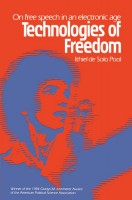 I was honored to be asked by the editors at Reason magazine to be a part of their “Revolutionary Reading” roundup of “The 9 Most Transformative Books of the Last 45 Years.” Reason is celebrating its 45th anniversary and running a wide variety of essays looking back at how liberty has fared over the past half-century. The magazine notes that “Statism has hardly gone away, but the movement to roll it back is stronger than ever.” For this particular feature, Reason’s editors “asked seven libertarians to recommend some of the books in different fields that made [the anti-statist] cultural and intellectual revolution possible.”
When Jesse Walker of
Reason first contacted me about contributing my thoughts about which technology policy books made the biggest difference, I told him I knew exactly what my choices would be: Ithiel de Sola Pool’s Technologies of Freedom (1983) and Virginia Postrel’s The Future and Its Enemies (1998). Faithful readers of this blog know all too well how much I love these two books and how I am constantly reminding people of their intellectual importance all these years later. (See, for example, this and this.) All my thinking and writing about tech policy over the past two decades has been shaped by the bold vision and recommendations set forth by Pool and Postrel in these beautiful books.
As I note in my
Reason write-up of the books: Continue reading →
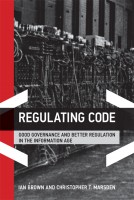 Ian Brown and Christopher T. Marsden’s new book, Regulating Code: Good Governance and Better Regulation in the Information Age, will go down as one of the most important Internet policy books of 2013 for two reasons. First, their book offers an excellent overview of how Internet regulation has unfolded on five different fronts: privacy and data protection; copyright; content censorship; social networks and user-generated content issues; and net neutrality regulation. They craft detailed case studies that incorporate important insights about how countries across the globe are dealing with these issues. Second, the authors endorse a specific normative approach to Net governance that they argue is taking hold across these policy arenas. They call their preferred policy paradigm “prosumer law” and it envisions an active role for governments, which they think should pursue “smarter regulation” of code.
In terms of organization, Brown and Marsden’s book follows the same format found in Milton Mueller’s important 2010 book Networks and States: The Global Politics of Internet Governance; both books feature meaty case studies in the middle bookended by chapters that endorse a specific approach to Internet policymaking. (Incidentally, both books were published by MIT Press.) And, also like Mueller’s book, Brown and Marsden’s Regulating Code does a somewhat better job using case studies to explore the forces shaping Internet policy across the globe than it does making the normative case for their preferred approach to these issues. Continue reading →



 The Technology Liberation Front is the tech policy blog dedicated to keeping politicians' hands off the 'net and everything else related to technology.