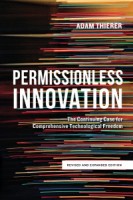
I am pleased to announce the release of the second edition of my book, Permissionless Innovation: The Continuing Case for Comprehensive Technological Freedom. As with the first edition, the book represents a short manifesto that condenses — and attempts to make more accessible — arguments that I have developed in various law review articles, working papers, and blog posts over the past few years. The book attempts to accomplish two major goals.
First, I attempt to show how the central fault line in almost all modern technology policy debates revolves around “the permission question,” which asks:
Must the creators of new technologies seek the blessing of public officials before they develop and deploy their innovations? How that question is answered depends on the disposition one adopts toward new inventions. Two conflicting attitudes are evident.
One disposition is known as the “precautionary principle.” Generally speaking, it refers to the belief that new innovations should be curtailed or disallowed until their developers can prove that they will not cause any harms to individuals, groups, specific entities, cultural norms, or various existing laws, norms, or traditions.
The other vision can be labeled “permissionless innovation.” It refers to the notion that experimentation with new technologies and business models should generally be permitted by default. Unless a compelling case can be made that a new invention will bring serious harm to society, innovation should be allowed to continue unabated and problems, if they develop at all, can be addressed later.
I argue that we are witnessing a grand clash of visions between these two mindsets today in almost all major technology policy discussions today. Continue reading →
Throughout the year, I collect some of the more notable tech policy-related essays that I’ve read and then publish an end-of-year list here. (Here, for example, are my end-of-year lists from 2014 and 2013.) So, here are some of my favorite essays and editorials from 2015. (Note: They are just in chronological order. No ranking here.)
Larry Downes – “Take note Republicans and Democrats, this is what a pro-innovation platform looks like,” Washington Post, January 7. (Downes explains how governments need to adapt to accommodate and embrace new forms of technological innovation. He notes: “Here at home, the opportunity to wrap themselves in the flag of innovation is knocking for both parties, but so far there are few takers. Republicans and Democrats regularly invoke the rhetoric of innovation, entrepreneurship, and the transformative power of technology. But in reality neither party pursues policies that favor the disruptors. Instead, where lawmakers once took a largely hands-off approach to Silicon Valley, as the Internet revolution enters a new stage of industry transformation, the temptation to intervene, to usurp, to micromanage, to circumscribe the future — becomes irresistible.”) Equally excellent was Larry’s essay later in the year, “Fewer, Faster, Smarter.” (“As the technology revolution proceeds, the concept of government may return to its pre-industrial roots, setting the most basic rules of the economy and standing by as regulator of last resort when markets fail for some or all consumers over an extended period of time. Even then, the solution may simply be to tweak the incentives to encourage better behavior, rather than more full-fledged—and usually ill-fated—micromanagement of fast-changing industries.”)
Bryant Walker Smith – “Slow Down That Runaway Ethical Trolley,” CIS Blog, January 12. (Smith, a leading expert on autonomous vehicle systems, notes that, while serious ethical dilemmas will always be present with such technologies, we should not allow the perfect to be the enemy of the good. “The fundamental ethical question, in my opinion, is this: In the United States alone, tens of thousands of people die in motor vehicle crashes every year, and many more are injured. Automated vehicles have great potential to one day reduce this toll, but the path to this point will involve mistakes and crashes and fatalities. Given this stark choice, what is the proper balance between caution and urgency in bringing these systems to the market? How safe is safe enough?”)
Andrew McAfee – “Who are the humanists, and why do they dislike technology so much?” Financial Times, July 7, 2015. (A brief but brilliant exploration of the philosophical fight over differing conceptions of “humanism.” McAfee, appropriately in my opinion, calls into question technological critics who self-label themselves “humanists” and then suggest that those who believe in the benefits of technological innovation and progress are somehow opposed to humanity. In reality, of course, nothing could be further from the truth!)
Jocelyn Brewer – “Techno-Fear is Hurting Kids, Not Their Use of Digital Devices,” July 7, 2015. (A beautiful piece that makes it clear why “the Internet… is not addictive. Technology is not a drug.” Brewer continues on to make the case for avoiding fear-based messaging about Internet problems and instead adopting a more sensible approach: “Rather than trotting out interminable lists of the negative consequences of our adoption of technology lets raise awareness of how to avoid the pitfalls of not approaching this new era with solutions and proactive thinking.” Amen, sister!)
Evan Ackerman – “We Should Not Ban ‘Killer Robots,’ and Here’s Why,” IEEE Spectrum, July 29, 2015, (A thought-provoking piece about a controversial subject in which Ackerman argues that “banning the technology is not going to solve the problem if the problem is the willingness of humans to use technology for evil”)
Tim O’Reilly – “Networks and the Nature of the Firm,” Medium, August 14, 2015. (Explores the economics of the sharing economy and “the huge economic shift led by software and connectedness.”)
Joe Queenan – “America’s Need for Pointless Updates and Cat Videos,” Wall Street Journal, December 3, 2015. (“The back-to-nature, turn-off-your-cellphone movement is based on a false assumption. . . . Time not spent doing dumb stuff would otherwise be wasted doing other dumb stuff. It’s called ‘play,’ without which Jack is a dull boy. It is a variation on the old saying that nature abhors a vacuum. So nature created the Internet.”)
Dominic Basulto – “Can we just stop with all these tech dystopia stories?” Washington Post, Dec 8, 2015. (“Yes, a dystopian future is possible, but so is a utopian future. Most likely, the answer is somewhere in the middle, the way it’s been for millennia.”)
I wanted to draw your attention to yet another spectacular speech by Maureen K. Ohlhausen, a Commissioner with the Federal Trade Commission (FTC). I have written here before about Commissioner Ohlhausen’s outstanding speeches, but this latest one might be her best yet.
On Tuesday, Ohlhausen was speaking at U.S. Chamber of Commerce Foundation day-long event on “The Internet of Everything: Data, Networks and Opportunities.” The conference featured various keynote speakers and panels discussing, “the many ways that data and Internet connectiviting is changing the face of business and society.” (It was my honor to also be invited to deliver an address to the crowd that day.)
As with many of her other recent addresses, Commissioner Ohlhausen stressed why it is so important that policymakers “approach new technologies and new business models with regulatory humility.” Building on the work of the great Austrian economist F.A. Hayek, who won a Nobel prize in part for his work explaining the limits of our knowledge to plan societies and economies, Ohlhausen argues that: Continue reading →
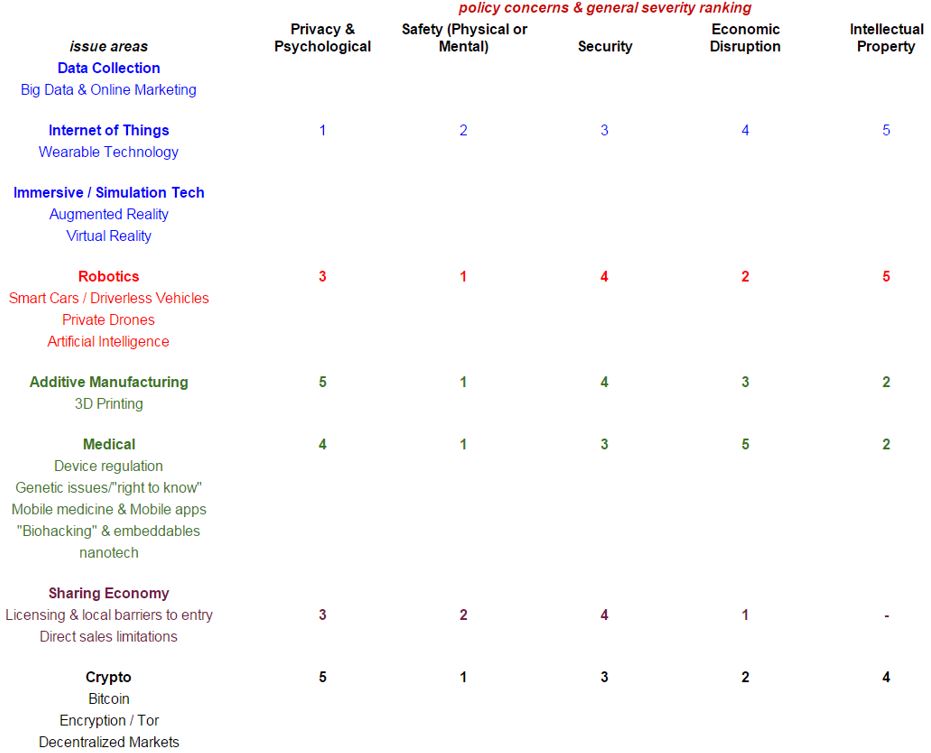
On the whiteboard that hangs in my office, I have a giant matrix of technology policy issues and the various policy “threat vectors” that might end up driving regulation of particular technologies or sectors. Along with my colleagues at the Mercatus Center’s Technology Policy Program, we constantly revise this list of policy priorities and simultaneously make an (obviously quite subjective) attempt to put some weights on the potential policy severity associated with each threat of intervention. The matrix looks like this: [Sorry about the small fonts. You can click on the image to make it easier to see.]
I use 5 general policy concerns when considering the likelihood of regulatory intervention in any given area. Those policy concerns are:
privacy (reputation issues, fear of “profiling” & “discrimination,” amorphous psychological / cognitive harms);
safety (health & physical safety or, alternatively, child safety and speech / cultural concerns);
security (hacking, cybersecurity, law enforcement issues);
The FTC has now posted the videos from their workshop and down below I have embedded my particular panel. My remarks begin around the 5-minute mark of the video.
Last Wednesday, it was my great pleasure to testify at a Senate Commerce Committee hearing entitled, “The Connected World: Examining the Internet of Things.” The hearing focused “on how devices… will be made smarter and more dynamic through Internet technologies. Government agencies like the Federal Trade Commission, however, are already considering possible changes to the law that could have the unintended consequence of slowing innovation.”
But the session went well beyond the Internet of Things and became a much more wide-ranging discussion about how America can maintain its global leadership for the next-generation of Internet-enabled, data-driven innovation. On both sides of the aisle at last week’s hearing, one Senator after another made impassioned remarks about the enormous innovation opportunities that were out there. While doing so, they highlighted not just the opportunities emanating out of the IoT and wearable device space, but also many other areas, such as connected cars, commercial drones, and next-generation spectrum.
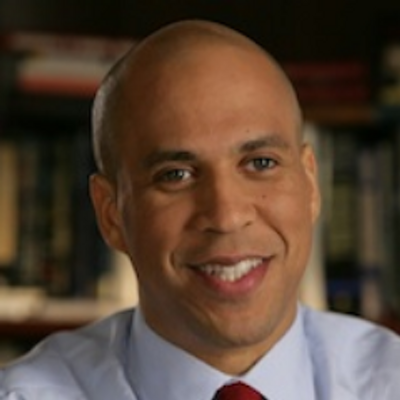
I was impressed by the energy and nonpartisan vision that the Senators brought to these issues, but I wanted to single out the passionate statement that Sen. Cory Booker (D-NJ) delivered when it came his turn to speak because he very eloquently articulated what’s at stake in the battle for global innovation supremacy in the modern economy. (Sen. Booker’s remarks were not published, but you can watch them starting at the 1:34:00 mark of the hearing video.) Continue reading →
I’ve spent much of the past year studying the potential public policy ramifications associated with the rise of the Internet of Things (IoT). As I was preparing some notes for my Jan. 6th panel discussing on “Privacy and the IoT: Navigating Policy Issues” at this year’s 2015 CES show, I went back and collected all my writing on IoT issues so that I would have everything in one place. Thus, down below I have listed most of what I’ve done over the past year or so. Most of this writing is focused on the privacy and security implications of the Internet of Things, and wearable technologies in particular.
I plan to stay on top of these issues in 2015 and beyond because, as I noted when I spoke on a previous CES panel on these issues, the Internet of Things finds itself at the center of what we might think of a perfect storm of public policy concerns: Privacy, safety, security, intellectual property, economic / labor disruptions, automation concerns, wireless spectrum issues, technical standards, and more. When a new technology raises one or two of these policy concerns, innovators in those sectors can expect some interest and inquiries from lawmakers or regulators. But when a new technology potentially touches all of these issues, then it means innovators in that space can expect an avalanche of attention and a potential world of regulatory trouble. Moreover, it sets the stage for a grand “clash of visions” about the future of IoT technologies that will continue to intensify in coming months and years.
That’s why I’ll be monitoring developments closely in this field going forward. For now, here’s what I’ve done on this issue as I prepare to head out to Las Vegas for another CES extravaganza that promises to showcase so many exciting IoT technologies. Continue reading →
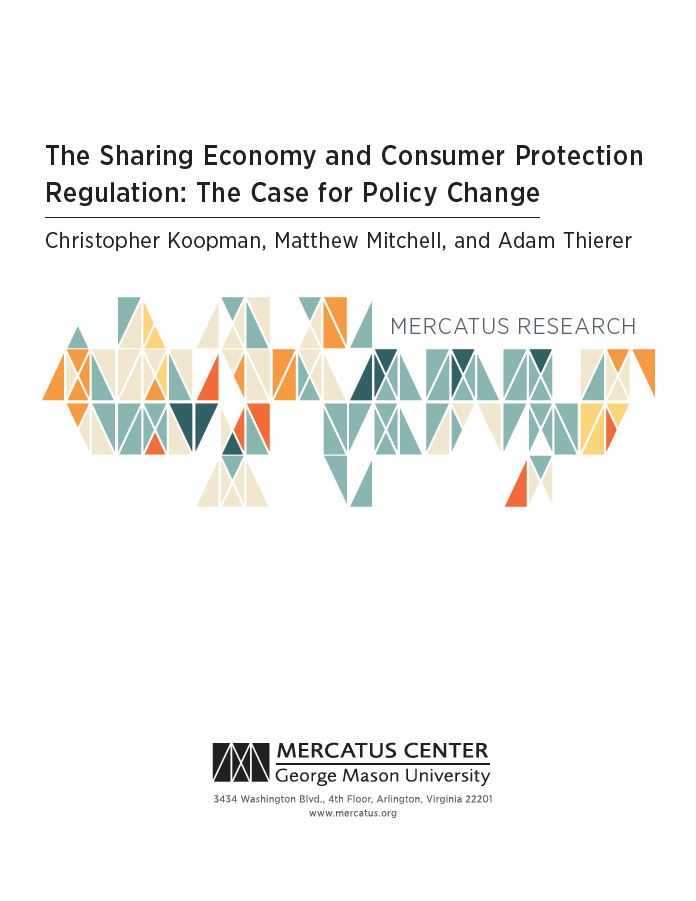
In this new paper, Koopman, Mitchell, and I discuss how the sharing economy has changed the way many Americans commute, shop, vacation, borrow, and so on. Of course, the sharing economy “has also disrupted long-established industries, from taxis to hotels, and has confounded policymakers,” we note. “In particular, regulators are trying to determine how to apply many of the traditional ‘consumer protection’ regulations to these new and innovative firms.” This has led to a major debate over the public policies that should govern the sharing economy.
We argue that, coupled with the Internet and various new informational resources, the rapid growth of the sharing economy alleviates the need for much traditional top-down regulation. These recent innovations are likely doing a much better job of serving consumer needs by offering new innovations, more choices, more service differentiation, better prices, and higher-quality services. In particular, the sharing economy and the various feedback mechanism it relies upon helps solve the tradition economic problem of “asymmetrical information,” which is often cited as a rationale for regulation. We conclude, therefore, that “the key contribution of the sharing economy is that it has overcome market imperfections without recourse to traditional forms of regulation. Continued application of these outmoded regulatory regimes is likely to harm consumers.” Continue reading →
Writing last week in The Wall Street Journal, Matt Moffett noted how many European countries continue to struggle with chronic unemployment and general economic malaise. (“New Entrepreneurs Find Pain in Spain“) It’s a dismal but highly instructive tale about how much policy incentives matter when it comes to innovation and job creation–especially the sort of entrepreneurial activity from small start-ups that is so essential for economic growth. Here’s the key takeaway:
Scarce capital, dense bureaucracy, a culture deeply averse to risk and a cratered consumer market all suppress startups in Europe. The Global Entrepreneurship Monitor, a survey of startup activity, found the percentage of the adult population involved in early stage entrepreneurial activity last year was just 5% in Germany, 4.6% in France and 3.4% in Italy. That compares with 12.7% in the U.S. Even once they are established, European businesses are, on average, smaller and slower growing than those in the U.S. The problems of entrepreneurs are one reason Europe’s economy continues to struggle after six years of crisis. The European Union this month cut its growth forecasts for the region for this year and next, citing weaker than expected performance in the eurozone’s biggest economies, Germany, France and Italy. This week, the Organization for Economic Cooperation and Development delivered its own pessimistic appraisal, with chief economist Catherine Mann saying, “The eurozone is the locus of the weakness in the global economy.”
[…]
Europe’s unemployment crisis may be eroding a deeply ingrained fear of failure that is a bigger impediment to entrepreneurship on the Continent than in other regions, according to academic surveys. “Fear of failure is less of an issue because the whole country is a failure, and most of us are out of business or have a hard time paying our bills,” said Nick Drandakis of Athens, who in 2011 founded Taxibeat, an app that provides passenger ratings on taxi drivers.
I am pleased to announce the release of my latest book, “Permissionless Innovation: The Continuing Case for Comprehensive Technological Freedom.” It’s a short manifesto (just under 100 pages) that condenses — and attempts to make more accessible — arguments that I have developed in various law review articles, working papers, and blog posts over the past few years. I have two goals with this book.
First, I attempt to show how the central fault line in almost all modern technology policy debates revolves around “the permission question,” which asks:
Must the creators of new technologies seek the blessing of public officials before they develop and deploy their innovations? How that question is answered depends on the disposition one adopts toward new inventions. Two conflicting attitudes are evident.
One disposition is known as the “precautionary principle.” Generally speaking, it refers to the belief that new innovations should be curtailed or disallowed until their developers can prove that they will not cause any harms to individuals, groups, specific entities, cultural norms, or various existing laws, norms, or traditions.
The other vision can be labeled “permissionless innovation.” It refers to the notion that experimentation with new technologies and business models should generally be permitted by default. Unless a compelling case can be made that a new invention will bring serious harm to society, innovation should be allowed to continue unabated and problems, if they develop at all, can be addressed later.
I argue that we are witnessing a grand clash of visions between these two mindsets today in almost all major technology policy discussions today. Continue reading →
The Technology Liberation Front is the tech policy blog dedicated to keeping politicians' hands off the 'net and everything else related to technology. Learn more about TLF →



 The Technology Liberation Front is the tech policy blog dedicated to keeping politicians' hands off the 'net and everything else related to technology.