Posts tagged as:

Internet policy Shame Artist extraordinaire Chris Soghoian has struck again! Chris recently shamed the online advertising industry into improving their privacy practices with his Targeted Advertising Cookie Opt-Out (TACO) plug-in for Firefox. Now Chris has set his sight on the security practices of cloud service providers.

A letter released this morning, signed by 37 leading online security experts (and organized by Chris), calls on Google to offer persistent SSL (HTTPS) encryption by default for all Google servicesor at the very least, to make more visible the option currently given to users to opt-in to use SSL for all communications. Google, in its response, indicated that it was already “looking into whether it would make sense to turn on HTTPS as the default for all Gmail users.”

While Google’s response identifies some clear problems with implementing persistent SSL for all users (esp. connection speed), few would deny that it makes sense for webmail providers to encrypt all traffic using SSL, rather than sending email data “in the clear,” which risks interception by hackers. We at PFF hold no brief for Google, in fact we have found ourselves disagreeing with them on many other occasions on a range of issues (most notably net neutrality mandates). Nonetheless, on this front, Google has long been a leader, having offered SSL since Gmail launched and having begun providing the persistent HTTPS option last summer while most of their competitors still use SSL only for the initial authentication that occurs when a user first signs in. While the letter focuses on Google and webmail in particular, this issue has far broader implications for all online cloud service providers.

No Free Lunch: The Costs of Encryption Gmail, Yahoo! Mail, Hotmail, etc. are, of course, “free” ( i.e., ad-supported). Google in particular has lead the way in increasing the functionality offered in Gmail, not just constantly increasing the total storage space provided to every user (now over 7GB), but regularly adding innovative new features—at no charge to users. Continue reading →

Google has announced that it will soon begin allowing U.S. advertisers to use trademarked keywords in limited circumstances in text ads, much as Yahoo! already does.  Google currently allow advertisers to bid on trademarked terms as keywords that could cause an ad to appear, either next to Google search results or on a third-party publisher’s website.  That policy will not change, and is discussed here by my PFF colleague Sid Rosenzweig.  The new policy is focused on the text seen by users in ads themselves and applies only if the “landing page” (to which the ad links) is used by a reseller, aggregator or parts supplier to sell only products that are relevant to the mark in question, or if the page is used to provide impartial reviews or other information about the trademarked product.  The new policy does not apply to sites/pages that (a) facilitate the sale of counterfeit goods, (b) allow the sale of a competitor’s goods, (c) criticize the trademarked good, or (d) do not provide substantial information or a purchase option.  Despite these limitations and other safeguards, Google has been sharply criticized by some trademark holders and might even be sued (e.g., for contributory infringement).

I’ll defer to the real trademark lawyers to figure out whether Google is correct that its new policy falls within the bounds of trademark law (particularly the “nominative fair use” doctrine).  But since Adam Thierer and I have been involved in an ongoing defense of online advertising against those who would squelch it through regulation in the name of privacy concerns (not at play here), I think it’s important to highlight the potential benefits to users from this seemingly arcane policy change-and to consider what this episode says about online advertising generally.  I see three main benefits to consumers from the policy change that should be considered alongside the vitally important role that trademarks play in our economy in communicating reputational information.

First, Google’s new policy will allow consumers to find products more easily because advertisers will be able to offer more descriptive and therefore informative ads, mentioning what they sell by name. Continue reading →

Is $1,200,000,000,000.00.  That’s the expected 2009 Federal budget deficit.  Since the current Federal debt is estimated at a “mere” $10.6 trillion, this means that we’re expected to add nearly 9% in a single year to a debt accumulated over 233 years (since 1774).  This number also amounts to more than 8% of the U.S. economy. 

So what does this have to do with technology policy?  To start with, this figure comes from Congressional Budget Office estimates, which “don’t account for the huge economic stimulus bill Obama is expected to propose soon to try to jolt the economy.”  So, while the Obama team has talked about big “public works” and “infrastructure” spending (which used to be called, variously, “make-work,” “pork barrel” and “corporate welfare”), there’s sure to be huge pressure not to waste more taxpayer money on top of this staggering figure.  Whatever blame Bush deserves, Obama probably doesn’t want to go down in history as the man who finally caused the U.S. government to default on its unmanageable debt burden.

One certainly could make an argument that the kind of technology-related “infrastructure” stimulus Obama has talked about (e.g., broadband subsidies) would be less of a waste of money than, say, simply building more bridges (as Japan did in the 1990s, its “lost decade”) or other reflexively Keynesian responses.  But even so, I suspect that the total amount of funding made available for such projects won’t be anywhere near enough to satisfy the technology policy Left.  

This could result in increased pressure on the Administration to increase regulation of the technology sector in order to implement tech-leftist ideas about “protecting” users’ privacy, promoting media diversity or “fairness”, mandating net “neutrality,” “opening up” spectrum, etc.  Such  proposals might seem attractive precisely because they generally wouldn’t require increased Federal expenditures other than the cost of hiring more bureaucrats (which means more government employee union jobs anyway—hardly a bad thing for Democrats)—while the economic consequences of such proposals for companies and consumers will probably surely be trivialized.  For example, if the advocates of government control at the so-called “Free Press” can’t get universal broadband, they’ll probably press that much harder to cripple online advertising and traffic management by ISPs, just to name two popular bogeymen.obamas-new-new-deal

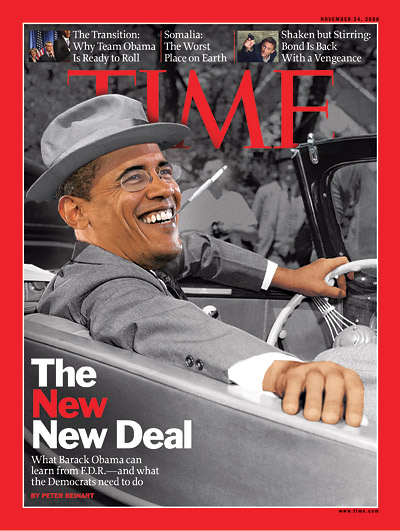
One might think that a sharp economic decline would cause policy-makers to think twice before undermining the business models that have supported IT innovation and real infrastructure investment.  But one has only to look at the policies of FDR’s first two terms to see how even an amiable, soft-spoken president elected on a mantra of change and “uniting” the nation in a time of crisis could consistently choose to place “Reform” (i.e., increased regulation) over “Recovery” (i.e., the health of the economy)—with devastating economic consequences.

Continue reading →

Microsoft’s share of the browser market across all versions of Internet Explorer has dropped, by one estimate, dropped from 78.58%  in December 2007 to 68.15% in December 2008 (or by just under 8% in another estimate).

[IE’s] share dropped from 69.77% in November to 68.15% in December. [During the same period,] Firefox gained more than half a point and ended up at 21.34%, Safari approaches the [10%] hurdle with 7.93% and Chrome came in at 1.04%, the first time Google was able to cross the 1% mark.

This is particularly interesting: 

Since IE6 is used primarily within corporations, its market share is much higher during the week than it is on weekends. As a result, all other browsers gain on weekends and especially during a holiday. Because of that circumstance, Net Applications noted that the December numbers should be taken with a grain of salt. However, it is worth the note that IE6 achieved … market share numbers of about 28% during the week and about 21% on weekends in early 2008. In December, these numbers were down to about 20% during the week and 15% on weekends.    

So, Microsoft still has an established base among corporate users, where IT administrators  generally prevent employees from installing new applications (including browsers) and the sysadmins often don’t roll out alternative browsers across a corporate network for any one of several possible reasons, including:

  • They just don’t want to bother having to install, regularly upgrade and support another piece of software;
  • They may overestimate the security vulnerability of such alternative browsers compared to Internet Explorer;
  • The crustier sysadmins may not realize that today’s browsers are not only free for individual users, but also for corporate users–unlike the old Netscape Navigator; and
  • Corporate intranets may be designed for IE, in which case rolling out an alternative browser might cause confusion among less tech-savvy employees.

Microsoft may still have an advantage that could be considered “unfair,” but so what?   Continue reading →

My Kid is the Man of Steel!

My Kid is the Man of Steel! ... in his mind.

Regular readers will recall my great interest in video games and the public policy debates surrounding efforts to regulate “violent” games in particular. One thing I bring up in almost every essay I write on this subject is how fears about kids and video games are almost always overblown and that kids can typically separate fantasy from reality. Nonetheless, kids have active imaginations and adults sometimes fear that which they cannot understand or appreciate.  Friendly mentoring and open-minding parenting can go a long way to encouraging kids to make smart choices and understand where to draw lines, whereas efforts to demonize video games and youth culture almost always backfire.

Anyway, what got me thinking about all this again was an entertaining column in today’s Washington Post by Ron Stanley (“Who Needs a TV to Play Video Games“), which describes the author’s experiences with his nephew when they played out video game-like scenarios using traditional toys and household items. It’s a wonderful piece worth reading in its entirety, but here’s the key takeaway that I’d like to discuss:

There was no evidence that television and video games had stifled the kids’ creativity. Nor was there any evidence that technology had made them smarter than earlier generations. They simply had a different frame of reference, one that included video games and computers as well as ponies, pet stores and sword fights. Children play with the tools at hand, and they’re great at thinking metaphorically — at imagining that a landspeeder is a sentient robot or that a stick is a gun or that salt-and-pepper shakers are a bride and groom or that a card table is a horse’s stable. They’re also geniuses at figuring out simple mechanics. My 6-year-old nephew had to explain to me that miniature low-rider cars don’t roll very well on carpet and will flip over more than if racing on hardwood floors. Novice that I was, I was choosing cars that looked the coolest. And they are geniuses at intuiting rules and systems, and at re-creating these rules and systems in their own play. Children who play lots of card games will invent their own card games. Children who play lots of board games will invent their own board games. And children who play lots of video games will invent their own video-game-like games when they don’t have access to the game controllers.

Continue reading →

Ken Ferree and I just filed an amicus brief with the D.C. Circuit in what could be among the most important First Amendment cases involving economic regulation in years:  Comcast’s challenge to the FCC’s cap on the maximum size of a cable operator’s nationwide subscriber-audience.  While few may feel righteous indignation at limitations targeted at large corporations such as Comcast or Time Warner, the larger principle at stake here is deeply important: Will the First Amendment provide a meaningful check on what USC law professor Chris Yoo has called “architectural censorship” (i.e., so-called “structural” regulations that “have the unintended consequence of reducing the quantity, quality, and diversity of media content”).

In a nutshell, we argue that that:

  1. The provisions of the 1992 Cable Act authorizing the FCC to impose a “cable cap” are outdated in world of media abundance and vibrant platform competition.
  2. Because cable is no longer the unique “bottleneck” or “gatekeeper” that it was in 1992, these statutory provisions (not just the FCC’s 30% rule) must be subject to strict scrutiny under the First Amendment as a limitation on free speech.
  3. Because there are “less restrictive means” of ensuring cable operators do not impede the flow of video programming to consumers, the court should strike down these provisions.
  4. Even if the court upholds the statute, it should nonetheless strike down the cap issued by the FCC in December 2007 (30% of all Multichannel Video Programming (MVPD)  subscribers as based on an outdated model of the video marketplace.

I encourage you to read our brief (below).  I’ve provided a summary below, along with some additional commentary we just couldn’t cover under our 3500 word limit.

Strict Scrutiny.  Yoo’s article Architectural Censorship and the FCC is essential reading for anyone who believes that government regulations on the size and shape of the “soapbox” can have huge effects on speech itself.   Yoo argues that the First Amendment should check this kind of regulation–however “content-neutral” it might seem–under “strict scrutiny”, which requires that the government show that a regulation is the “least restrictive means” available for advancing a “compelling government interest.”  But Yoo ultimately concludes (pp. 713-718, PDF pp. 45-50) that, under existing precedent, most “architectural censorship will be effectively insulated from meaningful judicial review.”  Continue reading →

Jesse Walker has a terrific feature story looking “Beyond the Fairness Doctrine” in this month’s issue of Reason magazine. I highly recommend it. It’s an in-depth exploration of what an Obama Administration means for the future of tech and media policy. Walker rightly opens the piece by noting that “The fairness doctrine is still dead, and it probably will stay dead even if Barack Obama becomes president.” The danger, however, is that an Obama FCC will still pursue a variety of onerous regulatory objectives that could do a great deal of damage to markets and free speech.

Walker touches upon the various issues that will likely be a priority for an Obama Administration and the Left-leaning media reformistas like Free Press, Media Access Project, Public Knowledge, and New America Foundation. Those policy issues include: net neutrality, “localism” mandates and increased “community oversight” regulations, media ownership rules, minority ownership requirements, increased merger meddling, spectrum policy, and other new “public interest” obligations.

Of course, as Walker also correctly points out, it is difficult to see how things could get much worse than they have been under Bush Administration’s FCC and the leadership of Chairman Kevin Martin.  Walker was kind enough to quote my thoughts on this point: “Martin is the most regulatory Republican FCC Chairman in decades,” I told him. “He wants to control speech and will use whatever tools he has to get there.”

I stand by those words, but I am also aware that things could get worse — much worse — under a Democratic FCC influenced by radical Leftist activists like Free Press.  Indeed, in our new book A Manifesto for Media Freedom, Brian Anderson and I inventory the many looming threats to media and technology freedom that exist today and show how most of them arise from the Left.  As Walker notes in his article, however, it is unlikely that a re-empowered Democratic FCC would come right out of the gates with the same sort of command-and-control approaches they’ve employed in the past.  And we’ll still have to worry about some right-of-center lawmakers and regulatory joining some of these misguided campaigns. “The real danger,” Walker concludes in his piece, “is more subtle and more mundane.  It’s a bipartisan bureaucracy slowly, steadily increasing its power.”    Make sure to read Jesse’s entire piece.  Great stuff.

The introduction below was originally written by Berin Szoka, but now that I (Adam Marcus) am a full-fledged TLF member, I have taken authorship.


Adam Marcus, our exceptionally tech-savvy new research assistant at PFF, has published his first piece at the PFF blog, which I reprint here for your edification.

Today Google’s DC office hosted an interesting panel on cloud computing.  What was missing was a good definition of what “cloud computing” actually is.

While Wikipedia has its own broad definition of cloud computing, many think of cloud computing more narrowly as strictly web-based for which clients need nothing but a web browser. But that definition doesn’t cover things like Skype and SETI@home.  And just because PFF has implemented Outlook Web Access so we can access the Exchange server via the Web, doesn’t necessarily mean we’ve implemented what most people might think of as “cloud computing.”  Yet these are all variations on a common theme, which leads me to propose my own basic definition: any client/server system that operates over the Internet.

To understand the potential policy and legal issues raised by cloud computing so-defined, one must break down the discussion into a 4-part grid.  One axis is divided into private data ( e.g., email) and public data (e.g., photo sharing).  The other axis is divided into data hosted on a single server or centralized server farm and data hosted on multiple computers in a dynamic peer-to-peer network (e.g., BitTorrent file sharing).

Examples User Data is Public User Data is Private
Centralized Server(s) Blogs Discussion boards Flickr Web-based email servers Windows Terminal Services
Peer-to-Peer BitTorrent FreeNet (article) Skype Wuala

Continue reading →