Posts tagged as:

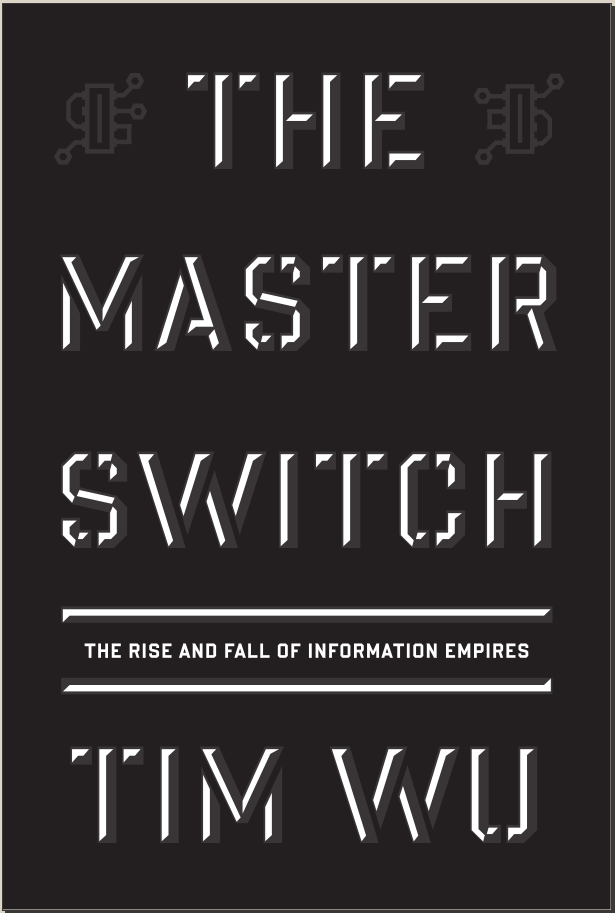
Tim Wu’s new book, The Master Switch: The Rise and Fall of Information Empires, will be released next week and it promises to make quite a splash in cyberlaw circles.  It will almost certainly go down as one of the most important info-tech policy books of 2010 and will probably win the top slot in my next end-of-year list.

Of course, that doesn’t mean I agree with everything in it.  In fact, I disagree vehemently with Wu’s general worldview and recommendations, and even much of his retelling of the history of information sectors and policy.  Nonetheless, for reasons I will discuss in this first of many critiques, the book’s impact will be significant because Wu is a rock star in this academic arena as well as a committed activist in his role as chair of the radical regulatory activist group, Free Press. Through his work at Free Press as well as the New America Foundation, Professor Wu is attempting to craft a plan of action to reshape the Internet and cyberspace.

I stand in opposition to almost everything that Wu and those groups stand for, thus, I will be spending quite a bit of time addressing his perspectives and proposals here in coming months, just as I did when Jonathan Zittrain’s hugely important The Future of the Internet & How to Stop It was released two years ago (my first review is here and my latest critique is here).  In today’s essay, I’ll provide a general overview and foreshadow my critiques to come.  (Note: Tim was kind enough to have his publisher send me an advance uncorrected proof of the book a few months ago, so I’ll be using that version to construct these critiques. Please consult the final version for cited material and page numbers.) Continue reading →

TLF readers will definitely want to check out the online symposium underway over at the Concurring Opinions blog debating the thesis set forth in Jonathan Zittrain’s important 2008 book, The Future of the Internet and How to Stop It. The symposium will feature a terrific cast of thinkers, including: Steven Bellovin, Ryan Calo, Laura DeNardis, James Grimmelmann, Orin Kerr, Lawrence Lessig, Harry Lewis,Daithí Mac Síthigh, Betsy Masiello, Salil Mehra, Quinn Norton, Alejandro Pisanty, Joel Reidenberg, Barbara van Schewick and me!  Regular contributors to the Concurring Opinions blog, such as Frank Pasquale, are also taking part.

Faithful readers will recall that I named Zittrain’s book the most important Internet policy book of 2008 and one of the most important books of the past decade.  It’s impact has already been enormous. But I’ve also been unrelenting in my criticism of the book and Zittrain’s dour forecast for the future of Internet “openness” and digital “generativity.” Down below I have reproduced my contribution to the Concurring Opinions symposium, but I encourage you to hop over there to check out all the essays that are pouring in on this topic.


In his opening essay in this symposium, Jonathan Zittrain ensures us that he is “not exactly a pessimist.” “I recognize, and celebrate,” he says, “the fact that the digital environment of 2010 is the coolest, most interesting, most option-filled it’s ever been.” Terrific! I am glad to hear that because the crux of my repeated critiques of his book, The Future of the Internet, over the past two years has been focused on its unrelenting – and largely unwarranted – pessimism about our possible cyber-futures. Alas, his essay on these pages still displays much of that underlying techno-pessimism and begs me to ask: Will the real Jonathan Zittrain please stand up? Continue reading →

[I’ve been working on an outline for a book I hope to write surveying technological skepticism throughout history. I first started thinking about this topic two years when I noticed that a great number of recent books about Internet policy could generally be grouped into one of two camps: Internet optimists vs. Internet pessimists. I subsequently penned an essay on the subject that generated a fair bit of attention. So, I figured I must be on to something, and the more Net policy books I read, the more I realized that the divisions between these two camps were growing wider and increasingly heated. Thus, I thought I would share this very rough draft (much of it still in outline form) of the opening chapter of that book I want to write about this great intellectual war over the impact of technology on society. I invite reader input. Update Jan. 2011: I finally published a full-length essay on this topic. You can find it here. ]

__________

The impact of technological change on culture, learning, and morality has long been the subject of intense debate, and every technological revolution brings out a fresh crop of both pessimists and pollyannas. Indeed, a familiar cycle has repeat itself throughout history whenever new modes of production (from mechanized agriculture to assembly-line production), means of transportation (water, rail, road, or air), energy production processes (steam, electric, nuclear), medical breakthroughs (vaccination, surgery, cloning), or communications techniques (telegraph, telephone, radio, television) have appeared on the scene.

The cycle goes something like this. A new technology appears. Those who fear the sweeping changes brought about by this technology see a sky that is about to fall. These “techno-pessimists” predict the death of the old order (which, ironically, is often a previous generation’s hotly-debated technology that others wanted slowed or stopped).  Embracing this new technology, they fear, will result in the overthrow of traditions, beliefs, values, institutions, business models, and much else they hold sacred.

The pollyannas, by contrast, look out at the unfolding landscape and see mostly rainbows in the air. Theirs is a rose-colored world in which the technological revolution du jour is seen as improving the general lot of mankind and bringing about a better order.  If something has to give, then the old ways be damned! For such “techno-optimists,” progress means some norms and institutions must adapt—perhaps even disappear—for society to continue its march forward.

Our current Information Revolution is no different. It too has its share of techno-pessimists and techno-optimists. Indeed, before most of us had even heard of the Internet, people were already fighting about it—or at least debating what the rise of the Information Age meant for our culture, society, and economy. Continue reading →

2009 was not as big of a year for Internet and information technology (“info-tech”) policy books as 2008 was, but there were still some notable titles released that offered interesting perspectives about the future of the Net and the impact the Digital Revolution is having on our lives, culture, and economy.  So, like last year, I figured I would throw together my list of the 10 most important info-tech policy books of the year.

book covers collage 2009First, let me repeat a few of the same caveats and disclaimers that I set forth last year.  What qualifies as an “important” info-tech policy book? Simply put, it’s a title that many people are currently discussing and that we will likely be referencing for many years to come.  However, I want to be clear that merely because a book appears on my list it does not necessarily mean I agree with everything said in it. In fact, as was the case in previous years, I found much with which to disagree in my picks for the most important books of 2009 and I find that the cyber-libertarianism I subscribe to has very few fans out there.

Another caveat: Narrowly-focused titles lose a few points on my list. For example, if a book deals mostly with privacy issues, copyright law, or antitrust policy, it does not exactly qualify as the same sort of “tech policy book” as other titles found on this list since it is a narrow exploration of just one set of issues with a bearing on technology policy.

With those caveats in mind, here are my choices for the Most Important Info-Tech Policy Books of 2009. Continue reading →

DroidSeems like everywhere I turn someone is gushing about their new Droid phone, including my TLF colleagues Berin Szoka, Braden Cox, and Ryan Radia, who all had great fun rubbing their new toys in my nose over the past couple of days. And why not, it’s a very cool little device.  It makes my HTC Touch seems positively archaic in some ways, and it’s only a year old.  Apparently, 100,000 people already picked up a Droid in just its first weekend on the market.

But here’s the first thing that pops in my mind every time I see someone showing off their new Droid: How can a device like this even exist when America’s leading cyberlaw experts have been telling us that the whole digital world is increasingly going to hell because of “closed” devices, proprietary code, and managed networks?  I’m speaking, of course, about the lamentations of Harvard professors Lawrence Lessig, Jonathan Zittrain, and their many disciples.  As faithful readers will recall, I have relentlessly hammered this crew for their unwarranted cyber-Chicken Little-ism and hyper techno-pessimism. (See my many battles with Zittrain [1, 2, 3, 4, 5, 6 + video] and my 2-part debate with Lessig earlier this year).

“Left to itself,” Lessig warned in Code, “cyberspace will become a perfect tool of control.”  He went on to forecast a dystopian future in which nefarious corporate schemers would quash our digital liberties unless benevolent public philosopher kings stepped in to save our poor souls. Code was the Old Testament of cyber-collectivism. The New Testament arrived last year with Zittrain’s The Future of the Internet and How to Stop It. In it, we hear the grim prediction that “sterile and tethered” digital technologies and networks will triumph over the more “open and generative” devices and systems of the past.  The iPhone and TiVo are cast as villains in Zittrain’s drama since they apparently represent the latest manifestations of Lessig’s “perfect control” paranoia.

Apple’s “Angel of Death”

How completely out-of-control has this thinking gotten?  Well, here’s David Weinberger — another Harvard Berkman Center worrywart — talking about that supposed satanic font of all evil, the Apple AppStore: Continue reading →

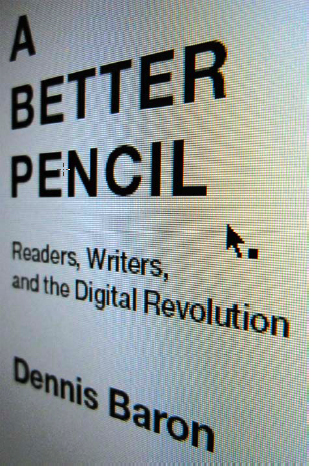
A Better Pencil book coverI very much enjoyed Dennis Baron’s new book, A Better Pencil: Readers, Writers, and the Digital Revolution, and highly recommend you pick it up. Baron does a wonderful job exploring the history of techno-pessimism and the endless battles about the impact of new technologies on life and learning, something I have written about here before in my essays on “Internet optimists vs. pessimists” (See: 1, 2, 3).

I have a complete review of Baron’s A Better Pencil now up on the City Journal‘s website here.  I’ve also pasted it down below.


Plato Wrote it Down by Adam Thierer

a review of A Better Pencil: Readers, Writers, and the Digital Revolution, by Dennis Baron (Oxford University Press, 280 pp., $24.95)

In the beginning, Dennis Baron reminds us in his new book, A Better Pencil, there was the word—the spoken word, that is. Oral tradition, the passing of knowledge through stories and lectures, was the primary method of instruction and learning throughout early human civilization. But then a few innovative souls decided to start writing everything down on stones and clay. Almost as soon as they did, a great debate began on the impact of new communications technology on culture and education. And it rages on today, with a new generation of optimists and skeptics battling over the impact that computing, the Internet, and digital technologies have on our lives and on how we learn about the world.

Continue reading →

I’ve posted another response in the Cato Unbound online debate over the impact of Lawrence Lessig’s Code and Other Laws of Cyberspace upon the book’s 10th anniversary.  You will recall that I went fairly hard on Prof. Lessig in my essay, “Code, Pessimism, and the Illusion of ‘Perfect Control,’” and Lessig responded with a counter-punch that went after me for it.  I respond in a new essay about “Our Conflict of Cyber-Visions.” In the piece, I address Lessig’s assertion that I just didn’t understand the central teachings of Code, as well as his reluctance to accept the “cyber-collectivism” label that I affixed to his book and life’s work.  Again, please hop over to Cato Unbound for my complete response.

But one thing from the essay that I thought worth reproducing here is my effort to better define the key principles that separate the cyber-libertarian and cyber-collectivist schools of thinking.  I argue that it comes down to this:

The cyber-libertarian believes that “code failures” are ultimately better addressed by voluntary, spontaneous, bottom-up, marketplace responses than by coerced, top-down, governmental solutions. Moreover, the decisive advantage of the market-driven approach to correcting code failure comes down to the rapidity and nimbleness of those response(s).

Of course, another key difference relates to how quickly one jumps to the conclusion that “code failures” are actually occurring at all. I argue:

Continue reading →

The week-long Cato Unbound online debate about the 10th anniversary of Lawrence Lessig’s Code and Other Laws of Cyberspace continues today with Prof. Lessig’s response to Declan McCullagh’s opening essay, “What Larry Didn’t Get,” Jonathan Zittrain’s follow-up essay, and my essay on, “Code, Pessimism, and the Illusion of ‘Perfect Control.’”  Needless to say, Prof. Lessig isn’t too happy with my response. You should jump over to the Cato site to read the entire thing, but here are a couple of excerpts and my response.

To my suggestion that there is a qualitative difference between law and code, Prof. Lessig says:

I’ve argued that things aren’t quite a simple as some libertarians would suggest. That there’s not just bad law. There’s bad code. That we don’t need to worry just about Mussolini. We also need to worry about DRM or the code AT&T deploys to help the government spy upon users. That public threats to liberty can be complemented by private threats to liberty. And that the libertarian must be focused on both.  […] Of course, law is law. Who could be oblivious to that? And who would need a book to explain it?  But the fact that “law is law” does not imply that it has a “much greater impact in shaping markets and human behavior.” Sometimes it does — especially when that “law” is delivered by a B1 bomber. But ask the RIAA whether it is law or code that is having a “greater impact in shaping markets” for music. Or ask the makers of Second Life whether the citizens of that space find themselves more constrained by the commercial code of their geo-jurisdiction or by the fact that the software code of Second Life doesn’t permit you simply to walk away (so to speak) with another person’s scepter. Whether and when law is more effective than code is an empirical matter — something to be studied, and considered, not dismissed by banalities spruced up with italics.

Well, I beg the professor’s pardon for excessive use of italics.  [I won’t ask for an apology for misspelling my last name in his piece!] Regardless, it’s obvious that we’ll just never see eye-to-eye on the crucial distinction between law and code. Again, as I stated in my essay: “With code, escape is possible. Law, by contrast, tends to lock in and limit; spontaneous evolution is supplanted by the stagnation of top-down, one-size-fits-all regulatory schemes.”

Lessig largely dismisses much of this with that last line above, suggesting that we just need to keep studying the matter to determine the right mix of what works best.  To be clear, while I’m all for studying the impact of law vs. code as “an empirical matter,” that in turn begs the question of how we define effectiveness or success. I suspect that the professor and I would have a “values clash” over some rather important first principles in that regard.  This is, of course, a conflict of visions that we see throughout the history of philosophy; a conflict between those who put the individual and the individual’s rights at the core of any ethical political system versus those who would place the rights of “the community,” “the public” or some other amorphous grouping(s) at the center of everything.  It’s a classic libertarian vs. communitarian / collectivist debate.

Continue reading →

The Cato Unbound online debate about the 10th anniversary of Lawrence Lessig’s Code and Other Laws of Cyberspace continues today with my response to Declan McCullagh’s opening essay, “What Larry Didn’t Get,” as well as Jonathan Zittrain’s follow-up.

In my response, “Code, Pessimism, and the Illusion of ‘Perfect Control,'” I begin by arguing that:

The problem with peddling tales of a pending techno-apocalypse is that, at some point, you may have to account for your prophecies — or false prophecies as the case may be. Hence, the problem for Lawrence Lessig ten years after the publication of his seminal book, Code and Other Laws of Cyberspace.

I go on to argue that:

Lessig’s lugubrious predictions proved largely unwarranted. Code has not become the great regulator of markets or enslaver of man; it has been a liberator of both. Indeed, the story of the past digital decade has been the exact opposite of the one Lessig envisioned in Code.

After providing several examples of just how wrong Lessig’s predictions were, I then ask:

[W]hy have Lessig’s predictions proven so off the mark? Lessig failed to appreciate that markets are evolutionary and dynamic, and when those markets are built upon code, the pace and nature of change becomes unrelenting and utterly unpredictable. With the exception of some of the problems identified above, a largely unfettered cyberspace has left digital denizens better off in terms of the information they can access as well as the goods and services from which they can choose. Oh, and did I mention it’s all pretty much free-of-charge? Say what you want about our cyber-existence, but you can’t argue with the price!

Continue reading →