I’ve been blathering on about this week’s big Supreme Court decision in FCC v. Fox, [See Parts 1, 2, 3, 4, 5], so I thought I would just wrap this series of essays up with a collection of other articles and views on the decision in case readers are looking for alternative perspectives:
Mainstream Media Stories
Conservative, Religious, & “Family” Groups
Free Speech Advocates or Other Views
My friend Anne Collier of Net Family News, one of America’s great sages on child safety issues, has produced a terrific list of reasons “Why Technopanics are Bad.” Technopanics and moral panics are topics I’ve spent quite a bit of time commenting on here. (See 1, 2, 3, 4.) Anne is a rare voice of sanity and sensible advice when it comes to online child safety issues and I encourage you to read all her excellent work on the subject, including her book with Larry Magid, MySpace Unraveled: A Parent’s Guide to Teen Social Networking. Anyway, here’s Anne’s list, and I encourage you to go over to her site and contribute your thoughts and suggestions about what else to add:
Technopanics are bad because they…
- Cause fear, which interferes with parent-child communication, which in turn puts kids at greater risk.
- Cause schools to fear and block digital media when they need to be teaching constructive use, employing social-technology devices and teaching new media literacy and citizenship classes throughout the curriculum.
- Turn schools into barriers rather than contributors to young people’s constructive use.
- Increase the irrelevancy of school to active young social-technology users via the sequestering or banning of educational technology and hamstring some of the most spirited and innovative educators.
- Distract parents, educators, policymakers from real risks – including, for example, child-pornography laws that do not cover situations where minors can simultaneously be victim and “perpetrator” and, tragically, become registered sex offenders in cases where there no criminal intent (e.g., see this).
- Reduce the competitiveness of US education among developed countries already effectively employing educational technology and social media in schools.
- Reduce the competitiveness of US technology and media businesses practicing good corporate citizenship where youth online safety is concerned.
- Lead to bad legislation, which aggravates above outcomes and takes the focus off areas where good laws on the books can be made relevant to current technology use.
- Widen the participation gap for youth – technopanics are barriers for children and teens to full, constructive participation in participatory culture and democracy.
As anyone who has spent time searching for comments on the FCC’s website can tell you, the agency doesn’t exactly have the most user-friendly website. In the interest of making it easier for others to read the comments that came in last week in the agency’s “Child Safe Viewing Act” Notice of Inquiry, I have compiled all the major comments (those over 3 or 4 pages) and provided links to them below the fold.
Again, this proceeding was required under the “Child Safe Viewing Act of 2007,” which Congress passed last year and President Bush signed last December. The goal of the bill and the FCC’s proceeding (MB 09-26) is to study “advanced blocking technologies” that “may be appropriate across a wide variety of distribution platforms, including wired, wireless, and Internet platforms.” I filed 150+ pages worth of comments in this matter last week, and here’s my analysis of why this bill and the FCC’s proceeding are worth monitoring closely.
Continue reading →
Today I filed comments with the Federal Communications Commission (FCC) in its proceeding examining the marketplace for “advanced blocking technologies.” This proceeding was required under the “Child Safe Viewing Act of 2007,” which Congress passed last year and President Bush signed last December. The goal of the bill and the FCC’s proceeding (MB 09-26) is to study “advanced blocking technologies” that “may be appropriate across a wide variety of distribution platforms, including wired, wireless, and Internet platforms.” My colleagues will no doubt laugh about the fact that I have dropped an absurd 150 pages worth of comments on the FCC in this matter, but I had a lot to say on this topic! Parental controls, child safety, and free speech issues have been the focus of much of my research agenda over the past 10 years.
In my filing, I argue that the FCC should tread carefully in this matter since the agency has no authority over most of the media platforms and technologies described in the Commission’s recent Notice of Inquiry. Moreover, any related mandates or regulatory actions in in this area could diminish future innovation in this field and would violate the First Amendment rights of media creators and consumers alike. The other major conclusions of my filing are as follows:
- There exists an unprecedented abundance of parental control tools to help parents decide what constitutes acceptable media content in their homes and in the lives of their children.
- There is a trade-off between complexity and convenience for both tools and ratings, and no parental control tool is completely foolproof.
- Most homes have no need for parental control technologies because parents rely on other methods or there are no children in the home.
- The role of household media rules and methods is underappreciated and those rules have an important bearing on this debate.
- Parental control technologies work best in combination with educational efforts and parental involvement.
- The search for technological silver-bullets and “universal” solutions represent a quixotic, Holy Grail-like quest and it will destroy innovation in this marketplace.
- Enforcement of “household standards” made possible through use of parental controls and other methods negates the need for “community standards”-based content regulation.
My entire filing can be found here and down below in a Scribd reader. All comments in the matter are due tomorrow and then reply comments are due on May 18th.
Continue reading →
The Federal Communications Commission (FCC) has just released a Notice of Inquiry (NOI) in the matter of “Implementation of the Child Safe Viewing Act; Examination of Parental Control Technologies for Video or Audio Programming.” (MB Docket No. 09-26) This NOI was required by S. 602, the “Child Safe Viewing Act of 2007,” which Congress passed last October and President Bush signed into law on December 2nd. The measure requires the FCC to examine:
(1) the existence and availability of advanced blocking technologies that are compatible with various communications devices or platforms;
(2) methods of encouraging the development, deployment, and use of such technology by parents that do not affect the packaging or pricing of a content provider’s offering; and
(3) the existence, availability, and use of parental empowerment tools and initiatives already in the market.
The Act defines the term “advanced blocking technologies” as “technologies that can improve or enhance the ability of a parent to protect his or her child from any indecent or objectionable video or audio programming, as determined by such parent.” Importantly, the Act also directs the agency to look into blocking technologies that “may be appropriate across a wide variety of distribution platforms, including
wired, wireless, and Internet platforms” and which “operate independently of ratings pre-assigned by the creator of such video or audio programming.” The Act requires that the FCC issue a report to Congress about these technologies no later than August 29, 2009.
When writing about the Child Safe Viewing Act shortly after its introduction in the summer of 2007, I noted that the measure potentially represented the beginning of “convergence-era content regulation” at the FCC. Those two clauses highlighted above are of particular importance in that regard. Congress has essentially invited the FCC to engage in unprecedented oversight of media platforms and ratings systems that the agency previously had very little ability to influence. Continue reading →
Ben Edelman of the Harvard Business School has just released an interesting new study in the Journal of Economic Perspectives entitled, “Red Light States: Who Buys Online Adult Entertainment?” Using data he obtained from a top-10 seller of adult entertainment, Edelman examined adult website subscriptions on the zip code level and found that conservatives seem to be every bit as interested in pornography as liberals. In fact, “Subscriptions [to adult entertainment sites] are slightly more prevalent in states that have enacted conservative legislation on sexuality” and “subscriptions are also more prevalent in states where surveys indicate conservative positions on religion, gender roles, and sexuality.” He also finds that:
In states where more people agree that “Even today miracles are performed by the power of God” and “I never doubt the existence of God,” there are more subscriptions to this service. Subscriptions are also more prevalent in states where more people agree that “I have old-fashioned values about family and marriage” and “AIDS might be God’s punishment for immoral sexual behavior.”
Even more interesting is the fact that, on a state-by-state basis, Utah* residents topped all other Americans in terms of subscriptions to online adult entertainment websites. Finally, Edelman concludes:
On the whole, these adult entertainment subscription patterns show a remarkable consistency: all but eleven states have between two and three subscribers to this service per thousand broadband households, and all but four have between 1.5 and 3.5. With interest in online adult entertainment relatively constant across regions, there’s little sign of a major divide.
But it’s not just Internet porn where we see this trend at work. As I noted in my law review article, “Why Regulate Broadcasting?” we’ve seen a similar trend at work with television. When you look at some of the TV shows that conservatives and religious groups gripe most about, you might be surprised to know that it is conservatives who make those shows as popular as they are!
Continue reading →
I’ve got a new PFF paper out today entitled, “Who Needs Parental Controls? Assessing the Relevant Market for Parental Control Technologies.” In this piece, I address the argument made by some media and Internet critics who say that government intervention (perhaps even censorship) may be necessary because parental control technologies are not widely utilized by most Americans. But, as I note in the paper, the question that these critics always fail to ask is: How many homes really need parental control technologies? The answer: Far fewer than you think. Indeed, the relevant universe of potential parental control users is actually quite limited.
I find that the percentage of homes that might need parental control technologies is certainly no greater than the 32% of U.S. households with children in them. Moreover, the relevant universe of potential parental control users is likely much less than that because households with very young children or older teens often have little need for parental control technologies. Finally, some households do not utilize parental control technologies because they rely on alternative methods of controlling media content and access in the home, such as household media rules. Consequently, policymakers should not premise regulatory proposals upon the limited overall “take-up” rate for parental control tools since only a small percentage of homes might actually need or want them.
If you don’t care to read the whole nerdy thing, I’ve created this short video summarizing the major findings of the paper.
http://www.youtube.com/v/a7Fnf3Ztt-U&hl=en&fs=1
And the document is embedded below the fold in a Scribd reader.
Continue reading →
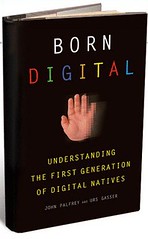 Earlier this year, I mentioned an outstanding book that John Palfrey of the Berkman Center for Internet & Society at Harvard Law School co-edited entitled Access Denied: The Practice and Policy of Global Internet Filtering. It’s an excellent resource for anyone studying the methods governments are (unfortunately) using to stifle online expression across the globe. It’s one of the most important technology policy books of the year.
Well, it looks like John Palfrey will have a second title on this year’s “Best Tech Books” list. I’ve just finished his new book with his Berkman Center colleague Urs Gasser, Born Digital: Understanding the First Generation of Digital Natives, and it is definitely worthy of your attention. In my book review posted today on the City Journal’s website, I argue that “Palfrey and Gasser’s fine early history of this generation serves as a starting point for any conversation about how to mentor the children of the Web.” It’s a comprehensive and very even-handed discussion about a variety of concerns or Internet pathologies, including: online safety, personal privacy, copyright piracy, offensive content, classroom learning, and much more.
My
City Journal review is down below, but in coming weeks I will be posting some additional thoughts about some specific things in the book worthy of more attention (including a few things I disagreed with). Overall, I’d say Born Digital is a close runner-up in the race for “Tech Book of the Year,” closely trailing Jonathan Zittrain’s Future of the Internet and How to Stop It (which I have reviewed multiple times) and Nick Carr’s The Big Switch. But I found far more to agree with in Born Digital than I did in those two books. Highly recommended.
Continue reading →
Just FYI, the latest update of my booklet on “Parental Controls and Online Child Protection: A Survey of Tools & Methods” is now live. The new version, Version 3.1, provides minor updates to all sections of the book and a new appendix of relevant research in the field. I issue major updates early each year and 1 or 2 tweaks during the course of the year to reflect the evolution of the parental control and online child safety market and debate. 
For those not familiar with the report, it explores the market for parental control tools, rating schemes, education efforts, and initiatives aimed at promoting online child safety. I believe that the parental controls and content management tools cataloged in the report represent a better, less restrictive alternative to government regulation. As I conclude after evaluating that state of the market: “There has never been a time in our nation’s history when parents have had more tools and methods at their disposal to help them decide what constitutes acceptable media content in their homes and in the lives of their children.”
The report is available free-of-charge on the PFF website, and the previous editions of the report are housed there too in case you want to see how it has evolved over the past two years. For those interested in taking a quick look at the report, I have embedded it down below the fold as a Scribd file. Finally, as is always the case, I encourage readers to send me updates and suggestions for how to improve the report and I will incorporate them into future versions.
Continue reading →
 Each year the Entertainment Software Association (ESA), which represents the video game and computer game industry, produces a great little report entitled “Essential Facts About the Computer and Video Game Industry.” The 2008 edition is out and it has some interesting stats:
- 65 percent of American households play computer and video games;
- 38 percent of American homes have a video game console;
- The average game player is 35 years old;
- One out of four gamers are over age 50;
- Women age 18 or older represent a significantly greater portion of the game-playing population (33 percent) than boys age 17 or younger (18 percent); and,
- 41 percent of Americans expect to purchase one or more games this year.
Those findings make it clear that gaming really has gone mainstream. As I noted in an essay earlier this week, “gaming is now fully integrated into the fabric of my life and the lives of my children. It has become one of the most enjoyable media experiences for my generation and the generation of kids that we are raising.”
Some other important stats that have relevance for debates about public policy:
- 94 percent of parents are present when games are purchased or rented;
- 88 percent of parents report always or sometimes monitoring the games their children play; and,
- 63 percent of parents believe games are a positive part of their children’s lives.
Those are impressive numbers, and it makes it clear, as I have argued before, that parents are parenting! (And that reflects what is going on for television as well).

 The Technology Liberation Front is the tech policy blog dedicated to keeping politicians' hands off the 'net and everything else related to technology.