Anthony Prestia of Laws of Play, a blog dedicated to covering legal developments in the gaming industry, somehow got some face time with Supreme Court Justice Scalia and was able to ask for his feelings concerning the constitutionality of recent state video game legislation. “In particular,” Prestia says, “I asked him whether as an originalist he believed that state laws banning the sale of mature-rated video games to minors ran afoul of the First Amendment.” Here’s Prestia’s summary and analysis of Scalia’s answer:
In his most succinct reply of the day, Justice Scalia replied that he did believe such legislation was constitutional. He began by explaining his belief that sound constitutional precedent holds that minors may be subjected to prohibitions that adults are not–-he instantly drew the parallel to regulation of pornography sales. However, Justice Scalia emphasized that unprotected speech, such as obscenity–which he was unwilling to define for reasons that are immediately evident to any constitutional scholar–-can be prohibited from sale regardless of the purchaser’s age. I think the important thing to note here is that Justice Scalia did not suggest that violent and/or sexual content in games rises to the level of unprotected speech. In fact, he did not even suggest that video games themselves are not protected by the First Amendment despite his strict originalist beliefs.
That’s an interesting response in that Scalia’s latter comments imply that even older, more conservative judges are coming around to understanding how video games are a form of artistic expression deserving the protection of the First Amendment. But Scalia’s earlier suggestion that state laws banning sales of certain video games to minors maybe constitutional deserves a response.
Continue reading →
One of the things I find most interesting about calls to regulate “excessively violent” content on television, in movies, or in video games is the way critics make massive leaps of logic and draw outrageous conclusions based on myopic, anecdotal reasoning. I was reminded of that again today when reading through an interview with Sen. Jay Rockefeller (D-W.Va), one of the most vociferous critics of all sorts of media content and a long-time proponent of regulation to censor such violent content in particular (however it is defined). (I have written about his past regulatory proposals here and here).
Here’s what he recently told the editorial board of The Register-Herald of West Virginia:
Continue reading →
PFF has just released my latest paper entitled “Parental Control Perfection? The Impact of the DVR and VOD Boom on the Debate over TV Content Regulation.” In the report, I focus on the extent to which new video technologies, such as digital video recorders (DVRs) and video on demand (VOD) services, are changing the way households consume media and are helping parents better tailor viewing experiences to their tastes and values. I provide evidence showing the rapid spread of these technologies and discuss how parents are using these tools in their homes. Finally, I argue that these developments will have profound implications for debates over the regulation of video programming. As parents are given the ability to more effectively manage their family’s viewing habits and experiences, it will lessen—if not completely undercut—the need for government intervention on their behalf.
This 16-page report can be found at: http://www.pff.org/issues-pubs/pops/pop14.20DVRboomcontentreg.pdf
The video game industry’s string of unbroken First Amendment court victories continued this week with a win in the case of Video Software Dealers Association v. Schwarzenegger. [Decision here.] In this case, the VSDA and the Entertainment Software Association brought a suit seeking a permanent injunction against a California law passed in October 2005 (A.B.1179), which would have blocked the sale of violent video games to those under 18. Offending retailers could have been fined for failure to comply with the law.
The court’s decision overturning the law was written by Judge Ronald Whyte and it echoed what every previous decision on this front has held, namely:
Continue reading →
This is the final installment of my 10-part series of essays that have coincided with “Internet Safety Month.” Many of these essays have focused on the variety of parental controls tools on the market that can help parents better control, or at least monitor, their children’s Internet usage or online communications. (See parts 1, 2, 3, 4, 5, and 6.) Other essays focused on the importance of education, building public awareness, and the need for stepped-up law enforcement efforts aimed at prosecuting online predators. (See parts 7, 8, and 9).
In this final installment, I want to focus on what I believe is the most important—and most frequently overlooked—part of the parental controls and online safety discussion: Good parenting!
Specifically, it is important to realize that many household-level rules and informal parental control methods exist that represent the most important steps that most parents can take in dealing with potentially objectionable content or teaching their children how to be sensible, savvy media users. Indeed, to the extent that many households never take advantage of the many technical tools I outlined in earlier essays, it is likely because they rely instead on the informal household media rules and strategies discussed below.
Continue reading →
In late April, the Federal Communications Commission released a new report recommending that the government assume a great role in regulating violent video content on television.In response to that report, I penned a lengthy essay entitled, “FCC Violence Report Concludes that Parenting Doesn’t Work.”
I wasn’t kidding. Flipping through that report, one is struck by the fact that the FCC seems to think that parents are completely incompetent and that only benevolent-minded bureaucrats can save the day from objectionable fare that enters the home. And now Congress is ready to get into the game as well. During the House Commerce hearing I testified at last Friday on “The Images Kids See on the Screen,” Rep. Ed Markey, Chairman of the Telecommunications & Internet subcommittee, said that “I believe Big Father and Big Mother are better able to decide what is appropriate for their kids to watch, rather than Big Brother.” Yet, almost in the same breath, he went on to note that he was prepared to give the FCC greater authority to regulate certain things on television “for the children.” Several others members of the subcommittee made similar statements, professing on one hand to believe in parental responsibility, but then quickly listing several caveats and calling for government to regulate media content in some fashion. Not to be outdone, the Senate Commerce Committee plans a hearing tomorrow on “The Impact of Media Violence on Children.”
For those of us who continue to believe in personal responsibility (as well as that little thing called the First Amendment), this is all very frustrating. As I pointed out in my recent book, “Parental Controls and Online Child Protection: A Survey of Tools and Methods,” there has never been a time in our nation’s history when parents have had more tools and methods at their disposal to help them decide what is acceptable in their homes and in the lives of their children. Parents have been empowered to make decisions for themselves and their families. And parents seem to be growing more comfortable with the idea of making these decisions for themselves instead of turning to government to do it for them. Two new public opinion polls reflect that reality.
Continue reading →
Some lawmakers at the federal, state and local level have advocated video game industry regulation in the name of protecting children from potentially objectionable content, usually of a violent nature. In my opinion, the better approach–and one that doesn’t involve government censorship or regulation of games–is to empower parents to better make these decisions for their own families. And the key to that effort is an effective rating / labeling system for game content that parents understand and use.
Luckily, there are good signs that the video game industry’s voluntary ratings system–the ESRB (the Entertainment Software Rating Board)–is doing exactly that. The game industry established the ESRB in 1994 and it has rated thousands of games since then. (The ESRB estimates it rates over 1,000 games per year). Virtually every title produced by major game developers for retail sale today carries an ESRB rating and content descriptors. Generally speaking, the only games that do not carry ESRB ratings today are those developed by web amateurs that are freely traded or downloaded via the Internet.
The ESRB applies seven different rating symbols and over 30 different content “descriptors” that it uses to give consumers highly detailed information about games. Thus, by simply glancing at the back of each game container, parents can quickly gauge the appropriateness of the title for their children.
So, how effective is this system, as measured by parental awareness and usage of the ESRB ratings and labels? Since 1999, the ESRB has asked Peter D. Hart Research Associates to study that question and conduct polls asking parents if they are aware of the ESRB ratings and if they use them. As this chart illustrates, the results are impressive with both awareness and use growing rapidly since 1999:
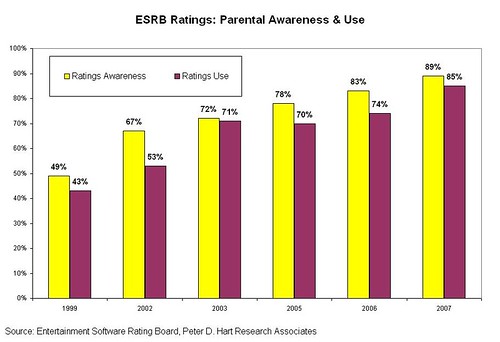
Better yet, all gaming platforms and most PCs can read these ratings and labels and allow parents to block games rated above a certain level they find unacceptable. But the real strength of the ESRB’s ratings system lies in the content descriptors, which give parents plenty of warning about what they will see or hear in each title. That way, parents can talk to their kids about those games or just not buy them for their kids until they think they are ready.
The game industry deserves credit not only for creating such an excellent content rating / labeling system, but also putting significant resources into public education / awareness efforts to ensure parents know how to take advantage of it. So then, why are lawmakers continuing to waste millions of taxpayer dollars litigating unneeded regulatory efforts?
Over at National Review Online today, Peter Suderman has a good discussion of the current state of video game politics. As usual, a lot of politicians are playing games; political games, that is. Suderman notes that:
…attacking the video-game industry has long been a favored sport amongst politicians eager to shore up their credibility with the concerned parent crowd. At the state level, at least ten laws banning the sale of certain video games to minors have been brought to life. In California, Governor Arnold Schwarzenegger, a guy who made his name hacking and slashing his enemies to a bloody pulp on the big screen, apparently didn’t want high schoolers doing digital imitations: He tried to ban the sale of violent games to minors back in 2005. Oregon is currently considering a similar law, and New York Governor Eliot Spitzer recently stated that he intends to pursue one as well. But these laws go down like a final level boss once they hit the courts. To date, not one of the dubious proposals has stood up to a court challenge.
Some lawmakers can’t even be bothered to worry about anything so insignificant as considering whether a law is constitutional. Regarding one video-game ban, Minnesota state legislator Sandy Poppas shrugged off any such responsibility, saying, “Legislators don’t worry too much about what’s constitutional. We just try to do what’s right, and we let the courts figure that out.” The recurrent bashing of the game industry tends to resemble a major league team taking on a troop of t-ballers: Politicians get to knock a couple of balls out of the park in front of parents, but the whole thing is just a show.
Indeed it is. I made a similar argument in a piece for NRO last year as well as my big PFF study, “Fact and Fiction in the Debate over Video Game Regulation.”
It is too early to say for sure but there are some encouraging signs that our public policymakers are finally starting to get the point went it comes to the sensibility (and constitutional futility) of trying to regulate video game content. Just yesterday, for example, lawmakers in the District of Columbia passed legislation that establishes a program to educate consumers about existing video game ratings and console-based controls. This represents a major shift away from the regulatory approach originally floated by incoming D.C. Mayor Adrian Fenty. While serving as a D.C. Councilman, Fenty introduced a bill that would have proposed the old regulatory combo of mandates and stiff fines on game retailers who didn’t enforce the city’s approved regulatory scheme.
But the new version of the bill, entitled the “Consumer Education on Video and Computer Games for Minors Act,” takes a very different approach. The bill requires the city to “Develop a consumer education program to educate consumers about the appropriateness of video and computer games for certain ago groups, which may include information on video and computer game rating systems and the manner in which parental controls can enhance the ability of parents to regulate their children’s access to video and computer games.”
In a phrase, D.C.’s new approach is “education, not regulation.” And while some might object to the idea of government promoting education efforts about video game ratings or console controls, that approach is infinitely more sensible (and constitutionally permissible) than government censorship.
Continue reading →

 The Technology Liberation Front is the tech policy blog dedicated to keeping politicians' hands off the 'net and everything else related to technology.