Just FYI, the latest update of my booklet on “Parental Controls and Online Child Protection: A Survey of Tools & Methods” is now live. The new version, Version 3.1, provides minor updates to all sections of the book and a new appendix of relevant research in the field. I issue major updates early each year and 1 or 2 tweaks during the course of the year to reflect the evolution of the parental control and online child safety market and debate. 
For those not familiar with the report, it explores the market for parental control tools, rating schemes, education efforts, and initiatives aimed at promoting online child safety. I believe that the parental controls and content management tools cataloged in the report represent a better, less restrictive alternative to government regulation. As I conclude after evaluating that state of the market: “There has never been a time in our nation’s history when parents have had more tools and methods at their disposal to help them decide what constitutes acceptable media content in their homes and in the lives of their children.”
The report is available free-of-charge on the PFF website, and the previous editions of the report are housed there too in case you want to see how it has evolved over the past two years. For those interested in taking a quick look at the report, I have embedded it down below the fold as a Scribd file. Finally, as is always the case, I encourage readers to send me updates and suggestions for how to improve the report and I will incorporate them into future versions.
Continue reading →
Over at Ars, Ben Kuchera has a review of Ask.com’s redesign of its web portal for kids, AskKids.com. It’s a great new addition to the growing list of safe seach tools and web portals geared toward younger surfers.

I’m also a big fan of KidZui, the new browser for kids that provides access to over 800,000 kid-friendly websites, videos, and pictures that have been pre-screened by over 200 trained teachers and parents. The company employs a rigorous 5-step “content selection process” to determine if it is acceptable for kids between 3-12 years of age. My kids, both under the age of 7, just love it, but I can’t see many kids older than 10 enjoying it because it is mostly geared toward the youngest web surfers.

Last year, as part of my 10-part series coinciding with “Internet Safety Month,” I wrote about the market for safe search tools and web portals for kids. I generally divide these sites and services into two groups:
(1)
“Safe Search” Tools and Portals for Kids
(2)
Child- and Teen-Oriented Websites
Below I will describe each group and list the many sites and services currently available. I encourage readers to offer additional suggestions for sites that belong on the list. (I keep a running list of these sites and services in my book, “Parental Controls and Online Child Protection: A Survey of Tools & Methods.”)
Continue reading →
 Along with my friends John Morris and Sophia Cope of the Center for Democracy & Technology, I have just submitted an amicus brief to the Supreme Court in the potentially historic free speech case FCC v. Fox, which will be heard in November.
[Reminder: The
FCC v. Fox case is the indecency case involving the FCC’s new policy for “fleeting expletives.” I wrote about the Second Circuit Court of Appeals decision here. The full decision is here. By contrast, the so-called “Janet Jackson case” — CBS v. FCC — took place in the Third Circuit Court of Appeals and that court recently handed down a decision that also went against the FCC. I wrote about the Third Circuit’s decision here.]
The
FCC v. Fox case could become the most important First Amendment-related Supreme Court case since FCC v. Pacifica Foundation, which just turned 30 years old last month. Of course, it could be that the Supreme Court simply sticks to the procedural questions regarding whether the FCC moved too far, too fast in reversing it’s long-standing policy of restraint regarding “fleeting expletives.” That’s essentially what the Second Circuit did. On the other hand, the Supremes might reach the substantive First Amendment issues tied up in the Pacifica case. We just won’t know for sure until the case is handed down.
Regardless, in the joint CDT-PFF amicus brief filed today, we argue that the FCC has both gone too far procedurally and that “the time is rapidly approaching for this Court to find that broadcast, like the Internet and other means of mass communication, ‘is entitled to the highest protection from government intrusion’ and that there is no longer a factual ‘basis for qualifying the level of First Amendment scrutiny that should be applied to this medium.'” Citing
Reno v. ACLU, 521 U.S. at 863, 870.”
A more detailed summary of our argument follows below.
Continue reading →
A few days ago I posted an open letter to New York Gov. David Patterson about a measure that recently passed through the New York legislature and was awaiting his signature. The bill proposes a new regulatory regime for video games that would include greater state-based oversight of video game labels and console controls as well as an advisory board to monitor the industry. Unfortunately—but quite unsurprisingly—Gov. Patterson signed the bill last night. And so I am certain that another legal battle will ensue regarding the constitutionality of the measure, and it will likely be struck down like every other measure on this front because it violates the First Amendment. Regardless, let’s talk a little more about what animates this specific legislative effort, because I think it is very important and foreshadows the heated debate to come over video games and all media in coming years.
The New York measure is notable in that, unlike most of the other state or local measures that had been stuck down in recent years that proposed penalties for the sale of games to youngsters which were labeled by the ESRB to be intended for an older audience, it simply proposed more “oversight” of the ratings process and parental control technologies by the state. Specifically, it mandated that all games be rated and that all consoles contain screening controls. The response to that proposal has generally been: “So what?” After all, all video games are rated already and all game consoles contain parental controls. The measure also mandated a 16-member oversight board to monitor the industry and this process. Again, that proposal was not regarded by many as a serious threat to the video games or free speech.
But I fear that many are missing the big picture here. The New York bill is actually far more important that many people suspect because of what it foreshadows: A day when politicians will claim that we can make rating systems more “scientific” by putting public health bureaucrats or university social scientists in charge of them. Indeed, last night on Bloomberg TV, this became the focus of a debate between me and Dr. Michael Rich, Director of the Center for Media and Child Health at the Harvard Medical School. After you watch the clip, I’ll have much more to say about this issue down below the fold.
http://eplayer.clipsyndicate.com/cs_api/get_swf/2/&csEnv=p&wpid=0&va_id=649150
Continue reading →
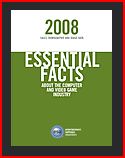 Each year the Entertainment Software Association (ESA), which represents the video game and computer game industry, produces a great little report entitled “Essential Facts About the Computer and Video Game Industry.” The 2008 edition is out and it has some interesting stats:
- 65 percent of American households play computer and video games;
- 38 percent of American homes have a video game console;
- The average game player is 35 years old;
- One out of four gamers are over age 50;
- Women age 18 or older represent a significantly greater portion of the game-playing population (33 percent) than boys age 17 or younger (18 percent); and,
- 41 percent of Americans expect to purchase one or more games this year.
Those findings make it clear that gaming really has gone mainstream. As I noted in an essay earlier this week, “gaming is now fully integrated into the fabric of my life and the lives of my children. It has become one of the most enjoyable media experiences for my generation and the generation of kids that we are raising.”
Some other important stats that have relevance for debates about public policy:
- 94 percent of parents are present when games are purchased or rented;
- 88 percent of parents report always or sometimes monitoring the games their children play; and,
- 63 percent of parents believe games are a positive part of their children’s lives.
Those are impressive numbers, and it makes it clear, as I have argued before, that parents are parenting! (And that reflects what is going on for television as well).
To: Hon. David Patterson, Governor, State of New York
From: Adam Thierer, life-long gamer and Senior Fellow at the Progress & Freedom Foundation
Date: July 17, 2008
Re: That video game bill (A. 11717/ S. 6401) you have been asked to sign
Dear Gov. Patterson:
I write today to ask a few questions about a measure that is currently sitting on your desk awaiting your signature. The measure (A. 11717/ S. 6401), which recently passed through the New York legislature, proposes a new regulatory regime for video games. It would include greater state-based oversight of video game labels and console controls as well as an advisory board to monitor the industry.
As a life-long gamer—and now the parent of two young gamers—this is a subject I care deeply about. I also come at this topic from an academic perspective as someone who analyzes the intersection of child safety concerns and free speech issues surrounding various types of media and communications technologies. I am the author of a frequently-updated book,
Parental Controls & Online Child Safety: A Survey of Tools & Methods, which provides a comprehensive look at the many tools and methods on the market today that can help parents deal with concerns about objectionable media content.
But mostly I write you today from the perspective of someone who just enjoys games. Actually, let me clarify that: I am utterly infatuated with video games. Gaming has been a life-long passion of mine and something I have enjoyed with friends and family since I owned my very first PONG and Atari 2600 systems in the 1970s. Since then, I have owned virtually every major video game console sold in the United States. Even today, as I approach 40 years of age, I find myself sitting down many nights to enjoy games with my son and daughter on the Xbox 360 and Sony PS3 consoles that we have in our home.
Like millions of other Americans, gaming is now fully integrated into the fabric of my life and the lives of my children. It has become one of the most enjoyable media experiences for my generation and the generation of kids that we are raising. And, although I am certain that the New York legislature had the best of intentions in mind when passing this bill, I believe I speak for a great number of those other American gamers when I say that the measure on your desk is somewhat of an insult to our intelligence. Let me explain by raising a few questions about this bill, which I will argue is unnecessary, unworkable, and unconstitutional:
Continue reading →
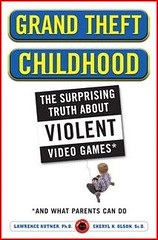 Don’t judge a book by its cover (or its title, for that matter). I’m usually faithful to that maxim, but I must admit that when I first saw the title and cover of “<a href="http://www.amazon.com/Grand-Theft-Childhood-Surprising-Violent/dp/0743299515/ref=pd_bbs_sr_1?ie=UTF8&s=books&qid=1208179493&sr=8-1″>Grand Theft Childhood: The Surprising Truth About Violent Video Games and What Parents Can Do,” I rolled my eyes and thought to myself, “here we go again.” I figured that I was in for another tedious anti-gaming screed full of myths and hysteria about games and gamers. Boy, was I wrong. Massively wrong.
Lawrence Kutner, PhD, and Cheryl K. Olson, ScD, cofounders and directors of the Harvard Medical School Center for Mental Health and Media, have written the most thoroughly balanced and refreshingly open-minded book about video games ever penned. They cut through the stereotypes and fear-mongering that have thus far pervaded the debate over the impact of video games and offer parents and policymakers common-sense advice about how to approach these issues in a more level-headed fashion. They argue that:
Today, an amalgam of politicians, health professionals, religious leaders and children’s advocates are voicing concerns about video games that are identical to the concerns raised one, two and three generations ago with the introduction of other new media. Most of these people have the best of intentions. They really want to protect children from evil influences. As in the past, a few have different agendas and are using the issue manipulatively. Unfortunately, many of their claims are based on scanty evidence, inaccurate assumptions, and pseudoscience. Much of the current research on violent video games is both simplistic and agenda driven. (p. 55)
They note that these groups, “probably worry too much about the wrong things and too little about more subtle issues and complex effects that are much more likely to affect our children.” They continue:
Continue reading →
I have just released a new PFF white paper on “The Perils of Mandatory Parental Controls and Restrictive Defaults.” It points out the dangers of government mandating that parental controls be defaulted to their most restrictive position. I’ve gone ahead and just pasted the entire text below (but without the footnotes):
During ongoing debates about parental controls, ratings, and online child safety, there have occasionally been rumblings about the possibility of requiring that media, computing and communications devices: (1) be shipped to market with parental controls embedded, and possibly, (2) those controls being defaulted to their most restrictive position, forcing users to opt out of the controls later if they wanted to consume media rated above a certain threshold.
Imagine, for example, a law requiring that every television, TV set-top box, and video game console be shipped with on-board screening technologies that were set to block any content rated above “G” for movies, “TV-Y” for television, or “E” for video games, which are the most restrictive rating designations for each type of media. Similarly, all personal computers or portable media devices sold to the public could be forced to have filters embedded that were set to block all “objectionable” content, however defined.
If “default” requirements such as this were mandated by law, parents would be forced to opt out of the restrictions by granting their children selective permission to media content or online services. In theory, this might help limit underage access to objectionable media or online content. Such a mandate might be viewed as less intrusive than direct government censorship and, therefore, less likely to run afoul of the constitution.
For these reasons, such a proposal would likely have great appeal among some policymakers, “family” groups, child safety advocates, and parents. But mandating parental controls and restrictive defaults is a dangerous and elitist idea that must be rejected because it will have many unintended consequences and not likely achieve the goal of better protecting our kids.
Continue reading →
Today and tomorrow I am attending a terrific conference at Penn State University called, “Playing to Win: The Business and Social Frontiers of Videogames.” It features panel discussions about various legal and business issues facing the video game industry, as well as discussions about how video games are used to aid teaching and learning. There are also panels on multiplayer online worlds and virtual reality environments and the issues surrounding both. [They will apparently be posting videos from the conference on their site shortly.]
 The folks at PSU were kind enough to invite me to deliver the luncheon keynote on Day 1 and I decided to provide a broad overview of the policy issues facing video games that I have covered in some of my past work. My presentation was entitled, “Video Games, Ratings, Parental Controls, & Public Policy: Where Do We Stand?” and the entire 36-slide presentation is now available online here. Down below, I thought I would just outline a couple of the key themes I touched upon in my presentation.
Continue reading →
The long-awaited final report of the UK’s Byron Review on Children and New Technology is finally out. It is called Safer Children in a Digital World. It focuses on the benefits and risks associated with the Internet and video games. I will be posting more about the specifics in coming days, but the general thrust of the report–at least from the executive summary–looks quite good. Here’s a few key quotes:
* Technology offers extraordinary opportunities for all of society including children and young people. The internet allows for global exploration which can also bring risks, often
paralleling the offline world.
* “New media are often met by public concern about their impact on society and anxiety and polarisation of the debate can lead to emotive calls for action.” … “Debates and research in this area can be highly polarised and charged with emotion.”
* “I propose that we seek to achieve gains in these three areas by having a national strategy for child internet safety which involves better self-regulation and better provision of information and education for children and families.”
* “We need to take into account children’s individual strengths and vulnerabilities, because the factors that can discriminate a ‘beneficial’ from a ‘harmful’ experience online and in video games will often be individual factors in the child. The very same content can be useful to a child at a certain point in their life and development and may be equally damaging to another child.”
I like the focus on education and parental oversight that I see in the report. Here’s a particular good recommendation that closely parallels what I have called for in my own work:
Continue reading →

 The Technology Liberation Front is the tech policy blog dedicated to keeping politicians' hands off the 'net and everything else related to technology.