FCC Chairman Julius Genachowski suggested at an FCC field hearing this week that the federal government might create its own “version of iTunes.” Multichannel News reports:
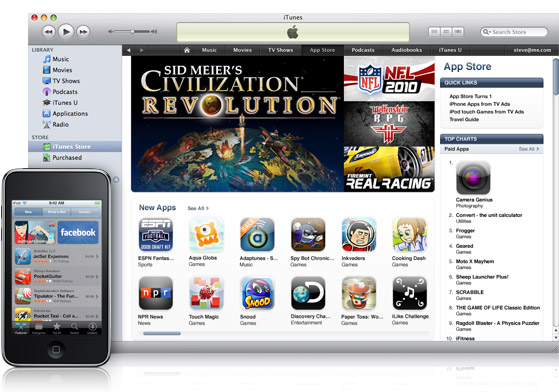
The chairman asked panelists to think about the value of a clearinghouse where best practices could be shared. He suggested that might be a way to spur the spin-off of public-sector apps from private sector initiatives and to prevent reinventing the wheel, rather than tapping into what is already being done. There is not a lot of shared info out there, he said.
If all we’re talking about is a clearinghouse that provides easy access to apps for government-developed apps, Google Code or SourceForge may be a better model than iTunes—though perhaps without the instant name recognition by ordinary consumers. Like SourceForge, Google Code allows hosting and management of open source projects, including Google’s own products. iTunes, by contrast, essentially offers consumers finished apps. Also, iTunes is a stand-alone piece of software, of which the Apps Store is just one part, while I can’t imagine why Genachowski’s “store” need be anything more than a website.
Whatever the analogy, such a “store” could well be a valuable tool for sharing the benefits of software development by government employees, both with the private sector and among federal agencies as well as state, local and even foreign governments. But what, exactly, Genachowski had in mind for the store remains awfully vague: Multichannel News mentions, as examples, “applications that do everything from monitoring heart rates and blood sugar to checking for greenhouse gas levels.” If the idea ever goes anywhere, it should be based on two principles:
- All apps should be open source and available to all users to use as they see fit.
- The store should be limited to apps developed by government employees to meet the needs of government agencies.
Continue reading →
Over at Ars, Ryan Paul has an appropriately sharp-tongued response to the Mozilla Foundation’s troubling move to become a cheerleader for the European Commission’s ongoing antitrust efforts against Microsoft. Apparently Mozilla will assist the EC’s investigation “by offering expertise about the browser market.”
Paul focuses on what’s wrong with this in both a micro and macro sense. He rightly points out that the potential remedies here do not bode well for the future of this sector, since regulatory tinkering with high-tech product standards is bound to end badly and create a terrible precedent for future interventions. “It’s hard to find a rational argument in favor of mandatory standards enforcement,” Paul says. “It would be punitive and unhelpful to the advancement of the web.” Moreover, Paul notes that things have never looked better on the browser front:
Claims that Microsoft’s monopoly status has eliminated competition in the browser market sound hollow in the face of the profoundly vibrant browser market that exists today. The record-setting launch of Firefox 3 added up to over 8 million downloads in the first 24 hours alone. Firefox’s global market share continues to climb every month and the browser has grabbed almost 30 percent of the European market.
And let’s not forget about those two little companies called Google and Apple who have competing products in the field! They’re making serious inroads in the browser wars. Moreover, Microsoft is struggling to hold on to whatever “dominance” they have left in their core market: OS. As Paul concludes:
To the observant tech enthusiast, all signs seem to indicate that Microsoft’s monopoly is on its way out. The Redmond giant is in no danger of annihilation, but it’s definitely not positioned to dictate terms to the rest of the industry anymore.
But what is perhaps most shocking about Mozilla’s call for intervention is the way that Mozilla Foundation chairperson Mitchell Baker minimizes the importance of not just Firefox, but the entire open source movement, when justifying EC intervention in this marketplace.
Continue reading →
Microsoft’s share of the browser market across all versions of Internet Explorer has dropped, by one estimate, dropped from 78.58% in December 2007 to 68.15% in December 2008 (or by just under 8% in another estimate).
[IE’s] share dropped from 69.77% in November to 68.15% in December. [During the same period,] Firefox gained more than half a point and ended up at 21.34%, Safari approaches the [10%] hurdle with 7.93% and Chrome came in at 1.04%, the first time Google was able to cross the 1% mark.
This is particularly interesting:
Since IE6 is used primarily within corporations, its market share is much higher during the week than it is on weekends. As a result, all other browsers gain on weekends and especially during a holiday. Because of that circumstance, Net Applications noted that the December numbers should be taken with a grain of salt. However, it is worth the note that IE6 achieved … market share numbers of about 28% during the week and about 21% on weekends in early 2008. In December, these numbers were down to about 20% during the week and 15% on weekends.
So, Microsoft still has an established base among corporate users, where IT administrators generally prevent employees from installing new applications (including browsers) and the sysadmins often don’t roll out alternative browsers across a corporate network for any one of several possible reasons, including:
- They just don’t want to bother having to install, regularly upgrade and support another piece of software;
- They may overestimate the security vulnerability of such alternative browsers compared to Internet Explorer;
- The crustier sysadmins may not realize that today’s browsers are not only free for individual users, but also for corporate users–unlike the old Netscape Navigator; and
- Corporate intranets may be designed for IE, in which case rolling out an alternative browser might cause confusion among less tech-savvy employees.
Microsoft may still have an advantage that could be considered “unfair,” but so what? Continue reading →
“Damn their lies and trust your eyes. Dig every kind of fox!” I here sing one for the freedom to mix it up as you and your honey alone see fit:
http://www.youtube.com/v/JTcHzGbBoe0&hl=en&fs=1
“Hapa” means “mixed race” in Hawaiian. Skin-tone mash ups have profoundly enriched my life, first with the Honolulu Hapa herself and then with our own little hapas. Honolulu Hapa celebrates coloring across the lines, knocks racism, and gives a shout-out to Loving v. Virginia, 88 U.S. 1 (1967)—the case where the U.S. Supreme Court struck down anti-miscegenation laws as unconstitutional restraints on personal liberty.
As with the prior four songs I’ve posted in this recent series (Take Up the Flame, Sensible Khakis, Nice to Be Wanted, and Hello, Jonah,), Honolulu Hapa comes with a Creative Commons license that allows pretty liberal use by all but commercial licensees, who have to pay a tithe to one of my favorite causes. Honolulu Hapa aims to help Creative Commons, an organization that helps all of us to mix—and remix—it up. Unlike those other songs, however, Honolulu Hapa adds a special ‘unrestricted use” term effective on June 12, Loving Day.
With
Honolulu Hapa, I conclude my recent series of freedom-loving music videos. Like it or not, though, I’ve got more music-making plans. Next, I’ll record some good studio versions of those (and perhaps some other) songs. Eventually, I’d like to release a fundraising CD, one that might help out some good causes. Silly? Yeah, I guess so. But it does add another data point in support of my hypothesis: Freedom has more fun.
[Crossposted at Agoraphilia and Technology Liberation Front.]
[Note: I updated this discussion and chart in a subsequent essay. See: “Are You An Internet Optimist or Pessimist? The Great Debate over Technology’s Impact on Society.”]
A number of very interesting books have been released over the past year or two which debate how the Internet is reshaping our culture and the economy. I’ve reviewed a couple of them here but I have been waiting to compile a sort of mega-book review once I found a sensible way to conceptually group them together. I’m not going to have time to cover each of them here in the detail they deserve, but I think I have at least found a sensible way to categorize them. For lack of better descriptors, I’ve divided these books and thinkers into two camps: “Internet optimists” versus “Internet Pessimists.” Here’s a list of some of the individuals and books (or other articles and blogs) that I believe epitomize these two camps of thinking:
Adherents & Their Books / Writings
|
Internet Optimists
|
Internet Pessimists
|
|
Yochai Benkler, The Wealth of Networks
|
Andrew Keen, The Cult of the Amateur
|
|
Chris Anderson, The Long Tail and “Free!”
|
Lee Siegel, Against the Machine
|
|
Clay Shirky, Here Comes Everybody
|
Nick Carr, The Big Switch
|
|
Cass Sunstein, Infotopia
|
Cass Sunstein, Republic.com
|
|
Don Tapscott, Wikinomics
|
Todd Gitlin, Media Unlimited
|
|
Kevin Kelly & Wired mag in general
|
Alex Iskold, “The Danger of Free”
|
|
Mike Masnick & TechDirt blog
|
Mark Cuban
|
And here’s a rough sketch of the major beliefs or key themes that separate these two schools of thinking about the impact of the Internet on our culture and economy:
Beliefs / Themes
|
Internet Optimists
|
Internet Pessimists
|
|
Culture / Social
|
|
Net is Participatory
|
Net is Polarizing
|
|
Net yields Personalization
|
Net yields Fragmentation
|
|
a “Global village”
|
Balkanization
|
|
Heterogeneity
/ Diversity of Thought
|
Homogeneity
/ Close-mindedness
|
|
Net breeds pro-democratic tendencies
|
Net breeds anti-democratic tendencies
|
|
Tool of liberation & empowerment
|
Tool of frequent misuse & abuse
|
|
|
|
Economics / Business
|
|
Benefits of “free”
(“Free” = future of media / business)
|
Costs of “free”
(“Free” = end of media / business)
|
|
Increasing importance of “Gift economy”
|
Continuing importance of property rights, profits, firms
|
|
“Wiki” model = wisdom of crowds; power of collective intelligence
|
“Wiki” model = stupidity of crowds; errors of collective intelligence
|
|
Mass collaboration
|
Individual effort
|
So, what to make of this intellectual war? Who’s got the story right?
Continue reading →
Global handset manufacturing giant Nokia has purchased the shares they didn’t already own in Symbian, Ltd., the company formed in 1998 as a partnership among Ericsson, Nokia, Motorola and Psion and the developer of the Symbian mobile operating system, by far the world’s leading OS for “smart mobile” phones with 67% of the market, followed by Microsoft on 13%, with RIM on 10% (source).
But wait, there’s more (per Engadget)!
Here’s where it gets interesting, though: rather than taking Symbian’s intellectual private for Nokia’s own benefit, the goods will be turned over to the Symbian Foundation, a nonprofit whose sole goal will be the advancement of the Symbian platform in its many flavors. Motorola and Sony Ericsson have signed up to contribute UIQ assets, while NTT DoCoMo (which uses Symbian-based wares in a number of its phones) will be donating code as well.
Other Symbian Foundation members include Texas Instruments, Vodafone, Samsung, LG, and AT&T (yep, the same AT&T that currently sells precisely one Symbian-based phone), so things could get interesting. The move clearly seems to be a preemptive strike against Google’s Open Handset Alliance, LiMo, and other collaborative efforts forming around the globe with the goal of standardizing smartphone operating systems; the writing was on the wall, and Symbian didn’t want to miss the train. Total cash outlay for the move will run Nokia roughly €264 million — about $410 million in yankee currency.
Other reports note that the Symbian Foundation will eventually take Symbian open source, and that this move is as much as response to Apple’s closed iPhone platform as it is to Gogole’s open Android and LiMo platforms. (Although it is intriguing to note that AT&T, Apple’s exclusive U.S. partner for the iPhone, is among the backers of the new Symbian Foundation, perhaps indicating that even AT&T is hedging its bets.)
The fact that we will soon see
three open source platforms (counting Google’s Android and LiMo) competing for market share provides yet another measure of the exceptionally high degree of competition in the wireless industry. Continue reading →

 The Technology Liberation Front is the tech policy blog dedicated to keeping politicians' hands off the 'net and everything else related to technology.