Gabriella Coleman, the Wolfe Chair in Scientific and Technological Literacy in the Art History and Communication Studies Department at McGill University, discusses her new book, “Coding Freedom: The Ethics and Aesthetics of Hacking,” which has been released under a Creative Commons license.
Coleman, whose background is in anthropology, shares the results of her cultural survey of free and open source software (F/OSS) developers, the majority of whom, she found, shared similar backgrounds and world views. Among these similarities were an early introduction to technology and a passion for civil liberties, specifically free speech.
Coleman explains the ethics behind hackers’ devotion to F/OSS, the social codes that guide its production, and the political struggles through which hackers question the scope and direction of copyright and patent law. She also discusses the tension between the overtly political free software movement and the “politically agnostic” open source movement, as well as what the future of the hacker movement may look like.
Download
Related Links
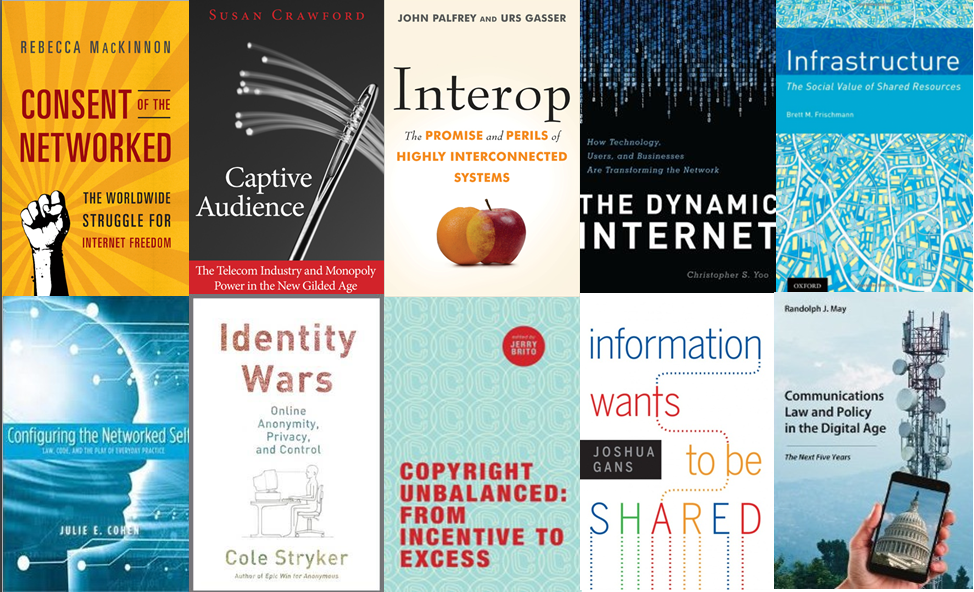
The number of major cyberlaw and information tech policy books being published annually continues to grow at an astonishing pace, so much so that I have lost the ability to read and review all of them. In past years, I put together end-of-year lists of important info-tech policy books (here are the lists for 2008, 2009, 2010, and 2011) and I was fairly confident I had read just about everything of importance that was out there (at least that was available in the U.S.). But last year that became a real struggle for me and this year it became an impossibility. A decade ago, there was merely a trickle of Internet policy books coming out each year. Then the trickle turned into a steady stream. Now it has turned into a flood. Thus, I’ve had to become far more selective about what is on my reading list. (This is also because the volume of journal articles about info-tech policy matters has increased exponentially at the same time.)
So, here’s what I’m going to do. I’m going to discuss what I regard to be the five most important titles of 2012, briefly summarize a half dozen others that I’ve read, and then I’m just going to list the rest of the books out there. I’ve read most of them but I have placed an asterisk next to the ones I haven’t. Please let me know what titles I have missed so that I can add them to the list. (Incidentally, here’s my compendium of all the major tech policy books from the 2000s and here’s the running list of all my book reviews.)
Continue reading →
I have always found it strange that the ACLU speaks with two voices when it comes to user empowerment as a response to government regulation of the Internet. That is, when responding to government efforts to regulate the Internet for online safety or speech purposes, the ACLU stresses personal responsibility and user empowerment as the first-order response. But as soon as the conversation switches to online advertising and data collection, the ACLU suggests that people are basically sheep who can’t possibly look out for themselves and, therefore, increased Internet regulation is essential. They’re not the only ones adopting this paradoxical position. In previous essays I’ve highlighted how both EFF and CDT do the same thing. But let me focus here on ACLU.
Writing today on the ACLU “Free Future” blog, ACLU senior policy analyst Jay Stanley cites a new paper that he says proves “the absurdity of the position that individuals who desire privacy must attempt to win a technological arms race with the multi-billion dollar internet-advertising industry.” The new study Stanley cites says that “advertisers are making it impossible to avoid online tracking” and that it isn’t paternalistic for government to intervene and regulate if the goal is to enhance user privacy choices. Stanley wholeheartedly agrees. In this and other posts, he and other ACLU analysts have endorsed greater government action to address this perceived threat on the grounds that, in essence, user empowerment cannot work when it comes to online privacy.
Again, this represents a very different position from the one that ACLU has staked out and brilliantly defended over the past 15 years when it comes to user empowerment as the proper and practical response to government regulation of objectionable online speech and pornography. For those not familiar, beginning in the mid-1990s, lawmakers started pursuing a number of new forms of Internet regulation — direct censorship and mandatory age verification were the primary methods of control — aimed at curbing objectionable online speech. In case after case, the ACLU rose up to rightly defend our online liberties against such government encroachment. (I was proud to have worked closely with many former ACLU officials in these battles.) Most notably, the ACLU pushed back against the Communications Decency Act of 1996 (CDA) and the Child Online Protection Act of 1998 (COPA) and they won landmark decisions for us in the process. Continue reading →
John Palfrey of the Berkmann Center at Harvard Law School, discusses his new book written with Urs Gasser, Interop: The Promise and Perils of Highly Interconnected Systems. Interoperability is a term used to describe the standardization and integration of technology. Palfrey discusses how the term can describe many relationships in the world and that it doesn’t have to be limited to technical systems. He also describes potential pitfalls of too much interoperability. Palfrey finds that greater levels of interoperability can lead to greater competition, collaboration, and the development of standards. It can also lead to giving less protection to privacy and security. The trick is to get to the right level of interoperability. If systems become too complex, then nobody can understand them and they can become unstable. Palfrey describes the current financial crises could be an example of this. Palfrey also describes the difficulty in finding the proper role of government in encouraging or discouraging interoperability.
Download
Related Links
My most recent Forbes column is entitled, “We All Hate Advertising, But We Can’t Live Without It.” It’s my attempt to briefly (a) defend the role advertising has traditionally played in sustaining news, entertainment, and online service, and (b) discuss some possible alternatives to advertising that could be tapped if advertising starts failing us a media cross-subsidy.
What got me thinking about this issue again was the controversy over satellite video operator DISH Network offering its customers a new “Auto Hop” capability for its Hopper whole-home HD DVR system. Auto Hop will give viewers the ability to automatically skip over commercials for most recorded prime time programs shown on ABC, CBS, FOX and NBC when viewed the day after airing. It makes the viewing experience feel like the ultimate free lunch. Alas, something still must pay the bills. As innovative as that technology is, we can be certain that it will not make content consumption cost-free. We’ll just pay the price in some other way. The same is true for online services since it’s never been easier to use technology to block ads.
So, what is going to pay the bills for content as ad-skipping becomes increasingly automated and effortless? Stated differently, what are the other possible methods of picking up the tab for content creation? Here’s a rough taxonomy: Continue reading →
[UPDATE: 2/14/2013: As noted here, this paper was published by the Minnesota Journal of Law, Science & Technology in their Winter 2013 edition. Please refer to that post for more details and cite this final version of the paper going forward.]
I’m pleased to report that the Mercatus Center at George Mason University has just released my huge new white paper, “Technopanics, Threat Inflation, and the Danger of an Information Technology Precautionary Principle.” I’ve been working on this paper for a long time and look forward to finding it a home in a law journal some time soon. Here’s the summary of this 80-page paper:
Fear is an extremely powerful motivating force, especially in public policy debates where it is used in an attempt to sway opinion or bolster the case for action. Often, this action involves preemptive regulation based on false assumptions and evidence. Such fears are frequently on display in the Internet policy arena and take the form of full-blown “technopanic,” or real-world manifestations of this illogical fear. While it’s true that cyberspace has its fair share of troublemakers, there is no evidence that the Internet is leading to greater problems for society.
This paper considers the structure of fear appeal arguments in technology policy debates and then outlines how those arguments can be deconstructed and refuted in both cultural and economic contexts. Several examples of fear appeal arguments are offered with a particular focus on online child safety, digital privacy, and cybersecurity. The various factors contributing to “fear cycles” in these policy areas are documented.
To the extent that these concerns are valid, they are best addressed by ongoing societal learning, experimentation, resiliency, and coping strategies rather than by regulation. If steps must be taken to address these concerns, education and empowerment-based solutions represent superior approaches to dealing with them compared to a precautionary principle approach, which would limit beneficial learning opportunities and retard technological progress.
The complete paper can be found on the Mercatus site here, on SSRN, or on Scribd. I’ve also embedded it below in a Scribd reader. Continue reading →
Filings are due to the Federal Trade Commission (FTC) today as part of its review of the Children’s Online Privacy Protection Act (COPPA) and the COPPA rule that the FTC devised and enforces. I didn’t have time to pen as much as I wanted, but I did submit a short filing to the agency in the matter based on some of my previous work both with Berin Szoka and on my own. Here’s the executive summary for my filing:
It goes without saying that the Children’s Online Privacy Protection Act (COPPA) is complicated law and rule. When considering the rule and proposals to amend it, it is easy to get lost in the weeds and ignore the bigger picture. That would be a mistake. There are broader, more important questions that need to be asked as part of the Federal Trade Commission’s effort to expand this regulatory regime. These questions involve not only the costs of increased regulation for online business interests, but the impact of expanded regulation on market structure, competition, and innovation. More importantly, these questions cut to the core of whether the public (including children) will be served with more and better digital innovations in the future. There is no free lunch. Regulation—even well-intentioned regulation like COPPA—is not a costless exercise. There are profound trade-offs for online content and culture that must always be considered.
Whatever one thinks about the effectiveness or sensibility of the COPPA regulatory model for the Web 1.0 world, it is clear that the regime is being strained by the unforeseen realities of the Web 2.0 world of hyper-ubiquitous connectivity and user-generated content creation and sharing. The digital genie cannot be put back in the bottle. While COPPA may continue to have a marginal role to play in this rapidly evolving world, that role will likely be increasingly limited by the inherent realities of the information age.
Entire filing can be found on the Mercatus website, on SSRN, or via Scribd [Also embedded below in a Scribd reader.] Continue reading →
 Over the weekend, Janet Morrissey of The New York Times posted an excellent article on the U.S. government’s continuing crackdown on Internet gambling. (“Poker Inc. to Uncle Sam: Shut Up and Deal“) Ironically, her article arrives on the same week during which PBS aired the terrific new Ken Burns and Lynn Novick documentary on the history of alcohol prohibition in the United States. It’s a highly-recommended look at the utter hypocrisy and futility of prohibiting a product that millions of people find enjoyable. If there’s a simple moral to the story of Prohibition, it’s that you can’t repress human nature–not for long, at least, and not without serious unintended consequences. Which is why Morrissey of the Times notes:
And so the poker world now finds itself in a situation many liken to Prohibition. America didn’t stop drinking when the government outlawed alcoholic beverages in 1919. And, in this Internet age, it won’t be easy to prevent people from gambling online, whatever the government says. “It’s a game of whack-a-mole,” says Behnam Dayanim, an expert on online gambling and a partner at the Axinn Veltrop & Harkrider law firm. “They’ve whacked three very large moles, but over time, more moles will pop up.”
Exactly right (except that it should be “whac” not “whack”! There’s no K in whac-a-mole.) It reminds me of the paper that my blogging colleague Tom Bell penned back in 1999 for the Cato Institute with its perfect title: “Internet Gambling: Popular, Inexorable, and (Eventually) Legal.” As Tom noted back then: Continue reading →
 Last year I was asked by the Aspen Institute Communications and Society Program and the John S. and James L. Knight Foundation to author a study on models for local online hubs or community web portals. This paper was one of several commissioned by the Knight Foundation to implement the 15 recommendations found in the Knight Commission report on the Information Needs of Communities in a Democracy. The specific Knight Commission recommendation I focused on in my white paper read as follows: “Ensure that every local community has at least one high-quality online hub.” More specifically, it said: “Communities should have at least one well-publicized portal that points to the full array of local information resources. These include government data feeds, local forums, community e-mail listservs, local blogs, local media, events calendars, and civic information. [The entire three paragraph recommendation can be read here.]
My resulting white paper is entitled,
Creating Local Online Hubs: Three Models for Action, and it was released by the Aspen Inst. & Knight Foundation at an event this morning. (Another Aspen/Knight white paper was simultaneously released on Government Transparency: Six Strategies for More Open and Participatory Government. It was written by Jon Gant and Nicol Turner-Lee.) A short summary of my report follows down below, and you can find the entire report online here. I’ve also embedded the video of this morning’s launch event for both reports.
Continue reading →
Today I filed roughly 30 pages worth of comments with the Federal Trade Commission (FTC) in its proceeding on “Protecting Consumer Privacy in an Era of Rapid Change: a Proposed Framework for Businesses and Policy Makers.” [Other comments filed in the proceeding can be found here.] Down below, I’ve attached the Table of Contents from my filing so you can see the major themes I’ve addressed, and I’ve also attached the entire document in a Scribd reader. In coming days and weeks, I’ll be expanding upon some of these themes in follow-up essays.
In my filing, I argue that while it remains impossible to predict with precision the impact a new privacy regulatory regime will have the Internet economy and digital consumers, regulation
will have consequences; of that much we can be certain. As the FTC and other policy makers move forward with proposals to expand regulation in this regard, it is vital that the surreal “something-for-nothing” quality of current privacy debate cease. Those who criticize data collection or online advertising and call for expanded regulation should be required to provide a strict cost-benefit analysis of the restrictions they would impose upon America’s vibrant digital marketplace.
In particular, it should be clear that the debate over Do Not Track and online advertising regulation is fundamentally tied up with the future of online content, culture, and services. Thus, regulatory advocates must explain how the content and services supported currently by advertising and marketing will be sustained if current online data collection and ad targeting techniques are restricted. Continue reading →

 The Technology Liberation Front is the tech policy blog dedicated to keeping politicians' hands off the 'net and everything else related to technology.