By Berin Szoka & Adam Thierer
Progress Snapshot 4.19 (PDF)
Since the fall of 2008, a debate has raged in Washington over “targeted online advertising,” an ominous-sounding shorthand for the customization of Internet ads to match the interests of users. Not only are these ads more relevant and therefore less annoying to Internet users than untargeted ads, they are more cost-effective to advertisers and more profitable to websites that sell ad space. While such “smarter” online advertising scares some—prompting comparisons to a corporate “Big Brother” spying on Internet users—it is also expected to fuel the rapid growth of Internet advertising revenues from $21.7 billion in 2007 to $50.3 billion in 2011-an annual growth rate of more than 24%. Since this growing revenue stream ultimately funds the free content and services that Internet users increasingly take for granted, policymakers should think very carefully about what’s really best for consumers before rushing to regulate an industry that has thrived for over a decade under a layered approach that combines technological “self-help” by privacy-wary consumers, consumer education, industry self-regulation, existing state privacy tort laws, and Federal Trade Commission (FTC) enforcement of corporate privacy policies.
In an upcoming PFF
Special Report, we will address the many technical, economic, and legal aspects of this complicated policy issue-especially the possibility that regulation may unintentionally thwart market responses to the growing phenomenon of users blocking online ads.
We will also issue a three-part challenge to those who call for regulation of online advertising practices:
- Identify the harm or market failure that requires government intervention.
- Prove that there is no less restrictive alternative to regulation.
- Explain how the benefits of regulation outweigh its costs.
Continue reading →
By Berin Szoka & Adam Thierer
As we noted in our intro to this ongoing series, Google’s tenth anniversary has passed with Googlephobia reaching new heights of hysteria.
But is Google really too big and dangerous, or are people just too lazy to find other alternatives to each of the wonderful services that Google offers? If one is truly paranoid about the firm’s supposed dominance, it doesn’t take much effort to live a Google-free life. To prove it, we set out to find alternatives to each of the services that Google provides. After awhile, we got a little tired of compiling alternatives in each category and just provided links for the additional choices at your disposal. It’s tough to see what the fuss is about with the cornucopia of choices at our disposal. If you don’t like Google, then just don’t use it or any of its services. The choice is yours.
In each case, we’ve listed Google first, even though Google may not be the market leader (
e.g., Google’s relatively unknown social network Orkut).
Search Engines
Continue reading →
By Berin Szoka & Adam Thierer
as part of an
ongoing series

With Google celebrating its 10th anniversary this week, many panicky pundits are using the occasion to claim that Google has become the Great “Satan” of the Internet. Nick Carr wonders what the future holds for “The OmniGoogle.” The normally level-headed Mike Malone worries that Google is “turning into Big Brother.” And Washington Post’s Rob Dubbin says that he can’t escape Google’s “tentacles,” even for just 24 hours. Meanwhile, speculation abounds that the Justice Department is preparing a major antitrust lawsuit against Google concerning its advertising partnership with Yahoo! or perhaps even a broader suit concerning Google’s “dominance” of online advertising generally.
Carr quotes Google co-founder Sergey Brin’s now-famous 2003 interview:
I think people tend to exaggerate Google’s significance in both directions. Some say Google is God. Others say Google is Satan. But if they think Google is too powerful, remember that with search engines, unlike other companies, all it takes is a single click to go to another search engine. People come to Google because they choose to. We don’t trick them.
In the last five years, Google has become far more than just a search engine. As Google’s suite of suite of complementary products continues to grow, so too does the specter of Google as an all-knowing and therefore all-powerful economic colossus. Yet Google isn’t even close to being the sort of nefarious monopolist out to destroy user privacy at every turn, as some seem to imply—if not exclaim. Indeed, in our view, the Net is overall a far better place because of the existence of Google and the many free services it provides consumers.
Our point is not that Google should be immune from criticism. Indeed, healthy criticism of corporate actions plays a vital role in the free market by disciplining corporate policies and behavior—often thus providing an effective alternative to government regulation. This is particularly important in the area of consumer privacy protection, as demonstrated by Google’s quick response to public concern about its Chrome EULA. Continue reading →
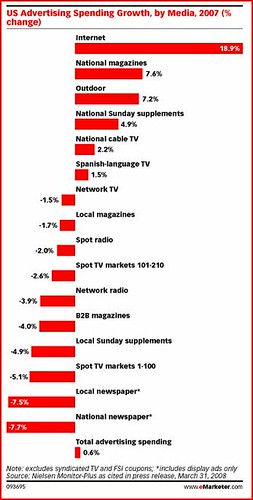 As we’ve discussed here before, newspapers are struggling. We all know that. The question is what, if anything, will save them? Most pundits tend to point to a two-fold solution: (1) get serious about leveraging the natural local advantages newspapers hold; (2) and find away to do so online as quickly as possible before they lose the bulk of the local online ad market to other competitors. This is why there’s a lot of talk these days about turning traditional papers into “hyper-local” web portals for their communities. Of course, there’s no guarantee that will work, especially in light of changing attitudes about “media localism.”
But let’s assume that that is indeed the best path forward. Will it really save newspapers? As eMarketer reports in today’s newsletter on “Can Local Web Ads Save Newspapers,” it’s a bit of a good news–bad news story:
The good news is that newspaper site ad revenues are growing along with other online ad spending, especially for local news sites. Local newspaper online ad revenues are predicted to reach $3.7 billion this year, according to eMarketer calculations based on Borrell Associates data.
The bad news is that this spending will not make up for print ad losses for some time, according to Lisa Phillips, senior analyst at eMarketer. Ms. Phillips noted that advertisers still pay more for print readers than for online readers. “This is a transition that will take several years,” she said. “Local advertisers are paying attention to the shift in reader behavior, but it will take a while for everyone to adjust.”
And so we will have to wait to see how it all plays out. But I am highly skeptical that traditional newspapers operators will be able to make up anywhere near the amount of revenue online that they are hemorrhaging over on the print side of the business. There’s just too much other competition out there online already for our eyes and ears. The age of “protectable scarcity” is dead and that means newspapers just don’t have the lock on local or regional markets they once did.

 The Technology Liberation Front is the tech policy blog dedicated to keeping politicians' hands off the 'net and everything else related to technology.