
Posts tagged as:

The Space Frontier Foundation issued this press release today, following our earlier call for NASA to fund its COTS-D program for demonstrating commercial human spaceflight capabilty.  

The Space Frontier Foundation today called on President-elect Barack Obama to use the innovation and drive of American entrepreneurs to “close the Gap” in U.S. human spaceflight after the Space Shuttle is retired in 2010.

President-elect Obama has promised $2 billion in additional funding for NASA to address the Gap, when the U.S. will be dependent upon Russia’s Soyuz for crew access to the International Space Station.  But two of the options proposed – extending Space Shuttle operations or accelerating the Constellation program – wouldn’t reduce the current estimate of a five year gap by much.

“Space leaders are considering three or four options for reducing the Space Gap, but only one reflects the spirit of positive change that Senator Obama campaigned on,” said Foundation Chairman Berin Szoka.  “According to NASA’s own estimates, flying the Shuttle beyond 2010 will cost at least $2 billion  per year, so that only cuts the Gap by one year.  And $2 billion is a drop in the bucket for Constellation, at best helping to address shortfalls that the Congressional Budget Office just predicted will add another 18 months to the Gap.”

A third option is being considered by some at NASA, according to published reports:  Strip the Orion Crew Exploration Vehicle of the capability to support Lunar exploration, making it simpler and lighter, and supposedly easier to complete sooner.

“This idea is crazy, because it will strand NASA in low Earth orbit, instead of exploring the solar system,” said Foundation co-founder Rick Tumlinson.  “The whole point of the Vision for Space Exploration was to send NASA’s Lewis & Clarks further out into the frontier, to the Moon, Mars, and near-Earth asteroids, while the private sector takes over Earth orbit.  Cutting Orion back gives us ‘Gemini on steroids’, which would be a change for the worse.”

“The only option that makes sense is to use President-elect Obama’s promised $2 billion to catalyze as many as five new commercial human spaceflight companies that will compete to close the Gap using the safest, most capable and affordable system they can develop,” said Will Watson, Foundation Executive Director.

“Let’s not put all our eggs in one basket by pouring even more money into the Shuttle, an old system that’s on its last legs, or a controversial new program that’s already behind schedule,” Watson said.  “If we’re serious about closing the Gap and about making humanity’s presence in space economically sustainable, we need real change in how we put humans in space.  Let’s use this $2 billion to stimulate multiple entrepreneurial systems that will not only slash costs, improve safety, and close the Gap, but also help create a whole new space industry with new jobs here in America.”

Jesse Walker has a terrific feature story looking “Beyond the Fairness Doctrine” in this month’s issue of Reason magazine. I highly recommend it. It’s an in-depth exploration of what an Obama Administration means for the future of tech and media policy. Walker rightly opens the piece by noting that “The fairness doctrine is still dead, and it probably will stay dead even if Barack Obama becomes president.” The danger, however, is that an Obama FCC will still pursue a variety of onerous regulatory objectives that could do a great deal of damage to markets and free speech.

Walker touches upon the various issues that will likely be a priority for an Obama Administration and the Left-leaning media reformistas like Free Press, Media Access Project, Public Knowledge, and New America Foundation. Those policy issues include: net neutrality, “localism” mandates and increased “community oversight” regulations, media ownership rules, minority ownership requirements, increased merger meddling, spectrum policy, and other new “public interest” obligations.

Of course, as Walker also correctly points out, it is difficult to see how things could get much worse than they have been under Bush Administration’s FCC and the leadership of Chairman Kevin Martin.  Walker was kind enough to quote my thoughts on this point: “Martin is the most regulatory Republican FCC Chairman in decades,” I told him. “He wants to control speech and will use whatever tools he has to get there.”

I stand by those words, but I am also aware that things could get worse — much worse — under a Democratic FCC influenced by radical Leftist activists like Free Press.  Indeed, in our new book A Manifesto for Media Freedom, Brian Anderson and I inventory the many looming threats to media and technology freedom that exist today and show how most of them arise from the Left.  As Walker notes in his article, however, it is unlikely that a re-empowered Democratic FCC would come right out of the gates with the same sort of command-and-control approaches they’ve employed in the past.  And we’ll still have to worry about some right-of-center lawmakers and regulatory joining some of these misguided campaigns. “The real danger,” Walker concludes in his piece, “is more subtle and more mundane.  It’s a bipartisan bureaucracy slowly, steadily increasing its power.”    Make sure to read Jesse’s entire piece.  Great stuff.

Peter Ferrara, offering us a taste of the dismal science for the American Spectator in reviewing a recent book’s economic predictions for an Obama Presidency (but what about civil liberties?). Hey, maybe they’ll send out more economic stimulus checks! We used ours this year to pay down a tax bill. It’s like the circle of life. (Other references to the Lion King will be swiftly and severely dealt with).

Smart as Paint

by on October 6, 2008 · 19 comments

I remark briefly on the commentary “how smart is Palin,” noting her mispronunciation of “verbiage” and “pundit.” I’d suggest that observers be wary of assessing qualifications based on this kind of thing. Example: one very well-educated person I know, whose IQ is high enough to qualify enough for Mensa, mispronounces several words because he was socially isolated for his formative years and formed the habit of saying them before he had the chance to hear others pronounce them correctly. I don’t mean he was shut in a closet, which wouldn’t be relevant as Palin clearly hasn’t been, but just that he lived in a rural area where most of his peers were relatively uneducated.

In any case, it is curious that the anxious analysis of Palin, stemming from the fact that she is relatively unknown, seems to turn on characteristics of social class rather than on information about her decision-making as an executive. What significant choices about things like taxes, education policy, resources, and so on was she faced with as governor? What did she do in those situations? Why? What were the alternatives? Many voters probably do elect candidates based on how someone talks or looks, but mightn’t it be nice for a change for the talking classes to assess a candidate on policy? Would she make a better political candidate if some professor had had a couple months to drill her on vocabulary and delivery, like the hapless flower seller Eliza whats-her-name? Continue reading →

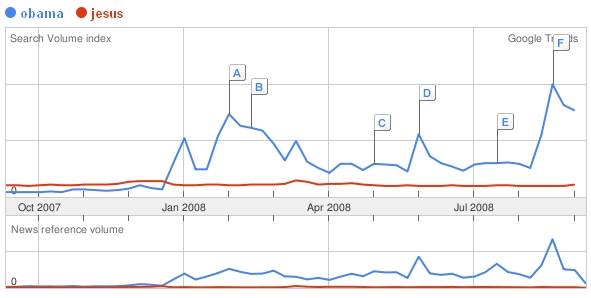
“Bigger than Jesus”

by on September 17, 2008 · 3 comments

In the beginning, there was Obamamania:

C|Net’s Charles Cooper reports today that Department of Justice trustbusters are considering a comprehensive antitrust attack on Google.

Sources who have provided testimony to the government say a departmental debate revolves around whether antitrust regulators should challenge Google’s proposed revenue-sharing deal with Yahoo, or go for the whole enchilada–and haul Google into court on broader charges related to its dominance in search advertising.

C|Net’s Declan McCullagh speculated earlier this week about how Google would fare under an Obama administration:

[Obama’s] technology campaign platform pledges to “reinvigorate antitrust enforcement” and “step up review of merger activity.” He complained to the American Antitrust Institute that “the current administration has what may be the weakest record of antitrust enforcement of any administration in the last half century.” If the Bush administration’s current antitrust probe of Google, coupled with this week’s apparent threat of a federal lawsuit, amounts to a “weak” record, imagine what antitrust true believers in an Obama administration might do. (A three-way split of Google into search, applications, and display ads, anyone?)

I’m not sure whether structural separation is on Google’s near-term horizon, but Washington, D.C.’s parasite economy will make its move.

Writing at Slate, Tim Wu tries to make Obama out to be the real Big Government candidate on media policy, who will deliver “if not a chicken in every pot, a fiber-optic cable in every home.” By contrast, Wu implies that McCain is just another pro-big business lackey who doesn’t understand “that the media and information industries are special—that like the transportation, energy, or financial industries, they are deeply entwined with the public interest.” Wu goes on to say:

Ultimately, most of the difference in Obama’s and McCain’s media policies boils down to questions about whether the media is special and a dispute over how much to trust the private sector. Camp McCain would tend to leave the private sector alone, with faith that it will deliver to most Americans what they want and deserve. The Obama camp would probably administer a more frequent kick in the pants, in the belief that good behavior just isn’t always natural.

First, as a factual matter, Wu is just wrong about McCain being some sort of a radical hands-off, pro-market liberalizer on media policy issues. Oh, if only that were true! But for those of us who have been in DC covering telecom and media policy for many years, it is widely understood there is no nailing down John McCain on any tech, telecom or media policy issue. He’s been all over the board. While he has sponsored or supported some deregulatory initiatives on the telecom front in the past, he’s also been a supporter of other regulatory causes. His battles with broadcasters and cable, for example, are well-known. Most recently, McCain has been leading the effort to impose a la carte mandates on cable and satellite operators. Continue reading →

In case you didn’t catch it the debate last night, Sen. Obama had some very encouraging things to say when asked about the role of government when it comes to media content. “[T]he primary responsibility is for parents,” Obama said. “And I reject the notion of censorship as an approach to dealing with this problem.” He then stressed the importance of making sure that parents have the tools to make these determinations for their families (something I’ve spent a lot of time stressing in my work):

“[I]t is important for us to make sure that we are giving parents the tools that they need in order to monitor what their children are watching. And, obviously, the problem we have now is not just what’s coming over the airwaves, but what’s coming over the Internet. And so for us to develop technologies and tools and invest in those technologies and tools, to make sure that we are, in fact, giving parents power — empowering parents I think is important.”

Good for him. That’s the exactly the right position, and one that his opponent Mrs. Clinton would be wise to adopt. After all, she’s had some rather misguided views on these issues through the years.

Here’s the transcript if you care to read more.

In Part 1 of this series, I argued that the Democratic Party seems to be gradually abandoning whatever claim it once had to being the party of the First Amendment. Regrettably, examples of Democrats selling out the First Amendment are becoming more prevalent and the few champions of freedom of speech and expression left in the party are getting more difficult to find.

For example, in my previous essay, I documented how Democratic politicians were leading the charge to reinstitute the so-called Fairness Doctrine. In today’s entry I will discuss how Democrats are now working hand-in-hand with Republicans to orchestrate what would constitute the most significant expansion of content regulation in decades–the regulation of “excessive violence” on television.

Continue reading →

The idea that the Democrats are the party of free speech and the great protectors of our nation’s First Amendment heritage has always been a bit of a myth. In reality, when you study battles over freedom of speech and expression throughout American history you quickly come to realize that there are plenty of people in both parties would like to serve as the den mothers of the American citizenry. That being said, it is generally true that there have been a few more voices in the Democratic party willing to stand in opposition to governmental attempts to regulate speech in the past.

But I’m starting to wonder where even that handful of First Amendment champions has gone. Sadly, examples of Democrats selling out the First Amendment are becoming so common that I’ve decided to start a new series to highlight recent examples of Dems actually leading the charge for increased government regulation of speech and expression. I want to stress that I’m not trying to pick on Democrats here, rather, I’m just trying to point out that–unless there is a sea change in their approach to these issues by Democrats in coming months and years–both parties now appear to be singing out of the same pro-regulatory hymnal. This constitutes an ominous threat to the future of free expression.

Today, as part of this new series, I’ll be focusing on the Democratic-led efforts to revive the hideously misnamed “Fairness Doctrine.”

Continue reading →