Posts tagged as:

Three passages from Obama’s inaugural address stand out as important for the mix of technology policy issues covered here at the TLF.  On technology policy (a non-trivial 5.4% of the address by word count):

For everywhere we look, there is work to be done. The state of the economy calls for action, bold and swift, and we will act – not only to create new jobs, but to lay a new foundation for growth. We will build the roads and bridges, the electric grids and digital lines that feed our commerce and bind us together. We will restore science to its rightful place, and wield technology’s wonders to raise health care’s quality and lower its cost. We will harness the sun and the winds and the soil to fuel our cars and run our factories…. All this we can do. And all this we will do.

On how to determine whether government intervention is warranted:

The question we ask today is not whether our government is too big or too small, but whether it works…. Where the answer is yes, we intend to move forward. 

On regulatory policy:

Nor is the question before us whether the market is a force for good or ill. Its power to generate wealth and expand freedom is unmatched, but this crisis has reminded us that without a watchful eye, the market can spin out of control….

So what does all this mean for tech policy? Continue reading →

In early December, Jerry Brito asked whether Obama’s proposal to create the post of  Chief Technology Officer (CTO) should be feared or welcomed:

I think the question turns on whether this person will be CTO of the United States or CTO of the U.S. Federal Government. While I personally believe the former should be feared, the latter should be welcomed.

I agree completely—and it now seems that this is in fact where the incoming Administration is heading.  BusinessWeek reports that the Obama Administration has narrowed its choices down to two Indian-American CTOs:

  • Vivek Kundra, D.C.’s CTO
  • Padmasree Warrior, Cisco’s CTO

Judging by BusinessWeek’s short descriptions, both candidates sound terrifically well-qualified to lead implementation of Obama’s oft-repeated promises to bring the United States government into the Web 2.0 era.  More importantly, the fact that the two likely candidates are CTOs—rather than, say, advocates of any particular technology policy agenda—strongly suggests that the Obama administration isn’t contemplating giving the CTO authority to set technology policy outside the Federal government.  

Whomever Obama chooses in the end will have his or her work cut out for them.  While free marketeers may indeed have much to fear from Obama’s technology policy agenda in terms of over-regulation, increased government control and market-distorting subsidies, e-government is one area where we ought to be able to cheer the new President on:   The Federal government could be made much more transparent and democratically accountable if Federal agencies simply adopted some of the tools users take for granted on private websites-such as RSS feeds and standardized data. 

Let’s just hope that Obama makes it very clear in creating the CTO post that its responsibilities are indeed strictly limited directing adoption of information technology inside the Federal government, so that the position doesn’t mushroom into the more powerful “Technology Czar” some rightly fear.

Is $1,200,000,000,000.00.  That’s the expected 2009 Federal budget deficit.  Since the current Federal debt is estimated at a “mere” $10.6 trillion, this means that we’re expected to add nearly 9% in a single year to a debt accumulated over 233 years (since 1774).  This number also amounts to more than 8% of the U.S. economy. 

So what does this have to do with technology policy?  To start with, this figure comes from Congressional Budget Office estimates, which “don’t account for the huge economic stimulus bill Obama is expected to propose soon to try to jolt the economy.”  So, while the Obama team has talked about big “public works” and “infrastructure” spending (which used to be called, variously, “make-work,” “pork barrel” and “corporate welfare”), there’s sure to be huge pressure not to waste more taxpayer money on top of this staggering figure.  Whatever blame Bush deserves, Obama probably doesn’t want to go down in history as the man who finally caused the U.S. government to default on its unmanageable debt burden.

One certainly could make an argument that the kind of technology-related “infrastructure” stimulus Obama has talked about (e.g., broadband subsidies) would be less of a waste of money than, say, simply building more bridges (as Japan did in the 1990s, its “lost decade”) or other reflexively Keynesian responses.  But even so, I suspect that the total amount of funding made available for such projects won’t be anywhere near enough to satisfy the technology policy Left.  

This could result in increased pressure on the Administration to increase regulation of the technology sector in order to implement tech-leftist ideas about “protecting” users’ privacy, promoting media diversity or “fairness”, mandating net “neutrality,” “opening up” spectrum, etc.  Such  proposals might seem attractive precisely because they generally wouldn’t require increased Federal expenditures other than the cost of hiring more bureaucrats (which means more government employee union jobs anyway—hardly a bad thing for Democrats)—while the economic consequences of such proposals for companies and consumers will probably surely be trivialized.  For example, if the advocates of government control at the so-called “Free Press” can’t get universal broadband, they’ll probably press that much harder to cripple online advertising and traffic management by ISPs, just to name two popular bogeymen.obamas-new-new-deal
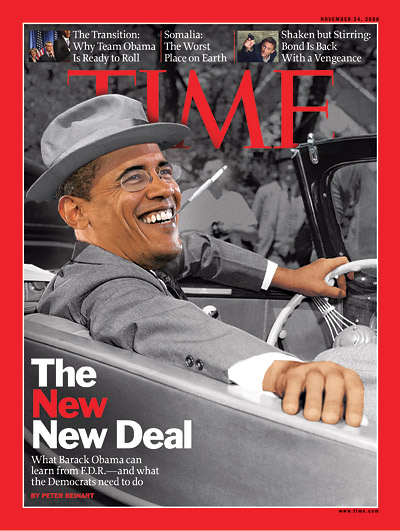
One might think that a sharp economic decline would cause policy-makers to think twice before undermining the business models that have supported IT innovation and real infrastructure investment.  But one has only to look at the policies of FDR’s first two terms to see how even an amiable, soft-spoken president elected on a mantra of change and “uniting” the nation in a time of crisis could consistently choose to place “Reform” (i.e., increased regulation) over “Recovery” (i.e., the health of the economy)—with devastating economic consequences.

Continue reading →

SunsteinPresident-elect Barack Obama will soon be naming Cass Sunstein, an old friend of his from their University of Chicago Law School days together, the new head the White House Office of Information and Regulatory Affairs (OIRA). OIRA oversees regulation throughout the U.S. government. Basically, Sunstein’s position is the equivalent of the federal regulatory czar.

Sunstein certainly possess excellent qualifications for the job. During his time at the University of Chicago and Harvard Law School, Sunstein has established himself as a leading liberal thinker in the field of law and economics. And, as I have joked in writing about him before, he is so insanely prolific that it seems every time I finish reading one of his new books a new title by him lands on my desk. I am quite convinced that both he and Richard Posner are actually cyborgs. I just don’t understand how two humans can compose words so rapidly!

Anyway, Professor Sunstein’s new position as head of OIRA gives him the ability influence federal regulatory decisions in both a procedural and substantive way. In terms of substance, it gives him an important platform to subtly “nudge” the regulatory philosophy and direction of the Obama Administration on many matters, including Internet policy. So, what has Professor Sunstein had to say about Internet policy in his recent work? Sunstein has developed his thinking about these issues primarily in his two recent books: Republic.com (2000) and Infotopia: How Many Minds Produce Knowledge (2006). But he’s also had a few relevant things to say about Internet issues in his recent book with Richard Thaler, Nudge: Improving Decisions About Health, Wealth, and Happiness (2008).

There are 3 Internet policy-related things from his work that I’d like to focus on here because I find them all quite troubling. Continue reading →

Before commenting on Lawrence Lessig’s latest call to abolish the Federal Communications Commission (he issued a similar call for the FCC’s abolition earlier this year, which I commented on here), let’s recall what Tim Lee posted yesterday about “Real Regulators“:

Too many advocates of regulation seem to have never considered the possibility that the FCC bureaucrats in charge of making these decisions at any point in time might be lazy, incompetent, technically confused, or biased in favor of industry incumbents. That’s often what “real regulators” are like, and it’s important that when policy makers are crafting regulatory scheme, they assume that some of the people administering the law will have these kinds of flaws, rather than imagining that the rules they write will be applied by infallible philosopher-kings.

Ironically, Prof. Lessig — who typically defends many forms of high-tech regulation like Net neutrality and online content labeling — is essentially agreeing with Tim’s critique of bureaucracy. But Lessig seems to ignore the underlying logic of Tim’s critique and instead imagines that we need only reinvent bureaucracy in order to save it. But I’m getting ahead of myself. First, let’s hear what Lessig proposes.

In a Newsweek column this week entitled “Reboot the FCC,” Lessig argues that the FCC is beyond saving because, instead of protecting innovation, the agency has succumb to an “almost irresistible urge to protect the most powerful instead.” Consequently, he continues:

The solution here is not tinkering. You can’t fix DNA. You have to bury it. President Obama should get Congress to shut down the FCC and similar vestigial regulators, which put stability and special interests above the public good. In their place, Congress should create something we could call the Innovation Environment Protection Agency (iEPA), charged with a simple founding mission: “minimal intervention to maximize innovation.” The iEPA’s core purpose would be to protect innovation from its two historical enemies–excessive government favors, and excessive private monopoly power.

As was the case with his earlier call to “blow up the FCC,” I am tickled to hear Lessig call for shutting down an agency that many of us have been fighting against for the last few decades. (Here’s a 1995 blueprint for abolishing the FCC that I contributed to, and here’s PFF’s recent “DACA” project to comprehensively reform and downsize the agency.)

But is Lessig really calling for the same sort of sweeping regulatory reform and downsizing that others have been calling for? And has he identified the real source of the problem that he hopes to correct?  I don’t think so. There are 3 basic problems with the argument Lessig is putting forward in his essay. I will address each in turn.

Continue reading →

censored-pornChairman Mao–er… Martin–has canceled (WSJ) the FCC’s December 18 meeting, when the Commission was set to vote on Martin’s proposal to rig an auction to give away a valuable piece of spectrum (“AWS-3”) to M2Z networks.  In exchange for a sweetheart deal on the spectrum, the company would have been required to use a quarter of it to provide a free (but very slow) wireless broadband service.  Martin had initially proposed to require that the service be made porn-free, but eventually suggested that users over 18 would be able to opt-out of network-level filtering.

Two weeks ago, when it became clear that Martin would attempt to ram this proposal through while he still could, I asked how the ascendant Left would respond:

Will the defenders of free expression triumph over those who see ensuring free broadband as a social justice issue?  Or will those on the Left who usually joining us in opposing censorship simply remain silent as the government extends the architecture of censoring the “public airways” onto the Net (where the underlying rationale of traditional broadcast regulation–that parents are powerless–does not apply)?

I’m glad to see that the deathblow to this unconstitutional proposal did indeed come from the political Left–specifically, from Sen. John Rockefeller, (D-W.Va.) and Rep. Henry Waxman, (D-Calif.), who will be responsible for overseeing the FCC in the new Congress.  (The Bush administration had already opposed the proposal, as with so many of Martin’s abuses, had failed to stop it.)

With President-elect Obama having declared that, “Here in the country that invented the Internet, every child should have the chance to get online,” it seems almost certain that the Administration will press ahead with some kind of universal broadband proposal of its own.  But what would such a proposal look like?  If it’s another public broadband utility, would it include network-level filtration like Martin’s proposal?  If so, will the Democratic opponents of government censorship stick by their principles and fight that, too?

I suspect we may find that what’s constitutional is politically impossible (unfiltered free Internet) and what’s politically possible (filtered free Internet) is unconstitutional. Continue reading →

The Space Frontier Foundation , the 20-year old free-market space advocacy organization I chair, released the following press release yesterday:

President-elect Obama’s transition team has published for public comment a white paper entitled Space Solar Power (SSP) – A Solution for Energy Independence & Climate Change. The paper was prepared and submitted by the Space Frontier Foundation and other citizen space advocates, and calls for the new Administration to make development of Space Solar Power a national priority.

The SSP white paper was among the first ten released by the Obama transition team. It is the first and only space-related white paper released by the transition team to date. With 145 comments thus far [now 209], it is already among the top five most-discussed of the 20-some white papers on Change.gov.

Foundation Chairman Berin Szoka called upon all Americans to join the discussion about Space Solar Power at Change.gov: “For over twenty years, the Space Frontier Foundation has championed Space Solar Power as a world-changing technology that could do more to improve life here on Earth than any space program or commercial space venture ever. We applaud the Obama transition team’s interest in developing Space Solar Power as a clean energy source that could significantly reduce U.S. dependence on strategically vulnerable energy sources.”

The Foundation was created in 1988 to advocate for the space industrialization and space settlement ideas of Princeton Physicist Dr. Gerard O’Neill’s Space Studies Institute, including Space Solar Power. The Foundation has testified three times (in 1995, 1997 and 1998) to the U.S. Congress in support of Space Solar Power. In 2000, the Foundation completed a $100,000 project for NASA on Assessment, Outreach, and Future Research of Environmental and Safety Factors related to Space Solar Power. Most recently, the Foundation has sponsored a public discussion to generate input for the National Security Space Office’s SSP study, published in October 2007, which concluded that SSP had “enormous potential.” The Foundation also published comments on that study.

“Harnessing Space Solar Power is a huge challenge,” Szoka concluded. “While we support a national initiative for Space Solar Power, we do not support, nor can the taxpayers afford, another massively expensive ‘White Elephant’ government space program. Only real ‘Change’ in how we pursue national space objectives can make SSP competitive with other energy sources. We believe the private sector will eventually develop SSP-the only questions are how long it takes and which country will lead. The government cannot economically develop SSP on its own, but it can assist the U.S. private sector by funding basic R&D, creating the right investment incentives, and buying SSP for its own needs. Such an unprecedented collaboration between the private and public sectors could build not just another program, but a new, green industry that would create large numbers of high-paying jobs for American citizens. Someday, well into this century, the SSP industry could even turn America into a net energy exporter.” Continue reading →

First, Jim Harper would kill me if I didn’t begin this post by mentioning that I’ll be speaking at a Cato Institute lunch panel entitled, “Just Give Us the Data! Prospects for Putting Government Information to Revolutionary New Uses,” on Wednesday, Dec. 10, along with Ed Felten of Princeton and Gary Bass of OMB Watch. RSVP here. That said, I want to talk about CTOs.

A while back I engaged in a debate about whether Barack Obama’s promise to appoint a national chief technology office should be feared. I think the question turns on whether this person will be CTO of the United States or CTO of the U.S. Federal Government. While I personally believe the former should be feared, the latter should be welcomed.

The good news is that in all of Obama’s pronouncement’s on the matter the position has always been described as having a brief to open the government by employing online tools. Here’s how the position is described in Obama’s campaign position paper on technology:

Bring Government into the 21st Century: Barack Obama and Joe Biden will use technology to reform government and improve the exchange of information between the federal government and citizens while ensuring the security of our networks. Obama and Biden believe in the American people and in their intelligence, expertise, and ability and willingness to give and to give back to make government work better. Obama will appoint the nation’s first Chief Technology Officer (CTO) to ensure that our government and all its agencies have the right infrastructure, policies and services for the 21st century. The CTO will ensure the safety of our networks and will lead an interagency effort, working with chief technology and chief information officers of each of the federal agencies, to ensure that they use best-in-class technologies and share best practices.

To me this sounds more like a Chief Transparency Officer, and that’s a good thing. Most federal government websites are terrible relative to the state of the art. Any effort to make them as useful or informative as the barackobama.com website should be welcomed. We can see the beginning of this transformation at the new change.gov site for the Obama transition team.

Continue reading →

There’s much to discuss as Obama shapes his administration (more on this at OpenMarket.org) but arguably one of the most important unanswered questions is who Obama will pick to staff the Federal Communications Commission.

CNET reports that Henry Rivera, a lawyer and former FCC Commissioner, has been selected to head the transition team tasked with reshaping the FCC. This selection gives us a glimpse of what the FCC’s agenda will look like under Obama, and it’s quite troubling.

Rivera has embraced a media “reform” agenda aimed at promoting minority ownership of broadcast media outlets. A couple weeks ago, Rivera sent a letter to the FCC that backed rules originally conceived by the Media Access Project to create a new class of stations to which only “small and distressed businesses” (SDB) could belong. The S-Class stations would be authorized to sublease digital spectrum and formulate must-carry programming, with the caveat that only half of the content can be “commercial”. To avoid the Constitutional issues surrounding racial quotas, eligibility for SDB classification would be based on economic status, rather than the racial composition of would-be station owners.

The S-Class proposal, like other media reform proposals, falsely assumes that current owners of media outlets are failing to meet the demands of their audience for a diverse range of content. The proposal also ignores the fact that consumers already enjoy an abundance of voices from all viewpoints, as we’ve discussed extensively here on TLF.

Continue reading →

See my take on the election and the prospects for capitalism in today’s Wall Street Journal:

If Barack Obama ran for president by calling for a heavier hand of government, he also won by running one of the most entrepreneurial campaigns in history. Will he now grasp the lesson his campaign offers as he crafts policies aimed at reigniting the national economy? Amid a recession, two wars, and a global financial crisis, will he come to see that unleashing the entrepreneur is the best way to raise the revenue he needs for his lofty priorities?