We’ve talked here before about the dangers of a government-subsidized press as a way of “saving journalism.” But I don’t think I’ve ever read anything quite as eloquent on the issue as Seth Lipsky’s editorial in today’s Wall Street Journal entitled “All the News That’s Fit to Subsidize.” Mr. Lipsky is a member of the adjunct faculty at the Columbia Journalism School. In his essay today, he warns of the very real slippery slope associated with proposal to have government step in and somehow bailout newspapers as they find themselves in a time of crisis.Specifically, Mr. Lipsky addressees a new report (“The Reconstruction of American Journalism“) by Leonard Downie (former executive editor of the Washington Post) and co-author Michael Schudson (also of Columbia Journalism School), in which the authors call for a mixture of legal and regulatory changes as well as government subsidies to help prop up failing news operations.
Mr. Lipsky argues that they have “stepped onto an exceptionally slippery slope”: Continue reading →
Deposuit potentes de sede, et exaltavit humiles;
[The Lord] hath put down the mighty from their seats [of power] and raised up the lowly.
– “Magnificat”
The Internet continues to humble the mighty in journalism. We hear a lot about the humbling of news outlets like the New York Times, but little about the humbling of news-makers. While the media
reformistas would have us believe that dark, shadowy forces control what we hear, see and read, the reality is that it’s becoming increasingly impossible for even the world’s largest companies to “manage” stories because we live in an age of true media abundance. There’s no better sign of this than the fact that Michael Arrington has declared, with good reason, the “news embargo” dead. In the days of media scarcity (which the reformistas like Andrew Keen want to re-create), press releases often declared a story to be “embargoed” until a specific day and time, allowing companies to shape the story by planting releases with the “right” journalists ahead of time. Such embargoes have been breaking down for some time, but now, with the explosion of media abundance, even Google no longer has “the clout to force press to stick to embargoes.”
It’s not my favorite recording but this clip of Bach’s “Magnificat” (BWV 243) should sear into your brain the irrepressibility of the Internet as the greatest leveling force since the invention of the printing press. The two are not unrelated: Bach’s Lutheranism was made possible only by the ready availability of the printed word.
Google Trends for websites reveals all kinds of fascinating insights into the way technology is reshaping the world. Among them is the fact that the HuffingtonPost.com has matured from a scruffy group blog into a new media powerhouse to rival the Wall Street Journal and Washington Post:
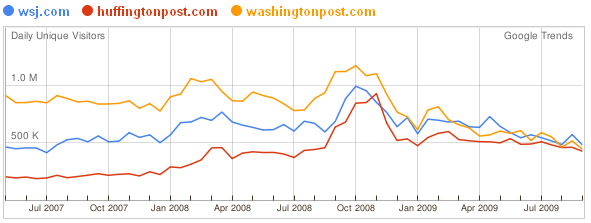
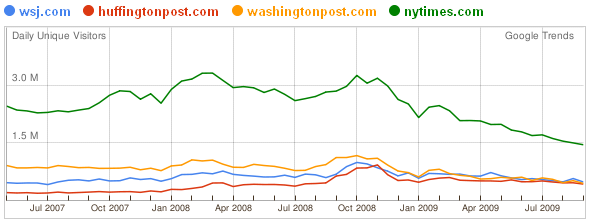
Note that the convergence of these three sites has happened both because HuffPo has doubled its audience and because the audience for the WashingtonPost.com has shrunk by half. While WSJ.com’s audience has returned to roughly its pre-election level, the decline of NYTimes.com suggests that the Internet really is splintering audiences and bringing the giants of news media like the “Gray Lady” down from their once unassailable heights:
 Two great articles today about the dangers of government getting too involved in the newspaper business as the industry experiences serious marketplace difficulties. Slate’s Jack Shafer (“Saving Newspapers From Their Saviors“) and Mark Hopkins of Silicon Angle (“Obama Administration ‘Open’ to State Run Newspapers“) both raise concerns about President Obama’s recent comments hinting that he is open to legislation that might grant struggling news organizations tax breaks if they were to restructure as nonprofit businesses.
In a piece for the
City Journal back in March entitled “Socializing Media in Order to Save It,” I discussed the specific proposal in question, Senator Benjamin L. Cardin’s (D-MD) bill, S. 673, the “Newspaper Revitalization Act,” which would allow newspapers to become nonprofit organizations in an effort to help them stay afloat. Importantly, however, the measure would also disallow political endorsements on their editorial pages as part of the deal. In my essay, I pointed out how “If the FCC received grant-making authority to dole out subsidies to media operators… it’s hard to imagine how journalists won’t be expected to surrender something in exchange.” And that something would be their journalistic independence.
Shafer and Hopkins raise similar concerns in their essays. Continue reading →
On the problems with the newspaper industry, Michael Kinsley writes in the Washington Post:
You may love the morning ritual of the paper and coffee, as I do, but do you seriously think that this deserves a subsidy? Sorry, but people who have grown up around computers find reading the news on paper just as annoying as you find reading it on a screen. (All that ink on your hands and clothes.) If your concern is grander – that if we don’t save traditional newspapers we will lose information vital to democracy – you are saying that people should get this information whether or not they want it. That’s an unattractive argument: shoving information down people’s throats in the name of democracy.
I rarely say it, but the whole thing is worth reading.
Over on the Poynter Online blog, Amy Gahran has a very smart piece on some of the confusion surrounding debates about “media localism.” In her essay asking “How Important is Local, Really?”, she challenges some of the assumptions underlying the Knight Foundation’s new Commission on the Information Needs of Communities in a Democracy.
I particularly like her line about how, “in many senses, ‘local’ is just one set of ripples on the lake of information — especially when it comes to ‘news.’ And for many people, it’s not even the biggest or most important set of ripples.” That is exactly right. Today, local choices are just a few more choices along the seemingly endless continuum of media choices. It’s foolish to assume that “media localism”
in a geographic sense is as important now as it was in the past for the reasons Gahran makes clear in her essay:
I’m glad that the Knight Foundation is asking basic questions about what kinds of information people need support community and democracy. However, I question the Commission’s strong focus on geographically defined local communities. It seems to me that with the way the media landscape has been evolving, geographically defined local communities are becoming steadily less crucial from an information perspective. I suspect that defining communities by other kinds of commonalities (age, economic status/class, interests, social circles, etc.) would be far more relevant to more people — although more complex to define.
Continue reading →

 The Technology Liberation Front is the tech policy blog dedicated to keeping politicians' hands off the 'net and everything else related to technology.