I used to get endless grief from pro-regulatory media activists here in DC when I put forward the argument in days past that Google was a media company and a major player in the battle for eyes, ears and ad dollars in America’s media marketplace. Increasingly, however, more people are coming around to seeing that point, even the crusty old media giants themselves.
In a smart essay over at the Freedom to Tinker blog, David Robinson takes the New York Times to task for an article today again wondering, “Is Google a Media Company?” As David rightly argues:
Continue reading →
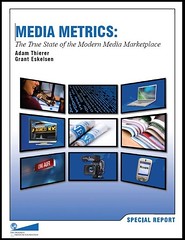 Faithful readers will recall that, several months ago, I penned a 7-part “Media Metrics” series that took a hard look at the health of the media marketplace. Today, the Progress & Freedom Foundation is releasing a greatly expanded version of these essays that I have put together with my PFF colleague Grant Eskelsen. In this 100-page special report, “Media Metrics: The True State of the Modern Media Marketplace,” we begin by noting that heated debates about the state of the media marketplace continue to rage in Washington, and opinions seem to range from grim to outright apocalyptic. As we note on pg. 1:
Many people—including a large number of legislators and regulators—argue that America’s media marketplace is in a miserable state. Some claim that citizens lack choice in media outlets and that options are just as scarce as ever. Others believe that media “localism” is dead or that many groups or niches go underserved because of a lack of true “diversity” in media. Others argue that the market is hopelessly over-concentrated in the hands of a few evil media barons who are hell-bent on force-feeding us corporate propaganda. And still others say that the quality of news and entertainment in our society has deteriorated because of a combination of all of the above. It all sounds quite troubling, but is any of it true?
After taking an objective look at the true state of America’s media marketplace, we conclude that such pessimism is unwarranted. Indeed, a careful review of the facts reveals that—contrary to what those media critics suggest—we have more media choice, more media competition, and more media diversity than ever before. Indeed, to the extent there was ever a “golden age” of media in America, we are living in it today. The media sky has never been brighter and it is getting brighter with each passing year.
Continue reading →
Seth Schiesel of the New York Times seems to be channeling me in his piece yesterday entitled, “Courts Block Laws on Video Game Violence.”
As video games have surged in popularity in recent years, politicians around the country have tried to outlaw the sale of some violent games to children. So far all such efforts have failed. Citing the Constitution’s protection of free speech, federal judges have rejected attempts to regulate video games in eight cities and states since 2001. The judge in a ninth place, Oklahoma, has temporarily blocked a law pending a final decision. No such laws have been upheld.
I’ve been doing a lot of writing on this subject in recent years and have pointed out that every single court that has reviewed the constitutionality of video game regulation has concluded that:
(1) Video games are a form of expression protected by the First Amendment.
(2) Not a single court in America has supported the theory that a causal link exists between exposure to video games and real-world acts of actual violence.
(3) Parents have many less-restrictive means of dealing with underage access to potentially objectionable games—such as the industry’s private rating and labeling system, third-party ratings and info, console-based controls, and the fact that they don’t have to buy the games in the first place! [See my paper and book for more details on all these things.]
Continue reading →

 The Technology Liberation Front is the tech policy blog dedicated to keeping politicians' hands off the 'net and everything else related to technology.