I’ve been hammering Jonathan Zittrain pretty hard here over the past year for the thesis he sets forth in The Future of the Internet and How to Stop It that digital “generativity” is at risk today. The reason I have been doing so is because all signs point in the exact opposite direction, and more so with each passing day. Contrary to Jonathan’s fear that the Internet and digital technologies are growing more closed, tethered, and sterile, I have argued that the facts on the ground show us how the world is actually becoming far more open, untethered, and innovative. And that’s true even for the technology that Jonathan singles out in the book for special scorn — the iPhone.
Consider David Pogue’s post today on the
New York Times‘ technology blog today entitled “So Many iPhone Apps, So Little Time.” Pogue reports that:
there are now 15,000 programs available on the App Store, and so many more are flooding in that Apple’s army of screeners can’t even keep up. I keep meaning to write a thoughtful, thorough roundup of the very best of these amazing programs, but every day that I don’t do it, the job becomes more daunting.
[…]
Apple, which runs the store, keeps 30 percent of each sale. Even so, Ocarina [an application Pogue discusses in his essay] demonstrates that a programmer can make a staggering amount of money from the iPhone store. It’s a crazy new software model that I don’t remember seeing anywhere else. It’s not a boxed software program for $600, or even a shareware program you download for $25. It’s a buck a copy.
The beauty here is that at these prices, there’s very little risk in trying something out. How many software programs have you bought for your Mac or PC? Two? Four? Well, the average iPhone owner may wind up installing 10, 20 or 30 programs. In all, according to Apple, iPhone owners have downloaded 500 million copies of these programs. Half a billion–since last July.
There’s a lot of gloom in the tech industry (and every industry, for that matter). But even when the economy is crashing down around us, there’s still amazing power in a single good idea. And the one on display here–pricing software so low that millions of people buy it without batting an eye–is turning a few clever programmers into millionaires.
I ask you: Does this sound like a world that is growing less generative, as Zittrain argues? Because it sure doesn’t sound like it to me. Moreover, if you still don’t think the iPhone is open enough, then there’s always a simple solution to that: just buy another phone!
 I finally got around to reading Planet Google: One Company’s Audacious Plan to Organize Everything We Know, by Randall Stross. It’s very well done. Stross is a frequently contributor to the New York Times and the author of several other interesting books on the technology industry. He knows how to weave a story together, and it helps that Google’s story is a pretty amazing one.
Each chapter discusses a different part of Google’s growing family of services — GMail, Google Maps, Google Earth, Book Search, and YouTube. Of course, it all started with search and Stross does a good job explaining how the ingenious Google search algorithm has grown from dorm room project to the greatest aggregator of human knowledge that the world has ever known. This, in turn, has powered Google’s hugely successful online advertising system. The real secret of their success with online advertising, Stross argues, is that “Google’s impersonal, mathematical approach search also provides you with the ability to serve advertisements that are tailored to a search, rather than to the person submitting the search request, whose identity would have to be known.”
Despite the benefits of such generally anonymous searching, as Google has grown and added new services and capabilities, concerns about the sheer volume of data that the company collects have led to heightened privacy concerns. Indeed, privacy is a core theme that Stross uses in the book to tie many of the chapters and issues together. Google is constantly struggling to strike the right balance between providing more access to the world’s information while also being careful not to raise privacy concerns. But it’s unclear exactly how much more information collection that users (or public officials) will tolerate before advocating stricter limits on Google’s reach. As Stross points out:
Guided by its founding mission, to organize all the world’s information, Google has created storage capacity that allows it to gain control of what its users are you doing in a comprehensive way that no other company has done, and to preserve those records indefinitely, without the need to clear out old records to make way for new ones. Moreover, Google differentiates its service by refining its own proprietary software formula to mine and massage the data, technology that it zealously protects from the sight of rivals. This sets up a conflict between Google’s wish to operate a “black box” (completely opaque to the outside) and its users’ wish for transparency.
Continue reading →
Some sensible thinking here about broadband pork stimulus plans from Saul Hansell of the New York Times. In his piece on the NYT Bits blog this week, “Does Broadband Need a Stimulus?” he argues that people should stop grumbling about the “relatively small sum” of $6 billion that the new administration has proposed for wiring rural areas and urban centers. Hansell argues:
This also seems to be a rather sound policy choice because, as I look at it, the noise about a broadband gap is hooey. With new cable modem technology becoming available, 19 out of 20 American homes eventually will be able to have Internet service that is faster than any available now anywhere in the world. And that’s without one new cable being laid.
That fact hasn’t prevented a lot of folks involved in telecommunications policy from calling for a lot of money to be spent on backhoes and cable riggers. For example, the Communications Workers of America and the Telecommunications Industry Association called for $25 billion in subsidies to network providers as well as tax breaks. The Free Press, a group that advocates for media diversity, recommended spending $44 billion, with an emphasis on subsidizing companies to compete with existing cable and phone companies.
Running a new fiber-optic cable to every American home may well increase competition in broadband providers, but it isn’t needed to deliver high-speed Internet service. Current cable modems use just one of the more than 100 channels on a typical cable system and can often offer speeds of 16 megabits per second or more. The next generation of modems, using a technology called Docsis 3, allows several of those video channels to be combined to offer what ultimately can be Internet service as fast as 1 gigabit per second — 10 times faster than is offered in Japan, which generally is regarded as having the fastest broadband infrastructure.
Continue reading →
Over the past year or so, many market-oriented critics of Google, like Scott Cleland and Richard Bennett, have criticized the company for aligning itself with Left-leaning causes and intellectuals. Lately, however, what I find interesting is how many leading leftist intellectuals and organizations have begun turning on the company and becoming far more critical of the America’s greatest capitalist success story of the past decade. The reason this concerns me is that I see a unholy Right-Left alliance slowly forming that could lead to more calls for regulation not just of Google, but the entire search marketplace. In other words, “Googlephobia” could bubble over into something truly ugly.
Consider the comments of Tim Wu and Lawrence Lessig in Jeff Rosen’s huge
New York Times Magazine article this weekend, “Google’s Gatekeepers.” Along with Yochai Benkler, Lessig and Wu form the Holy Trinity of the Digital Left; they set the intellectual agenda for the Left on information technology policy issues. Rosen quotes both Wu and Lessig in his piece going negative on Google. Wu tells Rosen that “To love Google, you have to be a little bit of a monarchist, you have to have faith in the way people traditionally felt about the king.” Moreover:
Continue reading →
I’ve spent a lot of time in recent years trying to debunk various myths about online child safety or at least put those risks into perspective. Too often, press reports and public policy initiatives are being driven by myths, irrational fears, or unjustified “moral panics.” Luckily, the New York Times reports that there’s another study out this week that helps us see things in a more level-headed light. This new MacArthur Foundation report is entitled Living and Learning with New Media: Summary of Findings from the Digital Youth Project. This white paper is a summary of three years of research on kids’ informal learning with digital media. The survey incorporates the insights from 800 youth and young adults and over 5000 hours of online observations. The information will eventually be contained in a book from MIT Press (“Hanging Out, Messing Around, Geeking Out: Living and Learning with New Media.”)
From the summary of the study on the MacArthur website:
“It might surprise parents to learn that it is not a waste of time for their teens to hang out online,” said Mizuko Ito, University of California, Irvine researcher and the report’s lead author. “There are myths about kids spending time online – that it is dangerous or making them lazy. But we found that spending time online is essential for young people to pick up the social and technical skills they need to be competent citizens in the digital age.”
Importantly, regarding the concerns many parents and policymakers have about online predation, Ms. Ito told the
New York Times that, “Those concerns about predators and stranger danger have been overblown.” “There’s been some confusion about what kids are actually doing online. Mostly, they’re socializing with their friends, people they’ve met at school or camp or sports.”
In the report, according to the summary, the researchers “identified two distinctive categories of teen engagement with digital media: friendship-driven and interest-driven. While friendship-driven participation centered on “hanging out” with existing friends, interest-driven participation involved accessing online information and communities that may not be present in the local peer group.” The specific findings of the study are as follows:
Continue reading →
In a big post two months ago entitled “Age Verification Debate Continues; Schools Now at Center of Discussion,” I noted that there has been an important shift in the age verification debate: Schools and school records are increasingly being viewed as the primary mechanism to facilitate online identity authentication transactions. I pointed out that this raises two very serious questions: Do we want schools to serve as DMVs for our children? And, do we want more school records or information about our kids being accessed or put online?
Brad Stone of the
New York Times has just posted an important article with relevance to this debate. In it, he points out that:
performing so-called age verification for children is fraught with challenges. The kinds of publicly available data that Web companies use to confirm the identities of adults, like their credit card or Social Security numbers, are either not available for minors or are restricted by federal privacy laws. Nevertheless, over the last year, at least two dozen companies have sprung up with systems they claim will solve the problem. Surprisingly, their work is proving controversial and even downright unpopular among the very people who spend their days worrying about the well-being of children on the Web.
Child-safety activists charge that some of the age-verification firms want to help Internet companies tailor ads for children. They say these firms are substituting one exaggerated threat — the menace of online sex predators — with a far more pervasive danger from online marketers like junk food and toy companies that will rush to advertise to children if they are told revealing details about the users.
Continue reading →
In a City Journal article earlier this year, I wondered “how long some local papers have left when they are barred from restructuring their businesses or partnering with other local media operators to stem the bleeding and reinvent their business models.” I was responding to the Senate’s smack-down of a half-hearted reform effort that FCC chairman Kevin Martin pushed through in November 2007, which proposed relaxing the FCC’s newspaper/broadcast cross-ownership rule. That rule, unrevised since going into effect in 1975, prohibits a newspaper operator from also owning a radio or television station in the same media market. However, waivers were granted to grandfather in some combined newspaper and broadcast operations that had existed long before the ban took effect. Martin’s proposal was to simply tweak the rule to permit similar combinations in just the nation’s 20 largest media markets.
Martin’s limited liberalization proposal, however, led to howls of disapproval from FCC democrats like Michael Copps and many folks on both side of the aisle in Congress. Supposedly, this was nothing more than a “giveaway” to the newspaper industry, which critics said was doing just fine. It really makes you wonder if any of those critics even both reading the news about newspapers today.
As I have documented here on many occasions, as well as in my big Media Metrics report, the newspaper industry is in huge trouble with every financial variable of importance rapidly heading south. Alan Mutter does a good job here of summarizing “the secular forces dragging down newspapers: Declining readership, shrinking advertising, high fixed costs and growing online competition that makes it increasingly difficult to charge the premium ad rates that were possible prior to the Internet.” As a result of these forces, everyday brings another headline like this one today in the New York Times: “The Star-Ledger of Newark Plans 40% Cut,” or this one in the Wall Street Journal: “Some Newspapers Shed Unprofitable Readers.” The numbers are just miserable, and they just get worse and worse.
Continue reading →
The New York Times, that dinosaur of old media, is currently live-blogging the most important Congressional debate since that epochal, thoughtful discussion back in October 2002 as to whether Iraq posed a clear and present danger to the United States justifying a declaration of war—I mean, total non-debate that preceded Congress’s decision to issue President a blank checkthat has proved nearly as expensive as the blank check currently before the Congress.
The highlight of the debate thus far:
11:39 a.m. | No socialism!: After Jeb Hensarling, a Republican representative from Texas, affirmed that he was voting against the bill because it smacks of socialism and might represent limits on liberty, Barney Frank, a Democratic representative from Massachusetts, said that he is “ever mindful” that George Bush might “lead us down the road to socialism,” and so Congress would monitor the bailout closely.
Wow. When Barney Frank, just about the closest thing to an avowed socialist in Congress after Bernie Sanders, warns about the dangers of a Republican president and supposed “free market” champion leading us down the “Road to (socialist) Serfdom,” we should all feel a terrible chill. To paraphrase the over-paraphrased Yeats:
Surely some revelation is at hand
Surely the Second Coming is at hand!
… what rough beast, its hour come round at last,
Slouches towards [Washington] to be born?
John Markoff had an interesting article in the New York Times this weekend entitled “Internet Traffic Begins to Bypass the U.S..” In the piece, Markoff notes that “The era of the American Internet is ending” since “data is increasingly flowing around the United States,” instead of all flowing though our country, as it once did. Markoff focuses on how that “may have intelligence — and conceivably military — consequences.”
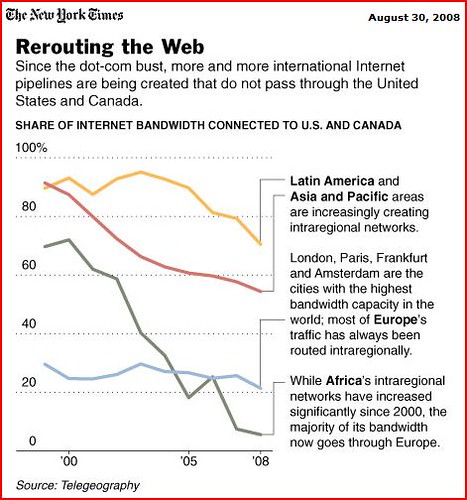 Indeed, it may. But what I also found interesting about this fact is the implications it will have for the future of content regulation. As Harvard’s Yochai Benkler told the
Times, “This is one of many dimensions on which we’ll have to adjust to a reduction in American ability to dictate terms of core interests of ours.” Content controls are one way that lawmakers enforce what they perceive to be a country’s “core interests.” As less and less Internet traffic flows through the U.S., it could become increasingly difficult for American lawmakers to impose their particular vision or morality on the Internet.
Indeed, it may. But what I also found interesting about this fact is the implications it will have for the future of content regulation. As Harvard’s Yochai Benkler told the
Times, “This is one of many dimensions on which we’ll have to adjust to a reduction in American ability to dictate terms of core interests of ours.” Content controls are one way that lawmakers enforce what they perceive to be a country’s “core interests.” As less and less Internet traffic flows through the U.S., it could become increasingly difficult for American lawmakers to impose their particular vision or morality on the Internet.
And that’s both good and bad news.
Continue reading →

 The Technology Liberation Front is the tech policy blog dedicated to keeping politicians' hands off the 'net and everything else related to technology.