The Comcast-NBC deal has the traditional media world all atwitter—well, better call it aflutter. “Atwitter” is losing its old media connotations.
So the
New York Times rounded up a foursome of advocates to air their views, among them Adam Thierer and yours truly.
Huzzahs and rotten fruit in the comments, please.
(And you can see from comparing our posts which of us believes in economy in the use of words.)
Today, Jim Harper and I took on Andy Schwartzman of Media Access Projects and Gigi Sohn of Public Knowledge in this New York Times online debate about, “Should Consumers Fear the Comcast Deal?” Like other media critics, Schwartzman and Sohn adopt the gloom and doom tone that many worrywarts use when discussing the deal. Andy Schwartzman says “Comcast’s proposed acquisition of NBC Universal poses a genuine threat to free expression and diversity of speech in our democratic society.” And Gigi Sohn predicts that “With all that programming under its control, Comcast will have every incentive to take its shows off of the Internet and force consumers to buy a cable subscription to get online access to that programming.”
But as Jim Harper and I point out, we’ve heard such Chicken Little horror stories before. Whether it was AOL-Time Warner, News Corp-DirecTV, Sirius-XM, or whatever else, the story is always that a veritable media apocalypse awaits if the deals aren’t blocked. But it just ain’t so. As I note in my response:
Back in the real world, the sky never fell — except on the merging companies! Just two years after the deal was announced, AOL-Time Warner had lost over $100 billion and Time Warner has now spun off AOL entirely. The News Corp.-DirecTV marriage ended in divorce after just three years. And Sirius-XM flirted with bankruptcy earlier this year as listeners continue to flock to other audio options. The moral of the story: markets worked. Shareholders abandoned bad deals, new niche markets developed, and innovative digital technologies continue to revolutionize media.
And as Harper notes in response to silly claims about restricting access to content or communications, “Comcast-NBC can no more impinge on communications among Internet users than AOL-Time Warner did.” Which is to say, not at all. They would be doomed if they tried to play such games. You can’t make money or retain viewers or customers by cutting off access to content or conduit. Finally, “the genuine threat to free expression and diversity of speech” is not Comcast-NBC, as Schwartman suggests, but a government big enough to crush media companies and control media platforms as if they were their playthings.
For more details about the actual historical record, check out my recent PFF white paper: “A Brief History of Media Merger Hysteria: From AOL-Time Warner to Comcast-NBC.”
Google Trends for websites reveals all kinds of fascinating insights into the way technology is reshaping the world. Among them is the fact that the HuffingtonPost.com has matured from a scruffy group blog into a new media powerhouse to rival the Wall Street Journal and Washington Post:
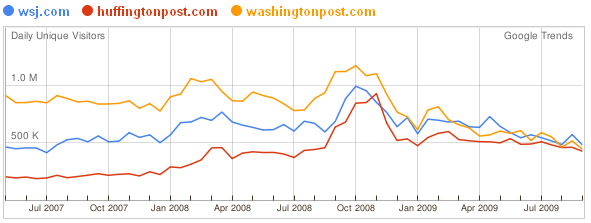
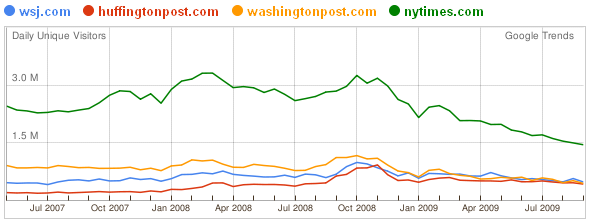
Note that the convergence of these three sites has happened both because HuffPo has doubled its audience and because the audience for the WashingtonPost.com has shrunk by half. While WSJ.com’s audience has returned to roughly its pre-election level, the decline of NYTimes.com suggests that the Internet really is splintering audiences and bringing the giants of news media like the “Gray Lady” down from their once unassailable heights:
In response to Professor Jonathan Zittrain’s op-ed in The New York Times last Monday about online privacy and open platforms (which Adam thoroughly refuted last week) I have a letter to the editor in today’s The New York Times:
To the Editor:
Re “Lost in the Cloud” (Op-Ed, July 20):
In discussing the privacy risks that have accompanied the growth of the Internet, Prof. Jonathan Zittrain rightly bemoans the willingness of governments to violate individuals’ privacy rights. Unfortunately, he proposes new legal restrictions that would stifle online innovation while doing little to enhance consumer privacy.
Mr. Zittrain proposes a “fair practices law” that would require companies to release personal data back to users upon request. Such a rule may sound workable, but purging specific data across globally dispersed server farms is no simple endeavor. Who is to pay for the implementation of such privacy procedures — especially for free services like Facebook or Twitter that have yet to turn a profit?
A better approach to online privacy is to educate users on safeguarding personal information. Ultimately, however, the only foolproof approach to protecting sensitive data online is to simply not disclose it.
Continue reading →
Well, here we go again. Harvard’s Jonathan Zittrain has penned another gloomy essay about how “freedom is at risk in the cloud” and the future of the Internet is in peril because nefarious digital schemers like Apple, Facebook, and Google are supposedly out to lock you into their services and take away your digital rights. And so, as I have done here many times before (see 1, 2, 3, 4, 5 + video!), I will offer a response arguing that Jonathan’s cyber-Chicken Little-ism is largely unwarranted.
Zittrain’s latest piece is entitled “Lost in the Cloud” and it appears in today’s New York Times. It closely tracks the arguments he has set forth in his book The Future of the Internet–And How to Stop It, which I named the most important technology policy book of 2008, but not because I agreed with its central thesis. Zittrain’s book and his new NYT essay are the ultimate exposition of Lessigite technological pessimism. I don’t know what they put in the water up at the Berkman Center to make these guys so remarkably cranky and despondent about the future of of the Internet, but starting with Lawrence Lessig’s Code in 1999 and running through to Zittrain’s Future of the Internet we have been forced to endure endless Tales of the Coming Techno-Apocalypse from these guys. Back in the late 90s, Prof. Lessig warned us that AOL and some other companies would soon take over the new digital frontier since “Left to itself, cyberspace will become a perfect tool of control.” Ah yes, how was it that we threw off the chains of our techno-oppressors and freed ourselves from that wicked walled garden hell? Oh yeah, we clicked our mouses and left! And that was pretty much the end of AOL’s “perfect control” fantasies. [See my recent debate with Prof. Lessig over at Cato Unbound for more about this “illusion of perfect control,” as I have labeled it.]
But Zittrain is the equivalent of the St. Peter upon which the Church of Lessigism has been built and, like any good disciple, he’s still vociferously preaching to the unconverted and using fire and brimstone sermons to warn of our impending digital damnation. In fact, he’s taken it to all new extremes. In
Future of the Internet, Jonathan argues that we run the risk of seeing the glorious days of the generative, open Net and digital devices give way to more “sterile, tethered devices” and closed networks. The future that he hopes to “stop” is one in which Apple, TiVo, Facebook, and Google — the central villains in his drama — are supposedly ceded too much authority over our daily lives because of a combination of (a) their wicked ways and (b) our ignorant ones.
Continue reading →
I’ve been blathering on about this week’s big Supreme Court decision in FCC v. Fox, [See Parts 1, 2, 3, 4, 5], so I thought I would just wrap this series of essays up with a collection of other articles and views on the decision in case readers are looking for alternative perspectives:
Mainstream Media Stories
Conservative, Religious, & “Family” Groups
Free Speech Advocates or Other Views
Speaking of socializing media, acting FCC Chairman Michael Copps is someone who has devoted much of his life to regulating the media marketplace into the ground. If he had his way, federal bureaucrats would be controlling virtually every aspect of the media universe. Nothing would get done with Big Nanny’s permission.
That’s what makes his recent comments about the impact of media regulation so delicious.. and hypocritical. According to an article Bloomberg ran on Thursday, Copps is now saying that, with newspapers struggling to remain afloat, the FCC should now reconsider regulations that prohibit combined ownership of broadcast stations and newspapers. The agency should “visit this whole problem” before long, Copps apparently told Bloomberg.
“Visit this problem before long”?? Please! Congress and the FCC have had opportunities to “visit” and revisit this problem for many years now, but it has been Michael Copps and his merry band of media reformistas who have stopped every reform effort dead in its tracks. (See my essays “Congress Fiddles, Newspapers Burn” and “Media Deregulation is Dead” for more evidence of how these radicals hijacked media policy in this country.) As I documented in my 2005 Media Myths book, these charlatans have used hyperbolic rhetoric, shameless fear-mongering, and unsubstantiated claims in opposition to each and every sensible effort to reform our nation’s outdated media ownership policies. Those laws and regulations have created artificial market structures and hindered the ability of media operators to find new business models that might throw them a lifeline in difficult times.
Consider the fact that it was just 14 months ago that then-Commissioner Copps issued this gem of a hysteria-ridden statement in response to the agency’s last effort to ever-so-slightly loosen the newspaper-broadcast cross ownership rule:
Continue reading →
Ben Edelman of the Harvard Business School has just released an interesting new study in the Journal of Economic Perspectives entitled, “Red Light States: Who Buys Online Adult Entertainment?” Using data he obtained from a top-10 seller of adult entertainment, Edelman examined adult website subscriptions on the zip code level and found that conservatives seem to be every bit as interested in pornography as liberals. In fact, “Subscriptions [to adult entertainment sites] are slightly more prevalent in states that have enacted conservative legislation on sexuality” and “subscriptions are also more prevalent in states where surveys indicate conservative positions on religion, gender roles, and sexuality.” He also finds that:
In states where more people agree that “Even today miracles are performed by the power of God” and “I never doubt the existence of God,” there are more subscriptions to this service. Subscriptions are also more prevalent in states where more people agree that “I have old-fashioned values about family and marriage” and “AIDS might be God’s punishment for immoral sexual behavior.”
Even more interesting is the fact that, on a state-by-state basis, Utah* residents topped all other Americans in terms of subscriptions to online adult entertainment websites. Finally, Edelman concludes:
On the whole, these adult entertainment subscription patterns show a remarkable consistency: all but eleven states have between two and three subscribers to this service per thousand broadband households, and all but four have between 1.5 and 3.5. With interest in online adult entertainment relatively constant across regions, there’s little sign of a major divide.
But it’s not just Internet porn where we see this trend at work. As I noted in my law review article, “Why Regulate Broadcasting?” we’ve seen a similar trend at work with television. When you look at some of the TV shows that conservatives and religious groups gripe most about, you might be surprised to know that it is conservatives who make those shows as popular as they are!
Continue reading →
There’s been plenty written about the death spiral that America’s newspaper industry finds itself stuck in — here’s an amazing summary of the recent online debates — and I’ve spent a lot of time writing on this issue here in the past, too. Ben Compaine, one of America’s sharpest media analysts and the co-author of the classic study Who Owns the Media?, has added his own two cents in his latest essay over at the Rebuilding Media blog. Like everything Ben writes, it is well worth reading:
If newspapers have essentially been able to thrive on the revenue from advertisers alone (again, with cost of printing more or less covered by circulation revenue), why are they having so much trouble today? The answer is not one single factor, but a major contributor is that newspapers – whether print or digital—are just worth less to advertisers than they were 20 years ago. Back then, local advertisers did not have many options for reaching the mass local audience. What was the alternative for auto dealers? For real estate agents? Supermarkets or department stores? For some, direct mail was one possible option. But that was about it. Using pre-prints instead of ROP became attractive for some large display advertisers, leaving the publishers with a piece of the cash flow. Advertisers were hit with regular rate increases. And they pretty much had to pay, The publishers made good money.
But then a double whammy. Just about the time the Internet became a real alternative for classified listings—think Craigslist, Monster.com, eBay, Autotrader.com—and for retailers—think DoubleClick, Google, et al—the boys at the cable operators had perfected the insertion of highly local spots into their feeds. Between 1989 and 2007 local cable advertising increased from $500 million to $4.3 billion—or from 0.4% of all advertising to 1.6%. Advertising in newspapers fell from 26% to 15% in this period. Although some of the highly local advertisers going to cable may have taken some of their funds from budgets for radio or other local media, it is probable that a significant share came from the hides of newspapers. I estimate perhaps up to 20% of the decline in local newspaper advertising share can be attributed to local cable spots.
The other whammy, the gorilla in the room, is Internet advertising. No need to elaborate. But its impact on newspapers is not just that it has siphoned off dollars per se. Much more importantly is that
the Internet has given most advertisers greater market power against newspaper publishers. Many big advertisers—like car dealers, real estate offices and big box retailers—don’t need the newspapers as much.
Ben’s got it exactly right. The decline of newspapers comes down to the death of “protectable scarcity” (thanks to Canadian media expert Ken Goldstein for that phrase). There’s just too much other competition out there online already for our eyes and ears. We’re witnessing substitution effects on a scale never seen in the media world, with disruptive digital technologies and networks splintering our attention spans. That de-massification of media means that high fixed cost endeavors like daily newspapers are not going to be able to sustain the cross-subsidies they’ve long gotten from advertisers.
If you want to boil the newspaper death spiral down to an equation, it would look something like this:
Continue reading →
What would it take to create a more secure Internet? That’s what John Markoff explores in his latest New York Times article, “Do We Need a New Internet?” Echoing some of the same fears Jonathan Zittrain articulates in his new book The Future of the Internet, Markoff wonders if online viruses and other forms of malware have gotten so out-of-control that extreme measures may be necessary to save the Net. Compared to when cyber-security attacks first started growing over 20 years ago, Markoff argues that:
[T]hings have gotten much, much worse. Bad enough that there is a growing belief among engineers and security experts that Internet security and privacy have become so maddeningly elusive that the only way to fix the problem is to start over.
Like many others, Markoff fingers anonymity as one potential culprit:
The Internet’s current design virtually guarantees anonymity to its users. (As a New Yorker cartoon noted some years ago, “On the Internet, nobody knows that you’re a dog.”) But that anonymity is now the most vexing challenge for law enforcement. An Internet attacker can route a connection through many countries to hide his location, which may be from an account in an Internet cafe purchased with a stolen credit card. “As soon as you start dealing with the public Internet, the whole notion of trust becomes a quagmire,” said Stefan Savage, an expert on computer security at the University of California, San Diego.
Consequently, Markoff suggests that:
A more secure network is one that would almost certainly offer less anonymity and privacy. That is likely to be the great tradeoff for the designers of the next Internet. One idea, for example, would be to require the equivalent of drivers’ licenses to permit someone to connect to a public computer network. But that runs against the deeply held libertarian ethos of the Internet.
Indeed, not only does it run counter to the ethos of the Net, but as Markoff rightly notes, “Proving identity is likely to remain remarkably difficult in a world where it is trivial to take over someone’s computer from half a world away and operate it as your own. As long as that remains true, building a completely trustable system will remain virtually impossible.” I’ve spent a lot of time writing about that fact here and won’t belabor the point other than to say that efforts to eliminate anonymity for the entire Internet would prove extraordinarily intrusive and destructive — of both the Internet’s current architecture and the rights of its users. There’s just something about a “show-us-you-papers,” national ID card-esque system of online identification that creeps most of us out. That’s why I spend so much time fighting age verification mandates for social networking sites and other websites; it’s the first step down a very dangerous road.
But what if we could apply such solutions in a narrower sense? That is, could we create more secure communities within the overarching Internet superstructure that might provide greater security? Markoff starts thinking along those lines when he suggests…
Continue reading →

 The Technology Liberation Front is the tech policy blog dedicated to keeping politicians' hands off the 'net and everything else related to technology.