Could net neutrality rules be unconstitutional? Maybe so, says Daniel Lyons of Boston College Law School. In a piece released last week by the Free State Foundation (based on a more extensive research paper for Boston College last March) he argues that rules of the sort being considered by the FCC may constitute a taking of property under the Fifth Amendment.
The idea that a regulation could be considered a “taking” is certainly nothing new. For decades, courts have recognized the concept of “regulatory takings,” rules so restrictive that they constitute a seizure of property under the Fifth Amendment. But Lyons doesn’t just argue that “net neutrality” is a regulatory seizure in some abstract sense. He argues that neutrality rules would constitute a very real seizure of tangible, albeit invisible, property.
Continue reading →
Leo Laporte claimed today on Twitter that Facebook had censored Texas radio station, KNOI Real Talk 99.7 by banning them from Facebook “for talking about privacy issues and linking to my show and Diaspora [a Facebook competitor]. Since Leo has a twitter audience of 193,884 follower
s and an even larger number of listeners to his This Week In Tech (TWIT) podcast, this charge of censorship (allegedly involving another station, KRBR, too) will doubtless attract great deal of attention, and helped to lay the groundwork for imposing “neutrality” regulations on social networking sites—namely, Facebook.
Problem is: it’s just another false alarm in a long series of unfounded and/or grossly exaggerated claims. Facebook spokesman Andrew Noyes responded:
The pages for KNOI and KRBR were disabled because one of our automated systems for detecting abuse identified improper actions on the account of the individual who also serves as the sole administrator of the Pages. The automated system is designed to keep spammers and potential harassers from abusing Facebook and is triggered when a user sends too many messages or seeks to friend too many people who ignore their requests. In this case, the user sent a large number of friend requests that were rejected. As a result, his account was disabled, and in consequence, the Pages for which he is the sole administrator were also disabled. The suggestion that our automated system has been programmed to censor those who criticize us is absurd.
Absurd, yes, but when the dust has settled, how many people will remember this technical explanation, when the compelling headline is “Facebook Censors Critics!”? There is a strong parallel here to arguments for net neutrality regulations, which always boil down to claims that Internet service providers will abuse their “gatekeeper” or “bottleneck” power to censor speech they don’t like or squelch competitive threats. Here are just a few of the silly anecdotes that are constantly bandied about in these debates as a sort of “string citation” of the need for regulatory intervention: Continue reading →
By Berin Szoka & Adam Thierer
 We learned from The Wall Street Journal yesterday that “Federal Communications Commission Chairman Julius Genachowski gets a little peeved when people suggests that he wants to regulate the Internet.” He told a group of Journal reporters and editors today that: “I don’t see any circumstances where we’d take steps to regulate the Internet itself,” and “I’ve been clear repeatedly that we’re not going to regulate the Internet.”
We’re thankful to hear Chairman Julius Genachowski to make that promise. We’ll certainly hold him to it. But you will pardon us if we remain skeptical (and, in advance, if you hear a constant stream of “I told you so” from us in the months and years to come). If the Chairman is “peeved” at the suggestion that the FCC might be angling to extend its reach to include the Internet and new media platforms and content, perhaps he should start taking a closer look at what his own agency is doing—and think about the precedents he’s setting for future Chairmen who might not share his professed commitment not to regulate the ‘net. Allow us to cite just a few examples:
Net Neutrality Notice of Proposed Rulemaking
We’re certainly aware of the argument that the FCC’s proposed net neutrality regime is not tantamount to Internet regulation—but we just don’t buy it. Not for one minute.
First, Chairman Genachowski seems to believe that “the Internet” is entirely distinct from the physical infrastructure that brings “cyberspace” to our homes, offices and mobile devices. The WSJ notes, “when pressed, [Genachowski] admitted he was referring to regulating Internet content rather than regulating Internet lines.” OK, so let’s just make sure we have this straight: The FCC is going to enshrine in law the principle that “gatekeepers” that control the “bottleneck” of broadband service can only be checked by having the government enforce “neutrality” principles in the same basic model of “common carrier” regulation that once applied to canals, railroads, the telegraph and telephone. But when it comes to accusations of “gatekeeper” power at the content/services/applications “layers” of the Internet, the FCC is just going to step back and let markets sort things out? Sorry, we’re just not buying it. Continue reading →
A funny thing happened to the FCC Friday on its way to regulating the Internet: a federal appeals court panel questioned the agency’s authority to regulate the web. There’s no final decision yet, but an adverse ruling could stop the agency’s Internet regulation plans in their tracks. And for good reason.
In proposing new neutrality rules last October, the FCC one rather inconvenient obstacle: there isn’t anything in the Communications Act, or any other statute, actually giving them power to regulate such things. Internet service, by the FCC’s own reckoning, is not a telecommunications service, nor is it cable TV, or broadcasting, or anything else the law give the FCC authority to regulate. Continue reading →
by Berin Szoka & Adam Thierer, Progress Snapshot 5.11 (PDF)
Ten years ago, Nobel Prize-winning economist Milton Friedman lamented the “Business Community’s Suicidal Impulse:” the persistent propensity to persecute one’s competitors through regulation or the threat thereof. Friedman asked: “Is it really in the self-interest of Silicon Valley to set the government on Microsoft?” After yesterday’s FCC vote’s to open a formal “Net Neutrality” rule-making, we must ask whether the high-tech industry—or consumers—will benefit from inviting government regulation of the Internet under the mantra of “neutrality.”
The hatred directed at Microsoft in the 1990s has more recently been focused on the industry that has brought broadband to Americans’ homes (Internet Service Providers) and the company that has done more than any other to make the web useful (Google). Both have been attacked for exercising supposed “gatekeeper” control over the Internet in one fashion or another. They are now turning their guns on each other—the first strikes in what threatens to become an all-out, thermonuclear war in the tech industry over increasingly broad neutrality mandates. Unless we find a way to achieve “Digital Détente,” the consequences of this increasing regulatory brinkmanship will be “mutually assured destruction” (MAD) for industry and consumers.
New Fronts in the Neutrality Wars
The FCC’s proposed rules would apply to all broadband providers, including wireless, but not to Google or many other players operating in other layers of the Net who favor such broadband-specific rules. With this rulemaking looming, AT&T came after Google with letters to the FCC in late September and then another last week accusing the company of violating neutrality principles in their business practices and arguing that any neutrality rules that apply to ISPs should apply equally to Google’s panoply of popular services. In particular, AT&T accused Google of “search engine bias,” suggesting that only government-enforced neutrality mandates could protect consumers from Google’s supposed “monopolist” control.
The promise made yesterday by the FCC—to only apply neutrality principles to the infrastructure layer of the Net—is hollow and will ultimately prove unenforceable. Continue reading →
The Post, hardly a bastion of radical cyber-libertarianism, has come out strongly against FCC Chairman Julius Genachowski’s plans to have the FCC issue “Net Neutrality” regulations. The editorial asks the critical threshold question we crazy cyber-libertarians always insist on:
Is this intervention necessary?
Mr. Genachowski claims to have seen “breaks and cracks” in the Internet that threaten to change the “fundamental architecture of openness.” He and other proponents of federal involvement cite a handful of cases they say prove that, left to their own devices, ISPs… will choke the free flow of information and technology. One example alluded to by the chairman: Comcast’s blocking an application by BitTorrent that would allow peer-to-peer video sharing. Yet that conflict was ultimately resolved by the two companies — without FCC intervention — after Comcast’s alleged bad behavior was exposed by a blogger.
Thus, the FCC oppposes pre-emptive regulation that would “prohibit ISPs from ‘discriminating against’ different applications,” noting that this would mean that “ISPs, which have poured billions of dollars into building infrastructure, would have little control — if any — over the kinds of information and technology flowing through their pipes.”
Three cheers for the
Post for recognizing both the property rights of ISPs in their networks and the fact that, even with Genachowski’s “slight concession” to allow “managed services in limited circumstances… unneeded regulation could still interfere with [ISPs] ability to manage bandwidth-hogging applications that can hamper service, especially during peak times.” Instead, the Post called for simple transparency, supporting a requirement that “ISPs be candid with the agency and the public about network management practices. The last paragraph hits the ball out of the park:
Mr. Genachowski claims that the FCC “will do as much as we need to do, and no more, to ensure that the Internet remains an unfettered platform for competition, creativity and entrepreneurial activity.” He will advance this goal by insisting on transparency; he will jeopardize it — and stifle further investments by ISPs — with attempts to micromanage what has been a vibrant and well-functioning marketplace.
Amen! The Post is about as “mainstream” as it gets in American journalism, so their strong opposition really underscores that preemptive “net neutrality” regulation isn’t the popular cause some in Washington think it is. It is simply infrastructure socialism.
In a week in which neutrality regulation is making a lot of news, I hope that Robert Hahn and Hal Singer’s terrific new study, “Why the iPhone Won’t Last Forever and What the Government Should Do to Promote its Successor” gets some attention. It provides a wonderful overview of how dynamically competitive the mobile marketplace has been over the past two decades and why critics are wrong to get worked up about the short-term “dominance” of Apple’s iPhone. Here’s the abstract of their paper:
Because of the overwhelming, positive response to the iPhone as compared to other smart phones, exclusive agreements between handset makers and wireless carriers have come under increasing scrutiny by regulators and lawmakers. In this paper, we document the myriad revolutions that have occurred in the mobile handset market over the past twenty years. Although casual observers have often claimed that a particular innovation was here to stay, they commonly are proven wrong by unforeseen developments in this fast-changing marketplace. We argue that exclusive agreements can play an important role in helping to ensure that another must-have device will soon come along that will supplant the iPhone, and generate large benefits for consumers. These agreements, which encourage risk taking, increase choice, and frequently lower prices, should be applauded by the government. In contrast, government regulation that would require forced sharing of a successful break-through technology is likely to stifle innovation and hurt consumer welfare.
“New technologies often seemingly emerge from nowhere, but also frequently lose their luster quickly,” Hahn and Singer go on to argue. As evidence they cite the recent examples of Second Life and MySpace, which were hyped as potentially become dominant providers in their respective areas just a few years ago, but now are subjected to intense competition. “[T]he the mobile handset market is subject to these same disruptive forces,” they argue: Continue reading →
Adam Thierer and I have warned that neutrality regulation, once imposed on broadband providers, will
extend to other Internet services wherever “gatekeepers” are alleged to control access to a platform used by others. In short, the slippery slope of creeping common carriage is real and we’re already heading down it, with cyber-collectivist “luminaries” like Jonathan Zittrain and Frank Pasquale demanding neutrality regulation for devices, application platforms like iTunes and Facebook, and search!
TLF Reader Jim Reardon made a particularly astute observation on my post asking whether Americans really want net neutrality regulation:
Regulation of any service, product or industry is preceded by definition. Once defined, it is subject to taxation.
[Net Neutrality regulation] is a prelude to taxation of Internet products and services. It will likely start with telephony services and proceed accordingly to financial services, and continue from there.
As such, the activity is essentially neutral insofar as technology innovation is concerned — so long as applicable taxes are paid the government will ensure that the service is not disfavored by the network operators.
Absolutely right! One of the greatest barriers to government regulation and taxation of the Internet today is the lack of clear definitions: The FCC rules will tell you precisely what “cable television” or “commercial radio” mean, but the concepts of “social networking,” “Internet video,” “blogging,” and even “search” are indeterminate and constantly evolving.
Ronald Reagan once quipped:
Government’s view of the economy could be summed up in a few short phrases: If it moves, tax it. If it keeps moving, regulate it. And if it stops moving, subsidize it.
Fortunately, government’s
ability to implement this view depends—to paraphrase President Clinton—”on what the meaning of the word ‘is’ ‘it’ is”: Allowing “it” to remain beautifully amorphous may be the best way to keep government at bay.
Those who advocate regulating Internet service providers as common carriers subject to “open access” mandates (a/k/a “Net Neutrality”) want us to believe that their cause is the “Civil Rights” issue of the digital age, with huge popular support and opposed only by self-interested cable companies and their henchmen. In fact, such regulations would actually harm consumers, increase broadband prices, retard the heretofore-explosive growth of bandwidth, and dramatically increase government control over the Internet. Of course, the degree of public interest in a cause doesn’t actually tell us anything about its justice and, fortunately, we live in a democratic oligarchic republic, not a pure democracy. But it’s worth asking whether Americans are really up in arms about the need for “Net Neutrality” regulations. Google Trends suggests not:
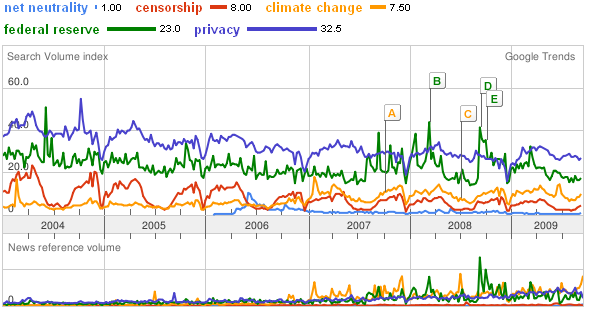 This kind of comparison should dispel once and for all the myth of a popular groundswell for net neutrality regulation—especially since online search volumes heavily over-represent the interests of the digerati, thus over-stating general interest in web-related topics.
In fact, “Net Neutrality” regulation is a
niche cause trumpeted incessantly by the blogosphere with about the same level of broad popular interest online as “housing rights”—a topic about which most of us probably don’t often fall into conversation (unless we happen to live in Bakuninist Berkeley or the Bolivarian Caliphate of Cambridge, MA, ground-zero of American Chavismo). Continue reading →
Over at TechDirt, Mike Masnick has an interesting post asking “Why Did Apple Approve Spotify?” which builds on an AdAge column asking a similar question: “Did Apple Sacrifice ITunes With Latest Apps?” As the title of that AdAge piece suggests, some folks are wondering if Apple shot itself in the foot by approving Spotify, a music streaming app that some regard as a potential iTunes killer. I don’t really have any comment on the business angle here, rather, I wanted to just comment on Mike’s suggestion that one possible explanation for Apple’s approval of the app is that:
As we noted when the app was approved, Apple appears to be somewhat gunshy, following the FCC inquiry into why it “blocked” Google Voice on the iPhone (and, yes, Apple still insists it didn’t actually block the app, but Google says otherwise). Given the scrutiny, Apple probably realized that it was in for some serious political trouble if it blocked an app like Spotify, which would have received a lot of press attention. Oddly, the AdAge article doesn’t mention this at all.
Indeed, it is odd that
AdAge didn’t bother mentioning that fact. But what I find doubly odd here is that nobody is even blinking an eye at the prospect of such political meddling with — or even possible FCC regulation of — Apple, iTunes, or music streaming market in general! Seriously, have we gotten to the point now in our Bold New World of Neutrality Regulation that innovative high-tech companies must live in fear of constant regulatory intervention even when they completely lack any statutory authority to play these games? Moreover, does anyone think that the a bunch of Beltway bureaucrats can micro-manage music and high-tech application markets and give us more options than we have today?
I know the prospect of such meddling makes some academics and regulatory activists groups happy, but I can’t see how this ends well for consumers or high-tech markets more generally. Regardless, for those of you who laugh when we suggest that the slippery slope of regulation is real, consider this case to be Exhibit A. Or perhaps it’s Exhibit B since the Google Voice spat with Apple was already moving the FCC in the direction of becoming a device regulator and applying “handset neutrality” principles that have no basis in law. It’s your anything-goes government at work.

 The Technology Liberation Front is the tech policy blog dedicated to keeping politicians' hands off the 'net and everything else related to technology.