Posts tagged as:

Eric Goldman, one of the few active cyberlibertarians in legal academe, has a thoughtful post about the search partnership announced today. Eric notes blogger Danny Sullivan’s observation about the decline in Yahoo’s assets and his comment that:

Microsoft is getting a huge bargain courtesy of the US Department Of Justice. Without Google being able to compete for Yahoo’s business, the billions that were floating around in 2008 become millions in 2009.

Danny and Eric certainly have a strong point: One of the costs of the Justice Department’s decision to block Google from partnering with Yahoo! is that Yahoo! wound up fetching much less in its deal with Microsoft. But the intervening slump in the economy and online advertising has also contributed in the drop in Yahoo!’s share price and overall valuation, so it’s difficult to make an apples-to-apples comparison. Eric is probably right that in assessment that:

Yahoo was unbelievably crazy for passing on Microsoft’s acquisition proposal from a year-and-a-half ago. It looked like a foolish mistake at the time, and hindsight has definitely not improved that assessment!

It would seem that both Yahoo! and Microsoft under-estimated the likelihood that antitrust regulators would block a Yahoo!/Google deal a year ago: Microsoft probably wouldn’t have offered as much as it did to acquire Yahoo!’s search business ($31/share) and Yahoo! (currently $15.14/share) certainly wouldn’t have held out for a better deal from Google. While the end result ended up being a Yahoo!/Microsoft deal anyway, the delay of over a year in reaching a deal is itself a significant cost of what economists would call the “regime uncertainty” created antitrust: Without clear rules, it’s difficult for economic actors to predict the decisions by regulators. A delay of a year could well prove to make a big difference in the ability of the two companies to mount a successful response to Google in search and advertising—just as Microsoft’s 18 month delay back in 2003-2004 in developing a search ad auction system to respond to Google’s AdWords system (which now produces 2/3 of its revenue) probably did much to thwart Microsoft’s initial efforts to compete in search. Continue reading →

A key point that Berin and I try to get across in our Forbes editorial today about the Yahoo!-Microsoft deal is that the high-tech marketplace evolves too rapidly for creaky Analog Era antitrust laws to keep up. We wanted to say more on that point in our piece, but we had a tight deadline (and a strict word limit!)  Well, turns out that we really don’t need to do so now because Farhad Manjoo of Slate has done a better job than we ever could have making that point in this essay today entitled, “The Case Against the Case Against Google“:

But if the government was right on the facts [in the Microsoft case], it was wrong on the big picture. The theory behind the prosecution was that Microsoft’s mobster tactics would raise the price of software and slow down innovation. But that didn’t happen. In 2002, Microsoft settled the antitrust case with the Bush administration; it faced no substantial penalties for its years of bad behavior. At that point, it still looked unbeatable—it had the same OS monopoly, office-software monopoly, and Web-browser monopoly. And you know what happened? It got beat anyway. Many of Microsoft’s assets turned out not to matter, because upstarts like Google and old foes like Apple found ways to innovate around them.

Continue reading →

We’ve just published an op-ed over at Forbes.com about today’s big Yahoo!-Microsoft deal.


Searching For Success: Web 1.0 Titans Struggle to Reinvent Themselves by Berin Szoka & Adam Thierer

Yahoo! and Microsoft on Wednesday announced a partnership in which Microsoft’s Bing search engine technology will power search for both companies, but Yahoo! will manage advertising sales and content creation.

This should be cause for celebration as a good thing for consumers. By providing a strong competitor with a combined 28% market share, the deal should also be a source of relief at Google, which has come under increasing attack for its supposed market dominance. But if recent concerns about online search, advertising, competition and privacy are any guide, many will fail to appreciate why the deal is pro-consumer, or what it says about the rapid evolution of the Internet.

It’s easy to forget that just a decade ago most of us still hadn’t done our first Google search, Microsoft was still focused on the desktop and Yahoo! was still serving up the online equivalent of the Yellow Pages. AltaVista, AOL, CompuServe and Geocities still ruled the roost.

Today, as we enjoy the fruits of a true cyber-renaissance, cyberspace circa 1999 increasingly looks like the Digital Dark Ages: The old online walled gardens have crumbled, desktop applications have migrated to the cloud and search has redefined our experience of the Web.

Oh, and did we mention just about all of it is “free“? Sounds like exactly the sort of vigorous innovation, expanding consumer choice, falling prices and cut-throat competition that policymakers should want, right?

Alas, regulators seem stuck in the past. European officials in particular seem hell-bent on continuing the antitrust crusade of the ’90s against Microsoft, myopically focused on fading paradigms (desktop operating systems and Web browsers). But instead of narrowly defining high-tech markets based on yesterday’s technologies or market structures, policymakers should embrace the one constant of the Internet economy: dynamic, disruptive and irrepressible change.

Continue reading →

Wired Magazine editor Chris Anderson has an important new book out, “Free: The Future of a Radical Price.” He focuses on the economics of free services, building on the excellent analysis of thinkers like Mike Masnick (whose 2007 essay, “The Grand Unified Theory on The Economics of Free,” succinctly sums up the concept).free-chris-anderson

Following up on his book, Anderson has a new op-ed up on CNN.com in which he explores how the emergence of free services in the digital age has raised new challenges for antitrust regulators:

Now Google has Microsoft-like dominance in search and search advertising. What should it not be allowed to do? That question may come to define this era of antitrust law. When [Christine] Varney was confirmed, she withdrew the Bush administration’s report setting relatively conservative standards of antitrust enforcement and declared, “The Antitrust Division will be aggressively pursuing cases where monopolists try to use their dominance in the marketplace to stifle competition and harm consumers…

Varney and her team of economists and lawyers are no doubt tangling with the question of how to enforce antitrust laws in a way that ensures an “even” playing field for competition without causing consumers to lose access to free services that are growing more abundant by the day.

But there’s a more important question that Varney should be asking: what actually constitutes market dominance in the age of free? Is the fact that a firm has a substantial share of a distinct marketplace a reliable indicator of dominance? And if the result of firms achieving high market share is an explosion of free goods and services, is it even in consumers’ interests for government to go after “dominant” firms?

Continue reading →

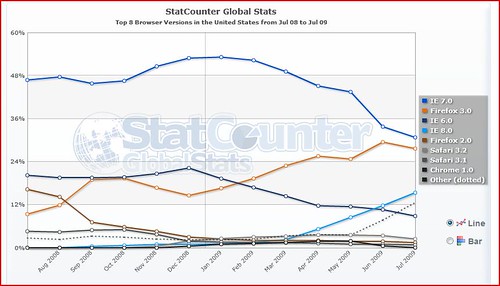
Really, what would we do without European antitrust regulators protecting us from the evils of browser innovation? If Microsoft was allowed to actually bundle its Internet Explorer browser alongside its operating system we might actually do something really crazy… like perhaps try it! After all, the latest browser stats make it pretty clear most of us have a choice and that fewer and fewer of us rely on IE. As Erick Schonfeld noted on Tech Crunch today:

The new browser wars on on. More than a decade after Microsoft killed off Netscape with Internet Explorer, competition in the browser market has never been stronger. Just last week, Mozilla released Firefox 3.5, which has now been downloaded nearly 14 million times. Earlier in June, Apple released Safari 4. In March, Microsoft introduced Internet Explorer 8, and Google came out with a speedier beta of its Chrome browser. Some early data is coming in showing relative market share and how fast people are upgrading. If you look at the chart above from Statcounter, it indicates that since March Internet Explorer has lost 11.4 percent market share to other browsers. [..] Where did that go? It went to Firefox, Safari, and Chrome. Nearly 5 percent of that, or about half, went to Firefox 3.0, which currently has 27.6 percent market share. That doesn’t count last week’s upgrade.

08-09 browser stats

Alas, as I pointed out in my essay a few weeks ago (“European Regulators Think Consumers Too Stupid to Know How to Download a Different Browser“), some Euro-crats still seem to believe that changing browsers requires great detective skills to unearth alternatives.  It’s just pure poppycock and yet another sad example of how antitrust law is usually hopelessly behind the times and has absolutely nothing to do with protecting consumers or fostering innovation.

Now, please excuse me while I get back to surfing the Net via Firefox and Chrome (and Opera on my mobile phone). My God, how did I ever find these browser alternatives!

The advocates of regulation pay lip service to the importance of advertising in funding online content and services but don’t seem to understand that this quid pro quo is a fragile one:  Tipping the balance, even slightly, could have major consequences for continued online creativity and innovation.

Michael-Mr-YogatoWho is this handsome young man and why does he have “Mr. Yogato Stamped Me!!!” on his forehead? More importantly, why does he look so darn happy?

Flashback: Earlier this week, my partner Michael (pictured) and I visited Mr. Yogato, a frozen yogurt shop in Washington’s Dupont Circle neighborhood which describes itself as “the FUNNEST yogurt experience you’ll ever have.”

Apart from serving exceptionally tasty frozen yogurt and letting customers play a vintage Nintendo, Mr. Yogato is famous for the eight “Rules of Yogato,” which offer discounts if users achieve certain feats, including:

  • Answering devilishly difficult trivia (10% off—or extra if you fail)
  • Reciting the Stirling battlefield speech from Braveheart in a great Scottish accent (20% off)

But the best discount, which Michael does every time (unless I’m there to help identify, say, countries that end in ‘L’), is offered for wearing the Yogato stamp on your forehead. Being stamped is, of course, almost as much fun as singing along to “Mr. Roboto” if you’re lucky enough to hear that played while you’re in the shop (10% off).  But the real fun is in engaging passersby on the street about the icy-sweet joys of Yogato. It’s also, of course, probably the most effective advertising Mr. Yogato could ever want.

So, the next time you hear Adam Thierer and I talk about the benefits of advertising, especially online, just remember that while there is no free lunch (nor free frozen yogurt), there is discounted frozen yogurt.  It’s a simple, obvious quid pro quo:  10% off in exchange for spreading the Gospel of Yogato. Continue reading →

Fred Vogelstein’s essay in Wired, “Great Wall of Facebook: The Social Network’s Plan to Dominate the Internet — and Keep Google Out” describes the intensifying clash between Google and Facebook—a clash that focuses on the ability to target advertising:

Like typical trash-talking youngsters, Facebook sources argue that their competition is old and out of touch. “Google is not representative of the future of technology in any way,” one Facebook veteran says. “Facebook is an advanced communications network enabling myriad communication forms. It almost doesn’t make sense to compare them.”

Apart from noting that Facebook directs users to Microsoft’s Bing as its default search engine for the Internet at large, the most interesting part of the article is Facebook’s “4-Step Plan for Online Domination”:

1. Build critical mass. In the eight months ending in April, Facebook has doubled in size to 200 million members, who contribute 4 billion pieces of info, 850 million photos, and 8 million videos every month. The result: a second Internet, one that includes users’ most personal data and resides entirely on Facebook’s servers. 2. Redefine search. Facebook thinks its members will turn to their friends—rather than Google’s algorithms—to navigate the Web. It already drives an eyebrow-raising amount of traffic to outside sites, and that will only increase once Facebook Search allows users to easily explore one another’s feeds. 3. Colonize the Web. Thanks to a pair of new initiatives—dubbed Facebook Connect and Open Stream—users don’t have to log in to Facebook to communicate with their friends. Now they can access their network from any of 10,000 partner sites or apps, contributing even more valuable data to Facebook’s servers every time they do it. 4. Sell targeted ads, everywhere. Facebook hopes to one day sell advertising across all of its partner sites and apps, not just on its own site. The company will be able to draw on the immense volume of personal data it owns to create extremely targeted messages. The challenge: not freaking out its users in the process.

Facebook can’t keep losing money forever.  Indeed, investors are willing to keep sinking money into Facebook during Phases 1-3 because they think it will pay off in Phase 4—when Facebook really threatens to be a fGoogle-killer.  But rather the fact that investors are willing to subsidize the creation of a wonderful platform now used by 200 million people (one fifth of all Internet users worldwide), or that Facebook might finally provide a counter-weight to the fearsome Google, the People for the Ethical Treatment of Data (PETD) are appalled.  One commenter on the Wired story put it best: Continue reading →

chris soghoianIn episode #44 of “Tech Policy Weekly,” Berin Szoka and Adam Thierer engage in a debate with Internet security expert Chris Soghoian, who is a student fellow at the Berkman Center for Internet & Society at Harvard University. He is also a Ph.D. candidate at Indiana University’s School of Informatics.

Chris is an up-and-coming star in the field of cyberlaw and technology policy as he has quickly made a name for himself in debates over privacy policy, data security, and government surveillance.  He straddles the line between academic and activist, and the role he often plays in many tech policy debates is somewhat akin to what Ralph Nader has done in many other fields through the years. Except, in this case, instead of “Unsafe at Any Speed” it’s more like “Unsafe at Any Setting,” since Chris is often raising a stink about what he regards as unjust or unreasonable privacy or security settings that various online websites or service providers use.

On the show, Chris talks about two of his recent crusades to get certain online providers to change their default settings to improve user security or privacy: (1) His effort this week to get major email providers—and Google in particular—to change their default security settings on their email offerings; and (2) his earlier crusade to create permanent opt-out cookies to stop behavioral advertising by advertising networks.

There are several ways to listen to today’s TLF Podcast. You can press play on the player below to listen right now, or download the MP3 file. You can also subscribe to the podcast by clicking on the button for your preferred service. (And do us a favor, Digg this podcast!)

[display_podcast]

Continue reading →

Internet policy Shame Artist extraordinaire Chris Soghoian has struck again! Chris recently shamed the online advertising industry into improving their privacy practices with his Targeted Advertising Cookie Opt-Out (TACO) plug-in for Firefox. Now Chris has set his sight on the security practices of cloud service providers.

A letter released this morning, signed by 37 leading online security experts (and organized by Chris), calls on Google to offer persistent SSL (HTTPS) encryption by default for all Google servicesor at the very least, to make more visible the option currently given to users to opt-in to use SSL for all communications. Google, in its response, indicated that it was already “looking into whether it would make sense to turn on HTTPS as the default for all Gmail users.”

While Google’s response identifies some clear problems with implementing persistent SSL for all users (esp. connection speed), few would deny that it makes sense for webmail providers to encrypt all traffic using SSL, rather than sending email data “in the clear,” which risks interception by hackers. We at PFF hold no brief for Google, in fact we have found ourselves disagreeing with them on many other occasions on a range of issues (most notably net neutrality mandates). Nonetheless, on this front, Google has long been a leader, having offered SSL since Gmail launched and having begun providing the persistent HTTPS option last summer while most of their competitors still use SSL only for the initial authentication that occurs when a user first signs in. While the letter focuses on Google and webmail in particular, this issue has far broader implications for all online cloud service providers.

No Free Lunch: The Costs of Encryption Gmail, Yahoo! Mail, Hotmail, etc. are, of course, “free” ( i.e., ad-supported). Google in particular has lead the way in increasing the functionality offered in Gmail, not just constantly increasing the total storage space provided to every user (now over 7GB), but regularly adding innovative new features—at no charge to users. Continue reading →