Interesting piece from Jeff Jarvis about “Google Bigotry,” or his belief that “media people are going after Google’s success for no good reason other than their own jealousy.” Jarvis argues that reporters penning hard-nosed stories about Google are, in reality, just a bunch of envious cry-babies:
newspaper people will use their last drops of ink to complain about Google’s success and try to blame it for their own failures rather than changing their own businesses. .. It’s not just that they dislike the competition – and they do, for it is a new experience for too many of them. If they were smart, they’d use Google to get more audience and make more money but they don’t know how to (or rather, they’d prefer not to change). No, the problem is that Google represents change and a new world they’ve refused to understand.
Well, yes and no. I don’t believe that
every story penned about Google by a mainstream media reporter is rooted in envy, and certainly not the one that Jarvis alludes to as prompting him to pen this piece. Jarvis apparently received an inquiry from a French journalist at Le Monde asking for comment about “an article about Google facing a rising tide of discontent concerning privacy and monopoly.” That doesn’t necessarily sound like an unreasonable journalistic inquiry to me. So, I’m not sure it’s fair to accuse every journalist who calls with a hard-nosed question about privacy and antitrust as being guilty of “Google bigotry.”
That being said,
some journalists are likely feeling a bit miffed about Google’s recent success, thinking it comes at their expense, and, therefore, their envy might be prompting some of them to pen attack stories on the company. I think Jarvis in on stronger ground, however, in asserting that most privacy and antitrust complaints about Google are unfounded, and also based on envy. Indeed, Berin Szoka and I have have been cataloging the complaints that we believe are driven by an irrational form of corporate envy we call “Googlephobia.” And in prior years we saw a similar form of Microsoft-bashing at work that we still have with us today. That’s why I think Jarvis is on to something when he notes that Google-bashing represents a broader sociological phenomenon: Continue reading →
I’ve noted that Google and Microsoft both face what Clayton Christensen famously called the “Innovator’s Dilemma” in trying to handle disruptive innovation in search technology. But noting Microsoft’s innovations in bringing social functionality to search with its “Ping” tools in Bing, I pointed out a few days ago that, “Microsoft, with less to lose and without a huge installed user base to worry about annoying by violating Google’s ‘Prime Directive’ of elegant simplicity, may have an easier time introducing ‘disruptive’ innovations to search than Google.”
The trick will be for Microsoft to find ways of promoting radical innovation from inside, despite the forces of inertia inherent in any large company. One way to do that, as I noted, would be by imitating Google’s “20 percent” program. But a more radical way would be for Microsoft to make Bing a “skunkworks” much like Lockheed Martin’s original “skunkworks,” Xerox’s Palo Alto Research Center (PARC), AT&T’s Bell Labs, GM’s Saturn Motors—or Microsoft’s own XBox. That’s precisely what SEO guru Rand Fishkin (CEO of SEOmoz) suggests Microsoft needs to do to “get serious” in an interview with Affilorama:
I think Google[‘s search market share] could be reduced from like 85% to like 75%, and you could see Microsoft, basically Bing taking over 25%. I don’t think they’ll get more than that. I don’t think they have the ability to do it. Until or unless they are willing do with Bing what they did with Xbox.
So Microsoft had, you know, the game market was well established – Sony competing head to head with Nintendo and other players like Neo Geo coming in and this kind of thing and how is Microsoft going to win this? They didn’t know the first thing about it, you know, they weren’t in this field. So what they did with XBox is they
made it a startup. They didn’t even put it on Microsoft campus, they made it a different team of people who were only reporting to Xbox people, they basically built a separate company. The fact that it was owned by Microsoft just means that they get the benefits of the cash and the relationships. That’s extremely powerful. The fact that they’re unwilling to do this with search tells me they’re not serious about it. Right? So you might hear like Steve Balmer and other executives from Microsoft say like “search is very important to us, we’re really serious about it”. I think it’s like “serious to them” and I’m using air quotes here, like serious to them in the same way that Google says “competing with Microsoft Office is serious to us”. It’s just sort of like, “Oh yeah?! You’re going to fight us there, well we’re going to fight you on this front!” Like, serious my ass. I just don’t see it.
If they do serious and spin it out, I’ll be interested – I’ll be very interested if it becomes it’s own startup if it becomes like its own XBox, that kind of thing, that could be exciting – that could be interesting.
Microsoft is making a major push to integrate social networking tools like Facebook and Twitter into its Bing search engine: users will soon be able to “Ping” search results they like to their friends directly from Bing. Back in January, in “Google, the Innovator’s Dilemma and the Future of Search & Web Ads,” I talked about the implications of this history of search from the WSJ):
Microsoft missed its opportunities to get into paid search not because it was “dumb,” “uninnovative” or a “bad” company, but for the same sorts of reasons that big, highly successful and even particularly innovative companies fail. The reasons companies generally succeed in mastering “adaptive” innovation of the technologies behind their established business models are the very reasons why such great companies struggle to encourage or channel the “disruptive” innovation that renders their core technologies and business models obsolete. This dynamic was described brilliantly in Harvard Business School professor Clayton Christensen’s classic 1997 book The Innovator’s Dilemma: When New Technologies Cause Great Firms to Fail…
Let’s hope that Microsoft—as well as Yahoo!—have carefully studied the vast literature produced by business schools in the wake of Christensen’s book about how big companies can avoid the Innovator’s Dilemma by promoting—and capitalizing on—radical innovation from within. Indeed, this seems to be precisely what has guided Google’s own strategy as it has grown from “disruptive innovator” to become the very sort of behemoth that cannot easily escape the Dilemma, even if corporate managers are fully aware of the problem on a theoretical level. If Google can do it, Microsoft should be able to, too. But let’s also not discount the possibility that, no matter how hard Google’s management might try to retain the innovative culture of a start-up, the giant
can’t do that well enough to prevent its own apparent market dominance from being disrupted by new upstart innovators in search and advertising technologies.
My prediction seems to be coming true: Microsoft, with less to lose and without a huge installed user base to worry about annoying by violating Google’s “Prime Directive” of elegant simplicity, may have an easier time introducing “disruptive” innovations to search than Google. Of course, it’s unlikely that any
one feature will prove the “killer app” that suddenly causes Bing’s market share to explode—and Google’s to plummet—but a steady stream of such nifty features could convince many users to switch to Bing.
At 29, I’m old enough to remember when Microsoft seemed as cool as Google does today. Hell, I remember being thrilled as a sophomore in high school by Bill Gates’ 1995 book
The Road Ahead and the accompanying CD-ROM (which included, as I recall, a tour of Gates’s ultra-futuristic home). If Microsoft can “get its mojo back,” the company could truly become a web services provider to rival Google. We’d all benefit from having more choices in search engines, advertising platforms and related tools. And, driving each other to “build a better mousetrap,” the two companies could lead us down the “Road Ahead” from Search 2.0 to Search 3.0 and beyond. So here’s to hoping that Redmond can solve the “Innovator’s Dilemma” with tools like Google’s “20 percent” time that free engineers to innovate!
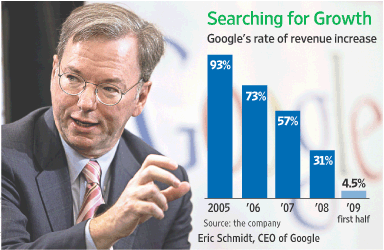 The Google juggernaut’s revenue growth has slowed steadily in the last five years, causing the Wall Street Journal to caution investors about buying Google stock. While much of the slow-down in Google’s revenue may be attributed to the recession, the WSJ cautions that:
- Microsoft is offering stiffer competition in search, which will only intensify once antitrust regulators approve its partnership with Yahoo! and the two companies actually implement their partnership (which could take another year);
- YouTube’s promise as an ad platform remains uncertain;
- Google lags behind Apple and Research in Motion in developing mobile phone operating systems, with Android still unproven;
- It remains unclear how successful the company will be in expanding beyond its existing lead in small text ads into the potentially lucrative realm of banner ads.
Somehow I doubt Google’s fall to Earth will do much to allay the concerns of those who see Google as the kind of evil monopolist Microsoft was made out to be in the 90s.
As the Journal concludes, “It would be foolish to predict that Google won’t have another business success, of course… Google may itself discover the next Google-like business.” As long as someone’s out there working to turn today’s idle fantasies into tomorrow’s multi-billion dollar businesses, consumers win—whoever that bold innovator might be.
Microsoft and Yahoo’s proposed deal faces a tough antitrust gauntlet. In today’s The Seattle Times, Jonathan Hillel and I have an op-ed in which we argue that trustbusters should let the deal go through:
 MICROSOFT and Yahoo want to join forces in Internet search to better compete against Google. But first, they need the blessing of government antitrust enforcers. Senate Antitrust Subcommittee Chairman Herb Kohl, D-Wis., already has threatened “careful scrutiny” of the deal. But trustbusters should not go fishing for problems in the Internet search market. In the relentlessly fast-moving digital economy, government intervention contorts the market and ultimately harms consumers.
Under their proposed decade-long pact, Yahoo searches will be powered by Microsoft’s Bing search engine, which launched this June. The two search firms will maintain separate Web sites, but Microsoft will administer the technical side of both. Microsoft will also gain access to Yahoo’s vast volume of searches and query data. In exchange, Yahoo will receive 88 percent of ad revenues from searches performed on its own site.
MICROSOFT and Yahoo want to join forces in Internet search to better compete against Google. But first, they need the blessing of government antitrust enforcers. Senate Antitrust Subcommittee Chairman Herb Kohl, D-Wis., already has threatened “careful scrutiny” of the deal. But trustbusters should not go fishing for problems in the Internet search market. In the relentlessly fast-moving digital economy, government intervention contorts the market and ultimately harms consumers.
Under their proposed decade-long pact, Yahoo searches will be powered by Microsoft’s Bing search engine, which launched this June. The two search firms will maintain separate Web sites, but Microsoft will administer the technical side of both. Microsoft will also gain access to Yahoo’s vast volume of searches and query data. In exchange, Yahoo will receive 88 percent of ad revenues from searches performed on its own site.
Continue reading →
I’ve spent a lot of time here deconstructing and criticizing the proposals set forth by the Free Press, the radical media “reformista” group founded by the prolific Marxist media theorist Robert McChesney. I have been trying to shine more light on their proposals and activities because I believe they are antithetical to freedom of speech and a free society. That’s because, as media scholar Ben Compaine has noted, “What the hard core reformistas really want, it seems, is not diversity or an open debate but a media that promotes their own vision of society and the world.” That’s exactly right and, more specifically, as I argued in my 2005 Media Myths book, the media reformistas want to impose this control by taking the fantasy that “the public owns the [broadcast] airwaves” and extending it to ALL media platforms and outlets. In other words, McChesney and the Free Press want an UnFree Press. To cast things in neo-Marxist terms that they could appreciate, they want to take control of the information means of production. And it begins, McChesney argues, by all of us having to give up this “sort of religious attachment to the idea of a ‘free-press'” from which we all suffer.
Some people accuse me of “red-baiting” or “McCarthyite” tactics when I use the “M-word” (Marxism) or the “S-Word” (socialism) to describe McChesney, the Free Press, and the movement they have spawned. But these are labels with real meaning and ones that McChesney himself embraces in his work. In his 1999 book
Rich Media, Poor Media, he says that “Media reform cannot win without widespread support and such support needs to be organized as part of a broad anti-corporate, pro-democracy movement.” He casts everything in “social justice” terms and speaks of the need “to rip the veil off [corporate] power, and to work so that social decision making and power may be made as enlightened and as egalitarian as possible.” What exactly would all that mean in practice for media? In his 2002 book Our Media, Not Theirs: The Democratic Struggle against Corporate Media with John Nichols of The Nation, McChesney argues that media reform efforts must begin with “the need to promote an understanding of the urgency to assert public control over the media.” They go on to state that, “Our claim is simply that the media system produces vastly less of quality than it would if corporate and commercial pressures were lessened.”
If you want additional proof of his intentions, then I encourage you to read this lengthy interview with McChesney that appears in the new edition of The Bullet, an online newsletter produced by the Canada-based “Socialist Project.” (If you ask me, there’s something strangely appropriate about a socialist newsletter named “The Bullet” in light of the millions of people who died while living under socialist tyranny!) Anyway, let’s ignore that and focus on what neo-Marxist media reform entails according to McChesney. Because never before has he laid his cards on the table as clearly as he does in this interview. Continue reading →
We’ve written a lot lately about Microsoft’s efforts to reinvent itself, first rebranding its Live search engine as the Bing, and then partnering with Yahoo! to make Bing the search engine on Yahoo!’s still-impressive empire of content and services. But if Microsoft is going to beat Google in Search 3.0 and master shifts in the driving paradigms of the Internet from search and browsers to ubiquitous integration of social networking and other paradigms as yet unforeseen, Microsoft will need more than just brilliant engineering: They’ll need clever marketing.
So it seems that the software titan is turning to user-generated advertising, such as this gem:
http://www.youtube.com/v/h9DBynJUCS4&color1=0xb1b1b1&color2=0xcfcfcf&hl=en&feature=player_embedded&fs=1
WARNING: Battlestar Galactica spoiler: Google may well be in danger of losing its monopoly on cool to Microsoft if Bing can get at least four of the Final Five Cylons to volunteer as back-up singers in a promo video contest.
Google clearly considers Microsoft a threat, having recently launched an ad campaign of its own for its Apps services, which compete directly with Microsoft Office.
Maybe Obama should invite Google CEO Eric Schmidt and Microsoft CEO Steve Ballmer over to the White House for a beer to settle the two companies’ differences!
http://www.youtube.com/v/Q0umKaGxkkE
While he’s at it, Obama might want to invite Apple CEO Steve Jobs, too, since the common cause Apple and Google once made against Microsoft now seems to be giving way to increased rivalry between the two titans of Internet cool. Or how about Facebook CEO Mark Zuckerberg, given Facebook’s growing challenge to Google? Yahoo!’s Carol Bartz seems to get along much better with everyone than the boys in the group, so she’d probably help Obama keep things under control.
The Internet industry’s war-of-all-against-all is reminiscent of Tom Lehrer‘s classic 1960s satire “National Brotherhood Week”:
http://www.youtube.com/v/aIlJ8ZCs4jY
Continue reading →
Like many others, I’ve wondered whether Yahoo! got less than it should have becuase government antitrust regulators prevented Google from bidding up the value of a deal with Yahoo!.
Carl Icahn, who owns 5% of Yahoo! seems happy enough while others still wonder if Microsoft got the better end of the deal, BusinessWeek reports. While many observers have howled that Yahoo! gets revenue-sharing instead of cash up front, Yahoo! Carol Bartz notes that a cash deal “would have had significant tax consequences while contributing only $3 million in annual interest to Yahoo’s bottom line.”
Whatever the initial terms of the deal, its value depends on speedy approval without onerous conditions being imposed by antitrust regulators—even if they take the form of “voluntary” concessions. Let’s hope the government gets out of the way to give this new partnership a real chance to go toe-to-toe with Google in search, as I’ve suggested here, here and especially here.
Nick Wingfield has a great piece in today’s WSJ: Yahoo Tie-Up Is Latest Sign Tide Turning for Microsoft’s Ballmer (subscription required but can be found through a Google News search) about how Microsoft’s fortunes may be looking up across the board—especially with yesterday’s Yahoo!/Microsoft search/advertising partnership. The most interesting passage is this one:
For [Microsoft CEO Steve] Ballmer, the agreement provides some redemption in an area he has stressed is critical to Microsoft’s future. In an interview, he says the Yahoo deal received “more of my personal attention over the last 18 months than anything else we’re involved with,” including focusing on its most important new product in years, Windows 7. “It’s a big deal,” he says.
Of course, complex partnerships always require lots of time from senior management, but in this case, Ballmer’s quip speaks directly to the costs of antitrust scrutiny in terms of one of the most valuable resources available to any company: the time and attention of senior management. The “attentional cost” can of this deal for Microsoft could be broken into four parts beyond the normal costs of structuring any deal to make the most business sense:
- How to structure the a Microsoft/Yahoo! deal so that it would be approved by regulators (defensive);
- How to block a Google/Yahoo! deal (offensive);
- Nursing the deal through the regulatory approval process over the coming months; and
- The possibility that all of these costs could be wasted, to varying degrees, if antitrust regulators decide to block or restrict the deal.
These are all “deadweight losses” on the economy pure and simple—and ultimately costs to consumers.
Continue reading →

 The Technology Liberation Front is the tech policy blog dedicated to keeping politicians' hands off the 'net and everything else related to technology.