Last July, Adam Thierer and I argued in a Forbes.com piece that the Microsoft/Yahoo! search partnership should be cause for “celebration among as a good thing for consumers. By providing a strong competitor with a combined 28% market share, the deal should also be a source of relief at Google, which has come under increasing attack for its supposed market dominance.” Today, 205 days later, the companies have finally announced that EU and US antitrust regulators have approved their deal.
So… how does a delay of nearly seven months help consumers? Wouldn’t we be better off if the two companies had been able to start working together immediately to develop a stronger search engine competitor without this “Mother, May I?” routine?
Last year, I described how Microsoft’s delayed entry into search advertising put them at a serious disadvantage in competing with Google. (The company dithered over buying search ad startup Overture and ultimately decided to build its own system—which proved a serious miscalculation.) I’ll just reiterate what we said about the Yahoo!/Microsoft deal when it was first announced.
Yahoo!/Microsoft pact is just the latest pairing of Web 1.0 titans struggling to reinvent themselves and compete with Google, a titan that still thinks of itself as a start-up. All three companies will struggle to meet new challenges as search evolves toward the social(reflecting what your friends like), the semantic (reflecting the precise, rather than presumed, meanings of Web content), the personalized (reflecting your own preferences) and the interactive (including user-generated comments or reviews)…. Continue reading →
Today I appeared on CNBC [video here and embedded down below] to discuss concerns about emerging “smart-sign” technology, which could give rise to a new generation of interactive retail advertising and marketing efforts. This is in the news because, as Don Clark and Nick Wingfield report today in The Wall Street Journal (“Intel, Microsoft Offer Smart-Sign Technology: Retailers, Product Marketers Could Discern Viewer, Make Choices on What to Display and Transfer Coupons Via Phone“), Intel and Microsoft have announced that:
they will collaborate to help companies create and use new forms of digital signs. By exploiting Intel chips and Microsoft software, the companies hope to bring more interactivity to such devices and help retailers customized marketing offers to consumers.
Signs equipped with cameras and specialized software could recognize the age, gender and height of people in front of them, and tell what products and images received the most attention, the companies said. By gathering information about which messages are more effective, they add, traditional retailers could develop marketing approaches that better counter Web-based competitors. “Every year retailers lose more ground to online [sellers], and they have to do something about that,” said Joe Jensen, general manager of Intel’s embedded computing division.
Down below, I have jotted down a couple of thoughts about the rise of “digital signage” and more targeted forms of retail marketing, only a few of which I was able to get across in this short TV spot. I think it’s an exciting new development for both retailers and consumers for the reasons I explain down below:
http://plus.cnbc.com/rssvideosearch/action/player/id/1383744249/code/cnbcplayershare
Continue reading →
I was just digging through some old files and came across a quote that I found entertaining. Back in 2003, when he was still president and chief operating officer of Viacom, Mel Karmazin said with reference to Microsoft, AOL-Time Warner, and Comcast: “I can’t imagine being a competitor with any of these guys.” At the time, some media worrywarts made great hay of Mel’s quip and claimed, as Gene Kimmelman of Consumers Union argued at the time, that it proved how “Media moguls themselves admit their desire to avoid real competition within their industry.”
Utter rubbish. In fact, just six years after Karmazin spoke those words, Microsoft finds itself in a heated war with Google on all fronts, AOL-Time Warner has crumbled (even Time Warner Cable and Time Warner Entertainment got divorced!), and Comcast is now squaring off against telco and online video competitors that were unfathomable at the time (not to mention traditional satellite TV competitors.) In the meanwhile, Karmazin abandoned Viacom and today, as CEO of Sirius XM, is struggling to find a way to make the satellite radio universe survive the ongoing digital music bloodbath thanks to unforeseen competition from online music services and a little thing called the iPod!
It’s proof positive that media markets and digital technologies
always evolve faster than most people — even smart industry titans like Karmazin — anticipate.
by Berin Szoka & Adam Thierer, Progress Snapshot 5.11 (PDF)
Ten years ago, Nobel Prize-winning economist Milton Friedman lamented the “Business Community’s Suicidal Impulse:” the persistent propensity to persecute one’s competitors through regulation or the threat thereof. Friedman asked: “Is it really in the self-interest of Silicon Valley to set the government on Microsoft?” After yesterday’s FCC vote’s to open a formal “Net Neutrality” rule-making, we must ask whether the high-tech industry—or consumers—will benefit from inviting government regulation of the Internet under the mantra of “neutrality.”
The hatred directed at Microsoft in the 1990s has more recently been focused on the industry that has brought broadband to Americans’ homes (Internet Service Providers) and the company that has done more than any other to make the web useful (Google). Both have been attacked for exercising supposed “gatekeeper” control over the Internet in one fashion or another. They are now turning their guns on each other—the first strikes in what threatens to become an all-out, thermonuclear war in the tech industry over increasingly broad neutrality mandates. Unless we find a way to achieve “Digital Détente,” the consequences of this increasing regulatory brinkmanship will be “mutually assured destruction” (MAD) for industry and consumers.
New Fronts in the Neutrality Wars
The FCC’s proposed rules would apply to all broadband providers, including wireless, but not to Google or many other players operating in other layers of the Net who favor such broadband-specific rules. With this rulemaking looming, AT&T came after Google with letters to the FCC in late September and then another last week accusing the company of violating neutrality principles in their business practices and arguing that any neutrality rules that apply to ISPs should apply equally to Google’s panoply of popular services. In particular, AT&T accused Google of “search engine bias,” suggesting that only government-enforced neutrality mandates could protect consumers from Google’s supposed “monopolist” control.
The promise made yesterday by the FCC—to only apply neutrality principles to the infrastructure layer of the Net—is hollow and will ultimately prove unenforceable. Continue reading →
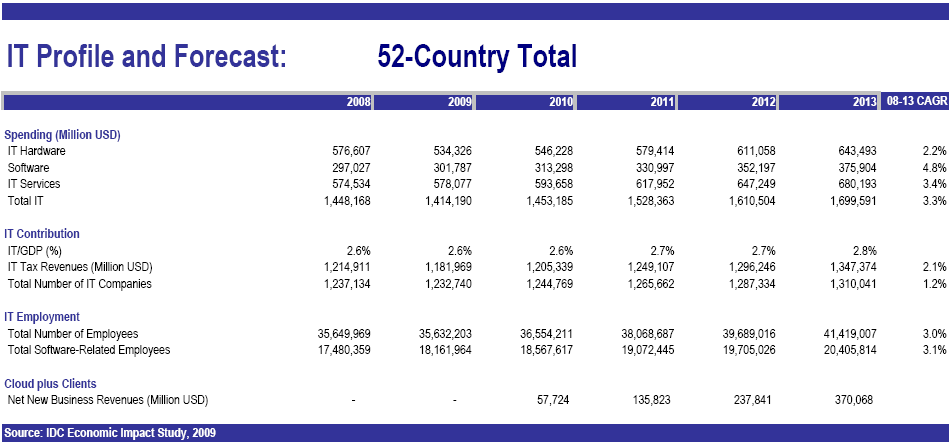
This Microsoft-funded study projects that, by 2013, cloud computing will have added $800 billion in net new business revenues for the 52 countries surveyed (over 2009 levels). The growing economic importance of the cloud is likely to increase pressure for government involvement. As President Reagan said: “Government’s view of the economy could be summed up in a few short phrases: If it moves, tax it. If it keeps moving, regulate it. And if it stops moving, subsidize it.”
Yesterday up on Capitol Hill, I hosted a very interesting discussion about “Next-Generation Parental Controls & Child Safety Efforts.” I thought I’d provide a quick recap here for those who couldn’t attend. [Note: audio of the event will be up shortly at the link above and transcript is in the works.] The event featured Steve Crown, Vice President and Deputy General Counsel of Microsoft Corporation’s Entertainment & Devices Division; Dane Snowden, Vice President of External & State Affairs of CTIA – The Wireless Association; and Stephen Balkam, Chief Executive Officer of Family Online Safety Institute.
Steve Crown of Microsoft kicked the show off with a terrific overview of some the current and next-generation parental control tools and awareness efforts that Microsoft is deploying to help empower parents and keep kids safer both online and in gaming environments. Crown outlined Microsoft’s 5-prong strategy regarding how they have approached these issues on the gaming front, and I think it represents an excellent model of how sensible industry self-regulation and “best practices” can go a long way toward addressing concerns that many parents and policymakers have. The five strategies Crown outlined were: (1) Respect both the freedom of game creators and freedom of choice for game consumers; (2) empower parents with ratings, tools, and information; (3) use independent ratings (like the ESRB) to label content; (4) require all games be rated before they can be used on a platform so that parents can implement blocking controls; and (5) respect regional laws and rating systems in different parts of the globe.
In my book on
Parental Controls & Online Child Safety: A Survey of Tools & Methods, I’ve documented many of the empowerment tools that Microsoft has deployed in recent years to make this empowerment vision a reality. One of the most important things MS does on its XBox 360 console is to provide an immediate “out-of-the-box” prompt for parents to set up parental controls and establish other limitations on online chat, spending, or Internet access. Microsoft announced another cool new feature in November 2007, the “Family Timer.” It lets parents limit how and when children play games on the console. This is similar to the time management tools Microsoft offers in its Vista operating system for PCs. Incidentally, my wife has asked me to start using the Family Timer on our XBox — not for our kids, but for me! This particular 40-year-old man is still a big kid at heart.
Continue reading →
Forbes.com has just published an editorial that Berin Szoka and I penned about yesterday’s net neutrality announcement from the FCC.
by Adam Thierer & Berin Szoka
There was a time, not so long ago, when the term “Internet Freedom” actually meant what it implied: a cyberspace free from over-zealous legislators and bureaucrats. For a few brief, beautiful moments in the Internet’s history (from the mid-90s to the early 2000s), a majority of Netizens and cyber-policy pundits alike all rallied around the flag of “Hands Off the Net!” From censorship efforts, encryption controls, online taxes, privacy mandates and infrastructure regulations, there was a general consensus as to how much authority government should have over cyber-life and our cyber-liberties. Simply put, there was a “presumption of liberty” in all cyber-matters.
Those days are now gone; the presumption of online liberty is giving way to a presumption of regulation. A massive assault on real Internet freedom has been gathering steam for years and has finally come to a head. Ironically, victory for those who carry the banner of “Internet Freedom” would mean nothing less than the death of that freedom.
We refer to the gradual but certain movement to have the federal government impose “neutrality” regulation for all Internet actors and activities—and in particular, to yesterday’s announcement by Federal Communications Commission (FCC) Chairman Julius Genachowski that new rules will be floated shortly. “But wait,” you say, “You’re mixing things up! All that’s being talked about right now is the application of ‘simple net neutrality,’ regulations for the infrastructure layer of the net.” You might even claim regulations are not really regulation but pro-freedom principles to keep the net “free and open.”
Such thinking is terribly short-sighted. Here is the reality: Because of the steps being taken in Washington right now, real Internet Freedom—for all Internet operators and consumers, and for economic and speech rights alike—is about to start dying a death by a thousand regulatory cuts. Policymakers and activists groups are ramping up the FCC’s regulatory machine for a massive assault on cyber-liberty. This assault rests on the supposed superiority of common carriage regulation and “public interest” mandates over not just free markets and property rights, but over general individual liberties and freedom of speech in particular. Stated differently, cyber-collectivism is back in vogue—and it’s coming very soon to a computer near you! Continue reading →
Gilder explains the true meaning of the microcosm with his uniquely poetic prose:
As Peter Drucker said. “What one man can do, another can do again.” Distilling discoveries of science, a set of technologies, and a Philosophy of enterprise, the microcosm is far too big for any one country. Even its products are mostly made of ideas—waves that suffuse the mindscape of the world. (p.127)
The vital importance of ideas in all aspects of the microcosm, including hardware, is a central theme of the book:
Computer hardware thus is another form of information technology like books, films, and disks. The value resides in the ideas rather than in their material embodiment. The chip design is itself a software program. Even the design of the computer’s plastic chassis and keyboard may well have begun as a software program. Like a book, a spreadsheet financial package, even a film on a videocassette, a microchip design is conceived and developed on a computer screen and takes form in a storage device that costs between 80 cents and $2 to manufacture. The current dominance of such products in the world economy signifies the end of the industrial era and the onset of the age of the microcosm. (p. 159)
Consider debate over handset exclusivity: Those who insist that AT&T be forced to relinquish its exclusive rights to the iPhone ignore the fact that the iPhone is not so much a device as a brilliant idea—actually, a cluster of innovations made possible because AT&T was willing to partner with Apple on the risky venture of developing the expensive device and bringing it to market. Speaking of ideas made reality, I can’t wait to get my hands on a Microsoft Surface!
http://www.youtube.com/v/rP5y7yp06n0
I vented my frustration earlier today with the FCC’s failure to make comments it receives easily accessible to the public—which means, more than anything, making them full-text searchable. This may seem like Inside Baseball to many, but it’s not. It’s a failure of the democratic process, a waste of taxpayer dollars, and a testimony to the general incompetence of bureaucracies, regardless of who’s running them. It denies the public an easy way to follow what goes on inside Washington, while essentially subsidizing law firms who get to bill clients for having paralegals or junior associates do things that existing web technology makes completely unnecessary—like reading through every comment in a document (at the rate of hundreds of dollars per hour) instead of just looking for keywords in a full-text search.
Later in the day the FCC announced:
- RSS feeds for all news from the agency (1 general feed + 48 issue-specific feeds);
- “FCC Connect” a page for Social Media Sites—so you can follow the FCC on Twitter and become a fan on Facebook; and
- A “crowdsourcing platform” to discuss the administration’s plan to transfer nearly $8 billion from taxpayers to broadband providers.
I’m thrilled about the RSS feeds, which go a long way in letting
all Americans know what the FCC does, supposedly in the “public interest.” Still, I can’t help but note that the FCC waited until after a huge discussion about whether RSS is dead to finally start using RSS in a serious way—fully a decade after the birth of the RSS standard. Better late than never, I suppose.
FCC Connect is also good news: once you have an RSS feed, there’s really no reason
not to pipe that feed into as many platforms as possible—which is precisely why RSS isn’t dead, even if most people will never use an RSS reader.
But I’m less thrilled about the crowdsourcing platform. Continue reading →


 The Technology Liberation Front is the tech policy blog dedicated to keeping politicians' hands off the 'net and everything else related to technology.
More on the FCC’s e-Government Transparency Efforts: ECFS, RSS, Social Media & Setting Priorities
by Berin Szoka on September 11, 2009 · 12 comments
I vented my frustration earlier today with the FCC’s failure to make comments it receives easily accessible to the public—which means, more than anything, making them full-text searchable. This may seem like Inside Baseball to many, but it’s not. It’s a failure of the democratic process, a waste of taxpayer dollars, and a testimony to the general incompetence of bureaucracies, regardless of who’s running them. It denies the public an easy way to follow what goes on inside Washington, while essentially subsidizing law firms who get to bill clients for having paralegals or junior associates do things that existing web technology makes completely unnecessary—like reading through every comment in a document (at the rate of hundreds of dollars per hour) instead of just looking for keywords in a full-text search.
Later in the day the FCC announced:
I’m thrilled about the RSS feeds, which go a long way in letting all Americans know what the FCC does, supposedly in the “public interest.” Still, I can’t help but note that the FCC waited until after a huge discussion about whether RSS is dead to finally start using RSS in a serious way—fully a decade after the birth of the RSS standard. Better late than never, I suppose.
FCC Connect is also good news: once you have an RSS feed, there’s really no reason not to pipe that feed into as many platforms as possible—which is precisely why RSS isn’t dead, even if most people will never use an RSS reader.
But I’m less thrilled about the crowdsourcing platform. Continue reading →