As I pointed out here last week, the Federal Trade Commission’s (FTC) recently released 47-page document outlining “Potential Policy Recommendations to Support the Reinvention of Journalism” has been raising eyebrows in many different quarters. Even though it is just a “discussion draft” and the agency hasn’t formally endorsed any of the recommendations in it yet, the sweeping scope and radical nature of many of the proposals in the document has already raised the blood pressure for many folks. It doesn’t help that the document reads like the CliffsNotes for the recent media-takeover manifesto, The Death and Life of American Journalism, by the neo-Marxist media scholar Robert W. McChesney and Nation editor John Nichols. Their book is horrifying in its imperial ambitions since it invites the government become the High Lord and Protector of the Fourth Estate. [For an in-depth look at all of McChesney’s disturbing views on these issues, see: “Free Press, Robert McChesney & the “Struggle” for Media.”]
The FTC’s seeming infatuation with McChesney’s proposals has many rightly concerned about where exactly the Obama Administration’s FTC (and FCC) may be taking us in the name of “saving journalism.” In an editorial this week, Investors Business Daily worries that the feds are “Seizing The News Business“ and wonders “why, as the administration contemplates a federal takeover of their business, [there is] such thundering silence” from journalists and media executive themselves. The good news, however, is that a recent survey found plenty of skepticism among news executives regading government subsidies and regulatory meddling in their business. According to this April survey by the Pew Research Center’s Project for Excellence in Journalism in association with the American Society of News Editors (ASNE) and the Radio Television Digital News Association (RTDNA), revealed that, “Fully 75% of all news executives surveyed—and 88% of newspaper executives—said they had ’serious reservations,’ or the highest level of concern, about direct subsidies from the government.” A smaller percentage (only 46%) had serious reservations about tax credits for news organizations, then again, only 13% said they “would welcome such funding” and just 6% said they were “enthusiastic” about it.
And now there’s this new survey by Rasmussen Reports which finds that average Americans find some of the FTC’s proposed recommendations pretty silly: Continue reading →
 I spend a lot of time here trying to debunk media “moral panics,” “techno-panics,” or unfounded hysteria over the impact of commercialism in general on kids. To believe what some politicians and regulatory agitators have to say, today’s youth always seem at the precipice of the moral abyss. Our misguided youth are seemingly all going straight to hell and they dragging our culture and society down with them.
Except they’re not. It’s all the same old tripe we’ve heard one generation after another. As the late University of North Carolina journalism professor Margaret A. Blanchard once noted: “[P]arents and grandparents who lead the efforts to cleanse today’s society seem to forget that they survived alleged attacks on their morals by different media when they were children. Each generation’s adults either lose faith in the ability of their young people to do the same or they become convinced that the dangers facing the new generation are much more substantial than the ones they faced as children.” And Thomas Hine, author of
The Rise and Fall of the American Teenager, argues that: “We seem to have moved, without skipping a beat, from blaming our parents for the ills of society to blaming our children. We want them to embody virtues we only rarely practice. We want them to eschew habits we’ve never managed to break.”
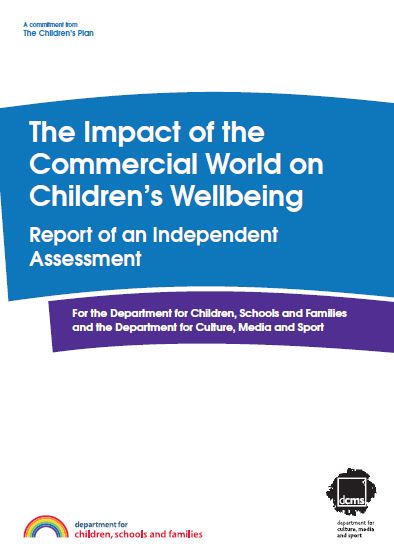
Anyway, I was reminded of this again today as I was finally reading through a report published last year by the U.K.’s Department for Children, Schools and Families and the Department for Culture, Media and Sport. It’s entitled “The Impact of the Commercial World on Children’s Wellbeing” and it is very much worth your attention. Several people had recommended I check it out in recent months, but I’m ashamed to say I am only now getting around to it as I prepare an amicus brief for the Supreme Court’s review of a California video game law. But this U.K. report is not to be missed. Here are a few of the choice bits from the study: Continue reading →
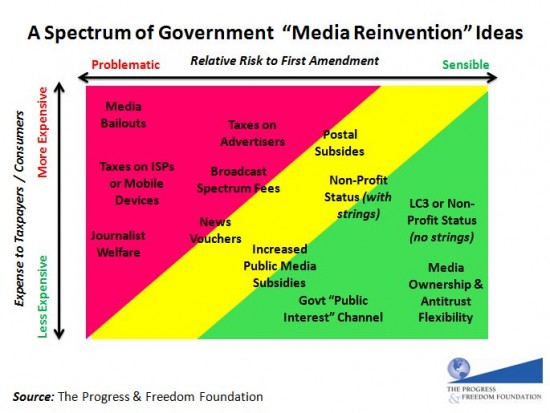
As I’ve noted here before, the Federal Trade Commission (FTC) has an ongoing proceeding asking “How Will Journalism Survive the Internet Age?” The agency has hosted two workshops on the issue and a third is scheduled for June 15th at the National Press Club. Recently, the FTC released a 47-page staff discussion draft entitled “Potential Policy Recommendations to Support the Reinvention of Journalism,” which outlines dozens of proposals that have been set forth in recent years to “save journalism,” “reinvent media,” or support various forms of so-called “public interest programming.” [I’ve embedded the document down below.] Although the FTC makes it very clear on the first page of the discussion draft that it “does not represent final conclusions or recommendations by the Commission or FTC staff [and] it is solely for purposes of discussion,” the document is drawing scrutiny and raising concern since it might foreshadow where the FTC (and Obama Administration) could be heading on this front.
Some of those raising a stink about the FTC draft include: Jeff Jarvis (“FTC Protects Journalism’s Past“); Rob Port (“Federal Government Considering “iPad Tax” To Subsidize Journalism“); Mark Tapscott: “(Will Journalists Wake up in Time to Save Journalism from Obama’s FTC?”); and Andrew Malcolm of the Los Angeles Times (“Obama’s FTC Plan to Reinvent America’s News Media“), who says, “this FTC study is rated R for anyone who thinks the federal government, the object of copious news coverage itself, has no business deciding which sectors of the private media business survive and thrive through its support, subsidies and encouragement with things like tax incentives. Yet that’s what this Obama administration paper is suggesting as another of the ex-community organizer’s galactic reform plans.” Ouch!
Continue reading →
There’s an inherent paradox in the Federal Communications Commission’s (FCC) media ownership regulations and the new Notice of Inquiry that the agency has just launched looking into those rules. Like everything else the FCC has been doing lately, this NOI poses hundreds of questions about the topic at hand. In this case, the agency is interested in knowing what the impact of its byzantine regulatory regime for media ownership has been. Complicating matters even more is that fact that the FCC wants people to provide detailed answers about the impact of these rules on amorphous values like “diversity” and “localism.” So, the agency asks, what has been the impact of the local TV ownership rule, the local radio ownership rule, the newspaper/broadcast cross-ownership rule, the radio/TV cross-ownership rule, the dual network rule, and so on, on the marketplace, competition, diversity, localism, etc.
But therein lies the fundamental paradox of the FCC’s inquiry and the media ownership regulations in general:
So long as the rules are preemptive and prophylactic in character, we will never get clear answers to the questions the agency poses. By definition, the agency’s media ownership rules make experimentation with new business models illegal. It is per se criminal to enter into combinations that the agency has presumptively divined to be counter to “the public interest,” whatever that means. Thus, we can never get definitive answers to the questions the agency poses when “the marketplace” isn’t a truly free marketplace at all. It is a regulatory construct artificially constrained in countless ways.
So, what’s the answer here? In a word: Antitrust. While I’m no fan of over-zealous antitrust regulation, it has one huge advantage over the media ownership regime that the FCC enforces: It doesn’t preemptively seek to determine supposedly sensible market structures or ownership patterns. The threat of antitrust intervention can be a very dangerous thing, and wrecking-ball style antitrust interventions are rarely sensible, but at least the DOJ and FTC aren’t turning the regulatory dials on a massive media marketplace industrial policy the way the Federal Communications Commission does with its media ownership regulations. Continue reading →
I’m keeping tabs on who filed “major” comments (more than a 10-15 pages) in the Federal Communications Commission’s “Future of Media” proceeding (GN Docket No. 10-25). As I noted last week, The Progress & Freedom Foundation submitted almost 80 pages of comments (single-spaced!) in the matter, so it’s something I care deeply about and will be tracking closely going forward.
Incidentally, the general consensus of those who filed (especially if you count “minor” comments) is fairly overwhelming:
Bring on Big Government! Seriously, I only found a handful of comments that object strenuously to government meddling in media markets or that raised concerns about the potential for the State’s increasing involvement in the journalism profession. Even many of the affected industries appear to be suffering from a bit of Stockholm syndrome here. Most of them just play up the good things they are doing but barely utter a peep about the dangers of federal encroachment into the affairs of the Press.
Anyway, for those of you who care to track the gradual federalization of media and journalism, I think what you see below is a fairly comprehensive listing of the major filings submitted thus far in the FCC’s “Future of Media” proceeding. I’ll try to add more as I find them. You might also want to track what was filed in the Federal Trade Commission’s workshops on “How Will Journalism Survive the Internet Age.” Finally, if you care to learn more of this issue, I’m hosting an event on the morning of May 20th to discuss these issues in more detail.
Continue reading →
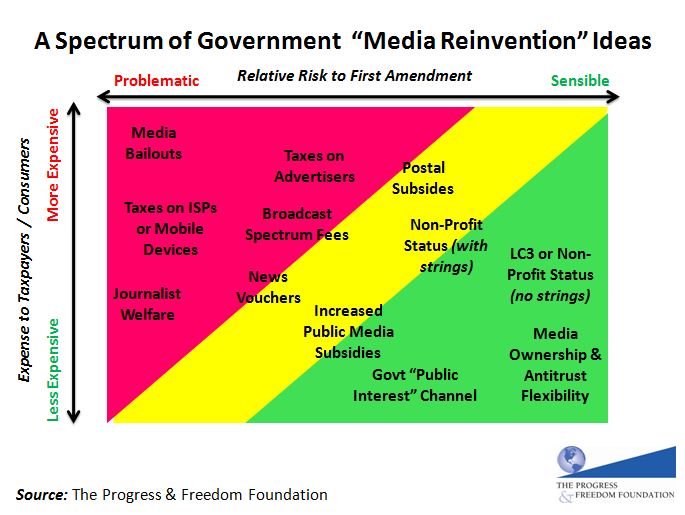
The Progress & Freedom Foundation today filed comments in the Federal Communication Commission’s (FCC) “Future of Media” proceeding. Berin Szoka, Ken Ferree, and I urged the FCC to “reject Chicken Little-esque calls for extreme media ‘reform’ solutions,” and counseled policymakers to move cautiously so that media reform can be “organic and bottom-up, not driven by heavy-handed, top-down industrial policies for the press.”
Our 79-page filing covers a wide range of ideas being examined by Washington policymakers to help struggling media outlets and unemployed journalists, or to expand public media / “public interest” content and regulation. Among the major issues explored in our filing:
- First Amendment concerns implicated by government subsidies;
- The pitfalls of imposing new “public interest” obligations on media operators;
- How advertising restrictions could harm the provision of media and news;
- Taxes, fees and other regulations to be avoided;
- The limited role in reform that public media subsidies can play; and
- Positive steps government could take.
We note that as “With many operators struggling to cope with intensifying competition, digitization, declining advertising budgets, and fragmenting audiences, some pundits and policymakers are wondering what the ‘future of media’ entails. The answer: Nobody knows.” While this uncertainty has put concerned policymakers at the ready to “help” the press, we warn that: “There is great danger in rash government intervention.” Instead, policymakers should be “careful to not inhibit potentially advantageous marketplace developments, even if some are highly disruptive.” Marketplace meddling, or government attempts to tinker with private media business models in the hopes that something new and better can be created, are misguided. Moreover, “Our constitutional traditions warn against it, history suggests it would be unwise, and practical impediments render such meddling largely unworkable, anyway.”
Continue reading →
Thought you all might be interested in this upcoming PFF event on “Can Government Help Save the Press?” It will take place on Thursday, May 20, 2010 from 8:30 a.m. – 12:00 p.m. in the International Gateway Room, Mezzanine Level of the Ronald Reagan Building on 1300 Pennsylvania Ave, N.W. here in DC. This event will consider the FCC’s “Future of Media” proceeding (comments are due this Friday) and debate what role the government should play (if any) in sustaining struggling media enterprises, “saving journalism,” or promoting more “public media” or “public interest” content. [You can find all our essays about this here.]
The event will feature a keynote address by
Ellen P. Goodman of the FCC’s Future of Media team. Ellen is one of the sharpest minds in the media policy universe today, and a real asset to the FCC team. She is a Distinguished Visiting Scholar at the FCC, a Research Fellow at American University’s Center for Social Media, and a Visiting Scholar at the University of Pennsylvania’s Annenberg School of Communications. She is also a Professor at Rutgers University School of Law at Camden, specializing in information law and policy. She has spoken before a wide range of audiences around the world on media policy issues, has consulted with the U.S. government on communications policy, and served as an advisor to President Obama’s presidential campaign and transition team.
After Ellen Goodman brings us up to speed with where the FCC’s Future of Media process stands, we’ll hear from a diverse panel of experts that I am still busy assembling. But so far it includes
Charlie Firestone of the Aspen Institute, who will be on hand to discuss the work he’s been doing with the Knight Commission on this front. I’ve also invited a rep from the Newspaper Association of America to come and talk about the diversity of new media monetization models that they have been aggregating. (Check out the appendix of their outstanding FTC filing last Nov.) And Kurt Wimmer of Covington & Burling, who represents broadcasters among others, will talk about the need for regulatory flexibility / forbearance, especially on ownership issues. Again, more panelists to come. But please sign up now!
PFF today released the fifth installment in our ongoing series on “The Wrong Way to Reinvent Media.” This series of papers explores various tax and regulatory proposals that would have government play an expanded role in supporting the press, journalism, or other media content. In the latest essay, Berin Szoka, Ken Ferree, and I discuss proposals for direct subsidies for failing media outlets and out-of-work journalists.
We argue taxpayer support for failing outlets and unemployed journalists implicates significant First Amendment concerns. On the whole, subsidies can make “journalists and media operators more dependent upon the State; compromise press independence and diminish public trust in the free press; and result in government discrimination in the politically inescapable dilemma of determining eligibility for subsidies.” Such an agenda would also entail huge cost to taxpayers—initially about $35 billion per year according to advocates—and would represent “a massive wealth transfer from one class of speakers to another…”
We warn that calls for seemingly beneficent bailouts “to save” the media and journalism may actually be driven by those who have something more nefarious in mind: a “post-corporate” world shorn of media capitalists, and “such radicalism must be rejected if we hope to sustain a truly free press and uphold America’s proud tradition of keeping a high and tight wall of separation between Press and State.”
The ideas within these and other essays in the series will be worked into a major PFF filing in the Federal Communications Commission’s (FCC) proceeding on the “Future of Media” on May 7. The paper may be viewed online here and I’ve attached it down below in a Scribd reader.
Continue reading →
In this latest PFF TechCast, Berin Szoka and I discuss the two latest installments in our ongoing “Wrong Way to Reinvent Media” series. These two recent installments dealt with “media vouchers” and expanded postal subsidies as methods of assisting struggling media enterprises or promoting more hard news. In this 7-minute podcast, PFF’s press director Mike Wendy chats with us about these proposals and we argue that they both raise a variety of practical and principled concerns that weigh against their adoption by policymakers.
MP3 file: PFF TechCast #3 – Media Vouchers & Postal Subsidies (4/27/2010)
As mentioned here before, PFF has been rolling out a new series of essays examining proposals that would have the government play a greater role in sustaining struggling media enterprises, “saving journalism,” or promoting more “public interest” content. We’re releasing these as we get ready to submit a big filing in the FCC’s “Future of Media” proceeding (deadline is May 7th). Here’s a podcast Berin Szoka and I did providing an overview of the series and what the FCC is up to.
In the first installment of the series, Berin Szoka and I critiqued an old idea that’s suddenly gained new currency: taxing media devices or distribution systems to fund media content. In the second installment, I took a hard look at proposals to impose fees on broadcast spectrum licenses and channeling the proceeds to a “public square channel” or some other type of public media or “public interest” content. The third installment dealt with proposals to steer citizens toward “hard news” and get them to financially support it through the use of “news vouchers” or “public interest vouchers.”
In our latest essay, “The Wrong Way to Reinvent Media, Part 4: Expanding Postal Subsidies,” Berin and I argue that expanding postal subsidies won’t likely do much to help failing media enterprises, will raise the risk of greater meddling by politicians with the press, and can’t be absorbed by the Postal Service without a significant increase in cost for ratepayers or taxpayers. The entire essay is attached down below.
Continue reading →

 The Technology Liberation Front is the tech policy blog dedicated to keeping politicians' hands off the 'net and everything else related to technology.
List of Major Comments in FCC “Future of Media” Proceeding
by Adam Thierer on May 10, 2010 · 8 comments
I’m keeping tabs on who filed “major” comments (more than a 10-15 pages) in the Federal Communications Commission’s “Future of Media” proceeding (GN Docket No. 10-25). As I noted last week, The Progress & Freedom Foundation submitted almost 80 pages of comments (single-spaced!) in the matter, so it’s something I care deeply about and will be tracking closely going forward.
Incidentally, the general consensus of those who filed (especially if you count “minor” comments) is fairly overwhelming: Bring on Big Government! Seriously, I only found a handful of comments that object strenuously to government meddling in media markets or that raised concerns about the potential for the State’s increasing involvement in the journalism profession. Even many of the affected industries appear to be suffering from a bit of Stockholm syndrome here. Most of them just play up the good things they are doing but barely utter a peep about the dangers of federal encroachment into the affairs of the Press.
Anyway, for those of you who care to track the gradual federalization of media and journalism, I think what you see below is a fairly comprehensive listing of the major filings submitted thus far in the FCC’s “Future of Media” proceeding. I’ll try to add more as I find them. You might also want to track what was filed in the Federal Trade Commission’s workshops on “How Will Journalism Survive the Internet Age.” Finally, if you care to learn more of this issue, I’m hosting an event on the morning of May 20th to discuss these issues in more detail.
Continue reading →