I’m excited to announce the release of my latest law review article, “The Pursuit of Privacy in a World Where Information Control is Failing,” which appears in the next edition (vol. 36) of the Harvard Journal of Law & Public Policy. This is the first of two complimentary law review articles that I will be releasing this year dealing with privacy policy. The second, which will be published later this summer by the George Mason University Law Review, is entitled, “A Framework for Benefit-Cost Analysis in Digital Privacy Debates.” (FYI: Both articles focus on privacy claims made against private actors — namely, efforts to limit private data collection — and not on privacy rights against governments.)
The new
Harvard Journal article is divided into three major sections. Part I focuses on some of normative challenges we face when discussing privacy and argues that there may never be a widely accepted, coherent legal standard for privacy rights or harms here in the United States. It also explores the tensions between expanded privacy regulation and online free speech. Part II turns to the many enforcement challenges that are often ignored when privacy policies are being proposed or formulated and argues that legislative and regulatory efforts aimed at protecting privacy must now be seen as an increasingly intractable information control problem. Most of the problems policymakers and average individuals face when it comes to controlling the flow of private information online are similar to the challenges they face when trying to control the free flow of digitalized bits in other information policy contexts, such as online safety, cybersecurity, and digital copyright.
If the effectiveness of law and regulation is limited by the normative considerations discussed in Part I and the practical enforcement complications discussed in Part II, what alternatives remain to assist privacy-sensitive individuals? I address that question in Part III of the paper and argue that the approach America has adopted to deal with concerns about objectionable online speech and child safety offers a path forward on the privacy front as well. Continue reading →
I hope that you’ve all been watching the terrific videos on “Economics of the Media” that Tyler Cowen and Alex Tabarrok have put together as part of their Marginal Revolution University online courses. They divide their media economics lessons into four groupings: (1) Basic economics of media; (2) Media bias; (3) Media and government; and (4) Media and economic development. Tyler and Alex asked Jerry Brito and me to contribute two videos on Net neutrality for the project. Jerry’s course offers an overview of Net neutrality as a general engineering principle. My video explores Net neutrality as a regulatory proposal and couches it in a broader discussion of network economics. Each video lasts approximately 6-7 minutes. Here they are:
Matt Yglesias today responded with a post of his own to a NYT article about sports channels and cable pricing by Brian Stelter that Yglesias believed had “bad analysis.” I’m here to defend Stelter a little bit because I think Yglesias was too harsh and that Yglesias erred in his own post about the nature of cable bundling. Yglesias’ posts on cable bundling are good, and especially valuable because his Slate and ThinkProgress audiences are not the most receptive to economic justifications for perceived unfair corporate pricing schemes. In part due to him I suspect, you rarely hear econ and business bloggers calling for a la carte pricing of cable channels.
And Yglesias is certainly right that you can’t really complain about the price of your cable package, which includes the few channels you watch plus the sports channels you don’t watch, because you obviously value the channels more than the price you pay per month, even if the sports are a “waste.” He falters when he says
So since those channels are worth $60 to you, even if unbundling happens your cable provider is going to find a way to charge you approximately $60 for them. Because at the end of the day, you’re paying your cable provider for access to the channels you do watch—not for access to the channels you don’t watch. The channels you don’t watch are just there. If the channels you do watch are worth $60 to you, then $60 is what you’ll pay for them.
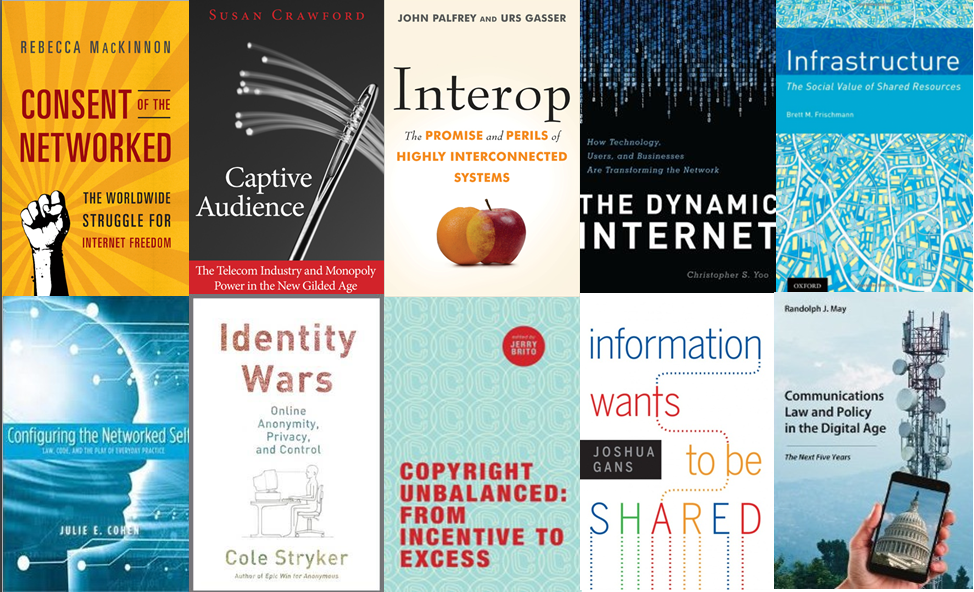
The number of major cyberlaw and information tech policy books being published annually continues to grow at an astonishing pace, so much so that I have lost the ability to read and review all of them. In past years, I put together end-of-year lists of important info-tech policy books (here are the lists for 2008, 2009, 2010, and 2011) and I was fairly confident I had read just about everything of importance that was out there (at least that was available in the U.S.). But last year that became a real struggle for me and this year it became an impossibility. A decade ago, there was merely a trickle of Internet policy books coming out each year. Then the trickle turned into a steady stream. Now it has turned into a flood. Thus, I’ve had to become far more selective about what is on my reading list. (This is also because the volume of journal articles about info-tech policy matters has increased exponentially at the same time.)
So, here’s what I’m going to do. I’m going to discuss what I regard to be the five most important titles of 2012, briefly summarize a half dozen others that I’ve read, and then I’m just going to list the rest of the books out there. I’ve read most of them but I have placed an asterisk next to the ones I haven’t. Please let me know what titles I have missed so that I can add them to the list. (Incidentally, here’s my compendium of all the major tech policy books from the 2000s and here’s the running list of all my book reviews.)
[Updated 7/10/14: See new addendum at bottom. Updated 4/28/13: Included links to several things + started list of additional resources at end.]
Each year I am contacted by dozens of people who are looking to break into the field of information technology policy as a think tank analyst, a research fellow at an academic institution, or even as an activist. Some of the people who contact me I already know; most of them I don’t. Some are free-marketeers, but a surprising number of them are independent analysts or even activist-minded Lefties. Some of them are students; others are current professionals looking to change fields (usually because they are stuck in boring job that doesn’t let them channel their intellectual energies in a positive way). Some are lawyers; others are economists, and a growing number are computer science or engineering grads. In sum, it’s a crazy assortment of inquiries I get from people, unified only by their shared desire to move into this exciting field of public policy.
I always do my best to answer their emails, calls, and requests for meetings. Unfortunately, there’s only so much time in the day and I am sometimes not able to get back to all of them. I always feel bad about that, so, this essay is an effort to gather my thoughts and advice and put it all one place so that I will at least have something to send these folks. Perhaps I’ll try to update it over time.
#1) Understand that Specialization Matters
I don’t want to bury the lede here, so let me start with the most important piece of advice I share with everyone who contacts me:
specialization matters. When I got started in the sleepy field of information technology policy back in 1991, it was possible to be a jack-of-all-trades. There were only a few issues that really mattered, and most of them were tied up with traditional communications and media policy. If you knew a little something about telephony, universal service subsidies, spectrum policy, and broadcast regulation, then you could be an analyst in this field. There were only a handful of people in the think tank world back then who even cared about such issues. Continue reading →
As I noted in an addendum to my previous post, less than an hour after I posted an essay about how the District of Columbia’s subsidy deal with LivingSocial was potentially set to unravel, I received a call from two representatives of the D.C. Mayor’s office asking me to clarify a few aspects of the deal. The tone and substance of the call was courteous and profession from the start and I told them I would be happy to post a quick update to my essay letting readers know of the points that they wanted stressed.
After I did so, however, I kept thinking how strange it was that I received such a quick response from the Mayor’s office about my little post. After all, I can’t imagine that the
Technology Liberation Front is on the top of their morning reading list! I just figured that someone in the Mayor’s office probably had a Google Alert set up that caught it. But then, as luck would have it, I was reading through the Wall Street Journal at lunch and came across a story entitled, “In D.C., Social-Media Surveillance Pays Off” by Sarah Portlock. She reports that:
The local government in the nation’s capital is paying hundreds of thousands of dollars to a startup to gather comments on Twitter, Facebook and other online message boards as well as the government’s own website. The data help form a letter grade for the bureaucracies that handle drivers licenses, building permits and the like. These social-media analytics services are already common for businesses such as restaurants and hotel chains that want to go beyond the comment cards most customers ignore. The D.C. experiment suggests governments are beginning to mirror the private sector in seeking real-time unvarnished feedback.
The D.C. government apparently has a 2-year $670,000 contract with newBrandAnalytics, Inc. to gather social media feedback and insights about the District. So, I figure that’s how the folks in the D.C. Mayor’s office stumbled upon my little rant. I had posted a link to my essay on both Twitter and Google+ and they probably got an immediate report back about it.
In any event, that got me wondering about how people are going to respond to this sort of “surveillance” of social media sites and activities by governments. Continue reading →
“All this top-40s music sounds the same.” I think we’ve all heard this sentiment. The nature of regional radio broadcasting almost requires a regression to the mean in musical tastes. A radio station cannot be all things to all people. I suspect most people will be surprised to learn that some of the most innovative radio broadcasts are taking place at hundreds of stations across the country—and only few people can listen to them. These stations, known as low power FM (LPFM), carry niche programming like independent folk rock music, fishing shows, political news, reggae, blues, and religious programming. (And one station in Sitka, Alaska consists entirely of a live feed of whale sounds.) Continue reading →
Perry Keller, Senior Lecturer at the Dickson Poon School of Law at King’s College London, and author of the recently released paper “Sovereignty and Liberty in the Internet Era,” discusses how the internet affects the relationship between the state and the media. According to Keller, media has played a formative role in the development of the modern state and, as it evolves, the way in which the state governs must change as well. However, that does not mean that there is a one-size-fits-all solution. In fact, as Keller demonstrates using real-world examples in the U.S., U.K., E.U., and China, the ways in which new media is governed can differ radically based upon the local legal and cultural environment.
Yesterday it was my privilege to speak at a Free State Foundation (FSF) event on “Ideas for Communications Law and Policy Reform in 2013.” It was moderated by my friend and former colleague Randy May, who is president of FSF, and the event featured opening remarks from the always-excellent FCC Commissioner Robert McDowell.
During the panel discussing that followed, I offered my thoughts about the problem America continues to face in cleaning up communications and media law and proposed a few ideas to get reform done right once and for all. I don’t have time to formally write-up my remarks, but I thought I would just post the speech notes that I used yesterday and include links to the relevant supporting materials. (I’ve been using a canned version of this same speech at countless events over the past 15 years. Hopefully lawmakers will take up some of these reforms some time soon so I’m not using this same set of remarks in 2027!)
On Wednesday morning, the U.S. House of Representatives Energy & Commerce Subcommittee on Communications and Technology will hold a hearing on “The Future of Video.”
As we Tech Liberators have long argued on these pages (1, 2, 3, 4, 5, 6, 7), government’s hands have been all over the video market since its inception, primarily in the form of the FCC’s rulemaking and enforcement enabled by the Communications Act. While the 1996 Telecommunications Act scrapped some obsolete video regulations, volumes of outdated rules remain law, and the FCC wields vast and largely unchecked authority to regulate video providers of all shapes and sizes. Wednesday’s hearing offers members an excellent opportunity to question each and every law that enables governmental intervention—and restricts liberty in—the television market.
It’s high time for Congress to free up America’s video marketplace and unleash the forces of innovation. Internet entrepreneurs should be free to experiment with novel approaches to creating, distributing, and monetizing video content without fear of FCC regulatory intervention. At the same time, established media businesses—including cable operators, satellite providers, telecom companies, broadcast networks and affiliates, and studios—should compete on a level playing field, free from both federal mandates and special regulatory treatment.
The Committee should closely examine the Communications and Copyright Acts, and rewrite or repeal outright provisions of law that inhibit a free video marketplace. Adam Thierer has chronicled many such laws. The Committee should, among other reforms, consider:
Restoring traditional copyright protection to broadcast signals, instead of the compulsory license created by the 1976 Copyright Act;
Abolishing the “must-carry” rule that requires pay-TV providers to transmit certain broadcast signals without compensation;
The Technology Liberation Front is the tech policy blog dedicated to keeping politicians' hands off the 'net and everything else related to technology. Learn more about TLF →
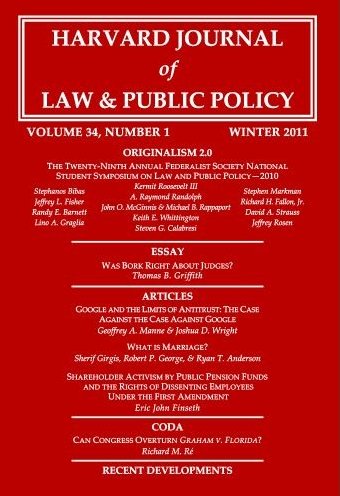 I’m excited to announce the release of my latest law review article, “The Pursuit of Privacy in a World Where Information Control is Failing,” which appears in the next edition (vol. 36) of the Harvard Journal of Law & Public Policy. This is the first of two complimentary law review articles that I will be releasing this year dealing with privacy policy. The second, which will be published later this summer by the George Mason University Law Review, is entitled, “A Framework for Benefit-Cost Analysis in Digital Privacy Debates.” (FYI: Both articles focus on privacy claims made against private actors — namely, efforts to limit private data collection — and not on privacy rights against governments.)


 The Technology Liberation Front is the tech policy blog dedicated to keeping politicians' hands off the 'net and everything else related to technology.