Posts tagged as:

This afternoon, Berin Szoka asked me to participate in a TechFreedom conference on “COPPA: Past, Present & Future of Children’s Privacy & Media.” [CSPAN video is here.] It was a in-depth, 3-hour, 2-panel discussion of the Federal Trade Commission’s recent revisions to the rules issued under the 1998 Children’s Online Privacy Protection Act (COPPA).

While most of the other panelists were focused on the devilish details about how COPPA works in practice (or at least should work in practice), I decided to ask a more provocative question to really shake up the discussion: What are we going to do when COPPA fails?

My notes for the event follow down below. I didn’t have time to put them into a smooth narrative, so please pardon the bullet points. Continue reading →

WP coverThe Mercatus Center at George Mason University has just released a new paper by Brent Skorup and me entitled, “A History of Cronyism and Capture in the Information Technology Sector.” In this 73-page working paper, which we hope to place in a law review or political science journal shortly, we document the evolution of government-granted privileges, or “cronyism,” in the information and communications technology marketplace and in the media-producing sectors. Specifically, we offer detailed histories of rent-seeking and regulatory capture in: the early history of the telephony and spectrum licensing in the United States; local cable TV franchising; the universal service system; the digital TV transition in the 1990s; and modern video marketplace regulation (i.e., must-carry and retransmission consent rules, among others.

Our paper also shows how cronyism is slowly creeping into new high-technology sectors.We document how Internet companies and other high-tech giants are among the fastest-growing lobbying shops in Washington these days. According to the Center for Responsive Politics, lobbying spending by information technology sectors has almost doubled since the turn of the century, from roughly $200 million in 2000 to $390 million in 2012.  The computing and Internet sector has been responsible for most of that growth in recent years. Worse yet, we document how many of these high-tech firms are increasingly seeking and receiving government favors, mostly in the form of targeted tax breaks or incentives. Continue reading →

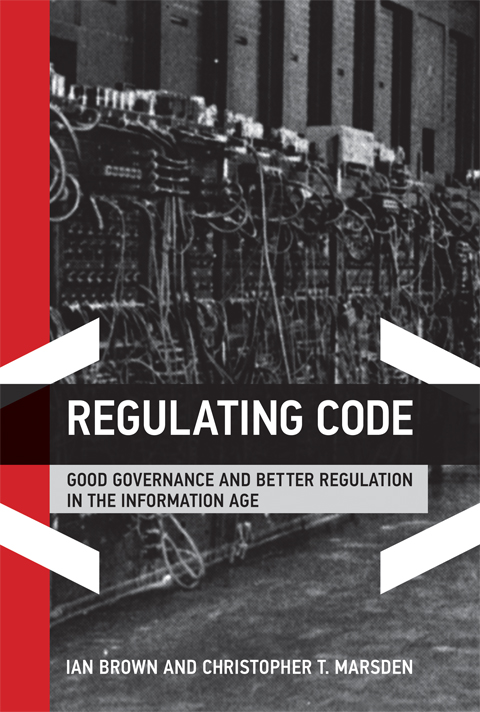
Regulating Code book coverIan Brown and Christopher T. Marsden’s new book, Regulating Code: Good Governance and Better Regulation in the Information Age, will go down as one of the most important Internet policy books of 2013 for two reasons. First, their book offers an excellent overview of how Internet regulation has unfolded on five different fronts: privacy and data protection; copyright; content censorship; social networks and user-generated content issues; and net neutrality regulation. They craft detailed case studies that incorporate important insights about how countries across the globe are dealing with these issues. Second, the authors endorse a specific normative approach to Net governance that they argue is taking hold across these policy arenas. They call their preferred policy paradigm “prosumer law” and it envisions an active role for governments, which they think should pursue “smarter regulation” of code.

In terms of organization, Brown and Marsden’s book follows the same format found in Milton Mueller’s important 2010 book Networks and States: The Global Politics of Internet Governance; both books feature meaty case studies in the middle bookended by chapters that endorse a specific approach to Internet policymaking. (Incidentally, both books were published by MIT Press.) And, also like Mueller’s book, Brown and Marsden’s Regulating Code does a somewhat better job using case studies to explore the forces shaping Internet policy across the globe than it does making the normative case for their preferred approach to these issues. Continue reading →

Declan McCullagh, chief political correspondent for CNET and former Washington bureau chief for Wired News, discusses recent leaks of NSA surveillance programs. What do we know so far, and what more might be unveiled in the coming weeks? McCullagh covers legal challenges to the programs, the Patriot Act, the fourth amendment, email encryption, the media and public response, and broader implications for privacy and reform.

Download

Related Links


Are we as globalized and interconnected as we think we are? Ethan Zuckerman, director of the MIT Center for Civic Media and author of the new book, Rewire: Digital Cosmopolitans in the Age of Connection, argues that America was likely more globalized before World War I than it is today. Zuckerman discusses how we’re more focused on what’s going on in our own backyards; how this affects creativity; the role the Internet plays in making us less connected with the rest of the world; and, how we can broaden our information universe to consume a more healthy “media diet.”

Download

Related Links


***Cross-posted from Forbes.com***

It was, to paraphrase Yogi Berra, déjà vu all over again.  Fielding calls last week from journalists about reports the NSA had been engaged in massive and secret data mining of phone records and Internet traffic, I couldn’t help but wonder why anyone was surprised by the so-called revelations.

Not only had the surveillance been going on for years, the activity had been reported all along—at least outside the mainstream media.  The programs involved have been the subject of longstanding concern and vocal criticism by advocacy groups on both the right and the left.

For those of us who had been following the story for a decade, this was no “bombshell.”  No “leak” was required.  There was no need for an “expose” of what had long since been exposed.

As the Cato Institute’s Julian Sanchez and others reminded us, the NSA’s surveillance activities, and many of the details breathlessly reported last week, weren’t even secret.  They come up regularly in Congress, during hearings, for example, about renewal of the USA Patriot Act and the Foreign Intelligence Surveillance Act, the principal laws that govern the activity.

In those hearings, civil libertarians (Republicans and Democrats) show up to complain about the scope of the law and its secret enforcement, and are shot down as being soft on terrorism.  The laws are renewed and even extended, and the story goes back to sleep.

But for whatever reason, the mainstream media, like the corrupt Captain Renault in “Casablanca,” collectively found itself last week “shocked, shocked” to discover widespread, warrantless electronic surveillance by the U.S. government.  Surveillance they’ve known about for years.

Let me be clear.  As one of the long-standing critics of these programs, and especially their lack of oversight and transparency, I have no objection to renewed interest in the story, even if the drama with which it is being reported smells more than a little sensational with a healthy whiff of opportunism. Continue reading →

David Garcia, post doctoral researcher at the Swiss Federal Institute of Technology and co-author of Social Resilience in Online Communities: The Autopsy of Friendster, discusses the concept of social resilience and how online communities, like Facebook and Friendster, withstand changes in their environment.

Garcia’s paper examines one of the first online social networking sites, Friendster, and analyzes its post-mortem data to learn why users abandoned it.

Garcia goes on to explain how opportunity cost and cost benefit analysis can affect a user’s decision whether or not to remain in an online community.

Download

Related Links


Gina Keating, author of Netflixed: The Epic Battle for America’s Eyeballs, discusses the startup of Netflix and their competition with Blockbuster.

Keating begins with the history of the company and their innovative improvements to the movie rental experience. She discusses their use of new technology and marketing strategies in DVD rental, which inspired Blockbuster to adapt to the changing market.

Keating goes on to describe Netflix’s transition to internet streaming and Blockbuster’s attempts to retain their market share.

Download

Related Links


The Information Economy Project at the George Mason University School of Law is hosting a conference tomorrow, Friday, April 19. The conference title is From Monopoly to Competition or Competition to Monopoly? U.S. Broadband Markets in 2013. There will be two morning panels featuring discussion of competition in the broadband marketplace and the social value of “ultra-fast” broadband speeds.

We have a great lineup, including keynote addresses from Commissioner Joshua Wright, Federal Trade Commission and from Dr. Robert Crandall, Brookings Institution.

The panelists include:

Eli Noam, Columbia Business School

Marius Schwartz, Georgetown University, former FCC Chief Economist

Babette Boliek, Pepperdine University School of Law

Robert Kenny, Communications Chambers (U.K.)

Scott Wallsten, Technology Policy Institute

The panels will be moderated by Kenneth Heyer, Federal Trade Commission and Gus Hurwitz, University of Pennsylvania, respectively. A continental breakfast will be served at 8:00 am and a buffet lunch is provided. We expect to adjourn at 1:30 pm. You can find an agenda here and can RSVP here. Space is limited and we expect a full house, so those interested are encouraged to register as soon as possible.

As noted here last week, as part of their Marginal Revolution University online courses, Tyler Cowen and Alex Tabarrok have been rolling out several classes on “Economics of the Media.” I think TLF readers will be interested in checking out their lessons on “Bundling” and “Cable TV Regulation” since these are topics we have frequently discussed here over the years. I’ve embedded those two presentations below, but please go the MRU site and watch all the videos in their media economics course when you get a chance. They are excellent.

Continue reading →