I’m fond of quoting Diane Mermigas, editor-at-large at MediaPost, who is one of the finest media market watchers in the journalism business today. Her latest MediaPost column offers another sobering look at the radical changing sweeping through the media marketplace today. In that article, she notes that even though we are in an era of Big Government bailouts for financial institutions and (possibly) auto makers, old media operators will be left to to fend for themselves, and many will likely die off as a result:
What we do know is there will be no federally funded bail for media, Internet, entertainment and advertising. Big media by definition is not nimble and innovative enough to simply dump what’s not working, modify what can be saved, and grow what works. There isn’t much that big media companies can bank on or reliably forecast moving into 2009. They are hamstrung between deteriorating traditional costs and revenues and evolving digital business models that do not offset the losses, generating less than 10% of their overall incomes. Big media isn’t just being ravaged by recession; it is being sacked by a technological transformation of enormous proportions.
I discussed a lot of the forces behind the current media meltdown in my recent PFF special report, “Media Metrics: The True State of America’s Marketplace.” As I noted there, this Schumpeterian “creative destruction” we are witnessing today is a normal (but gut-wrenching) part of any major technological transformation, and it need not be addressed with government subsides or interference. However, the problem for many traditional media providers is, as I noted in my special report:
Continue reading →
Jesse Walker has a terrific feature story looking “Beyond the Fairness Doctrine” in this month’s issue of Reason magazine. I highly recommend it. It’s an in-depth exploration of what an Obama Administration means for the future of tech and media policy. Walker rightly opens the piece by noting that “The fairness doctrine is still dead, and it probably will stay dead even if Barack Obama becomes president.” The danger, however, is that an Obama FCC will still pursue a variety of onerous regulatory objectives that could do a great deal of damage to markets and free speech.
Walker touches upon the various issues that will likely be a priority for an Obama Administration and the Left-leaning media reformistas like Free Press, Media Access Project, Public Knowledge, and New America Foundation. Those policy issues include: net neutrality, “localism” mandates and increased “community oversight” regulations, media ownership rules, minority ownership requirements, increased merger meddling, spectrum policy, and other new “public interest” obligations.
Of course, as Walker also correctly points out, it is difficult to see how things could get much worse than they have been under Bush Administration’s FCC and the leadership of Chairman Kevin Martin. Walker was kind enough to quote my thoughts on this point: “Martin is the most regulatory Republican FCC Chairman in decades,” I told him. “He wants to control speech and will use whatever tools he has to get there.”
I stand by those words, but I am also aware that things could get worse — much worse — under a Democratic FCC influenced by radical Leftist activists like Free Press. Indeed, in our new book A Manifesto for Media Freedom, Brian Anderson and I inventory the many looming threats to media and technology freedom that exist today and show how most of them arise from the Left. As Walker notes in his article, however, it is unlikely that a re-empowered Democratic FCC would come right out of the gates with the same sort of command-and-control approaches they’ve employed in the past. And we’ll still have to worry about some right-of-center lawmakers and regulatory joining some of these misguided campaigns. “The real danger,” Walker concludes in his piece, “is more subtle and more mundane. It’s a bipartisan bureaucracy slowly, steadily increasing its power.” Make sure to read Jesse’s entire piece. Great stuff.
In a City Journal article earlier this year, I wondered “how long some local papers have left when they are barred from restructuring their businesses or partnering with other local media operators to stem the bleeding and reinvent their business models.” I was responding to the Senate’s smack-down of a half-hearted reform effort that FCC chairman Kevin Martin pushed through in November 2007, which proposed relaxing the FCC’s newspaper/broadcast cross-ownership rule. That rule, unrevised since going into effect in 1975, prohibits a newspaper operator from also owning a radio or television station in the same media market. However, waivers were granted to grandfather in some combined newspaper and broadcast operations that had existed long before the ban took effect. Martin’s proposal was to simply tweak the rule to permit similar combinations in just the nation’s 20 largest media markets.
Martin’s limited liberalization proposal, however, led to howls of disapproval from FCC democrats like Michael Copps and many folks on both side of the aisle in Congress. Supposedly, this was nothing more than a “giveaway” to the newspaper industry, which critics said was doing just fine. It really makes you wonder if any of those critics even both reading the news about newspapers today.
As I have documented here on many occasions, as well as in my big Media Metrics report, the newspaper industry is in huge trouble with every financial variable of importance rapidly heading south. Alan Mutter does a good job here of summarizing “the secular forces dragging down newspapers: Declining readership, shrinking advertising, high fixed costs and growing online competition that makes it increasingly difficult to charge the premium ad rates that were possible prior to the Internet.” As a result of these forces, everyday brings another headline like this one today in the New York Times: “The Star-Ledger of Newark Plans 40% Cut,” or this one in the Wall Street Journal: “Some Newspapers Shed Unprofitable Readers.” The numbers are just miserable, and they just get worse and worse.
Continue reading →
Back in the mid- and even late 1990s, I was engaged in a lot of dreadfully boring telecom policy debates in which the proponents of regulation flatly refused to accept the argument that the hegemony of wireline communications systems would ever be seriously challenged by wireless networks. Well, we all know how that story is playing out today. People are increasingly “cutting the cord” and opting to live a wireless-only existence. For example, this recent Nielsen Mobile study on wireless substitution reports that, although only 4.2% of homes were wireless-only at the end of 2003…
At the end of 2007, 16.4 percent of U.S. households had abandoned their landline phone for their wireless phone, but by the end of June 2008, just 6 months later, that number had increased to 17.1 percent. Overall, this percentage has grown by 3-4 percentage points per year, and the trend doesn’t seem to be slowing. In fact, a Q4 2007 study by Nielsen Mobile showed that an additional 5 percent of households indicated that they were “likely” to disconnect their landline service in the next 12 months, potentially increasing the overall percentage of wireless-only households to nearly 1 in 5 by year’s end.
And one wonders about how many homes are like mine — we just keep the landline for emergency purposes or to redirect phone spam to that number instead of giving out our mobile numbers. Beyond that, my wife and I are pretty much wireless-only people and I’m sure there’s a lot of others like us out there.
Anyway, I’ve been having a strange feeling of deva vu lately as I’ve been engaging in policy debates about the future of the video marketplace. Like those old telecom debates of the last decade, we are now witnessing a similar debate — and set of denials — playing out in the video arena. Many lawmakers and regulatory advocates (and even some industry folks) are acting as if the old ways of doing business are the only ways that still count. In reality, things are changing rapidly as video content continues to migrate online.
I was reminded of that again this weekend when I was reading Nick Wingfield’s brilliant piece in the
Wall Street Journal entitled “Turn On, Tune Out, Click Here.” It is must-reading for anyone following development in this field. As Wingfield notes:
Continue reading →
 I’m pleased to announce the publication of A Manifesto for Media Freedom, which I co-authored with Brian C. Anderson of the Manhattan Institute. Brian serves as editor of Manhattan Institute’s excellent City Journal and he is the author of best-selling books like South Park Conservatives and Democratic Capitalism and Its Discontents.
In this little manifesto, we highlight one of the central ironies of the Information Age. Namely, that despite “the breathtaking abundance of new and old media outlets for obtaining news, information, and entertainment…”
many people hate this profusion, and never more than when it involves political speech. The current media market, they charge, doesn’t represent true diversity, or isn’t fair, or is subject to manipulation by a small and shrinking group of media barons. They want the government to regulate it into better shape, which just happens to be a shape that benefits them. Doing so… would be a disaster, a kind of soft or not-so-soft tyranny that would wipe out whole sectors of media, curtailing free speech and impoverishing our democracy.
In other words, instead of celebrating the unprecedented cornucopia of media choices at our collective disposal, many policymakers and media critics are calling for just as much media regulation as ever. We itemize these threats in our chapters and they include: efforts to revive the “Fairness Doctrine”, media ownership regulations, “localism” requirements, Net neutrality mandates, a la carte regulations, cable and satellite censorship, video game censorship, regulation of social networking sites, campaign finance-related speech restrictions, and so on.
In each case, we advance a pro-freedom paradigm to counter the advocates of media control. What do we mean by the “media freedom” that we advocate as the alternative to these new regulatory crusades? Here’s how we put it in the book:
Continue reading →
My ongoing media DE-consolidation series represents an effort to set the record straight regarding one of the leading myths about the media marketplace today: the notion that rampant consolidation is taking place and that operators are only growing larger and devouring more and more companies.
Nothing could be further from the truth. Over the past 3 to 5 years, traditional media operators and sectors have been coming apart at the seams in the face of unprecedented innovation and competition. The volume of divestiture activity has been quite intense, and most traditional media operators have been getting smaller, not bigger. “Traditional media’s numbers are shrinking,” argued FCC Commissioner Robert McDowell in a recent speech. “The ironic truth is,” McDowell continued, that “in many cases, media consolidation has actually become media divestiture. Companies… have been shedding properties to raise capital for new ventures.”
And so that trend continues today with the announcement from Cox Enterprises that it will be selling almost all its newspapers. According to the The Atlanta Journal-Constitution:
Continue reading →
I used to get endless grief from pro-regulatory media activists here in DC when I put forward the argument in days past that Google was a media company and a major player in the battle for eyes, ears and ad dollars in America’s media marketplace. Increasingly, however, more people are coming around to seeing that point, even the crusty old media giants themselves.
In a smart essay over at the Freedom to Tinker blog, David Robinson takes the New York Times to task for an article today again wondering, “Is Google a Media Company?” As David rightly argues:
Continue reading →
Over at Reason’s “Hit and Run” blog, Matt Welch has penned a piece pointing out how it is impossible to make the anti-media activists happy. Welch notes that radical activist groups like Free Press go around demonizing media moguls like Rupert Murdoch because he supposedly symbolizes the fact that will live in an age of media monopolists who puppeteer all our news and entertainment from on high. It’s all 100% B.S., of course, as we have shown here again and again.
But even when confronted by the rise of alternative owners and ownership models, the Free Press fanatics show their true colors by saying that won’t work for them either. Walsh notes, for example, that the skake-up of the old Tribune empire and the emergence of Sam Zell as an independent owner of the Trib — and an owner hellbent on downsizing the old empire, no less — should be exactly what Free Press wants:
Continue reading →
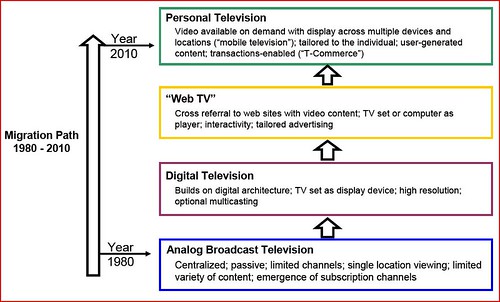
Progress & Freedom Foundation released a new report this week entitled “A Primer on the US Mobile Television Market,” by Joseph S. Kraemer, Ph.D., who is an Adjunct Fellow at PFF and a Director at Law and Economics Consulting Group. It’s not a policy piece; it just focuses on the projected growth of the mobile television marketplace over the next few years. Kraemer explains why “mobile video is forecasted to explode over the next four or five years.” He notes that it is the logical evolution of the television marketplace:
mobile digital television is a logical extension of the digitally-driven development of television from passive entertainment to an interactive, high value, versatile medium. Each stage builds upon the set of earlier stages. “Personal television” adds functionality and value to “web TV” which did the same to “digital television” which, in turn, did the same to “analog broadcast television.” The development process is additive and cumulative. Although critically important, mobile television is just one aspect of the evolving “personal television” stage.
 Continue reading →
Over at Technology 360, Dennis Haarsager points out that there’s probably too much gloom-and-doom out there in the blogosphere regarding the future of various media platforms. He did phrase searches “to see how the media stacked up in the death department.” He got back the following results:
“death of television”, 13,000 results
“death of TV”, 28,200 results
“death of radio”, 227,000 results
“death of newspapers”, 331,000 results
“death of blogs”, “death of the blogs”, “death of the blog”, 81,400 results
“death of the web”, 215,000 results
“death of the net”, 746,000 results
“death of the internet”, 1,910,000 results
No doubt—as Mark Twain might have said—the rumors of the death of media have been greatly exaggerated. And, as Mike Mansick of TechDirt points out, not all papers or media outlets are facing gloom and doom scenarios.
Nonetheless, many traditional media sectors and providers
do find themselves in troubled waters today as tsunami of creative destruction tears through their markets. In our new “Media Metrics” report, Grant Eskelsen and I show how two sectors in particular—radio broadcasting and newspapers—are getting hammered particularly hard by a sort of “media perfect storm”:
-
loss of protected markets or “protected scarcity” = there’s just no guaranteed audience anymore
-
rapid technological change = the way media is created and transmitted has been completely transformed
-
massive inflow of new competitors / platforms = no way to stop the deluge of new voices, including user-generated content
-
loss of consumer confidence and allegiance = people have plenty of other places to turn their attention
-
loss of advertiser confidence and allegiance = advertisers have plenty of other places to promote their goods and services (including direct-to-consumer appeals and ‘word-of-mouth’ marketing efforts)
-
loss of investor confidence and allegiance = shareholders have lots of other places to invest their capital today
The results have been particularly grim for newspaper in recent months as various reports have noted.
Continue reading →

 The Technology Liberation Front is the tech policy blog dedicated to keeping politicians' hands off the 'net and everything else related to technology.