There’s been plenty written about the death spiral that America’s newspaper industry finds itself stuck in — here’s an amazing summary of the recent online debates — and I’ve spent a lot of time writing on this issue here in the past, too. Ben Compaine, one of America’s sharpest media analysts and the co-author of the classic study Who Owns the Media?, has added his own two cents in his latest essay over at the Rebuilding Media blog. Like everything Ben writes, it is well worth reading:
If newspapers have essentially been able to thrive on the revenue from advertisers alone (again, with cost of printing more or less covered by circulation revenue), why are they having so much trouble today? The answer is not one single factor, but a major contributor is that newspapers – whether print or digital—are just worth less to advertisers than they were 20 years ago. Back then, local advertisers did not have many options for reaching the mass local audience. What was the alternative for auto dealers? For real estate agents? Supermarkets or department stores? For some, direct mail was one possible option. But that was about it. Using pre-prints instead of ROP became attractive for some large display advertisers, leaving the publishers with a piece of the cash flow. Advertisers were hit with regular rate increases. And they pretty much had to pay, The publishers made good money.
But then a double whammy. Just about the time the Internet became a real alternative for classified listings—think Craigslist, Monster.com, eBay, Autotrader.com—and for retailers—think DoubleClick, Google, et al—the boys at the cable operators had perfected the insertion of highly local spots into their feeds. Between 1989 and 2007 local cable advertising increased from $500 million to $4.3 billion—or from 0.4% of all advertising to 1.6%. Advertising in newspapers fell from 26% to 15% in this period. Although some of the highly local advertisers going to cable may have taken some of their funds from budgets for radio or other local media, it is probable that a significant share came from the hides of newspapers. I estimate perhaps up to 20% of the decline in local newspaper advertising share can be attributed to local cable spots.
The other whammy, the gorilla in the room, is Internet advertising. No need to elaborate. But its impact on newspapers is not just that it has siphoned off dollars per se. Much more importantly is that
the Internet has given most advertisers greater market power against newspaper publishers. Many big advertisers—like car dealers, real estate offices and big box retailers—don’t need the newspapers as much.
Ben’s got it exactly right. The decline of newspapers comes down to the death of “protectable scarcity” (thanks to Canadian media expert Ken Goldstein for that phrase). There’s just too much other competition out there online already for our eyes and ears. We’re witnessing substitution effects on a scale never seen in the media world, with disruptive digital technologies and networks splintering our attention spans. That de-massification of media means that high fixed cost endeavors like daily newspapers are not going to be able to sustain the cross-subsidies they’ve long gotten from advertisers.
If you want to boil the newspaper death spiral down to an equation, it would look something like this:
Continue reading →
I’ve got a new PFF paper out today entitled, “Who Needs Parental Controls? Assessing the Relevant Market for Parental Control Technologies.” In this piece, I address the argument made by some media and Internet critics who say that government intervention (perhaps even censorship) may be necessary because parental control technologies are not widely utilized by most Americans. But, as I note in the paper, the question that these critics always fail to ask is: How many homes really need parental control technologies? The answer: Far fewer than you think. Indeed, the relevant universe of potential parental control users is actually quite limited.
I find that the percentage of homes that might need parental control technologies is certainly no greater than the 32% of U.S. households with children in them. Moreover, the relevant universe of potential parental control users is likely much less than that because households with very young children or older teens often have little need for parental control technologies. Finally, some households do not utilize parental control technologies because they rely on alternative methods of controlling media content and access in the home, such as household media rules. Consequently, policymakers should not premise regulatory proposals upon the limited overall “take-up” rate for parental control tools since only a small percentage of homes might actually need or want them.
If you don’t care to read the whole nerdy thing, I’ve created this short video summarizing the major findings of the paper.
http://www.youtube.com/v/a7Fnf3Ztt-U&hl=en&fs=1
And the document is embedded below the fold in a Scribd reader.
Continue reading →
Interesting article here (“Not All Information Wants to Be Free“) by Jack Shafer of Slate. He notes that many people focus on why “pay wall” business models don’t work online, but few people discuss those models that do (i.e., the ones that successfully get customers to pay for access to content behind the wall). Shafer walks through some of the ones that have worked and concludes:
Not all successful paid sites are alike, but they all share at least one of these attributes:
1) They are so amazing as to be irreplaceable.
2) They are beautifully designed and executed and extremely easy to use.
3) They are stupendously authoritative.
Succinctly stated, the pay-per-view sites are damn unique, offering content or a service that consumers are unlikely to find elsewhere. Of course, that’s a pretty small universe of sites, and unless you content is extraordinarily unique and time-sensitive, I have a hard time believing that a pay wall model will work for most sites.
Continue reading →
Matt Lasar of Ars
tells us not to worry about the Fairness Doctrine being revived, only to go on and cite several lawmakers who have said they’d like to revive it. Meanwhile, over at the American Spectator, somebody called “The Prowler” seems to have all sorts of unnamed sources on the Hill telling him the Fairness Doctrine will be revived any day now.
Who knows what to believe. But let’s keep our eye on the real issue here. The danger is not that the Fairness Doctrine gets back on the books in the same form; it’s that versions of it sneak in through the back door via other regulatory initiatives. As Cord Blomquist pointed out here last April, “localism is the new Fairness Doctrine.” There are a lot of people are running around Washington today insisting that government must intervene in the marketplace to “save media localism” and “strengthen the public interest obligations” of local TV and radio broadcasters. There’s been an FCC proceeding open on this issue for some time, and everything about it reeks of the Fairness Doctrine in drag.
This effort is being spearheaded by the media reformistas whose short-term goal is to reinvigorate the amorphous “public interest standard” such that the FCC has open-ended powers to regulate everything under the sun going forward. That’s why a key part of the “localism” battle is their effort to breathe new life into “ascertainment rules,” which used to be more formal and required broadcasters to strictly report everything they aired and did in their communities. There’s lots of talk of ensuring more “accountability” from broadcasters regarding how they serve their local communities, and there’s even rumblings of “local community boards” who will sit as mini-free speech Star Chambers and pass judgment on whether local media outlets are doing their job. Again, it’s all just the Fairness Doctrine by another name. Continue reading →
This ongoing series has explored the increasing ability of consumers to “cut the cord” to traditional video distributors (cable, satellite, etc.) and instead receive a mix of “television” programming and other forms of video programming over the Internet. As I’ve argued, this change not only means lower monthly bills for those “early adopter” consumers who actually do “cut the cord”, but, in the coming years, a total revolution in the traditional system of content creation and distribution on which the FCC’s existing media regulatory regime is premised.
This revolution has two key parts:
- Conduits: The growing inventory—and popularity—of sites such as Hulu, Amazon Unboxed and the XBox 360 Marketplace (or software such as Apple’s iTunes store), that allow users to view or download video content. Drawing an analogy to the FCC’s term “Multichannel Video Programming Distibutor” or MVPD (cable, direct broadcast satellite, telco fiber, etc.), I’ve dubbed these sites “Internet Video Programming Distributors” or IVPDs.
- Interface: The hardware and software that allows users to display that content easily on a device of their choice, especially their home televisions.
While much of the conversation about “interface” has focused on special hardware that brings IVPD content to televisions through set-top boxes such as the Roku box or game consoles like the XBox 360, at least one company is making waves with a software solution. From the NYT:
Boxee bills its software as a simple way to access multiple Internet video and music sites, and to bring them to a large monitor or television that one might be watching from a sofa across the room.
Some of Boxee’s fans also think it is much more: a way to euthanize that costly $100-a-month cable or satellite connection.
“Boxee has allowed me to replace cable with no remorse,” said Jef Holbrook, a 27-year-old actor in Columbus, Ga., who recently downloaded the Boxee software to the $600 Mac Mini he has connected to his television. “Most people my age would like to just pay for the channels they want, but cable refuses to give us that option. Services like Boxee, that allow users choice, are the future of television.” ….
Boxee gives users a single interface to access all the photos, video and music on their hard drives, along with a wide range of television shows, movies and songs from sites like Hulu,Netflix, YouTube, CNN.com and CBS.com.
Continue reading →
[This represents a bit of a departure from the traditional format of my ongoing “Media Deconsolidiation Series,” but you will see how it ties in…]
So, some guy from the (Un)Free Press — the activist group that wants to regulate every facet of the media and broadband universe — has created a scary looking chart about “Information Control” [seen below]. It’s based loosely on the Periodic Table of Elements, you know, to give it the aura of science and fact. In reality, it’s just another silly scare tactic that tells us very little about the true nature of our modern media marketplace.
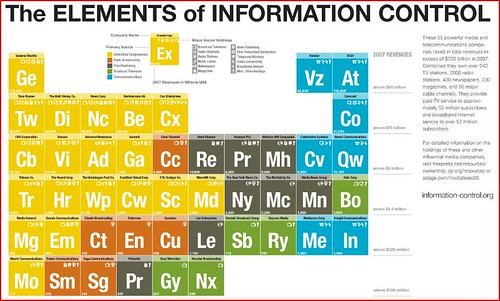
The chart is accompanied by the typical Free Press gloom-and-doom rhetoric about the unfolding media apocalypse. “Nearly everything you see, hear and read that isn’t from a friend — whether on TV, the radio, or even on the Web — comes from a for-profit gatekeeper.” And then comes the obligatory A.J. Liebling quote about how “Freedom of the press belongs to those who own one,” followed quickly by the typical punch line about how just a handful of companies (in this case 55 of ’em) are puppeteering all our thoughts in America today:
Combined, these 55 powerful media and telecommunications companies raked in total revenues in excess of $700 billion in 2007. Together they own over 540 TV stations, 2000 radio stations, 430 newspapers, 230 magazines, and 80 major cable channels in the United States. They provide paid TV service to approximately 52 million subscribers and broadband Internet service to over 57 million subscribers. They’re the bottlenecks through which our news, our entertainment, and our political discourse must travel. What they want to promote becomes prominent; what they suppress stays out of the mainstream. As such, these companies are the elements of information control.
Oh my God! We are all just brainwashed sheep!
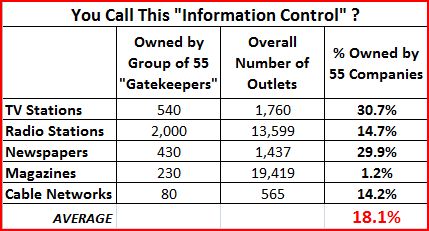
Except we’re not. It amazes me how these “information control” and “media monopoly” myths keep getting widespread circulation. But the first thing to note is how the media reformistas can’t get even their story straight when it comes to how many “monopolists” are supposedly out there today. As I noted in my 2005 book, Media Myths: Making Sense of the Debate over Media Ownership, the critics seem to just pull their numbers out of a hat. Some say as few as 3 companies control everything. Others says 5 or 6. Still others say it might be a few dozen. And now this guy says its 55. Hey, that’s progress that even the Free Press should love!
Regardless of the number, does this really represent the totality of our modern media universe? Do those 55 companies really “own most of the 21st-century presses in America” as the “Info Control” website states? Answer: NOT. EVEN. CLOSE. Here are the facts. [I happened to have compiled them for a PFF special report entitled Media Metrics: The True State of the Modern Media Marketplace to debunk myths just like this.]
Continue reading →
This is just a listing of the installments of my ongoing “Media Deconsolidation Series.” I needed to create a single repository of all the essays so I could point back to them in future articles and papers. For those not familiar with it, this series represents an effort to set the record straight regarding the many myths surrounding the media marketplace. These myths are usually propagated by a group of radical anti-media regulatory activists who I call the “media reformistas.” Sadly, however, many policymakers, journalists, and members of the public are buying into some of these myths, too.
In particular, I have spent much time here debunking the notion that rampant consolidation is taking place and that media operators are only growing larger and devouring more and more companies. In fact, nothing could be further from the truth. Over the past several years, traditional media operators and sectors have been coming apart at the seams in the face of unprecedented innovation and competition. The volume of divestiture activity has been quite intense, and most traditional media operators have been getting smaller, not bigger. As a result, America’s media marketplace is growing more fragmented and atomistic with each passing day.
Anyway, here’s the series so far…
Continue reading →
It almost seems pointless for me to continue my ongoing media DE-consolidation series, which has been an ongoing effort to debunk myths about the media marketplace (specifically, the notion that rampant consolidation is taking place and that operators are only growing larger and devouring more and more companies.) After all, even the kookiest of the media reformistas can’t deny the truth anymore: Traditional media operators are struggling to keep their heads above water, and markets are growing more atomistic by the day, not more concentrated.
The
New York Times website seems to run a story per day about traditional media giants falling apart as consumers and advertisers disappear. For those of you with short attention spans, you can even follow the death of old media on Twitter now via “The Media is Dying.” If 140 characters per entry is still too much for you to read, here’s the cribbed version: Lots of downsizing, bankruptcies, and closing of doors. The Tribune’s bankruptcy has been the biggest news this week, but few noticed the amazing statement by CBS Corp. Chief Executive Les Moonves that within 10 years he thinks CBS may dump all its affiliated TV stations and just sell programming direct to cable and satellite operators (and the Net, too). Once other networks take that path, that’s pretty much the end of traditional broadcast local affiliates. (I wonder who the FCC will impose those “localism” regulations on then!)
For those working in the business, the news couldn’t be any worse. As Ad Week reported a few days ago:
Continue reading →
George Will’s weekly Washington Post column focuses on the Fairness Doctrine and calls out those on the Left who would support its reinstatement:
Because liberals have been even less successful in competing with conservatives on talk radio than Detroit has been in competing with its rivals, liberals are seeking intellectual protectionism in the form of regulations that suppress ideological rivals. If liberals advertise their illiberalism by reimposing the fairness doctrine, the Supreme Court might revisit its 1969 ruling that the fairness doctrine is constitutional. The court probably would dismay reactionary liberals by reversing that decision on the ground that the world has changed vastly, pertinently and for the better.
Mr. Will was kind enough to cite my new book with Brian Anderson, A Manifesto for Media Freedom [more info here] on the explosion of media outlets and options since the Supreme Court’s disastrous 1969 Red Lion decision, which blessed the Fairness Doctrine. Some of those stats: today there are about 14,000 radio stations, twice as many as in 1969; 18.9 million subscribers to satellite radio, up 17 percent in 12 months; and that 86 percent of households with either cable or satellite television receive an average of 102 of the 500 available channels.
No need to be putting the “Unfairness Doctrine” back on the books with unprecedented abundance like that.
Today’s USA Today features a debate between the editors and me on the question of the impact media has on children and what should be done about it. Their editorial argues that “Today’s mass media penetrate deeply and quietly, inflicting real damage on young children, an increasing body of research shows.” Specifically, they are referring to a new study commissioned by Common Sense Media (CSM), which claims that a review of 173 studies shows “that a strong correlation exists between greater exposure and adverse health outcomes.”
In my response entitled “Don’t Scapegoat Media,” which appears in its entirety down below the fold, I argue that “Media have long been a convenient scapegoat for the woes of the world,” and that we must be careful not to assume correlation equals causation when surveying the impact of media on kids. After all, I argue, “how do [those studies] account for the other variables that influence youth development, including broken homes, bad parents, socioeconomic status, troubled peer relations, poor schools and so on? And how is media exposure weighted relative to these other influences? Is a beer ad really as much of a negative influence as an alcoholic parent?” Again, read my entire response below. [Of course, even if one assumes some media has an impact on some kids, there are plenty of ways for parents and guardians to take control over the media in their lives, as I have shown in my big book on the subject.]
I was also quoted in this Washington Post article about the new CSM study on Tuesday.
Continue reading →

 The Technology Liberation Front is the tech policy blog dedicated to keeping politicians' hands off the 'net and everything else related to technology.