Mark Cuban penned a sharp piece over the weekend entitled “Who Cares What People Write?” in which he explains why people shouldn’t get too worked up about what they might read about themselves (or their organizations) online since, chances are, very few people are ever going to see it anyway. To explain why, Cuban identifies two kinds of “Outties” (which is shorthand for someone who publishes on the web): (1) “professional outties” (or “Those that attempt to publish in a limited number of locations to a maximum number of readers or listeners, with a reasonable expectation of building a following.”) and (2) “amateur outties” (“Those that attempt to publish in as many places as possible hoping they are “discovered.”) But those “amateur outties… really [have] no impact on 99.99pct of the population,” Cuban argues, “[and the] vast majority of what is written on the web goes unread and even that which is read, is quickly forgotten.” Moreover, “even when something is heavily commented on, it is usually just an onslaught by the ‘amateur outties.’”
Thus, Cuban concludes:
Fragmentation applies to 100pct of media. We have gotten to the point where it is so easy to publish to the web, that most of it is ignored. When it is not ignored and it garners attention, the attention is usually from those people, the amateur outties, whose only goal is to create volume on the web in hopes of being noticed.
That’s not to say there are no sites that people consume and pay attention to. There obviously are. That’s where the “professional outties” come in. They are branded. They have an identity that usually extends beyond the net. They are able to make a living publishing, even if its not much of one. They are the sites that people consume and may possibly remember.
The moral of the story is that on the internet, volume is not engagement. Traffic is not reach. When you see things written about a person, place or thing you care about, whether its positive or negative, take a very deep breath before thinking that the story means anything to anyone but you.
Continue reading →
Adam Thierer & I have just released a detailed examination (PDF) of brewing efforts to expand the Children’s Online Privacy Protection Act of 1998 to cover adolescents and potentially all social networking sites—an approach we call “COPPA 2.0.”
As Adam explained on Larry Magid’s CNET podcast, COPPA mandates certain online privacy protections for children under 13, most importantly that websites obtain the “verifiable consent” of a child’s parent before collecting personal information about that child or giving that child access to interactive functionality that might allow the child to share their personal information with others. The law was intended primarily to “enhance parental involvement in a child’s online activities” as a means of protecting the online privacy and safety of children.
Yet advocates of expanding COPPA—or “COPPA 2.0″—see COPPA’s verifiable parental consent framework as a means for imposing broad regulatory mandates in the name of online child safety and concerns about social networking, cyber-harassment,
etc. Two COPPA 2.0 bills are currently pending in New Jersey and Illinois. The accelerated review of COPPA to be conducted by the FTC next year (five years ahead of schedule) is likely to bring to Washington serious talk of expanding COPPA—even though Congress clearly rejected covering adolescents age 13-16 when COPPA was first proposed back in 1998.
We’ll discuss some of the key points of our paper in a series of blog posts, but here are the top nine reasons for rejecting COPPA 2.0, in that such an approach would:
- Burden the free speech rights of adults by imposing age verification mandates on many sites used by adults, thus restricting anonymous speech and essentially converging—in terms of practical consequences—with the unconstitutional Children’s Online Protection Act (COPA), another 1998 law sometimes confused with COPPA;
- Burden the free speech rights of adolescents to speak freely on—or gather information from—legal and socially beneficial websites;
- Hamper routine and socially beneficial communication between adolescents and adults;
- Reduce, rather than enhance, the privacy of adolescents, parents and other adults because of the massive volume of personal information that would have to be collected about users for authentication purposes (likely including credit card data);
Continue reading →
As anyone who has spent time searching for comments on the FCC’s website can tell you, the agency doesn’t exactly have the most user-friendly website. In the interest of making it easier for others to read the comments that came in last week in the agency’s “Child Safe Viewing Act” Notice of Inquiry, I have compiled all the major comments (those over 3 or 4 pages) and provided links to them below the fold.
Again, this proceeding was required under the “Child Safe Viewing Act of 2007,” which Congress passed last year and President Bush signed last December. The goal of the bill and the FCC’s proceeding (MB 09-26) is to study “advanced blocking technologies” that “may be appropriate across a wide variety of distribution platforms, including wired, wireless, and Internet platforms.” I filed 150+ pages worth of comments in this matter last week, and here’s my analysis of why this bill and the FCC’s proceeding are worth monitoring closely.
Continue reading →
Today I filed comments with the Federal Communications Commission (FCC) in its proceeding examining the marketplace for “advanced blocking technologies.” This proceeding was required under the “Child Safe Viewing Act of 2007,” which Congress passed last year and President Bush signed last December. The goal of the bill and the FCC’s proceeding (MB 09-26) is to study “advanced blocking technologies” that “may be appropriate across a wide variety of distribution platforms, including wired, wireless, and Internet platforms.” My colleagues will no doubt laugh about the fact that I have dropped an absurd 150 pages worth of comments on the FCC in this matter, but I had a lot to say on this topic! Parental controls, child safety, and free speech issues have been the focus of much of my research agenda over the past 10 years.
In my filing, I argue that the FCC should tread carefully in this matter since the agency has no authority over most of the media platforms and technologies described in the Commission’s recent Notice of Inquiry. Moreover, any related mandates or regulatory actions in in this area could diminish future innovation in this field and would violate the First Amendment rights of media creators and consumers alike. The other major conclusions of my filing are as follows:
- There exists an unprecedented abundance of parental control tools to help parents decide what constitutes acceptable media content in their homes and in the lives of their children.
- There is a trade-off between complexity and convenience for both tools and ratings, and no parental control tool is completely foolproof.
- Most homes have no need for parental control technologies because parents rely on other methods or there are no children in the home.
- The role of household media rules and methods is underappreciated and those rules have an important bearing on this debate.
- Parental control technologies work best in combination with educational efforts and parental involvement.
- The search for technological silver-bullets and “universal” solutions represent a quixotic, Holy Grail-like quest and it will destroy innovation in this marketplace.
- Enforcement of “household standards” made possible through use of parental controls and other methods negates the need for “community standards”-based content regulation.
My entire filing can be found here and down below in a Scribd reader. All comments in the matter are due tomorrow and then reply comments are due on May 18th.
Continue reading →
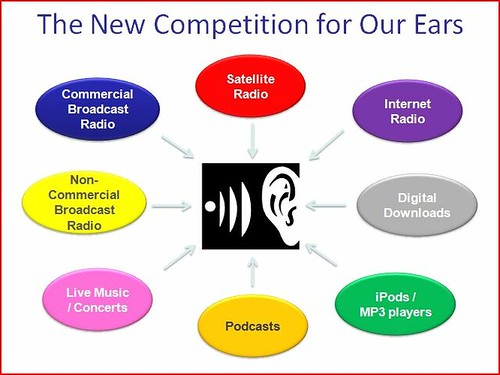
Much ink is spilled over the expanding array of video marketplace choices that are competing for the attention of our eyeballs, but much less is usually written about the competition for our ears. As this excellent new Business Week article by Olga Kharif makes clear, competition and innovation in the audio marketplace has never been more vibrant. It’s something I’ve pointed out here before and here’s a chart I created for my Media Metrics report to highlight all the new competition for our ears. We’ve come a long way since the days of my youth, when transistor radios and vinyl records were the extent of audio competition!
Speaking of socializing media, acting FCC Chairman Michael Copps is someone who has devoted much of his life to regulating the media marketplace into the ground. If he had his way, federal bureaucrats would be controlling virtually every aspect of the media universe. Nothing would get done with Big Nanny’s permission.
That’s what makes his recent comments about the impact of media regulation so delicious.. and hypocritical. According to an article Bloomberg ran on Thursday, Copps is now saying that, with newspapers struggling to remain afloat, the FCC should now reconsider regulations that prohibit combined ownership of broadcast stations and newspapers. The agency should “visit this whole problem” before long, Copps apparently told Bloomberg.
“Visit this problem before long”?? Please! Congress and the FCC have had opportunities to “visit” and revisit this problem for many years now, but it has been Michael Copps and his merry band of media reformistas who have stopped every reform effort dead in its tracks. (See my essays “Congress Fiddles, Newspapers Burn” and “Media Deregulation is Dead” for more evidence of how these radicals hijacked media policy in this country.) As I documented in my 2005 Media Myths book, these charlatans have used hyperbolic rhetoric, shameless fear-mongering, and unsubstantiated claims in opposition to each and every sensible effort to reform our nation’s outdated media ownership policies. Those laws and regulations have created artificial market structures and hindered the ability of media operators to find new business models that might throw them a lifeline in difficult times.
Consider the fact that it was just 14 months ago that then-Commissioner Copps issued this gem of a hysteria-ridden statement in response to the agency’s last effort to ever-so-slightly loosen the newspaper-broadcast cross ownership rule:
Continue reading →
I’ve got a new essay up over at the
City Journal about John Nichols and Robert McChesney’s proposal to have the government heavily subsidize failing media enterprises to “save journalism.” It follows below:
“Socializing Media in Order to Save It“
by Adam D. Thierer
City Journal March 27, 2009
With proposals to nationalize or heavily subsidize various segments of our economy more in vogue than ever, it was probably only a matter of time before someone suggested that America’s media marketplace should be brought into the government fold. John Nichols of The Nation and the prolific neo-Marxist media theorist Robert W. McChesney have now provided the road map for media’s march to serfdom. The cost to the American taxpayer would be at least $60 billion, but the cost for the First Amendment and our democracy would be incalculable.
Nichols and McChesney have coauthored several books and essays about media policy that view the world through the prism of class struggle, “manufactured consent” (á la Noam Chomsky), and the rest of the typical Marxoid tripe about history and economics. In their view, private, for-profit media cannot be trusted. As they stated in their 2003 call to arms,
Our Media, Not Theirs: The Democratic Struggle Against Corporate Media, media-reform efforts must begin with “the need to promote an understanding of the urgency to assert public control over the media.” “Our claim,” they continue, “is simply that the media system produces vastly less of quality than it would if corporate and commercial pressures were lessened.”
In a new
Nation essay, “The Death and Life of Great American Newspapers,” the authors bring their earlier work to its logical conclusion. Saving journalism, they argue, essentially requires that media become an appendage of the state. Journalism, they claim, is a “public good,” which—like education and defense—requires constant government oversight and support: “A moment has arrived at which we must recognize the need to invest tax dollars to create and maintain news gathering, reporting and writing with the purpose of informing all our citizens.” They propose that government devote $60 billion to “subscription subsidies, postal reforms, youth media and investment in public broadcasting.” Think of it as a “free press ‘infrastructure project,’” they say. “It would keep the press system alive. And it has the added benefit of providing an economic stimulus.” (Isn’t it amazing how everything stimulates the economy these days?)
Continue reading →
Today, it was my great privilege to guest lecture at Princeton University’s Center for Information Technology Policy. Under the leadership of Ed Felten, who also runs the excellent “Freedom to Tinker” blog, the CITP has quickly become one of America’s premier institutions in the field of IT policy matters. David Robinson, who some of you will remember from his days as an editor at The American, serves as associate director of the CITP program and was kind enough to invite me to speak. And our own Tim Lee is currently studying there as well. I wish I was smart enough to get into that program!
The topic of my talk was “The Future of the First Amendment in an Age of Technological Convergence” and I used the opportunity to create a narrated video of this presentation, which I have made to several other groups through the years. In this presentation, I talk about “America’s First Amendment Twilight Zone,” which refers to the fact that identical words and images are being regulated in completely different ways today depending on the mode of transmission. This illogical and unfair situation could eventually threaten the Internet, video games, and all new media with many of the misguided regulations that have long been imposed on broadcast television and radio operators. In my presentation, which you can watch below, I make the case for changing our First Amendment regime to ensure “bit equality”; all speech and media platforms should be accorded the gold standard of First Amendment protection.
http://www.youtube.com/v/xJo3tVMScyI&hl=en&fs=1
Continue reading →
The Federal Communications Commission (FCC) has just released a Notice of Inquiry (NOI) in the matter of “Implementation of the Child Safe Viewing Act; Examination of Parental Control Technologies for Video or Audio Programming.” (MB Docket No. 09-26) This NOI was required by S. 602, the “Child Safe Viewing Act of 2007,” which Congress passed last October and President Bush signed into law on December 2nd. The measure requires the FCC to examine:
(1) the existence and availability of advanced blocking technologies that are compatible with various communications devices or platforms;
(2) methods of encouraging the development, deployment, and use of such technology by parents that do not affect the packaging or pricing of a content provider’s offering; and
(3) the existence, availability, and use of parental empowerment tools and initiatives already in the market.
The Act defines the term “advanced blocking technologies” as “technologies that can improve or enhance the ability of a parent to protect his or her child from any indecent or objectionable video or audio programming, as determined by such parent.” Importantly, the Act also directs the agency to look into blocking technologies that “may be appropriate across a wide variety of distribution platforms, including
wired, wireless, and Internet platforms” and which “operate independently of ratings pre-assigned by the creator of such video or audio programming.” The Act requires that the FCC issue a report to Congress about these technologies no later than August 29, 2009.
When writing about the Child Safe Viewing Act shortly after its introduction in the summer of 2007, I noted that the measure potentially represented the beginning of “convergence-era content regulation” at the FCC. Those two clauses highlighted above are of particular importance in that regard. Congress has essentially invited the FCC to engage in unprecedented oversight of media platforms and ratings systems that the agency previously had very little ability to influence. Continue reading →
I’ve been catching up on Radio Berkman, the podcast produced by our friends at the Berkman Center for Internet & Society and a great companion to the TLF’s own Tech Policy Weekly Podcast. There’s been a lot of talk about government transparency on the TLF lately, including TPW 40: Obama, e-Government & Transparency. But that conversation has been mainly focused on how to make “public” records accessible.
The most recent Radio Berkman episode, “Can you Keep a Secret?” explores the thorny questions about what should be deemed public in the first place, and what should be classified:
The government keeps secrets. We take that for granted. But should we? Some speculate that intelligence agencies and elected officials are a little bit trigger happy with the “Top Secret” stamp, and that society would benefit from greater openness. With the government classifying millions of pages of documents per year – in a recent year the U.S. classified about five times the number of pages added to the Library of Congress – a great deal of useful human knowledge gets put under lock and key. But some argue that secrecy is still crucial to our national security.
Radio Berkman pokes its head into a recent talkback with the directors of the film
Secrecy, Harvard University professors Peter Galison and Robb Moss. They are joined by Harvard Law School professors Jonathan Zittrain, Martha Minow, and Jack Goldsmith.
I look forward to seeing the film (when it comes out on Netflix).
What I found most interesting was the discussion of the essential trade-off in the relationship between the media and the state has always been between the media’s “independence” and its “responsibility” (~33:30 in). Even the staunchest critics of the national security state would probably accept that there are
some stories in the media shouldn’t publish because they’d jeopardize the safety of Americans. But we all want the media to blow the whistle on the bad stuff that goes on behind a veil of secrecy. Drawing that line is a terribly difficult task. But it becomes even more complicated with the decline of traditional professional investigative journalism and the rise of blog/amateur journalism. Continue reading →

 The Technology Liberation Front is the tech policy blog dedicated to keeping politicians' hands off the 'net and everything else related to technology.