Posts tagged as:

Polish designer Jacek Utko acknowledged that, in the long-run, nothing can save the newspaper as a print medium, but makes a pretty good case newspapers’ ability to  stay afloat while figuring out how to make the transition to digital media depends heavily on shaking up the graphic design and layout of papers.

http://video.ted.com/assets/player/swf/EmbedPlayer.swf If nothing else, this should remind us all that innovation and entrepreneurship aren’t just about technical improvements or better business savvy, but aesthetics, too! The art of commercial culture is like the oxygen we breath: all around us but something we scarcely notice.

On July 27th, The Progress & Freedom Foundation hosted a Capitol Hill panel discussion entitled “Online Child Safety, Privacy, and Free Speech: An Overview of Challenges in Congress & the States.” The event featured remarks from:

  • Parry Aftab, Executive Director, WiredSafety.org
  • Todd Haiken, Senior Manager of Policy, Common Sense Media
  • Jim Halpert, Partner, DLA Piper
  • Berin Szoka, Senior Fellow, The Progress & Freedom Foundation

We’ve just released the transcript of the event, which I have also pasted down below the fold in a Scribd document reader. Also, the audio for this event can be heard by clicking below:

Download mp3

Here is the full event description: Continue reading →

Twitter Power Laws

by on August 17, 2009 · 12 comments

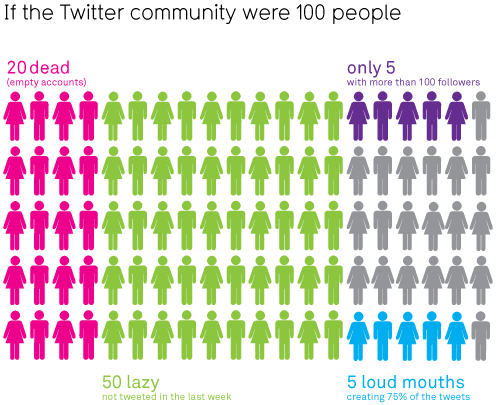
Thanks to Mashable, we clearly see power laws at work on Twitter. While many protest this as evidence of “media inequality,” the “non-tweeting will always be with us” (to paraphrase Jesus’s comment about the persistence of “the poor”)—and this is nothing to get bent out of shape about, as Adam has explained.

Courtesy of Mashable

Courtesy of Mashable, David McCandless

I’ve spent a lot of time here deconstructing and criticizing the proposals set forth by the Free Press, the radical media “reformista” group founded by the prolific Marxist media theorist Robert McChesney.  I have been trying to shine more light on their proposals and activities because I believe they are antithetical to freedom of speech and a free society.  That’s because, as media scholar Ben Compaine has noted, “What the hard core reformistas really want, it seems, is not diversity or an open debate but a media that promotes their own vision of society and the world.”  That’s exactly right and, more specifically, as I argued in my 2005 Media Myths book, the media reformistas want to impose this control by taking the fantasy that “the public owns the [broadcast] airwaves” and extending it to ALL media platforms and outlets.  In other words, McChesney and the Free Press want an UnFree Press.  To cast things in neo-Marxist terms that they could appreciate, they want to take control of the information means of production.  And it begins, McChesney argues, by all of us having to give up this “sort of religious attachment to the idea of a ‘free-press'” from which we all suffer.

Some people accuse me of “red-baiting” or “McCarthyite” tactics when I use the “M-word” (Marxism) or the “S-Word” (socialism) to describe McChesney, the Free Press, and the movement they have spawned.  But these are labels with real meaning and ones that McChesney himself embraces in his work. In his 1999 book Rich Media, Poor Media, he says that “Media reform cannot win without widespread support and such support needs to be organized as part of a broad anti-corporate, pro-democracy movement.” He casts everything in “social justice” terms and speaks of the need “to rip the veil off [corporate] power, and to work so that social decision making and power may be made as enlightened and as egalitarian as possible.”  What exactly would all that mean in practice for media? In his 2002 book Our Media, Not Theirs: The Democratic Struggle against Corporate Media with John Nichols of The Nation, McChesney argues that media reform efforts must begin with “the need to promote an understanding of the urgency to assert public control over the media.” They go on to state that, “Our claim is simply that the media system produces vastly less of quality than it would if corporate and commercial pressures were lessened.”

If you want additional proof of his intentions, then I encourage you to read this lengthy interview with McChesney that appears in the new edition of The Bullet, an online newsletter produced by the Canada-based “Socialist Project.”  (If you ask me, there’s something strangely appropriate about a socialist newsletter named “The Bullet” in light of the millions of people who died while living under socialist tyranny!)  Anyway, let’s ignore that and focus on what neo-Marxist media reform entails according to McChesney.  Because never before has he laid his cards on the table as clearly as he does in this interview. Continue reading →

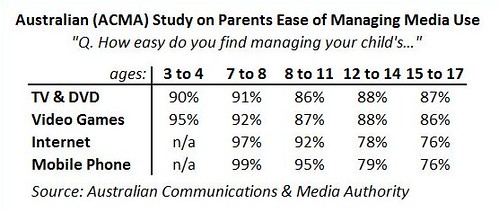
An interesting new survey has just been released by the Australian Communications and Media Authority (ACMA), which is the rough equivalent of the Federal Communications Commission here in the U.S., but with somewhat broader authority. ACMA’a latest report is entitled Use of Electronic Media and Communications: Early Childhood to Teenage Years and it takes a look at media technology usage among Australian youngsters in 5 age groupings (3 to 4 years of age, 7 to 8, 8 to 11, 12 to 14, and 15 to 17).

The survey also asked Australian parents “How easy do you find managing your child’s ___ use.”  They asked that question for four different media or communications technologies: TV & DVD; video games; Internet; and mobile devices.  They results, summarized in the table below, were quite interesting and seem to indicate that Australian parents find it much easier to manage their children’s media use than some of their elected leaders imagine.

Australian ACMA parents ease of use survey

Continue reading →

I’ve just had a new article published by the American Legislative Exchange Council (ALEC) in which I make the case against “techno-panics,” which refers to public and political crusades against the use of new media or technologies by the young. The article is entitled “Parents, Kids & Policymakers in the Digital Age: Safeguarding Against ‘Techno-Panics‘” and it appears in the July 2009 Inside ALEC newsletter.  This is something I have spent a lot of time writing about here in recent years (See 1, 2, 3, 4, 5) and I finally got around to putting it altogether in a concise essay here.  I have pasted the full text below. [And I just want to send a shout-out to my friend Anne Collier of Net Family News.org, whose work on this topic has been very influential on my thinking.]


Parents, Kids & Policymakers in the Digital Age: Safeguarding Against ‘Techno-Panics‘” by Adam Thierer

A cursory review of the history of media and communications technologies reveals a reoccurring cycle of “techno-panics” — public and political crusades against the use of new media or technologies by the young.  From the waltz to rock-and-roll to rap music, from movies to comic books to video games, from radio and television to the Internet and social networking websites, every new media format or technology has spawned a fresh debate about the potential negative effects they might have on kids.

Inevitably, fueled by media sensationalism and various activist groups, these social and cultural debates quickly become political debates. Indeed, each of the media technologies or outlets mentioned above was either regulated or threatened with regulation at some point in its history. And the cycle continues today. During recent sessions of Congress, countless hearings were held and bills introduced on a wide variety of media and content-related issues. These proposals dealt with broadcast television and radio programming, cable and satellite television content, video games, the Internet, social networking sites, and much more.  State policymakers, especially state Attorneys General (AGs), have also joined in such crusades on occasion.  The recent push by AGs for mandatory age verification for all social networking sites is merely the latest example.

What is perhaps most ironic about these techno-panics is how quickly yesterday’s boogeyman becomes tomorrow’s accepted medium, even as the new villains replace old ones.  For example, the children of the 1950s and 60s were told that Elvis’s hip shakes and the rock-and-roll revolution would make them all the tools of the devil. They grew up fine and became parents themselves, but then promptly began demonizing rap music and video games in the ‘80s and ‘90s.  And now those aging Pac Man-era parents are worried sick about their kids being abducted by predators lurking on MySpace and Facebook. We shouldn’t be surprised if, a decade or two from now, today’s Internet generation will be decrying the dangers of virtual reality.

Continue reading →

“Liberty upsets patterns.” That was one of the many lessons that the late Harvard philosopher Robert Nozick taught us in his 1974 masterpiece “Anarchy, State, and Utopia.” What Nozick meant was that there is a fundamental tension between liberty and egalitarianism such that when people are left to their own devices, some forms of inequality would be inevitable and persistent throughout society. (Correspondingly, any attempt to force patterns, or outcomes, upon society requires a surrender of liberty.)

No duh, right? Most people understand this today–even if some of them are all too happy to hand their rights over to the government in exchange for momentary security or some other promise.  In the world of media policy, however, many people still labor under the illusion that liberty and patterned equality are somehow reconcilable. That is, some media policy utopians and Internet pollyannas would like us to believe that if you give every man, woman, and child a platform on which to speak, everyone will be equally heard.  Moreover, in pursuit of that goal, some of them argue government should act to “upset patterns” and push to achieve more “balanced” media outcomes. That is the philosophy that has guided the “media access” movement for decades and it what fuels the “media reformista” movement that is led by groups like the (inappropriately named) Free Press, which was founded by neo-Marxist media theorist Robert McChesney.

Alas, perfect media equality remains an illusive pipe dream. As I have pointed out here before, there has never been anything close to “equal outcomes” when it comes to the distribution or relative success of books, magazines, music, movies, book sales, theater tickets, etc.  A small handful of titles have always dominated, usually according to a classic “power law” or “80-20” distribution, with roughly 20% of the titles getting 80% of the traffic / revenue.  And this trend is increasing, not decreasing, for newer and more “democratic” online media.

For example, recent research has revealed that “the top 10% of prolific Twitter users accounted for over 90% of tweets” and  “the top 15% of the most prolific [Wkipedia] editors account for 90% of Wikipedia’s edits.” As Clay Shirky taught us back in 2003 in this classic essay, the same has long held true for blogging, where outcomes are radically inegalitarian, with a tiny number of blogs getting the overwhelming volume of blogosphere attention.  The reason, Shirky pointed out, is that:

Continue reading →

In an earlier post, I mentioned an important new online child safety task force report that has just been released from the “Point Smart. Click Safe.” Blue Ribbon Working Group. It’s a great report and I encourage you to read the whole thing. It was my great pleasure to serve on this task force, and as we started finalizing our conclusions and recommendations, I started thinking about how much of what we were finding and recommending was consistent with what past online safety task forces had also concluded.

By way of background, over the past decade, five major online safety task forces or blue ribbon commissions have been convened to study online safety issues. Two of these task forces were convened in the United States and issued reports in 2000 (“COPA Commission”) and 2002 (“Thornburgh Commission“). Another was commissioned by the British government in 2007 and issued in a major report in March 2008 (“Byron Review“). Finally, two additional online safety task forces were formed in the U.S. in 2008 and concluded their work, respectively, in January (“Internet Safety Technical Task Force“) and July (“Point Smart. Click Safe.“) of 2009. [And yet another task force — the Online Safety Technology Working Group — was recently formed and has now gotten underway.]

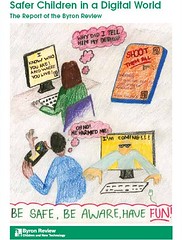
In a new PFF white paper, ” Five Online Safety Task Forces Agree: Education, Empowerment & Self-Regulation Are the Answer,” I walk through a chronological summary of each of these past task forces [click on covers of each report below to read them in their entirety] and highlight some of the similar themes and recommendations from them.

COPA Commission cover Thornburgh Commission cover Byron Commission report cover

ISTTF cover Point Smart Click Safe report cover Continue reading →

The leading trade associations in the online advertising industry have just released their new self-regulatory principles—the first comprehensive self-regulatory principles industry has produced, which track closely with the suggested guidelines released by the FTC in February.

I commend the industry for setting a new standard in transparency, consumer control and data security. These Principles do much to empower Americans to make their own decisions about privacy, but I fear that many critics of so-called “targeted advertising” will never be satisfied, no matter how high industry raises the bar.

These critics have insisted that ordinary users can’t be trusted to make the “right decisions” about privacy and have insisted on imposing restrictive default “opt-in” rules for the online data collection that makes online advertising valuable to websites that rely on ad revenue.  Such pre-emptive privacy regulation would stunt the growth of revenue for the “Free” online content and services we’ve all come to take for granted.  During a time of economic recession, and as traditional media like newspapers struggle to make the transition from print to the Internet, it’s more important than ever that policymakers allow self-regulation to evolve.  Only by doing so can we expect continued innovation and creativity online. We must all remember:  There is no free lunch!

I’ll lead a panel discussion on July 10 on Capitol Hill about “Regulating Online Advertising: What Will it Mean for Consumers, Culture & Journalism?”  Please RSVP here.

by Berin Szoka & Adam Thierer

This morning, the House Energy & Commerce Committee will hold a hearing on “Behavioral Advertising: Industry Practices And Consumers’ Expectations.” If nothing else, it promises to be quite entertaining:  With full-time Google bashers Jeff Chester and Scott Cleland on the agenda, the likelihood that top Google officials will be burned in effigy appears high!

Chester, self-appointed spokesman for what one might call the People for the Ethical Treatment of Data (PETD) movement, is sure to rant and rave about the impending techno-apocalypse that will, like all his other Chicken-Little scenarios, befall us all if online advertisers were permitted to better tailor ads to consumers’ liking. After all, can you imagine the nightmare of less annoying ads that might actually convey more useful information to consumers? Isn’t serving up “untargeted” dumb banner ads for Viagra to young women and Victoria’s Secret ads to Catholic school kids the pinnacle of modern online advertising?  Gods forbid we actually make advertising more relevant and interest-based!  (Those Catholic school boys may appreciate the lingerie ads, but few will likely buy bras.)

Anyway, according to National Journal’s Tech Daily Dose, the hearing lineup also includes:

  • Charles Curran, Executive Director, Network Advertising Initiative
  • Christopher Kelly, Chief Privacy Officer, Facebook
  • Edward Felten, Director, Center for IT Policy, Princeton University
  • Anne Toth, Chief Privacy Officer & Vice President, Policy, Yahoo!
  • Nicole Wong, Deputy General Counsel, Google

That’s an interesting group and we’re sure that they will say interesting things about the issue. Nonetheless, because four of them have a corporate affiliation that fact will inevitably be used by some critics to dismiss what they have to say about the sensibility of more targeted or interest-based forms of online advertising. So, we’d like to offer a few thoughts and pose a few questions to make sure that Committee members understand why, regardless of what it means for any particular online operator, targeting online advertising is very pro-consumer and essential to the future of online content, culture, and competition.  As Wall Street Journal technology columnist Walt Mossberg has noted, “Advertising is the mother’s milk of all the mass media.”  Much of the “free speech” we all cherish isn’t really free, but ad-supported!

Continue reading →