 I very much enjoyed Dennis Baron’s new book, A Better Pencil: Readers, Writers, and the Digital Revolution, and highly recommend you pick it up. Baron does a wonderful job exploring the history of techno-pessimism and the endless battles about the impact of new technologies on life and learning, something I have written about here before in my essays on “Internet optimists vs. pessimists” (See: 1, 2, 3).
I have a complete review of Baron’s
A Better Pencil now up on the City Journal‘s website here. I’ve also pasted it down below.
Plato Wrote it Down
by Adam Thierer
a review of A Better Pencil: Readers, Writers, and the Digital Revolution, by Dennis Baron (Oxford University Press, 280 pp., $24.95)
In the beginning, Dennis Baron reminds us in his new book,
A Better Pencil, there was the word—the spoken word, that is. Oral tradition, the passing of knowledge through stories and lectures, was the primary method of instruction and learning throughout early human civilization. But then a few innovative souls decided to start writing everything down on stones and clay. Almost as soon as they did, a great debate began on the impact of new communications technology on culture and education. And it rages on today, with a new generation of optimists and skeptics battling over the impact that computing, the Internet, and digital technologies have on our lives and on how we learn about the world.
Continue reading →
Another great column by the Wall Street Journal’s Gordon Crovitz, who is quickly becoming my favorite tech policy columnist. In today’s column, “Bloggers Mugged by Regulators,” he comments on the FTC’s new disclosure rules for bloggers, which I discussed here over the weekend. Crovitz focuses on the enforcement challenges associated with the new rules and also argues that self-regulation should be given a chance to work:
There should be more disclosure, but the Web is different from earlier media in ways that make government regulation less relevant and practical. The Web has its own self-regulatory mechanisms. Failing to disclose interests sullies one’s reputation online, and reputation harm travels faster and lasts longer than it did before the Web.
There’s also greater need for caveat emptor online, because there is no practical way that any government agency can monitor the world’s bloggers and posters. There will always be people who post comments about products and services that are self-serving in one way or another, at least by someone’s definition. […]
Instead of trying to extend analog-era regulations onto the Web, the FTC should encourage readers to be vigilant about assessing for themselves the independence of sources online. At least we now know the biggest fraudulent claim so far on the Web: It’s been committed by regulators claiming there can be a government stamp of approval on everything anyone posts anywhere on the Web.
Amen brother.
 I’ll be heading to Oxford University this week to participate in an Oxford Internet Institute (OII) forum on the subject of “Child Protection, Free Speech and the Internet: Mapping the Territory and Limitations of Common Ground.” It’s being led by several experts from the OII as well as my good friends John Morris and Leslie Harris of the Center for Democracy & Technology (CDT). The aims of this forum are:
- To facilitate a dialogue between NGOs campaigning to protect respectively, child protection and children’s rights online, and freedom of speech and other civil liberties online.
- To promote a better understanding of each others’ positions, to share perspectives and information with a view to identifying areas of common ground and areas of disagreement.
- To identify any shared policy goals, and possible tools to support the achievement of those goals.
- To publicize the findings of the forum in international policy debates about Internet governance and regulation.
Conference participants were asked to submit a 2-3 pg summary of their views on a couple of questions that will be discussed at this event. I have listed those questions, and my answers, down below the fold. It’s my best attempt to date to succinctly outline my views about how to balance content concerns and free speech issues going forward. Continue reading →
Yesterday up on Capitol Hill, I hosted a very interesting discussion about “Next-Generation Parental Controls & Child Safety Efforts.” I thought I’d provide a quick recap here for those who couldn’t attend. [Note: audio of the event will be up shortly at the link above and transcript is in the works.] The event featured Steve Crown, Vice President and Deputy General Counsel of Microsoft Corporation’s Entertainment & Devices Division; Dane Snowden, Vice President of External & State Affairs of CTIA – The Wireless Association; and Stephen Balkam, Chief Executive Officer of Family Online Safety Institute.
Steve Crown of Microsoft kicked the show off with a terrific overview of some the current and next-generation parental control tools and awareness efforts that Microsoft is deploying to help empower parents and keep kids safer both online and in gaming environments. Crown outlined Microsoft’s 5-prong strategy regarding how they have approached these issues on the gaming front, and I think it represents an excellent model of how sensible industry self-regulation and “best practices” can go a long way toward addressing concerns that many parents and policymakers have. The five strategies Crown outlined were: (1) Respect both the freedom of game creators and freedom of choice for game consumers; (2) empower parents with ratings, tools, and information; (3) use independent ratings (like the ESRB) to label content; (4) require all games be rated before they can be used on a platform so that parents can implement blocking controls; and (5) respect regional laws and rating systems in different parts of the globe.
In my book on
Parental Controls & Online Child Safety: A Survey of Tools & Methods, I’ve documented many of the empowerment tools that Microsoft has deployed in recent years to make this empowerment vision a reality. One of the most important things MS does on its XBox 360 console is to provide an immediate “out-of-the-box” prompt for parents to set up parental controls and establish other limitations on online chat, spending, or Internet access. Microsoft announced another cool new feature in November 2007, the “Family Timer.” It lets parents limit how and when children play games on the console. This is similar to the time management tools Microsoft offers in its Vista operating system for PCs. Incidentally, my wife has asked me to start using the Family Timer on our XBox — not for our kids, but for me! This particular 40-year-old man is still a big kid at heart.
Continue reading →
Whatever you think about this messy dispute between AT&T and Google about how to classify web-based telephony apps for regulatory purposes — in this case, Google Voice — the key issue not to lose site of here is that we are inching ever closer to FCC regulation of web-based apps! Again, this is the point we have stressed here again and again and again and again when opposing Net neutrality mandates: If you open the door to regulation of one layer of the Net, you open up the door to the eventual regulation of all layers of the Net.
You might not buy that story initially but if you doubt it then I invite you to read just about any history of American broadcast media regulation over the course of the past seven decades. (You might want to start with Krattenmaker & Powe’s Regulating Broadcast Programming or Jonathan Emord’s
Freedom, Technology, and the First Amendment). In such histories you will find a common theme: Once regulation of media and communications platforms gets underway, the natural progression of things is uni-directional — Up! That is, when new questions arise about how to “deal with” a new service, network, platform, or technology, the general tendency is the “regulate up” instead of “deregulating down.” When regulators are given a greater say about the contours of markets as technologies evolve and/or converge, we shouldn’t be surprised that their first instinct is to “bring them into the fold.”
And, sadly, that is exactly what is likely to occur eventually with Google Voice. The only really interesting question is what else regulators start mucking with in the search and applications layer once they get their hands on it. And if you still insist that I am being overly paranoid about “regulatory creep” and the prospect of the FCC gradually transforming into the Federal Information Commission, then consider what the agency had to say about cloud computing in paragraph 60 (pg. 21) of the FCC’s recent Wireless Innovation and Investment Notice of Inquiry, which was launched on August 27th: Continue reading →
Holman Jenkins has a stinging editorial in today’s Wall Street Journal entitled, “Neutering the ‘Net,” which borrows a term that my friend Randy May coined long ago to describe what net neutrality regulation will ultimately accomplish. What I like best about the Jenkins essay was the way he exposed Free Press for their hypocrisy over metering as a possible alternative approach to network management, something I documented in this piece and this piece about their new-found love of Internet price controls. Here’s how Jenkins puts it in his essay today:
The mask really slipped earlier this year when Time Warner Cable began experimenting with usage-based pricing to protect the average broadband customers from the 20% of users who create 80% of the traffic. A lobby called Free Press, the most extreme of the pro-net neutrality interests, went ballistic, calling metered pricing a “price-gouging scheme” and backing a bill in Congress to ban it.
Never mind that Free Press had previously argued just the opposite, saying usage-based pricing was a fairer way to deal with congestion than, say, by selectively slowing down file-sharing sites that gobble up disproportionate broadband capacity. Never mind, too, the irony that the net-neut campaign against the selective slowing of non-urgent traffic has left only differential pricing as a way to bring a modicum of efficiency to network usage.
Indeed. Of course, we should expect nothing less from the neo-Marxist media reformistas as the UnFree Press.
Google Trends for websites reveals all kinds of fascinating insights into the way technology is reshaping the world. Among them is the fact that the HuffingtonPost.com has matured from a scruffy group blog into a new media powerhouse to rival the Wall Street Journal and Washington Post:
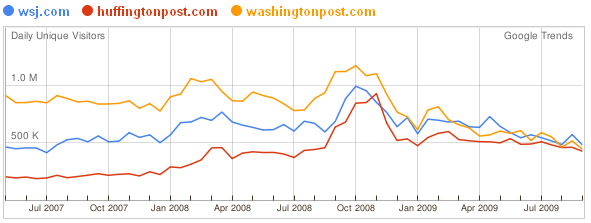
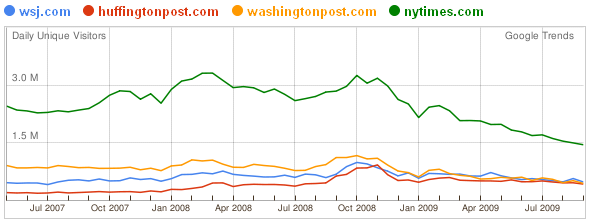
Note that the convergence of these three sites has happened both because HuffPo has doubled its audience and because the audience for the WashingtonPost.com has shrunk by half. While WSJ.com’s audience has returned to roughly its pre-election level, the decline of NYTimes.com suggests that the Internet really is splintering audiences and bringing the giants of news media like the “Gray Lady” down from their once unassailable heights:
I cannot in strong enough terms recommend that everyone read Gordon Crovitz’s latest Wall Street Journal column, “Free Speech, Now that Speech is Free.” It perfectly encapsulates everything we stand for here and makes the case that I have made again and again: Speech regulation — of all flavors — makes less and less sense in a world of information abundance and user empowerment, and it is a complete affront to our First Amendment rights. As Crovitz argues:
The Constitution was drafted at a time when there were few media outlets, and few people could be heard. Since then, technology has made it possible for everyone to express their views. The cost of expressing opinions continues to fall. Now that speech is no longer expensive, it’s time to return to the Founders’ intention that speech be free and that Congress not abridge anyone’s right to speak.
Amen brother! In his essay today, Crovitz specifically takes on America’s increasingly insane campaign finance laws, which make a mockery of the First Amendment. In the wake of last week’s Supreme Court arguments in the Citizens United case, Crovitz points out the insulting stupidity and sheer futility of these analog era, scarcity-oriented laws:
Continue reading →
 Who among us does not like the bitch about their least favorite journalists, or reporting that we find disagreeable? Indeed, we Americans are all armchair media critics at heart. That’s generally a healthy thing in a democracy, but how often do we step back and appreciate those who provide us with in-depth reporting and journalistic excellence? Not enough, I dare say. Perhaps my early pursuit of a career in journalism and a college degree in the subject has left me more sensitive to this, but I think it is important on occasion to send out a big “thank you” to those whose investigative reporting — especially on niche subjects — contributes greatly to societal knowledge and a better understanding of important issues.
In the case of journalist Dennis McCauley, long-time editor of
Game Politics.com, I wish I would have gotten around to thanking him publicly sooner, because he has just announced his departure from Game Politics and the journalism profession in general. That’s a shame because Dennis was a trailblazer in a field that desperately needed attention from serious journalists. Until Dennis came on the beat, no wait, strike that… until Dennis created the beat, most journalists just didn’t bother taking a serious look at “where politics and video games collide,” which is the motto of Game Politics.com (which is now part of the Entertainment Consumers Association). Before Dennis, most journalists looked a video games as a “kiddie” thing, and to the extent they reported on developments in this field at all, their stories where typically relegated to the back pages of most papers or magazines. And there wasn’t much serious reporting by online sources either.
Continue reading →
Today I was invited to the Federal Communications Commission (FCC) to testify at one of the agency’s Broadband Working Group workshops. This particular workshop was on “Broadband Consumer Context,” which focused on “a range of challenges and opportunities as the internet becomes a focal point for commercial transactions, social networking, and a host of activities pertaining to information gathering and exchange.”
I was asked to address the issue of whether there is a relationship between online safety concerns and broadband uptake. In my testimony, I noted that, in my 15 years of research in this area, I have never unearthed any substantive empirical evidence suggesting a correlation between parental concerns about online activity and overall household broadband uptake. I have seen occasional anecdotal news stories discussing the concerns some parents have had about their kids online that led them to reject online connectivity, but these stories have been exceedingly rare (and I haven’t seen any in recent memory).
I also argued that I did not think it at all surprising that such anecdotes are harder to find, or that empirical evidence on this front seems non-existent. I argued that there were four logical explanations for why parental concerns about online safety haven’t “moved the broadband needle” much in the negative direction:
- Not every home has children present
- Parents use a variety of household media rules to control media & Internet usage
- A vibrant marketplace of parental control technologies exists
- Likely that most parents believe that the benefits of broadband outweigh the potential downsides
For all the details on each of those, read my entire testimony or check out the presentation embedded below that I made to the FCC today. Continue reading →

 The Technology Liberation Front is the tech policy blog dedicated to keeping politicians' hands off the 'net and everything else related to technology.