Very cool little video here by Jess3 documenting Internet growth and activity. Ironically, Berin sent it to me as Adam Marcus and I were updating the lengthy list of Net & online media stats you’ll find down below. Many of the stats we were compiling are shown in the video. Enjoy!
http://vimeo.com/moogaloop.swf?clip_id=9641036&server=vimeo.com&show_title=1&show_byline=1&show_portrait=1&color=ffffff&fullscreen=1
- 1.73 billion Internet users worldwide as of Sept 2009; an 18% increase from the previous year.
[1]
- 81.8 million .COM domain names at the end of 2009; 12.3 million .NET names & 7.8 million .ORG names.
[2]
- 234 million websites as of Dec 2009; 47 million were added in 2009.
[3] In 2006, Internet users in the United States viewed an average of 120.5 Web pages each day.
[4]
- There are roughly 26 million blogs on the Internet
[5] and even back in 2007, there were over 1.5 million new blog posts every day (17 posts per second).
[6] Continue reading →
 C-SPAN is really quite incredible when you think about it. When I was growing up in the 70s, there was nothing like it. Like most other Americans, my informational inputs about national news and politics were limited to what a couple of old white dudes in bad suits delivered each night around 6:30 on the three VHF channels I had access to. And no national newspapers were delivered to my small town in rural Illinois, so I had to rely on crummy local papers to fill the void via whatever national reporting they offered, which wasn’t much.
And then came C-SPAN. C-SPAN alone covers more political and civic-minded activity in the course of a week than most of us probably came into contact with in our entire lives just 30 years ago. Consider these data points, which Peter Kiley, Vice President of C-SPAN Networks was kind enough to help me aggregate. In the 2009 calendar year, C-SPAN provided the following amount of first run programming across their three channels:
- 8,438 overall hours of programming;
- 2,709 hours of House & Senate floor activity; and,
- 1,222 hours of House & Senate committee hearings.
Moreover, C-SPAN recently created the C-SPAN Video Library, which archives 23 years worth (1987-on) of fully searchable (and free) video content, including: Continue reading →
By Berin Szoka & Adam Thierer
This morning, The Progress & Freedom Foundation (PFF) and the Electronic Frontier Foundation (EFF) filed joint comments with the Federal Communications Commission (FCC) in the inquiry “Empowering Parents and Protecting Children in an Evolving Media Landscape.” (MB Docket No. 09-194) As Adam summarized here before, the stated purpose of this FCC Notice of Inquiry is to:
seek information on the extent to which children are using electronic media today, the benefits and risks these technologies bring for children, and the ways in which parents, teachers, and children can help reap the benefits while minimizing the risks [and] to gather data and recommendations from experts, industry, and parents that will enable us to identify actions that all stakeholders can take to enable parents and children to navigate this promising electronic media landscape safely and successfully.
In our joint comments with Lee Tien and Seth David Schoen of EFF, we warned that the FCC should tread carefully when considering taking action on areas described in their inquiry. The agency simply has no authority to act on many of the topics discussed throughout the NOI, and it should not attempt to preempt successful private sector solutions. Congress never authorized the Commission to regulate Internet media, nor asked the agency to consider doing so. In fact, Congress plainly declared that the Internet should be kept “unfettered by Federal or State regulation.” Continue reading →
Just a reminder about tomorrow’s Georgetown Center for Business and Public Policy event on, “The Crisis in Journalism: What Should the Government Do?” It will be held at 9:30am tomorrow at the Newseum (Knight Conference Center) located at 555 Pennsylvania Ave here in Washington, DC. Breakfast will be served. (You can RSVP please by emailing: cbpp@msb.edustrong>cbpp@msb.edu</strong). Here’s the event description:
This roundtable discussion will bring together academics, government officials and industry leaders to consider the future of the journalism industry. Specifically, what does a future economic model for the journalism industry look like? What is the role of new media in modern journalism? How can news papers integrate web-based news into their business models? How can government entities, particularly the Federal Trade Commission and the Federal Communications Commission, help to form a sustainable 21st century model for journalism in the United States?
Mark MacCarthy of Georgetown Univ. will moderate the panel, which includes: Continue reading →
The website ProCon.org has a new debate online laying out the different perspectives about the question: “Do violent video games contribute to youth violence?” It includes citations for a wide variety of studies that come down on both sides of the question. Simply put, there’s a study for everyone out there. Do you want to find a study suggesting that there’s a strong correlation between violently-themed media and aggression? You can find plenty. Or do you want to hear that there’s no correlation between these things? Well, there’s plenty of studies suggesting that, too.
As someone who briefly flirted with a degree in psychology, I find this an interesting intellectual debate. But here’s the thing I can’t get away from —
lab studies by psychology professors and students are not the real-world. I am consistently shocked and disappointed at the lack of scrutiny these studies receive when they are little more than artificial constructions of reality.
So, how can we determine whether watching depictions of violence will turn us all into killing machines, rapists, robbers, or just plain ol’ desensitized thugs? Well, how about looking at the real world! Whatever lab experiments might suggest, the evidence of a link between depictions of violence in media and the real-world equivalent just does not show up in the data. The FBI produces ongoing Crime in the United States reports that document violent crimes trends. Here’s what the data tells us about overall violent crime, forcible rape, and juvenile violent crime rates over the past two decades: They have all fallen. Perhaps most impressively, the juvenile crime rate has fallen an astonishing 36% since 1995 (and the juvenile murder rate has plummeted by 62%).

Continue reading →
The Annenberg School at the University of Southern California recently released a paper by Geoffrey Cowan and David Westphal entitled, “Public Policy and Funding the News.” In it, Cowan and Westphal join the growing chorus of voices advocating a substantial role of government in propping up struggling media entities or investing in news production going forward.
I can’t say that I disagree with everything in the report, especially the contention that many traditional news-gathering institutions face serious challenges to their survival. But as I have noted here before, there are three big problems with recommendations to greatly expand the role of government in the media sector or journalistic profession as a solution:
- While public media & subsidies may have a role, that role should be tightly limited and focused on filling specific niches or unfilled needs within certain communities. Public subsidies should not be viewed as a replacement for traditional private media sources. Moreover, public subsidies will not begin to make up the shortfall from traditional private funding source, unless we plan on having Congress spend hundreds of billions of dollars (like the radical regulatory advocates at Free Press advocates) to subsidize news.
- If we do end up taking that path, it will raise profound fairness questions since it will leave taxpayers footing the bill for things they might not want or could find objectionable, even offensive. (Conservatives wouldn’t like funding Bill Moyers, and liberals wouldn’t be too keen on supporting Rush Limbaugh).
- Any plan to have government step up its role in supporting journalism will raise profound questions about press independence and threaten core First Amendment values. Putting journalists on the public dole is a serious threat to the integrity of the profession.
Continue reading →
by Adam Thierer & Berin Szoka, Progress Snaphot 6.1
Stephanie Clifford of the
New York Times posted a very interesting article this week summarizing a recent “on-the-record chat” the Times staff had with Federal Trade Commission (FTC) chairman Jon Leibowitz and FTC Bureau of Consumer Protection chief David Vladeck. The interview [discussed by Braden here] is profoundly important in that it reveals an alarming disconnect regarding the relationship between “privacy” regulation and the future of media, which were the subjects of their discussion with Times staff. Namely, Leibowitz and Vladeck apparently fail to appreciate how the delicate balance between commercial advertising and journalism is at risk precisely because of the sort of regulations they apparently are ready to adopt. Because the value of online advertising depends on data about its effectiveness and consumers’ likely interests, and because advertising is indispensable to funding media, what’s ultimately at stake here is nothing short of the future of press freedom.
The “Day of Reckoning” Is Upon Us
Leibowitz and Vladeck spend the first half of
The Times interview wringing their hands about “privacy policies,” the declarations made by websites and advertising networks about their data collection and use practices (for which the FTC can and must hold them accountable). But the two feel that privacy policies don’t adequately inform consumers. Chairman Leibowitz claims that online companies “haven’t given consumers effective notice, so they can make effective choices.” And Mr. Vladeck states that advise-and-consent models “depended on the fiction that people were meaningfully giving consent.” But he and the FTC seem ready to abandon the notice and choice model because the “literature is clear” that few people read privacy policies, Vladeck told the Times. He and Leibowitz continue:
“Philosophically, we wonder if we’re moving to a post-disclosure era and what that would look like,” Mr. Vladeck said. “What’s the substitute for it?” He said the commission was still looking into the issue, but it hoped to have an answer by June or July, when it plans to publish a report on the subject. Mr. Leibowitz gave a hint as to what might be included: “I have a sense, and it’s still amorphous, that we might head toward opt-in,” Mr. Leibowitz said.
This clearly foreshadows the regulatory endgame we have long suspected was coming. When the FTC released its “Self-Regulatory Principles for Online Behavioral Advertising” eleven months ago, we asked: “What’s the Harm & Where Are We Heading?” Their answers to both questions have become clearer with each new calculated comment—all apparently intended to slowly “turn up the heat” on the advertising industry so that the proverbial frog will stay in the pot until the water finally boils. Leibowitz’s FTC has simply dodged the “harm” question with a four-part strategy: Continue reading →
Free Press, the radical regulatory activist group founded by Marxist media scholar Robert W. McChesney, has never seen a media or technology regulation they don’t like, but their latest effort to have the feds halt innovation is shocking even by their standards. According to The Washington Post:
Free Press and other public advocacy groups are sending letters Monday to the Justice Department and the Federal Trade Commission calling for a probe of the “TV Everywhere” plan by cable, satellite and phone companies that brings television shows and movies to computers and devices, but only for those that subscribe to both television and high-speed Internet services.
Think about this. “TV Everywhere” is still in its cradle, having only just been launched recently. It will give multichannel video distributors a chance to find their footing as millions of consumers continue to “cut the video cord.” And it would provide consumers with ubiquitous access to content over the Internet while also ensuring that content creators are compensated for their programming.
OK, so what’s wrong with all this again? Why would we want federal antitrust officials throw a wrecking ball into this innovative new business model? Continue reading →
2009 was not as big of a year for Internet and information technology (“info-tech”) policy books as 2008 was, but there were still some notable titles released that offered interesting perspectives about the future of the Net and the impact the Digital Revolution is having on our lives, culture, and economy. So, like last year, I figured I would throw together my list of the 10 most important info-tech policy books of the year.
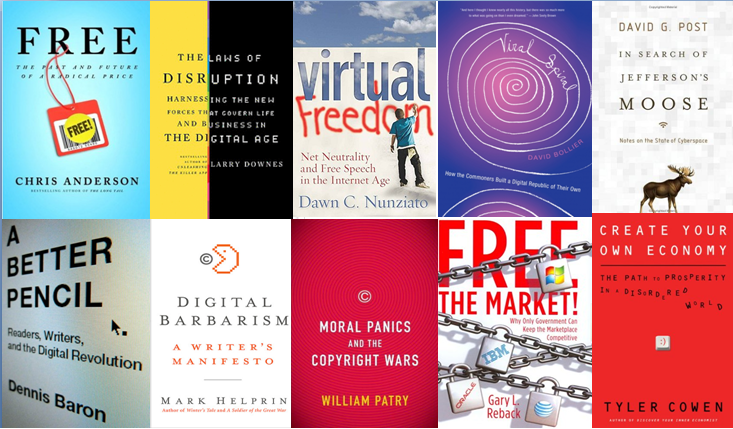 First, let me repeat a few of the same caveats and disclaimers that I set forth last year. What qualifies as an “important” info-tech policy book? Simply put, it’s a title that many people are currently discussing and that we will likely be referencing for many years to come. However, I want to be clear that merely because a book appears on my list it does not necessarily mean I agree with everything said in it. In fact, as was the case in previous years, I found much with which to disagree in my picks for the most important books of 2009 and I find that the cyber-libertarianism I subscribe to has very few fans out there.
Another caveat: Narrowly-focused titles lose a few points on my list. For example, if a book deals mostly with privacy issues, copyright law, or antitrust policy, it does not exactly qualify as the same sort of “tech policy book” as other titles found on this list since it is a narrow exploration of just one set of issues with a bearing on technology policy.
With those caveats in mind, here are my choices for the Most Important Info-Tech Policy Books of 2009. Continue reading →
As I pointed out here before (see, “And so the Comcast-NBC Merger Hysteria Begins: Help Me Document It!“), every time a media merger is proposed we hear all sorts of silly Chicken Little predictions of impending doom as well as preposterous conspiracy theories about supposed nefarious schemes to take over the media universe and control our minds. For good measure, there’s also plenty of talk of “the death of deliberative democracy,” or efforts to weed out one sort of perspective or another.
As history has shown, it’s all complete bunk. But that doesn’t stop critics from concocting asinine theories about media providers seeking to “silence critics.” Here’s two bits of Chicken Little-ism that I missed in my previous essay documenting this silliness. First, over at Huffington Post, Marvin Ammori tells us that America is about to become Italy or Argentina because of the deal:
Putting so much power in the hands of one company–and, specifically, its executives–is dangerous for a democracy. There is a reason why autocratic regimes control the media–media shape public opinion and define what is “possible” in politics. We have seen the problem of private media consolidation in many countries. In Italy, Silvio Berlusconi used his massive media empire to win elections and is now Prime Minister (Italy’s longest serving ever). In Argentina, the government had to pass a media consolidation law because of the power of one media company that happens to be far smaller than a combined Comcast-NBCU.
And then we have Wade Norris writing about the deal over at the Daily Kos, saying: “If you don’t want to see the progressive voices on MSNBC silenced, then join the ‘no merger’ petition.” Ah yes, another automated “stuff-the-online-complaint-ballot-box” petition. I love those gimmicks. But ignore fake complaints for a moment and focus on the accusations at hand here. The Ammori-Norris theory is: If Comcast and NBCU are allowed to marry (a) progressive voices will be driven off their platforms and (b) Silvio Berlusconi will take over America democracy will somehow suffer. Is there really any truth to this? Continue reading →

 The Technology Liberation Front is the tech policy blog dedicated to keeping politicians' hands off the 'net and everything else related to technology.
PFF & EFF File Joint Comments in FCC’s “Empowering Parents & Protecting Children” NOI
by Adam Thierer on February 24, 2010 · 3 comments
By Berin Szoka & Adam Thierer
This morning, The Progress & Freedom Foundation (PFF) and the Electronic Frontier Foundation (EFF) filed joint comments with the Federal Communications Commission (FCC) in the inquiry “Empowering Parents and Protecting Children in an Evolving Media Landscape.” (MB Docket No. 09-194) As Adam summarized here before, the stated purpose of this FCC Notice of Inquiry is to:
In our joint comments with Lee Tien and Seth David Schoen of EFF, we warned that the FCC should tread carefully when considering taking action on areas described in their inquiry. The agency simply has no authority to act on many of the topics discussed throughout the NOI, and it should not attempt to preempt successful private sector solutions. Congress never authorized the Commission to regulate Internet media, nor asked the agency to consider doing so. In fact, Congress plainly declared that the Internet should be kept “unfettered by Federal or State regulation.” Continue reading →