It’s been a big year for tech policy books. Several important titles were released in 2008 that offer interesting perspectives about the future of the Internet and the impact digital technologies are having on our lives, culture, and economy. Back in September, I compared some of the most popular technology policy books of the past five years and tried to group them into two camps: “Internet optimists” vs. “Internet pessimists.” That post generated a great deal of discussion and I plan on expanding it into a longer article soon. In this post, however, I will merely list what I regard as the most important technology policy books of the past year.
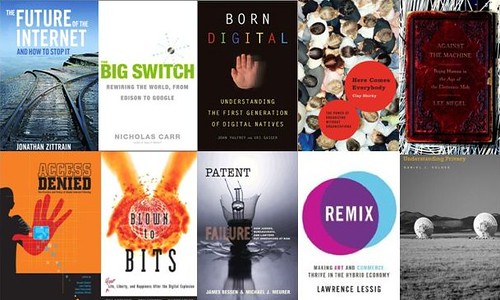
What qualifies as an “important” tech policy book? Basically, it’s a title that many people in this field are currently discussing and that we will likely be talking about for many years to come. I want to make it clear, however, that merely because a book appears on this list it does not necessarily mean I agree with everything said in it. In fact, I found much with which to disagree in my picks for the two most important books of 2008, as well as many of the other books on the list. [Moreover, after reading all these books, I am more convinced than ever that libertarians are badly losing the intellectual battle of ideas over Internet issues and digital technology policy. There’s just very few people defending a “Hands-Off-the-Net” approach anymore. But that’s a subject for another day!]
Another caveat: Narrowly focused titles lose a few points on my list. For example, as was the case in past years, a number of important IP-related books have come out this year. If a book deals exclusively with copyright or patent issues, it does not exactly qualify as the same sort of “tech policy book” as other titles found on this list since it is a narrow exploration of just one set of issues that have a bearing on digital technology policy. The same could be said of a book that deals exclusively with privacy policy, like Solove’s
Understanding Privacy. It’s an important book with implications for the future of tech policy, but I demoted it a bit because of its narrow focus.
With those caveats in mind, here are my Top 10 Most Important Tech Policy Books of 2008 (and please let me know about your picks for book of the year):
Continue reading →
 I’m finishing up Stanford Law School professor Lawrence Lessig’s latest book, Remix: Making Art and Commerce Thrive in the Hybrid Economy and wanted to make a brief comment about his call for a “simple blanket license” to solve online music piracy.
Overall, I thought Prof. Lessig made a good case regarding the benefits of “remix culture” and why copyright law should leave breathing room for the various derivative works of amateur creators. On the other hand, Lessig still too often blurs remix culture with “ripoff culture” (i.e., those who aren’t out to create anything new but instead just take something without paying a penny for it).
To solve that latter problem, Lessig again endorses a proposal that William Fisher, Electronic Frontier Foundation, and others have made for collective licensing of all online music, but he fails to drill down into the devilish details. He says, for example, that “by authorizing a simple blanket licensing procedure, whereby users could, for a low fee, buy the right to freely file-share” we could “decriminalize file sharing.” (p. 271)
I respect the fact that Lessig is at least acknowledging a problem exists and proposing a solution to it, but the collective licensing approach will be anything but “simple” in practice. As I have pointed out here before, collective licensing proposals and efforts almost always become compulsory in practice. They inevitably involve government mandates to determine (1) who pays in, (2) how much they pay in, as well as (3) how much gets paid out and, (4) who gets the money.
Continue reading →
Over the past year or so, many market-oriented critics of Google, like Scott Cleland and Richard Bennett, have criticized the company for aligning itself with Left-leaning causes and intellectuals. Lately, however, what I find interesting is how many leading leftist intellectuals and organizations have begun turning on the company and becoming far more critical of the America’s greatest capitalist success story of the past decade. The reason this concerns me is that I see a unholy Right-Left alliance slowly forming that could lead to more calls for regulation not just of Google, but the entire search marketplace. In other words, “Googlephobia” could bubble over into something truly ugly.
Consider the comments of Tim Wu and Lawrence Lessig in Jeff Rosen’s huge
New York Times Magazine article this weekend, “Google’s Gatekeepers.” Along with Yochai Benkler, Lessig and Wu form the Holy Trinity of the Digital Left; they set the intellectual agenda for the Left on information technology policy issues. Rosen quotes both Wu and Lessig in his piece going negative on Google. Wu tells Rosen that “To love Google, you have to be a little bit of a monarchist, you have to have faith in the way people traditionally felt about the king.” Moreover:
Continue reading →
 With the publication of Understanding Privacy (Harvard University Press 2008), George Washington University Law School professor Daniel J. Solove has firmly established himself as one of America’s leading intellectuals in the field of information policy and cyberlaw. Solove had already made himself a force to be reckoned with in this field with the publication of important books like The Future of Reputation: Gossip, Rumor, and Privacy on the Internet (Yale University Press 2007), The Digital Person: Technology and Privacy in the Information Age (NYU Press 2004) and his treatise on Information Privacy Law with Paul M. Schwartz of the Berkeley School of Law (Aspen Publishing, 2d ed. 2006). But with Understanding Privacy, Solove has now elevated himself to that rarefied air of “people worth watching” in the cyberlaw field; an intellectual — like Lawrence Lessig or Jonathan Zittrain — whose every publication becomes something of an event in the field to which all eyes turn upon release.
Like those other intellectuals, however, my respect for their stature should not be confused with agreement with their positions. In fact, my disagreements with Lessig and Zittrain are frequently on display here and, we have been critical of Solove here in the past as well. [Here’s Jim Harper’s review of Solove’s last book, with which I am in wholehearted agreement.] In a similar vein, although I greatly appreciate what Prof. Solove attempts to accomplish in Understanding Privacy — and I am sure it will change the way we conceptualize and debate privacy policy in the future — I found his approach and conclusions highly problematic.
Continue reading →

 The Technology Liberation Front is the tech policy blog dedicated to keeping politicians' hands off the 'net and everything else related to technology.