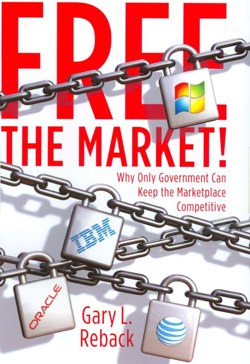
 I recently finished reading Free the Market: Why Only Government Can Keep the Marketplace Competitive, a new book by noted antitrust agitator Gary L. Reback. Unsurprisingly, Reback, who led the antitrust jihad against Microsoft during the 1990s, has written a book that reads like an extended love letter to antitrust law. This man loves antitrust the way teenage girls love the Jonas Brothers — gushing, teary-eyed, ‘I-would-just-die-for-you’ sort of love. In Reback’s world, antitrust seemingly has no costs, no downsides, no trade-offs. It is our salvation and he serves as its high prophet. Everything good that happened in the world of high-tech over the past few decades? Oh, you can thank Almighty Antitrust for that. Anything bad that happened? Well, then, clearly there just wasn’t enough antitrust enforcement! That’s this book in a nutshell.
Think I’m kidding? How about this gem of quote from pg. 247: “Antitrust enforcement spawned Silicon Valley’s software industry as well.” Wow, who knew! Of course, that’s utter poppycock and should be somewhat insulting to the many entrepreneurial men and women in the high-tech world who risked everything in an attempt to build a better mousetrap. In Reback’s view of things, however, none of those mousetraps would have ever gotten built without antitrust there to supposedly shelter them from wicked “monopolists” (read: any large company) already operating in the marketplace. I’m sure many in Silicon Valley will also be surprised to hear Reback’s assertion that, “On closer examination, the Valley looks like one big public welfare project.” (p. 54) Ah yes, the old myth that government gave us the Net we know and love today. Please. Like many others, Reback spins a revisionist history of how early ARPANET involvement and seed money somehow made the Internet great when, in reality, the Net was stuck in the digital dark ages until it was finally allowed to be commercialized in 1992.
What irks me most about this book, however, is Reback’s perpetuation of the myth that antitrust is somehow not a form of economic regulation. I hear this tired old argument trotted out time and time again, even by many conservatives. Reback says, for example, that “Antitrust sets the rules of the road, so to speak, but doesn’t tell people where to drive.” By contrast, he argues, “Advocates of regulation want[] continuing government oversight and rule making to produce what would be the beneficial results of a free market… Neither approach works all the time, and decided between them remains difficult.” (p. 19) Again, this “choice” is largely a fiction since, for many industries, we end up getting both! Continue reading →
 Over the past couple of years here, I have relentlessly hammered Harvard’s dynamic duo of digital doom, Jonathan Zittrain (see 1, 2, 3, 4, 5, 6) and Lawrence Lessig (see 1, 2, 3), for their extraordinarily gloomy predictions about the Internet creating a world of “perfect control.” In the hyper-pessimistic Lessig-Zittrain view of things, cyberspace is perpetually haunted by the specter of nefarious corporate schemers out to suffocate innovation, screw consumers, and quash dissent. In the 1990s, Lessig’s big-bad-bogeyman was AOL. Today, Zittrain casts Apple in the lead role of Cyber-Big Brother. The problem with their thesis? In a word: Reality. As Tim Lee has pointed out before, “Lessig’s specific predictions in Code turned out to be… spectacularly wrong”:
Lessig was absolutely convinced that a system of robust user authentication would put an end to the Internet’s free-wheeling, decentralized nature. Not only has that not happened, but I suspect that few would seriously defend Lessig’s specific prediction will come to pass.
Absolutely correct, and the same is true of the fears and predictions Zittrain tosses around in The Future of the Internet. And yet, as we saw most recently during my debate with Lessig and Zittrain over at Cato Unbound upon the occasion of the 10th anniversary of the publication Code, neither of them have relented one bit. Indeed, they have actually been escalating their morose rhetoric recently.
The fact that Zittrain casts Apple as the central villain in his drama is particularly interesting because millions upon millions of people absolutely love the company and its amazingly innovative products — even if I’m not one of them. And there is absolutely no way Zittrain can continue to sell us this story of Apple quashing innovation when, in just one year’s time, there were 1.5 Billion iPhone Store downloads of over 65,000 free and paid apps by consumers in 77 countries. I mean, seriously, is there any application you cannot get for the iPhone these days?
Apparently not, because over at the
Wall Street Journal “Digits” blog, Andrew LaVallee writes of the latest innovative application to pop up in the Apple iPhone Store, iPot — a tool to help you find dope shops in California!!
Continue reading →
 by Adam Thierer & Berin Szoka — (Ver. 1.0 — Summer 2009)
We are attempting to articulate the core principles of cyber-libertarianism to provide the public and policymakers with a better understanding of this alternative vision for ordering the affairs of cyberspace. We invite comments and suggestions regarding how we should refine and build-out this outline. We hope this outline serves as the foundation of a book we eventually want to pen defending what we regard as “Real Internet Freedom.” [Note: Here’s a printer-friendly version, which we also have embedded down below as a Scribd document.]
I. What is Cyber-Libertarianism?
Cyber-libertarianism refers to the belief that individuals—acting in whatever capacity they choose (as citizens, consumers, companies, or collectives)—should be at liberty to pursue their own tastes and interests online.
Generally speaking, the cyber-libertarian’s motto is “Live & Let Live” and “Hands Off the Internet!” The cyber-libertarian aims to minimize the scope of state coercion in solving social and economic problems and looks instead to voluntary solutions and mutual consent-based arrangements.
Cyber-libertarians believe true “Internet freedom” is freedom
from state action; not freedom for the State to reorder our affairs to supposedly make certain people or groups better off or to improve some amorphous “public interest”—an all-to convenient facade behind which unaccountable elites can impose their will on the rest of us.
Continue reading →
What Unites Advocates of Speech Controls & Privacy Regulation? [pdf]
by Adam Thierer & Berin Szoka
The Progress & Freedom Foundation,
Progress on Point No. 16.19
Anyone who has spent time following debates about speech and privacy regulation comes to recognize the striking parallels between these two policy arenas. In this paper we will highlight the common rhetoric, proposals, and tactics that unite these regulatory movements. Moreover, we will argue that, at root, what often animates calls for regulation of both speech and privacy are two remarkably elitist beliefs:
- People are too ignorant (or simply too busy) to be trusted to make wise decisions for themselves (or their children); and/or,
- All or most people share essentially the same values or concerns and, therefore, “community standards” should trump household (or individual) standards.
While our use of the term “elitism” may unduly offend some understandably sensitive to populist demagoguery, our aim here is not to launch a broadside against elitism as
Time magazine culture critic William H. Henry once defined it: “The willingness to assert unyieldingly that one idea, contribution or attainment is better than another.”[1] Rather, our aim here is to critique that elitism which rises to the level of political condescension and legal sanction. We attack not so much the beliefs of some leaders, activists, or intellectuals that they have a better idea of what it in the public’s best interest than the public itself does, but rather the imposition of those beliefs through coercive, top-down mandates.
That sort of elitism—elitism enforced by law—is often the objective of speech and privacy regulatory advocates. Our goal is to identify the common themes that unite these regulatory movements, explain why such political elitism is unwarranted, and make it clear how it threatens individual liberty as well as the future of free and open Internet. As an alternative to this elitist vision, we advocate an empowerment agenda: fostering an environment in which users have the tools and information they need to make decisions for themselves and their families. Continue reading →
Building on this week’s Cato Unbound online debate over the impact of Lawrence Lessig’s Code ten years after it’s release, Tim Lee has posted a terrific essay over at the Freedom to Tinker Blog “Sizing Up “Code” with 20/20 Hindsight.” Tim concludes:
It seems to me that the Internet is rather less malleable than Lessig imagined a decade ago. We would have gotten more or less the Internet we got regardless of what Congress or the FCC did over the last decade. And therefore, Lessig’s urgent call to action — his argument that we must act in 1999 to ensure that we have the kind of Internet we want in 2009 — was misguided. In general, it works pretty well to wait until new technologies emerge and then debate whether to regulate them after the fact, rather than trying to regulate preemptively to shape the kinds of technologies that are developed.
As I wrote a few months back, I think Jonathan Zittrain’s The Future of the Internet and How to Stop It makes the same kind of mistake Lessig made a decade ago: overestimating regulators’ ability to shape the evolution of new technologies and underestimating the robustness of open platforms. The evolution of technology is mostly shaped by engineering and economic constraints. Government policies can sometimes force new technologies underground, but regulators rarely have the kind of fine-grained control they would need to promote “generative” technologies over sterile ones, any more than they could have stopped the emergence of cookies or DPI if they’d made different policy choices a decade ago.
I agree whole-heartedly, of course, and this is the point I was trying to make in my in my first essay in the Cato debate when I argued:
Lessig’s lugubrious predictions proved largely unwarranted. Code has not become the great regulator of markets or enslaver of man; it has been a liberator of both. Indeed, the story of the past digital decade has been the exact opposite of the one Lessig envisioned in Code. Cyberspace has proven far more difficult to “control” or regulate than any of us ever imagined. More importantly, the volume and pace of technological innovation we have witnessed over the past decade has been nothing short of stunning.
Anyway, read Tim’s entire essay.
Ted Dziuba has penned a humorous and sharp-tongued piece for The Register about last week’s Adblock vs. NoScript fiasco. For those of you who aren’t Firefox junkies, a nasty public spat broke out between the makers of these two very popular Firefox Browser extensions (they are the #1 and #3 most popular downloads respectively). To make a long and complicated story much shorter, basically, NoScript didn’t like Adblock placing them on their list of blacklisted sites and so they fought back by tinkering with the NoScript code to evade the prohibition. Adblock responded by further tinkering with their code to circumvent the circumvention! And then, as they say, words were exchanged.
Thus, a war of words and code took place. In the end, however, it had a (generally) happy ending with NoScript backing down and apologizing. Regardless, Mr. Dzuiba doesn’t like the way things played out:
The real cause of this dispute is something I like to call Nerd Law. Nerd Law is some policy that can only be enforced by a piece of code, a public standard, or terms of service. For example, under no circumstances will a police officer throw you to the ground and introduce you to his friend the Tazer if you crawl a website and disrespect the robots.txt file.
The only way to adjudicate Nerd Law is to write about a transgression on your blog and hope that it gets to the front page of Digg. Nerd Law is the result of the pathological introversion software engineers carry around with them, being too afraid of confrontation after that one time in high school when you stood up to a jock and ended up getting your ass kicked.
Dziuba goes on to suggest that “If you actually talk to people, network, and make agreements, you’ll find that most are reasonable” and, therefore, this confrontation and resulting public fight could have been avoided. They “could have come to a mutually-agreeable solution,” he says.
But no. Sadly, software engineers will do what they were raised to do. And while it may be a really big hullabaloo to a very small subset of people who Twitter and blog their every thought as if anybody cared, to the rest of us, it just reaffirms our knowledge that it’s easy to exploit your average introvert. After all, what’s he gonna do? Blog about it?
OK, so maybe the developers could have come to some sort of an agreement if they had opened direct channels of communications or, better yet, if someone at the Mozilla Foundation could have intervened early on and mediated the dispute. At the end of the day, however, that did not happen and a public “Nerd War” ensued. But I’d like to say a word in defense of Nerd Law and public fights about “a piece of code, a public standard, or terms of service.”
Continue reading →
Over at the Verizon Policy Blog, Link Hoewing has a sharp piece up entitled, “Of Business Models and Innovation.” He makes a point that I have often stressed in my debates with Zittrain and Lessig, namely, that the whole “open vs. closed” debate is typically greatly overstated or misunderstood. Hoewing correctly argues that:
The point is not that open or managed models are always better or worse. The point is that there is no one “right” model for promoting innovation. There are examples of managed and open business models that have been both good for innovation and bad for it. There are also examples of managed and open models that have both succeeded and failed. The point is in a competitive market to let companies develop business models they believe will serve consumers best and see how things play out.
Exactly right. Moreover, the really important point here is that there exists a diverse spectrum of innovative digital alternatives from which to choose. Along the “open vs. closed” spectrum, the range of digital technologies and business models continues to grow and grow
in both directions. Do you want wide-open, tinker-friendly devices, sites, or software? You got it. Do you want a more closed, simple, and safe online experience? You can have that, too. And there are plenty of choices in between.
This is called progress!
 The Isle of Man may soon implement a “blanket license” whereby Manx broadband users could download as much music as they like in exchange for paying a “fee” (also known as a “tax,” since this would be non-optional) to their ISP that would supposedly be as low as $1.38/month. The Manx proposal sounds a lot like how SoundExchange administers a blanket license in the U.S. for web-casting of copyrighted music:
the money collected by the Internet providers would be sent to a special agency that would distribute the proceeds to the copyright owners, including the record labels and music publishers. They would receive payments based on how often their music was downloaded or streamed over the Internet, as they now do in many countries when it is performed live or on the radio.
As Adam Thierer has noted, Larry Lessig has endorsed at least a voluntary version of this idea, but Adam has raised a number of tough questions: Continue reading →
Before commenting on Lawrence Lessig’s latest call to abolish the Federal Communications Commission (he issued a similar call for the FCC’s abolition earlier this year, which I commented on here), let’s recall what Tim Lee posted yesterday about “Real Regulators“:
Too many advocates of regulation seem to have never considered the possibility that the FCC bureaucrats in charge of making these decisions at any point in time might be lazy, incompetent, technically confused, or biased in favor of industry incumbents. That’s often what “real regulators” are like, and it’s important that when policy makers are crafting regulatory scheme, they assume that some of the people administering the law will have these kinds of flaws, rather than imagining that the rules they write will be applied by infallible philosopher-kings.
Ironically, Prof. Lessig — who typically defends many forms of high-tech regulation like Net neutrality and online content labeling — is essentially agreeing with Tim’s critique of bureaucracy. But Lessig seems to ignore the underlying logic of Tim’s critique and instead imagines that we need only reinvent bureaucracy in order to save it. But I’m getting ahead of myself. First, let’s hear what Lessig proposes.
In a
Newsweek column this week entitled “Reboot the FCC,” Lessig argues that the FCC is beyond saving because, instead of protecting innovation, the agency has succumb to an “almost irresistible urge to protect the most powerful instead.” Consequently, he continues:
The solution here is not tinkering. You can’t fix DNA. You have to bury it. President Obama should get Congress to shut down the FCC and similar vestigial regulators, which put stability and special interests above the public good. In their place, Congress should create something we could call the Innovation Environment Protection Agency (iEPA), charged with a simple founding mission: “minimal intervention to maximize innovation.” The iEPA’s core purpose would be to protect innovation from its two historical enemies–excessive government favors, and excessive private monopoly power.
As was the case with his earlier call to “blow up the FCC,” I am tickled to hear Lessig call for shutting down an agency that many of us have been fighting against for the last few decades. (Here’s a 1995 blueprint for abolishing the FCC that I contributed to, and here’s PFF’s recent “DACA” project to comprehensively reform and downsize the agency.)
But is Lessig really calling for the same sort of sweeping regulatory reform and downsizing that others have been calling for? And has he identified the real source of the problem that he hopes to correct? I don’t think so. There are 3 basic problems with the argument Lessig is putting forward in his essay. I will address each in turn.
Continue reading →
Over just the past 24 hours, there’s been quite a hullabaloo surrounding the Wall Street Journal’s controversial front-page story on Google’s edge caching plan and whether it violates Net neutrality. (See Cord’s post and Bret’s). Lessig calls it a “made-up drama“, David Isenberg says it’s “bogus” and “bullshit,” and Google’s Rick Whitt has said it’s much ado about nothing.
Regardless, here’s the important thing not to overlook about this episode: It is a prime example of the what Tim Lee has referred to as “the fundamental problem of backlash” that ensues whenever there is even
a hint of a potential violation of network neutrality (however one defines it). As Tim argued in his excellent Cato paper on Net neutrality, “No widespread manipulation would go unnoticed for very long,” and a “firestorm of controversy would… be unleashed if a major network owner embarked on a systematic campaign of censorship on its network.” (p. 23). Indeed, this (non-)story about Google’s edge-caching plans have spawned an intense “firestorm of controversy” over the past 24 hours and it doesn’t even involve serious network meddling or censorship! I’ve been trying to keep up with all the traffic about this on TechMeme and Google News during that time, but I have given up trying to digest it all. (Take a look at those snapshots I pasted down below to get a feel for the volume we are talking about here).
In that regard, I love this quote from the always-bloodthirsty Tim Karr of the (inappropriately-named) regulatory activist group Free Press:
If Google or any other tech company were secretly violating Net Neutrality, there would be an absolute and cataclysmic backlash from the grassroots and netroots who have made Net Neutrality a signature issue in 21st Century politics. The Internet community would come crashing down on their heads like Minutemen on Benedict Arnold.
Indeed, that’s exactly what we saw today. But it wasn’t just pro-regulatory fanatics like Free Press. The entire tech and business blogoshere and even some of the mainstream media were on top of this. That’s the “fundamental problem of backlash” at work, and with a vengeance.



 The Technology Liberation Front is the tech policy blog dedicated to keeping politicians' hands off the 'net and everything else related to technology.