I want to thank Tim Wu for continuing to engage in a discussion here about his book, The Master Switch, with his various comments to my ongoing rants. After pouring out about 15,000 words over the past 4 days, I suspect I’m beginning to sound a bit like his cyber-stalker! I feel a bit bad about this because I really do like Tim a lot and find him to be one of the all-around coolest and most laid-back guys in the Net policy business. But, as I’ve noted in my ongoing series [see parts 1, 2, 3, & 4], we have profoundly different worldviews when it comes to information history and policy. And some of the recent comments he made to my 3rd post deserve a serious response.
In one of those comments he asks, “The question, then, is how you get, essentially, limited, controlled government in regulatory affairs; how you duplicate, in some sense, the limits imposed on other dangerous gov’t functions like the army. I don’t think this is having things both ways; I think this is trying to learn from what has gone wrong in the past.” In the other, he says: “The question I’m asking in the end of the book is whether we can do better; try to have rules against the worse forms abuse without a creeping regulation that turns into capture. I suspect you think that’s impossible, but I don’t.”
So, here’s my response (and I’m making it a new, dedicated post here instead of just a comment in an old thread because I feel we are getting to the heart of the difference between cyber-libertarians (like myself) and cyber-collectivists (or whatever Tim would call himself). Continue reading →
Tim Wu was kind enough to comment on my general overview and critique of his new book, The Master Switch:
The Rise and Fall of Information Empires. That essay will be the first of many I plan to pen about Wu’s important book. I appreciate Prof. Wu being willing to engage me in a debate over some of these issues since I’m sure he has better things to do with his time. Some of the points he raised in his comment will be addressed in subsequent posts.
In this post, I want to respond briefly to his assertion that I was “missing the point of the book” which is “to describe the world we live in.” He says that his book, “suggests that we tend to go through open and closed cycles in the Information Industries, and that, roughly, both have their strengths and weaknesses, and both become popular at different times for various reasons.” But he fears there are “greater risks in the closed periods.”
Contrary to what he suggests, I certainly understand that’s the point of his book, it’s just that I don’t fully agree with his analysis or conclusions. Let me be clear about a crucial point, however: I accept that almost every industry goes through “cycles” of some sort and that, typically, after a “Wild West” period of greater “openness” and more atomistic competition, some degree of “consolidation” or more “closed” (or proprietary) models often sets in. (A somewhat different and far more descriptive interpretation of such cycles can be found in Deborah Spar’s 2001 book, Ruling the Waves: Cycles of Discovery, Chaos, and Wealth from Compass to the Internet. She outlines a more refined 4-part cycle of: Innovation, Commercialization, Creative Anarchy, and Rules.)
My primary beef with Prof. Wu is that, contrary to his assertion yesterday in commenting on my post, his book seems to regard the progression of “the Cycle” as mostly linear and one-directional: straight down toward a perfectly closed, corporate-controlled, anti-consumer Hell. By my reading of his book – much like Lessig and Zittrain’s work – Wu is painting an overly pessimistic portrait of technologies being subjected to the “perfect control” of largely unfettered markets.
I believe history – especially recent history — teaches us something very different. Continue reading →
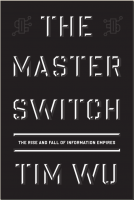 Tim Wu’s new book, The Master Switch: The Rise and Fall of Information Empires, will be released next week and it promises to make quite a splash in cyberlaw circles. It will almost certainly go down as one of the most important info-tech policy books of 2010 and will probably win the top slot in my next end-of-year list.
Of course, that doesn’t mean I agree with everything in it. In fact, I disagree vehemently with Wu’s general worldview and recommendations, and even much of his retelling of the history of information sectors and policy. Nonetheless, for reasons I will discuss in this first of many critiques, the book’s impact will be significant because Wu is a rock star in this academic arena as well as a committed activist in his role as chair of the radical regulatory activist group, Free Press. Through his work at Free Press as well as the New America Foundation, Professor Wu is attempting to craft a plan of action to reshape the Internet and cyberspace.
I stand in opposition to almost everything that Wu and those groups stand for, thus, I will be spending quite a bit of time addressing his perspectives and proposals here in coming months, just as I did when Jonathan Zittrain’s hugely important The Future of the Internet & How to Stop It was released two years ago (my first review is here and my latest critique is here). In today’s essay, I’ll provide a general overview and foreshadow my critiques to come. (Note: Tim was kind enough to have his publisher send me an advance uncorrected proof of the book a few months ago, so I’ll be using that version to construct these critiques. Please consult the final version for cited material and page numbers.) Continue reading →
TLF readers will definitely want to check out the online symposium underway over at the Concurring Opinions blog debating the thesis set forth in Jonathan Zittrain’s important 2008 book, The Future of the Internet and How to Stop It. The symposium will feature a terrific cast of thinkers, including: Steven Bellovin, Ryan Calo, Laura DeNardis, James Grimmelmann, Orin Kerr, Lawrence Lessig, Harry Lewis,Daithí Mac Síthigh, Betsy Masiello, Salil Mehra, Quinn Norton, Alejandro Pisanty, Joel Reidenberg, Barbara van Schewick and me! Regular contributors to the Concurring Opinions blog, such as Frank Pasquale, are also taking part.
Faithful readers will recall that I named Zittrain’s book the most important Internet policy book of 2008 and one of the most important books of the past decade. It’s impact has already been enormous. But I’ve also been unrelenting in my criticism of the book and Zittrain’s dour forecast for the future of Internet “openness” and digital “generativity.” Down below I have reproduced my contribution to the Concurring Opinions symposium, but I encourage you to hop over there to check out all the essays that are pouring in on this topic.


 In his opening essay in this symposium, Jonathan Zittrain ensures us that he is “not exactly a pessimist.” “I recognize, and celebrate,” he says, “the fact that the digital environment of 2010 is the coolest, most interesting, most option-filled it’s ever been.” Terrific! I am glad to hear that because the crux of my repeated critiques of his book, The Future of the Internet, over the past two years has been focused on its unrelenting – and largely unwarranted – pessimism about our possible cyber-futures. Alas, his essay on these pages still displays much of that underlying techno-pessimism and begs me to ask: Will the real Jonathan Zittrain please stand up? Continue reading →
[I am currently helping Berin Szoka edit a collection of essays from various Internet policy scholars for a new PFF book called “The Next Digital Decade: Essays about the Internet’s Future.” I plan on including two chapters of my own in the book responding to the two distinct flavors of Internet pessimism that I increasingly find are dominating discussions about Internet policy. Below you will see how the first of these two chapters begins. I welcome input as I refine this draft. ]
Surveying the prevailing mood surrounding cyberlaw and Internet policy circa 2010, one is struck by the overwhelming sense of pessimism about our long-term prospects for a better future. “Internet pessimism,” however, comes in two very distinct flavors:
- Net Skeptics, Pessimistic about the Internet Improving the Lot of Mankind: The first variant of Internet pessimism is rooted in general skepticism regarding the supposed benefits of cyberspace, digital technologies, and information abundance. The proponents of this pessimistic view often wax nostalgic about some supposed “good ‘ol days” when life was much better (although they can’t seem to agree when those were). At a minimum, they want us to slow down and think twice about life in the Information Age and how it is personally affecting each of us. Other times, however, their pessimism borders on neo-Ludditism, with proponents recommending steps be taken to curtail what they feel is the destructive impact of the Net or digital technologies on culture or the economy. Leading proponents of this variant of Internet pessimism include: Neil Postman (Technopoly: The Surrender of Culture to Technology), Andrew Keen, (The Cult of the Amateur: How Today’s Internet is Killing our Culture), Lee Siegel, (Against the Machine: Being Human in the Age of the Electronic Mob), Mark Helprin, (Digital Barbarism) and, to a lesser degree, Jaron Lanier (You Are Not a Gadget) and Nicholas Carr (The Big Switch and The Shallows).
- Net Lovers, Pessimistic about the Future of Openness: A different type of Internet pessimism is on display in the work of many leading cyberlaw scholars today. Noted academics such as Lawrence Lessig, (Code and Other Laws of Cyberspace), Jonathan Zittrain (The Future of the Internet & How to Stop It), and Tim Wu (The Master Switch The Rise and Fall of Information Empires), embrace the Internet and digital technologies, but argue that they are “dying” due to a lack of sufficient care or collective oversight. In particular, they fear that the “open” Internet and “generative” digital systems are giving way to closed, proprietary systems, typically run by villainous corporations out to erect walled gardens and quash our digital liberties. Thus, they are pessimistic about the long-term survival of the wondrous Internet that we currently know and love.
Despite their different concerns, two things unite these two schools of techno-pessimism. Continue reading →
Over at Convergences I consider the writings of Polk Wagner, beginning thus:
Polk Wagner has written some worthwhile papers on law and technology. I heartily recommend those that support points on which we agree, such as T
he Perfect Storm: Intellectual Property and Public Values, 73 Fordham L. Rev. 1107. 2005. This paper notes how the de facto balance between copyright and fair use has shifted over the years, and that in key respects copyright has lost, not gained, ground, and also noting that fair use is far from being the only key conceptual or practical limit on copyright.
But his paper “On Software Regulation,” is a bit muddled. It may not be Professor Wagner’s fault, for the article was written following up on the “code is law” meme, which is at bottom a rather unhelpful observation. If “code is law” then so is everything else—the laws of physics, architecture, road design, engineering, biology, the laws of physics, religion, education, insect swarming patterns, families, and so on. All of these things affect human behavior and shape and regularize society. My complaint with “code is law” is not that is not true, in a sense—but that it is very unhelpful in understanding any real problem. Many institutions and systems affect human behavior, but they do so in different ways. It is understanding the differences that will be the key to resolving any serious human problems.
Consistent with this, Professor Wagner begins by noting that “code is law” tells us nothing about how code and law relate. But he restates the view that software code constitutes regulation. Software “regulates” in the sense that it makes human conduct more regular and affects the public. But is it really much like “regulation” enacted through a legal process by Congress or the FCC, or even like law described by courts? Certainly not. But the paper’s description of the differences is oddly incomplete.
For the remainder, visit Convergences here.
Harvard Berkman Center professor Jonathan Zittrain has published another pessimistic, Steve-Jobs-is-Taking-Us-Straight-To-Cyber-Hell editorial building on the gloomy thesis he set forth in his 2008 book, The Future of the Internet and How to Stop It. His latest piece appears in the Financial Times and it’s entitled, “A Fight over Freedom at Apple’s Core. Concerning the recent Apple iPad announcement, Zittrain warns: “Mr Jobs ushered in the personal computer era and now he is trying to usher it out.”
I’m not going to go into yet another lengthy dissertation about what it so misguided about his thesis that cyberspace is becoming more “regulable” and that digital “generativity” is dying because of the rise of devices like the iPhone & iPad, or sites like Facebook. Instead, I will just point you to the many things I’ve written before explaining just how far off the mark Prof. Zittrain is on this point. [See the complete list down below + video of our debate.]
But let me just say this… Ignoring that fact that he is an iPhone user himself — which makes no sense considering that he thinks of Apple as the font of all cyber-evil — he can’t muster any substantive empirical evidence proving that the Net and digital devices are being more “closed, sterile, and tethered,” as he repeatedly claims in his book and editorials. And that’s not surprising because the reality is that the digital world is more open and generative than ever, and even if there are some “closed” devices and systems out there, they are actually quite innovative and not perfectly closed as Zittrain suggests. The spectrum of “open vs. closed” systems and devices is incredible diverse and nothing is
perfectly “open” or “closed.” We can have the best of both worlds: many open systems with some partial “walled gardens” here and there (or hybrid systems combining both). Regardless, we are witnessing greater digital “generativity” and innovation with each passing year. Until Zittrain can prove the opposite, his thesis must be considered a failure.
Finally, I want to associate myself with this excellent critique of the Zittrain thesis by Prof. Ed Felten, who points out that Zittrain’s argument doesn’t even work for the iPad, which I would agree is a fairly “closed appliance” in the Zittrainian scheme of the things:
Continue reading →
Arik Hesseldahl has an interesting piece in
Business Week about Apple’s control of the iPhone App approval process in which he asks: “Is a smartphone gatekeeper needed?” Plenty of people don’t think so and have raised a stink about Apple trying to play that role for the iPhone. It certainly could be true, as some critics suggest, that Apple is being too heavy-handed on occasion when rejecting apps, but it’s always easy for those of us on the outside of the process to think that. Hesseldahl notes that:
it’s tempting to consider the implications of a less hands-on approach, as is the case with Macs, Microsoft (MSFT) Windows PCs, or other smartphones, including those running the Google (GOOG)-backed Android operating system. The software market for personal computing has existed in this way for nearly three decades, and while there have certainly been some problems along the way, I’d argue that overall we’re better off without Microsoft or Apple or some other organization approving software applications before they’re released to the market. PC users have learned to be careful about what they put on their computers through unhappy trial and error.
But he also notes that there is another side to the story: Continue reading →
In a week in which neutrality regulation is making a lot of news, I hope that Robert Hahn and Hal Singer’s terrific new study, “Why the iPhone Won’t Last Forever and What the Government Should Do to Promote its Successor” gets some attention. It provides a wonderful overview of how dynamically competitive the mobile marketplace has been over the past two decades and why critics are wrong to get worked up about the short-term “dominance” of Apple’s iPhone. Here’s the abstract of their paper:
Because of the overwhelming, positive response to the iPhone as compared to other smart phones, exclusive agreements between handset makers and wireless carriers have come under increasing scrutiny by regulators and lawmakers. In this paper, we document the myriad revolutions that have occurred in the mobile handset market over the past twenty years. Although casual observers have often claimed that a particular innovation was here to stay, they commonly are proven wrong by unforeseen developments in this fast-changing marketplace. We argue that exclusive agreements can play an important role in helping to ensure that another must-have device will soon come along that will supplant the iPhone, and generate large benefits for consumers. These agreements, which encourage risk taking, increase choice, and frequently lower prices, should be applauded by the government. In contrast, government regulation that would require forced sharing of a successful break-through technology is likely to stifle innovation and hurt consumer welfare.
“New technologies often seemingly emerge from nowhere, but also frequently lose their luster quickly,” Hahn and Singer go on to argue. As evidence they cite the recent examples of Second Life and MySpace, which were hyped as potentially become dominant providers in their respective areas just a few years ago, but now are subjected to intense competition. “[T]he the mobile handset market is subject to these same disruptive forces,” they argue: Continue reading →
Forbes.com has just published an editorial that Berin Szoka and I penned about yesterday’s net neutrality announcement from the FCC.
by Adam Thierer & Berin Szoka
There was a time, not so long ago, when the term “Internet Freedom” actually meant what it implied: a cyberspace free from over-zealous legislators and bureaucrats. For a few brief, beautiful moments in the Internet’s history (from the mid-90s to the early 2000s), a majority of Netizens and cyber-policy pundits alike all rallied around the flag of “Hands Off the Net!” From censorship efforts, encryption controls, online taxes, privacy mandates and infrastructure regulations, there was a general consensus as to how much authority government should have over cyber-life and our cyber-liberties. Simply put, there was a “presumption of liberty” in all cyber-matters.
Those days are now gone; the presumption of online liberty is giving way to a presumption of regulation. A massive assault on real Internet freedom has been gathering steam for years and has finally come to a head. Ironically, victory for those who carry the banner of “Internet Freedom” would mean nothing less than the death of that freedom.
We refer to the gradual but certain movement to have the federal government impose “neutrality” regulation for all Internet actors and activities—and in particular, to yesterday’s announcement by Federal Communications Commission (FCC) Chairman Julius Genachowski that new rules will be floated shortly. “But wait,” you say, “You’re mixing things up! All that’s being talked about right now is the application of ‘simple net neutrality,’ regulations for the infrastructure layer of the net.” You might even claim regulations are not really regulation but pro-freedom principles to keep the net “free and open.”
Such thinking is terribly short-sighted. Here is the reality: Because of the steps being taken in Washington right now, real Internet Freedom—for all Internet operators and consumers, and for economic and speech rights alike—is about to start dying a death by a thousand regulatory cuts. Policymakers and activists groups are ramping up the FCC’s regulatory machine for a massive assault on cyber-liberty. This assault rests on the supposed superiority of common carriage regulation and “public interest” mandates over not just free markets and property rights, but over general individual liberties and freedom of speech in particular. Stated differently, cyber-collectivism is back in vogue—and it’s coming very soon to a computer near you! Continue reading →

 The Technology Liberation Front is the tech policy blog dedicated to keeping politicians' hands off the 'net and everything else related to technology.